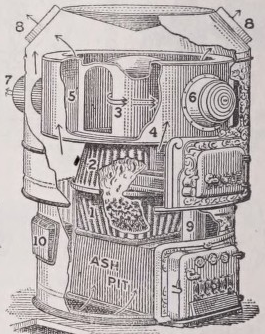
FURNACE. Under this name are included all contrivances for the production and utilization of heat by the combustion of fuel.
The word is common to all the Romance tongues, appearing in more or less modified forms of the Latin fornax. But in all those languages the word has a more extended meaning than in English, as it covers every variety of heating apparatus; while here, in addition to furnaces proper, we distinguish other varieties as ovens, stoves, and kilns. The first of these, in the form Ofen, is used in German as a general term like the French four ; but in English it has been restricted to those apparatus in which only a moderate temperature, usually below a red heat, is produced in a close chamber. Our bakers’ ovens, hot-air ovens or stoves, annealing ovens for glass or metal, <fcc., would all be called fours in French and Oefen in German, in common with furnaces of all kinds. Stove, an equivalent of oven, is from the German Stube, i.e., a heated room, and is commonly so understood; but is also applied to open fire-places, which appears to be somewhat of a departure from the original signification....
Furnaces are constructed according to many different patterns with varying degrees of complexity in arrangement; but all may be considered as combining three essential parts,—namely, the fire-place in which the fuel is consumed, the heated chamber, laboratory, hearth, or working bed, as it is variously called, where the heat is applied to the special work for which the furnace is designed, and the apparatus for producing rapid combustion by the supply of air under pressure to the fire. In the simplest cases, the functions of two or more of these parts may be combined into one, as in the smith’s forge, where the fire-place and heating chamber are united, the iron being placed among the coals, only the air for burning being supplied under pressure from a blowing engine by a second special contrivance, the tuyere, tuiron, twyer, or blast pipe; but in the more refined modern furnaces, where great economy of fuel is an object, the different functions are distributed over separate and distinct apparatus, the fuel being converted into gas in one, dried in another, and heated in a third, before arriving at the point of combustion in the working chamber of the furnace proper.
The most obvious distinction that can be used in the classification of furnaces is founded on the method adopted for supplying air, which may either be blown into the fire, under a pressure above that of the atmosphere sufficient to overcome the resistance presented by the packed columns of fuel and other materials to its free passage, or be drawn through it by a partial vacuum in a chimney formed by the heated gases on their way to the atmosphere. The former are known as blast furnaces, and the latter as chimney draught, air, or wind furnaces. Stack and Blast Furnaces.— The blast furnace in its simplest form is among the oldest, if not the oldest, of metallurgical contrivances. In the old copper smelting district of Arabia Petraea, clay blast pipes dating back to the earlier dynasties of the ancient empire of Egypt have been found in great numbers, buried in slag heaps; and in India the native smiths and iron workers continue to the present day the use of furnaces of similar primitive types. These, when reduced to their most simple expression, are mere basin-shaped hollows in the ground, containing ignited charcoal and the substances to be heated, the fire being urged by a blast of air blown in through one or more nozzles from a bellows at or near the top. This class of furnace is usually known as an open fire or hearth, and is represented in a more advanced stage of development by the Catalan, German, and Walloon forges formerly used in the production of malleable iron, and still current to some extent in Sweden, Corsica, and a few places in central Europe. Figs. 1 and 2 represent a Catalan forge in use a few years since at Mont-gaillard, in Ariége, then one of the few localities in which the process survived. It is now probably completely abandoned. In all of these the parts are essentially the same: the cavity in the ground is represented by a pit of square or rectangular section lined with brick or stone of a kind not readily acted on by heat, about 1∣ or 2 feet deep, usually somewhat larger above than below, with a tuyere or blast pipe of copper penetrating one of the walls near the top, with a considerable downward inclination, so that the air meets the fuel some way down. In the work of iron-smelting, the ore is laid in a heap upon the fuel (charcoal) filling up the hearth, and is gradually brought to the metallic state by the reducing action of the carbonic oxide formed at the tuyere. The metal sinks through the ignited fuel, forming, in the hearth, a spongy mass or ball which is lifted out by the smelters at the end of each operation, and carried to the forge hammer. The earthy matters form a fusible glass or slag melt, and collect at the lowest point of the hearth, whence they are removed by opening a hole pierced through the front wall at the bottom.
The active portion of such a furnace is essentially that above the blast pipe, the function of the lower part being merely the collection of the reduced metal; the fire may therefore be regarded as burning in an unconfined space, with the waste of a large amount of its heating power. By continuing the walls of the hearth above the tuyere, into a shaft or stack either of the same or some other section, we obtain a furnace of increased capacity, but with no greater power of consuming fuel, in which the material to be treated can be heated up gradually by loading it into the stack, alternately with layers of fuel, the charge descending regularly to the point of combustion, and absorbing a proportion of the heat of the flame that went to waste in the open fire. This principle is capable of very wide extension, the blast furnace being mainly limited in height by the strength the column of materials or “burden” has to resist crushing, under the weight due to the head adopted, and the power of the blowing engine to supply blast of sufficient density to overcome the resistance of the closely packed materials to the free passage of the spent gases. The consuming power of the furnace or the rate at which it can burn the fuel supplied, is measured by the number of tuyeres and their section. In the largest modern blast furnaces used for smelting iron ores, they may be as many as six or eight, but as a rule the smaller number of from three to five of larger area is adopted, and with these there is no difficulty experienced in burning from 80 to 100 tons of coke per day in hearths of 5 to 7 feet in diameter.
The profile adopted for blast furnaces has been very much varied at different times. The earliest examples were invariably square or rectangular in horizontal section, and the same class of form has been retained in many instances up to the present time; but the general tendency of modern practice is to substitute round sections, their construction being facilitated by the use of specially moulded bricks which have entirely superseded the sandstone blocks formerly used. The vertical section, on the other hand, is subject to considerable variation according to the work to which the furnace is applied. Where the operation is simply one of fusion, as in the iron-founder’s so-called cupola, in which there is no very great change in volume in the materials on their descent to the tuyeres, the stack is nearly or quite straight-sided, but when, as is the case with the smelting of iron ores with limestone flux, a large proportion of volatile matter has to be removed in the process, a wall of varying inclination is used, so that the body of the furnace is formed of two dissimilar truncated cones, joined by their bases as in fig. 3, the lower one passing downwards into a short, nearly cylindrical, position. The upper cone DC is known as the stack proper, the lower one, from the broadest part C to the tuyeres B, as the boshes, and the lower cylindrical part AB as the hearth. The further consideration of this subject belongs, however, more particularly to the article Iron. It may be sufficient to say that all blast furnaces of large size are more or less reducible to this pattern.
The use of bellows or of analogous contrivances is not essential to the working of stack furnaces; as tho supply of air may, in furnaces of small size, be equally well obtained by the draught of a chimney, or a steam jet aspirator. The former plan is adopted in the so-called economic furnace (fωrno economico) of the Cartagena lead district in Spain, used in re-smelting old slags and waste products of the Roman mines, and the latter in Woodward’s and Ireland’s cupolas for iron foundries. In either case numerous holes representing tuyeres are provided around the lower part of the furnace, often in two rows at different heights. These furnaces have not, however, been very generally adopted; and even in Spain the chimney draught has in many instances been replaced by a fan blower.
A more primitive form of the same contrivance is still in use in Burmah,—the furnace, about 5 or 6 feet high, being placed on the side of a bank facing the prevailing wind, which enters through a series of small round tuyere holes. Similar contrivances were used by the ancient Celtic inhabitants of the Rhine valley,—the ruins of furnaces and slag heaps being found in the Nassau and Eifel hill countries, in high exposed situations far away from streams, where water power for bellows could have been obtained.
Reverberatory Furnaces. — Blast furnaces are, from the intimate contact between the burden to be smelted and the fuel, the least wasteful of heat; but their use supposes the possibility of obtaining fuel of good quality and free from sulphur or other substances likely to deteriorate the metal produced. In all cases, therefore, where it is desired to do the work out of contact with the solid fuel, the operation of burning or heat-producing must be performed in a special fire-place or combustion chamber, the body of flame and heated gas being afterwards made to act upon the surface of the material exposed in a broad thin layer in the working bed or laboratory of the furnace by reverberation from the low vaulted roof covering the bed. Such furnaces are known by the general name of reverberatory or reverbatory furnaces, also as air or wind furnaces, to distinguish them from those worked with compressed air or blast.
Originally the term cupola was used for the reverberatory furnace, but in the course of time it has changed its meaning, and is now given to a small blast furnace such as that used by iron-founders,—reverberatory smelting furnaces in the same trade being called air furnaces.
Figs. 4, 5, and 6 represent a reverberatory furnace such as is used for the fusion of copper ores for regulus, and may be taken as generally representing its class. The fireplace A is divided from the working bed B by a low wall C known as the fire bridge, and at the opposite end there is sometimes, though not invariably, a second bridge of less height called the flue bridge D. A short diagonal flue or up-take E conveys the current of spent flame to the chimney
F which is of square section diminishing by steps at two or three different heights, and provided at the top with a covering plate or damper G, which may be raised or lowered by a chain reaching to the ground, and serves for regulating the speed of the exhaust gases, and thereby the draught of air through the fire. Where several furnaces are connected with the same chimney stack, the damper takes the form of a sliding plate in the mouth of the connecting flue, so that the draught in one may be modified without affecting the others. The fire bridge is partially protected against the intense heat of the body of flame issuing through the fire arch by a passage to which the air has free access. The material to be melted is introduced into the furnace from the hoppers HH through the charging holes in the roof. When melted the products separate on the bed (which is made of closely packed sand or other infusible substances), according to their density; the lighter earthy matters forming an upper layer of slag are drawn out by the slag hole K at the flue end into an iron waggon or bogie, while the metal subsides to the bottom of the bed, and at the termination of the operation is run out by the tap hole L into moulds or granulated into water. The opposite opening Μ is the working door, through which the tool for stirring the charge is introduceα, It is covered by a plate suspended to a lever, similar to that seen in the end elevation (fig. 6) in front of the slag hole.
According to the purposes to which they are applied, reverberatory furnaces may be classed into two groups, namely, fusion or melting furnaces, and calcining or wasting furnaces, also called calciners. The former have a very extended application in many branches of industry, being used by both founders and smelters in the fusion of metals; in the concentration of poor metallic compounds by fusion into regulus; in the reduction of lead and tin ores; for refining copper and silver; for making malleable iron by the puddling processes and welding; and for the manufacture of carbonate from sulphate of sodium in chemical works, &c. Calcining furnaces have a less extended application, being chiefly employed in the conversion of metallic sulphides into oxides by continued exposure to the action of air at a temperature far below that of fusion, or into chlorides by roasting with chloride of sodium. As some of these substances (for example, sulphide of lead and copper pyrites) are readily fusible when first heated, but become more refractory as part of the sulphur is dissipated and oxygen takes its place, it is important that the heat should be very carefully regulated at first, otherwise the mass may become clotted or fritted together, and the oxidizing effect of the air soon ceases unless the fritted masses be broken small again. This is generally done by making the bed of the furnace very long in proportion to its breadth and to the fire grate area, which may be the more easily done as a not inconsiderable amount of heat is given out during the oxidation of the ore,—such increased length being often obtained by placing two or even three working beds one above the other, and allowing the flame to pass over them in order from below upwards. Such calciners are used especially in roasting zinc blende into oxide of zinc, and in the conversion of sulphides of copper into chlorides in the wet extraction process, In some processes of lead smelting, where the minerals treated contain sand, the long calciner is provided with a melting bottom close to the fire-place, so that the desulphurized ore leaves the furnace as a glassy slag or silicate, which is subsequently reduced to the metallic state by fusion with fluxes in blast furnaces.
Muffle Furnaces.— A third class of furnaces are so arranged that the work is done by indirect heating; that is, the material under treatment, whether subjected to calcination, fusion, or any other process, is not brought in contact either with fuel or flame, but is raised to the proper temperature by exposure in a chamber heated externally by the products of combustion. These are known as muffle or chamber furnaces; and by supposing the crucibles or retorts to represent similar chambers of only temporary duration, the ordinary pot melting air furnaces, and those for the reduction of zinc ores or the manufacture of coal gas, may be ineluded in the same category. These are almost invariably air furnaces, though sometimes air under pressure is used; as for example in the combustion of small anthracitic coal, where a current of air from a fan-blower is sometimes blown under the grate to promote combustion.
Crucible Melting Furnaces.— Figs. 7 and 8 represent a series of one of the simplest furnaces of this class, the ordinary crucible air furnace, or pot melting hole, according to the Sheffield term used in cast-steel works. It is a chamber of brickwork a, either straight in the sides or more generally somewhat barrel-shaped, with a grate at the bottom, and of sufficient capacity to hold one or two crucibles b, containing from 50 to 70 lb weight of steel each, enough room being left around them for coke to bring the contents up to the melting point in five or six hours. The crucibles are supported upon disks, or “cheeses” of fire-brick, placed upon the grate; the draught is maintained by a chimney c about 30 feet high, communicating with the furnace by a short flue near the top of the latter. The furnace is placed nearly or quite leveLwith the floor of the casting shop f, and covered with a square fire tile or quarry g, set in an iron frame with a projecting handle, the fire grate being accessible from the cellar below.
Assay erMuffle Furnace.— The construction of a muffle furnace as used by assayers has already been described in the article Assaying, vol. ii. p. 726. It is simply a small square air furnace with a D-shaped chamber of fireclay fixed in the middle, so as to be surrounded with incandescent fuel, a current of air being drawn through it by a series of draught holes or slits in the roof or sides.
Larger-sized muffles are used by enamellers and painters, and in the production of enamelled iron goods, as well as for calcining minerals containing arsenic where it is to be collected for sale, and in the production of metallic colours where the material has to be kept free from the influence of flame and smoke.
Furnace Materials.— The materials used in the construction of furnaces are divisible into two classes, namely, ordinary, and refractory or fire-resisting. The former are used principally as casing, walls, pillars, or other supporting parts of the structure, and includes ordinary red or yellow bricks, clay-slate, granite, and most building stones; while the latter are reserved for the parts immediately in contact with the fuel and flame, such as the lining of the fire-place, the arches, roof, and flues, the lower part if not the whole of the chimney lining in reverberatory furnaces, and the whole of the internal walls of blast furnaces. Among such substances are fire-clay and fire-bricks, certain sandstones, silica in the form of ganister, and Dinas stone and bricks, ferric oxide and alumina, carbon (as coke and graphite), magnesia, lime and oxide of chromium,—their relative importance being indicated by their order, the last two or three indeed being only of limited use.
The most essential point in good fire-clays, or in the bricks or other objects made from them, is the power of resisting fusion at the highest heat to which they may be exposed. This supposes them to be free from metallic oxides, forming easily fusible compounds with silica, such as lime or iron, the presence of the former even in comparatively small proportion being very detrimental. As clays they must be sufficiently plastic to be readily moulded, but at the same time possess sufficient stiffness not to contract too strongly in drying, whereby the objects produced would be liable to be warped or cracked before firing. In most cases, however, the latter tendency is guarded against, in making up the paste for moulding, by adding to the fresh clay a certain proportion of burnt material of the same kind, such as old bricks or potsherds, ground to a coarse powder. Coke dust or graphite is used for the same purpose in crucible making.
The most highly valued fire-clays are derived from the Coal Measures. Among the chief localities are the neighbourhood of Stourbridge in Worcestershire and Stannington near Sheffield, which supply most of the materials for crucibles used in steel and brass melting, and the pots for glass houses; Newcastle-on-Tyne, and Glenboig near Glasgow, where heavy blast furnace and other fire-bricks, gas retorts, àc., are made in large quantities. Coarse-grained but very strong fire-bricks are also made of the waste of the china clay works at...