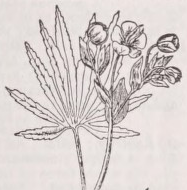
HELLEBORE (Greek, ∈λλe∕3oposj Modern Greek also σκάρφη ; German, Nieswurz, Christwurz ; French, ellébore, and, in the district of Avranche, herbe enragée), Helleborus, L., a genus of plants of the natural order lianunculaceae j natives of Europe, Western Asia, and North America. The leaves are palmate or pedate (Botany, vol. iv. p. 111., fig. 108), are usually solitary, and have five persistent petaloid sepals, within the circle of which are placed the minute gland-like tubular petals, the nectaries of Linnaeus, of the form of a horn with an irregular opening, and representing, according to Bâillon {Nat. Hist, of Plants, i. 13, 1871), “the lower or outermost stamens transformed into staminodes.” The stamens are very numerous, and are spirally arranged; and the carpels are variable in number, sessile or stipitate, and slightly united at the base, and dehisce by ventral suture (vol. iv. 141, 149)....
Helleborus ηiger, L., Black Hellebore, or, as from blooming in mid-winter it is termed, the Christmas Rose (Ger., Schwarze Nieswurz ; Fr., Rose de Noël), is found in southern and central Europe, and with other species was cultivated in the time of Gerard (see Herball., p. 977, ed. Johnson, 1633) in English gardens. Its knotty bracteated rhizome is blackish-brown externally, and, as with other species, gives origin to numerous straight roots. The leaves are radical, coriaceous, smooth, distinctly pedate, dark green above, and lighter below, with 7 to 9 segments, and long petioles. The scapes, which end the branches of the rhizome, have a loose entire bract at the base, and terminate in a single flower, with two bracts, from the axis of one of which a second flower may be developed. The flowers have 5 white or pale-rose, eventually greenish sepals, 15 to 18 lines in breadth; 8 to 13 tubular green petals containing a sweet liquid secretion; and 5 to 10 free carpels.
Varieties of Black Hellebore are H. niger minor, or H. angustifolius, and Giant Hellebore, distinguished as H. niger major, maximus, giganteus, and grandiflonιs, or as a distinct species, H. altifolius. H. foetidus, L., Stinking Hellebore, in Westmoreland Felon-grass, known also, from the shape of its leaves, as Beaτ ’ s-foot (Fr., Pied de Griffon), is a native of England, where, like H. viridis, it is confined chiefly to limestone districts; it is common in France and the south of Europe. Its leaves have 7- to 11-toothed divisions, and the flowers are in panicles, numerous, cup-shaped, and drooping, with many bracts, and green sepals tinged with purple, alternating with the five petals.
H. viridis, L., or Green Hellebore proper, ranges from England, where it is probably indigenous in some of the southern and eastern counties, to Spain and Italy, and even it is said to Turkey. It has bright yellowish-green flowers, 2 to 4 on a stem, with large leaf-like bracts. Brunfels and Bock (16th century) regarded the plant as the Black Hellebore of the Greeks.
The radical leaves of H. viridis and its varieties, as also of H. multifidus, Visian, H. purpurascens. N. & K. i H. cyclophyllus, Boiss., and several allied forms, wither in winter. In H. vesicarius, Auch. (Boissier, Fl. Orient., i. 60), a native of Syria, the flower-stem bears 4 to 5 flowers, and the carpels are much compressed laterally, and, when ripe, united half way up, as in certain Nigcllce. H. lividus, Soland (7Z. argutifolius, Viv., trifolius, Mill., and ilicifolius and triphyllus), Holly-leaved Hellebore, found in the Balearic Islands, and in Corsica and Sardinia, is remarkable for the handsomeness of its foliage. H. antiquorum, Braun, which has purplish-white flowers, occurs in Bithynian Olympus. H. Olympicus, Lindi., is perhaps a variety of it. H. cyclophyllus (Boiss., Fl. Orient., i. 61), a Grecian species, has ovate-orbicular green sepals. H. orientalis, Larn.,Fncy., iii. 92 (H. ponticus, Braun, see Boiss., op. cik), indigenous to Macdonia, Thrace, the vicinity of Constantinople, and northern Asia Minor as far east as Trebizond, has leaves pubescent below, and of 7 to 9 segments, and scapes bearing 3 to 5 flowers, with white or rosy sepals. Allied to it areZZ odorus, W. & K., of which Koch regards H. atrorubens as a variety, and H. caucasicus, Koch, having green and purplish-green sepals respectively.
Hellebores may be grown in any ordinary light garden mould, but thrive best in a soil of about equal parts of turfy loam and well-rotted manure, with half a part each of fibrous peat and coarse sand, and in moist but thoroughly-drained situations, more especially where, as at the margins of shrubberies, the plants can receive partial shade in summer. For propagation, cuttings of the rhizome may be taken in August, and placed in pans of light soil, with a bottom heat of 60° to 70° Fahr.; hellebores can also be grown from seed, which must be sown as soon as ripe, since it quickly loses its vitality. The seedlings usually blossom in their third year. The exclusion of frost favours the production of flowers; but the plants, if forced, must be gradually inured to a warm atmosphere, and a free supply of air must be afforded, without which they are apt to become much affected by greenfly. The flowers on one plant of II. niger major in Mr B. Hooke’s garden at Bradfield, Berks, about the end of January 1878, numbered nearly 500 {Gard. Ghroιι., 1878, i. 145). For potting, H. niger and its varieties, and II. orientalis, atrοrubens, and olympiens have been found well suited. After lifting, preferably in September, the plants should receive plenty of light, with abundance of water, and once a week liquid manure, not over-strong. The flowers are improved in delicacy of hue, and are brought well up among the leaves, by preventing access of light except to the upper part of the plants. Of the numerous species of hellebore now grown,, the deep-purple-flowered II. colchicus is one of the handsomest. II. atropurpureus, introduced in 1844, blooms in March or at the end of February, and may be effectively used in flower borders to succeed hepaticas, scillas, and crocuses (Maund, Bat. Gard., vi., pl. ccxviii., fig. 2). Hellebores having variously coloured spreading or bell-shaped flowers, spotted with crimson, red, or purple, were grown by Sauer, late superintendent of the Berlin University Garden, about the year 1851, as the result of crossing II. guttatus, Braun, and II. purpurascens. Other fine varieties have been obtained by Bouché, his successor, from crosses with H. olympiens, and by Carl Heinemann from II. guttatus and II. abchasicus.
The rhizome of II niger occurs in commerce in irregular and nodular pieces, from about 1 to 3 inches in length, white, and of a horny texture within. Cut transversely it presents internally a circle of 8 to 12 cuneiform ligneous bundles, surrounded by a thick bark. It emits a faint odour when cut or broken, and has a bitter and slightly acrid taste. The drug is sometimes adulterated with the rhizome of baneberry, Actoea spicata, L., which, however, may be recognized by the distinctly cruciate appearance of the meditullium of the attached roots when cut across, and by its decoction giving the chemical reactions for tannin. The rhizome is darker in colour in proportion to its degree of dryness, age, and richness in oil. A specimen dried by Schroff lost in eleven days 65 per cent, of water.
H. niger, orientalis, viriolis, foetidus, and several other species of hellebore contain the glucosides helleborin, C 36 H 4 .,O 6 , and helleborein, C. 23 H 44 O 15 , the former yielding glucose and helleboresin, C 30 H 3g O 4 , and the latter glucose and a violet-coloured substance helleboretin, C 14 H 20 O 3 . Helleborin is most abundant in H. viridis. A third and volatile principle is probably present in H. foetidus. Both helleborin and helleborein act poisonously on animals, but their decomposition-products helleboresin and helleboretin seem to be devoid of any injurious qualities. Helleborein produces excitement and restlessness, followed by paralysis of the lower extremities or whole body, quickened respiration, swelling and injection of the mucous membranes, dilatation of the pupil, and, as with helleborein, salivation, vomiting, and diarrhcea. Helleborein exercises on the heart an action similar to that of digitalis, but more powerful, accompanied by at first quickened and then slow and laboured respiration; it irritates the conjunctiva, and acts as a sternutatory, but less violently than veratrine.
Of various species of hellebore examined by him, Schroff found H. orientalis to possess most medicinal activity; less energetic in succession were H. viridis, foetidus, purpurascens, ponticus (l Braun, v. sup.), and niger. Pliny states that horses, oxen, and swine are killed by eating “black hellebore;” and Christison (On Boisons, p. 876, 11th ed., 1845) writes: “I have known severe griping produced by merely tasting the fresh root in January.” Parkinson, who questions the virulence of the drug (Theat. Botan., p. 216, 1640, fol.), possibly observed its effects in the dry condition. According to Bergius (J∕αi. Med., ii. 496, Stockh., 1778), the rhizome of H. niger, if fresh, is poisonous, rubefacient, and vesicant; when recently dried, emetic, purgative, emmenagogue, insecticidal, and sternutatory: and after long keeping scarcely purgative, but alterative and diuretic. Bayer also has observed that when dried and powdered it is almost devoid of purgative properties. Poisonous doses of hellebore occasion in man singing in the ears, vertigo, stupor, thirst, with a feeling of suffocation, swelling of the tongue and fauces, emesis and catharsis, slowing of the pulse, and finally collapse and death from cardiac paralysis. Inspection after death reveals much inflammation of the stomach and intestines, more especially the rectum. The drug has been observed to exercise a cumulative action. Its extract was an ingredient in Bacher’s pills, an empirical remedy once in great repute in France. In British medicine the rhizome was formerly official (see J. B. Nevins, Transi. New Bond. Bharm., p. 666, 2d ed., 1854), and the tincture, powder, or, more rarely, the decoction is still occasionally used. Parkinson (op. cit.) mentions the employment of the leaves and juice of II. niger “to help the Dropsie, Jaundies, and other evil dispositions of the liver and gall and Dr C. D. F. Phillips (Mat. Med. and Therap., p. 27, 1874) has found the tincture of the rhizome of value in dropsical affections, especially in anasarca resulting from scarlet fever. H. foetidus was in past times much extolled as an anthelmintic, and is recommended by Bisset (Med. Ess., pp. 169 and 195, 1766) as the best vermifuge for children; J. Cook, however, remarks of it (Oxford Mag., March 1769, p. 99): “Where it killed not the patient, it would certainly kill the worms; but the worst of it is, it will sometimes kill both.” This plant, of old termed by farriers Ox-heel, Setter-wort, and Setter-grass, as well as H. viridis (Fr., Herbe à séton), is employed in veterinary surgery, to which also the use of H. niger is now chiefly confined in Britain.
In the early days of medicine two kinds of hellebore were recognized, the white, or Veratrum album (vide supra, note), and the black, including the various species of Helleborus. The former, according to Codronchius (Comm. . . . de Elleb., 1610), Castellus (De Helleb. Episl., 1622), and others, is the drιιg usually signified in the writings of Hippocrates. Among the hellebores indigenous to Greece and Asia Minor, H. orientalis, Lam. (v. supra), the rhizome of which differs from that of II. niger and of H. viridis in the bark being readily separable from the woody axis, is the species found by Schroff to answer best to the descriptions given by the ancients of black hellebore, the e ∖ Kiβopos μi ∖ as of Dioscorides. The rhizome of this plant, if identical, as would appear, with that obtained by Tournefort at Prιιsa in Asia Minor (Rel. d'un Voy. du Levant, ii. 189, 1718), must be a remedy of no small toxic properties. According to an early tradition, black hellebore administered by the soothsayer and physician Melampus (whence its name Melam-podium), was the means of curing the madness of the daughters of Prcetus, king of Argos. The drug was used by the ancients in paralysis, gout, and other diseases, more particularly in insanity, a fact frequently alluded to by classical writers, e.g., Horace (Sat., ii. 3, 80-83; Ep. ad Pis., 300). Various superstitions were in olden times connected with the cutting of black hellebore. The best is said by Pliny (Nat. Hist., xxv. 21) to grow on Mt. Helicon. Of the three Anticyras (see vol. ii. p. 127), that in Phocis was the most famed for its hellebore, which, being there used combined with “sesamoides,” was, according to Pliny, taken with more safety than elsewhere.
See Hayne, Arzney. -Gewächse, i. pl. 2 and 7-10,1805; Sibthorp, Flora Gr<eca, vi. 19, 1840; Stephenson and Churchill, M<d. Βot., i., pl. xi. and xxi., 1831; woodville, Med. Boo, iii. 473-9, 3d ed., 1832; Spach, Suites à Buffon, Hist. Nat. des Vég., vii. 312-22, 1839; Reichenbach, Icon. Fl. Germ., iv., pl. ciii.-cxii., 1840; W. D. J. Koch, Synop. Fl. Germ. et Helv., p. 21, 2d ed., 1843, and Taschenb. d. Deutsch, u. Schweiz. ∏., p. 223, 2d ed., 1878; Schroff, Drager Vierteljahressch. f. d. pract. Heilk., lxii. 49-Î17, and lxiii. 95-134, 1859; Berg and Schmidt, Off. Gewächse, iv., ρl. xxix. sq., Ï8G3; Syme, Sowerby's Eng. Bot.,i. 56-59, pl. xliv., xlv., 1863; Marine and Husemann, Zeitsch. d. rat. Medic., 3d scr., xxvi. 1-98, 1865, also Dis A. and T. Husemann, Die l'flanzenstoffe, p. 796, 1871; Gard. Chron., 1874,1.480; 1877, i. 432, 464; The Garden, vii. 463, and xiv. 178, 451; The Florist, 1875, p. 159 ,∙ Bentley and Trimen, Med. PC, pt. 5, No. 2,1876; Journ. of Hort, and Cott. Gard., Nov. 21, 1877, p. 397; Von Boeck, Ziemssen's Cyd. of the Pract. of Med., xvii. 741, 1878; and for bibliography of early treatises on hellebore, J. D. Reuss, Repert. Comment., “Mat. Med.,” xi, 143, 1816; and E. J. waring, Bibliotheca Therapeutica, ii. 458, New Cav. Soc., 1879.