
git'ar. [Latin cithara.] A stringed instrument of music; in England and the United States, used chiefly by ladies, but in Spain and Italy, much used by men.
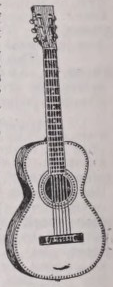
GUITAR, a stringed instrument of Eastern origin. The name no doubt is derived from the Greek κcθaρa i but the instrument itself we owe to the Arabs, who introduced it into Spain. In the 16th century it became known in Italy and France, and about 1790 a German instrument-maker of the name of Getto greatly increased its power by adding a sixth string to the five formerly in use. The genuine Spanish guitar was introduced into England after the Peninsular War by Ferdinand Sor, a Spaniard who was both a composer for and a player on the instrument. About the same time the guitar was very much in fashion on the Continent, and even Paganini cultivated it. But this circumstance was due to the romantic associations rather than to the intrinsic merits of the instrument, and accordingly it soon relapsed into comparative oblivion. It is, however, occasionally employed in the orchestra and for the accompaniment of simple vocal pieces, and for these purposes it has no doubt its merits. The guitar is a flat-backed instrument, the sides of which turn inwards. The soundboard, pierced by a round sound-hole, is generally made of pine, maple or cherry-wood being used for the sides and the back. The modern guitar, as already stated, has six strings, while the original El Aud of the Arabs had only four, subsequently increased to five. They are tuned to the notes E, A, D, G, B natural, and E. In the more remote keys transposition by means of a capo tasto, or nut, is effected. In this manner a basis of flat instead of natural keys may be substituted without any change of fingering. In the East, especially in Arabia, India, China, and Japan, many varieties of the guitar and its congeners are in use, the number of strings varying from two to five. For the technique of the guitar Madame Sidney ...Pratten’s treatise, Learning the Guitar simplified, may be consulted.