4. [I know not that this word is used in America.]
5. A term applied to a club in London, to which Addison and Steele belonged; so called from Christopher Cat, a pastrycook, who served the club with mutton pies; applied also to a portrait three fourths less than a half length, placed in the club-room.
KIT-CAT-CLUB, a convivial association of Whig wits, painters, politicians, and men of letters, founded in the reign of James II. The name, according to Defoe, was derived from the keeper of the house in which the club met, Christopher Catt, a pastrycook in ShireLane, which now no longer exists, but formerly ran parallel with ChanceryLane near Temple Bar. The pies of Christopher were the principal dish of the club, and the Spectator (No. 9) derives the name, not from the maker of the pies, but from the pies themselves, which were of a species generally known as “kit-cats.” According to another authority, the meeting place of the club was at the sign of the Cat and Fiddle in Gray’s Inn Lane, kept by a person of the name of Christopher. The locale of the club was afterwards changed to the Fountain tavern in the Strand, and latterly to a room specially built for the purpose at Barn Elms, the residence of the secretary, Jacob Tonson. In summer the club met at the Upper Flask, HampsteadHeath. The club consisted of thirty-nine noblemen and gentlemen, and included among other distinguished men the duke of Marlborough, Lords Halifax and Somers, Sir Robert Walpole, Vanbrugh, Congreve, Steele, and Addison. The portraits of many of the members were painted by Sir GodfreyKneller, himself also a member, of a uniform size, less than half length, which is known as the kit-cat size. The club was dissolved about’1720.
9th ed. Encyclopædia Britannica, vol. 14, p. 103 [253 words — estimated reading time: 2 minutes]
2. Designating a canvas used for portraits of a peculiar size, viz., twenty-right or twenty-nine inches by thirty-six; -- so called because that size was adopted by Sir GodfreyKneller for the portraits he painted of the members of the Kitcat Club.
Relics of neolithic man found on the coast of Denmark, consisting of shell mounds, some of which are ten feet high, one thousand feet long, and two hundred feet wide. The name is applied also to similar mounds found on the American coast from Canada to Florida, made by the North American Indians.
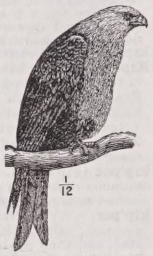
1. Any raptorial bird of the subfamily Milvinae, of which many species are known. They have long wings, adapted for soaring, and usually a forked tail.
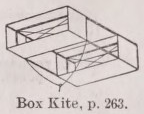
3. A light frame of wood or other material covered with paper or cloth, for flying in the air at the end of a string.
4. A lofty sail, carried only when the wind is light.
5. A quadrilateral, one of whose diagonals is an axis of symmetry.
6. Fictitious commercial paper used for raising money or to sustain credit, as a check which represents no deposit in bank, or a bill of exchange not sanctioned by sale of goods; an accommodation check or bill.
KITE, Anglo-Saxon Cyta, the Falco milvus of Linnaeus and Milνus ictinus of modern ornithologists, once perhaps the most familiar bird-of-prey in Great Britain, and now one of the rarest. Three or four hundred years ago foreigners were struck with its abundance in the streets of London, and the evidence of two of them, one being the eminent naturalistBelon, has been already given (Birds, vol. iii. p. 736, note). It was doubtless the scavenger in ordinary of that and other large towns (as a kindred species now is in Eastern lands), except where its place was taken by the Raven; for Sir Thomas Browne {circa 1662) wrote of the latter at Norwich—“in good plentie about the citty which makes so few Kites to be seen hereabout.” Wolley has well remarked of the modem Londoners that few “who see the paper toys hovering over the parks in fine days of summer, have any idea that the bird from which they derive their name used to float all day in hot weather high over the heads of their ancestors.” Even at the beginning of the present century the
formed a feature of many a rural landscape in England, as they had done in the days of Cowper. But an evil time soon came upon the species. It must have been always hated by the henwife, but the resources of civilization in the shape of the gun and the gin were denied to her. They were, however, employed with fatal zeal by the gamekeeper; for the Kite, which had long afforded the supremest sport to the falconer, was now left friendless, and in a very few years it seems to have been exterminated throughout the greater part of England, certain woods in Huntingdonshire and Lincolnshire and in the Western Midlands, as well as Wales, excepted. In these latter a small remnant still exists; but the well-wishers of this beautiful species are naturally chary of giving information that might lead to its further persecution. In Scotland there is no reason to suppose that its numbers suffered much diminution until about 1835 or even later, when the systematic destruction of “vermin” on so many moors was begun. In that kingdom, however, it is now as much restricted to certain districts as in England or Wales, and those districts it would be most inexpedient to indicate.
The Kite is, according to its sex, from 25 to 27 inches in length, about one half of which is made up by its deeply-forked tail, capable of great expansion, and therefore a powerful rudder, enabling the bird while soaring on its wide wings, more than 5 feet in extent, to direct its circling course with scarcely a movement that is apparent to the spectator below. Its general colour is pale reddish-brown or cinnamon, the head being greyish-white, but almost each feather has the shaft dark. The tail-feathers are broad, of a light red, barred with deep brown, and furnish the salmon-fisher with one of the choicest materials of his “flies.” The nest, nearly always built in the crotch of a large tree, is formed of sticks intermixed with many strange substances collected as chance may offer, but among them rags seem always to have a place. The eggs, three or four in number, are of a dull white, spotted and blotched with several shades of brown, and often lilac. It is especially mentioned by old authors that in Great Britain the Kite was resident throughout the year; whereas on the Continent it is one of the most regular and marked migrants, stretching its wings towards the south in autumn, wintering in Africa, and returning in spring to the land of its birth.
There is a second European species, not distantly related, the Milvus migrans or Μ. ater of most authors, smaller in size, with a general dull blackish-brown plumage and a less forked tail. In some districts this is much commoner than the red Kite, and on one occasion it has appeared in England. Its habits are very like those of the species already described, but it seems to be more addicted to fishing. Nearly allied to this Black Kite are the Μ. aegyptius of Africa, the Μ. govinda (the Pariah Kite of India), the Μ. melanοtis of Eastern Asia, and the Μ. affinis and Μ. isurus ; the last is by some authors removed to another genus or sub-genus as Lophoictiηia, and is peculiar to Australia, while Μ. affi,nis also occurs in Ceylon, Burmah, and some of the Malay countries as well. All these may be considered true Kites, while those next to be mentioned are more aberrant forms. First there is Elanus, the type of which is E. caeruleus, a beautiful little bird, the Blackwinged Kite of English authors, that comes to the south of Europe from Africa, and has several congeners— E. axillaris and E. scriptus of Australia being most worthy of notice. An extreme development of this form is found in the African Nauclerus rwcourU, as well as in Elanοides furcatus, the Swallow-tailed Kite, a widely-ranging bird in America, and remarkable for its length of wing and tail, which gives it a marvellous power of flight, and serves to explain the unquestionable fact of its having twice appeared in Great Britain. To Elanus also Ictinia, another American form, is allied, though perhaps more remotely, and it is represented by I. mississippiensis, the Mississippi Kite, which is by some considered to be but the northern race of the Neotropical I. plumbea. Gampsonyx, Rostrhamus, and Cymindis, all belonging to the Neotropical Region, complete the series of forms that seem to compose the subfamily Milvinae, though there may be doubt about the last, and some systematists would thereto add the Perns or Honey-Buzzards, Perninae. (a. n.)
9th ed. Encyclopædia Britannica, vol. 14, p. 103 [980 words — estimated reading time: 6 minutes]
איה, Lev. xi, 14; Deut. xiv, 13; Job xxviii, 7. Bochart supposes this to be the bird which the Arabians call the _ja-jao_, from its note; and which the ancients named _æsalon_, the merlin,” a bird celebrated for its sharp-sightedness. This faculty is referred to in Job xxviii, 7, where the word is rendered vulture.” As a noun masculine plural, איים, in Isaiah xiii, 22; xxxiv, 14; and Jer. 1, 39, Bochart says that jackals are intended; but, by the several contexts, particularly the last, it may well mean a kind of unclean bird, and so be the same with that mentioned above.
And, behold, six men came from the way of the higher gate, which lieth toward the north, and every man a slaughter weapon in his hand; and one man among them was clothed with linen, with a writer’s inkhorn by his side: and they went in, and stood beside the brasen altar.
And I saw six men coming from the direction of the Upper Gate, which faces north, each with a weapon of slaughter in his hand. With them was another man clothed in linen who had a writing kit at his side. And they came in and stood beside the bronze altar.
And the glory of the God of Israel was gone up from the cherub, whereupon he was, to the threshold of the house. And he called to the man clothed with linen, which had the writer’s inkhorn by his side;
Then the glory of the God of Israel rose from above the cherubim, where it had been, and moved to the threshold of the temple. And He called to the man clothed in linen who had the writing kit at his side.
For the ships of Chittim shall come against him: therefore he shall be grieved, and return, and have indignation against the holy covenant: so shall he do; he shall even return, and have intelligence with them that forsake the holy covenant.
Ships of Kittim will come against him, and he will lose heart. Then he will turn back and rage against the holy covenant and do damage. So he will return and show favor to those who forsake the holy covenant.
This site uses cookies to remember your display preferences (search sources and editions, Bible version, auto-link, images, light/dark theme). No personal data whatsoever is collected. Privacy Policy