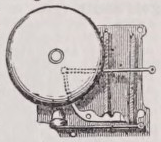
2. An instrument, first used in the East, made of an alloy of copper and tin, shaped like a disk with upturned rim, and producing, when struck, a harsh and resounding noise.
3. A flat saucerlike bell, rung by striking it with a small hammer which is connected with it by various mechanical devices; a stationary bell, used to sound calls or alarms; -- called also gong bell.
GONG (Chinese, gong-gong or tam-tam), a sonorous or musical instrument of Chinese origin and manufacture, made in the form of a broad thin disc with a deep rim. Gongs vary in diameter from about 20 to 40 inches, and they are made of bronze containing a maximum of 22 parts of tin to 78 of copper; but in many cases the proportion of tin is considerably less. Such an alloy, when cast and allowed to cool slowly, is excessively brittle, but it can be tempered and annealed in a peculiar manner. If suddenly cooled from a cherry-red heat, the alloy becomes so soft that it can be hammered and worked on the lathe, and afterwards it may be hardened by re-heating and cooling it slowly. In these properties, it will be observed, the alloy behaves in a manner exactly opposite to steel, and the Chinese avail themselves of the known peculiarities for preparing the thin sheets of which gongs are made. They cool their castings of bronze in water, and after hammering out the alloy in the soft state, the finished gongs are hardened by heating them to a cherry red, and allowing them to cool slowly. The gong is beaten with a round, hard, leather-covered pad, fitted on a short stick or handle. It emits a peculiarly sonorous sound, its complex vibrations bursting into a wave-like succession of tones, sometimes shrill, sometimes deep. In China and Japan it is used in religious ceremonies, state processions, marriages, and other festivals; and it is said that the Chinese can modify its tone variously by particular ways of striking the disc. Among Western communities it is only employed as a substitute for a dinner bell or a general household signal.
9th ed. Encyclopædia Britannica, vol. 10, p. 771 [294 words — estimated reading time: 2 minutes]
GONGORA Y ARGOTE, Luis de (1561-1627), Spanish lyric poet, was born at Cordova, on the 11th of July 1561. His father, Don Francisco de Argote, was corregidor of that city; and his mother, Dona Leonora de Gôngora, was descended from an ancient and noble family of Navarre. Having been sent, at the age of fifteen, as a studeut of civil and canon law to the university of Salamanca, he soon took a prominent place among his fellowstudents; but the great talent which he exhibited did not point in the direction either of legal or of diplomatic employments. Leaving the university some years afterwards (the exact date is unknown) without a degree, but already with a considerable literary reputation, he returned to Cordova, where he had succeeded to a moderate property, and where he was able to associate on terms of intimacy and equality with the best society of the city and province. Lope de Vega, writing about 1593, speaks of him as surrounded there by a literary society, and acknowledged as its chief. In 1604, when past his fortieth year, he took the tonsure, and accepted a prebendalstall in the cathedral of Cordova,—steps which have usually been attributed to worldly or sordid motives, but which really cannot be regarded as unnatural or unbecoming in a man circumstanced as he was. From this time he began to spend a portion of each year at the seat of the court, first at Valladolid and afterwards at Madrid, where as Pellicer, his contemporary, remarks, he “noted everything and pecked at everything with his satirical pen.” His circle of literary and other distinguished admirers was now greatly enlarged; but the acknowledgment which the court accorded to his singular genius was both slight and tardy. Ultimately indeed, through the influence of the duke of Lerma and the ...marquis of Siete Iglesias, he obtained an appointment as honorarychaplain to Philip III., but even this slight honour he was not permitted long to wear. A severe illness, which had seriously impaired his memory, compelled his retirement to Cordova, where, after a period of deep seclusion, he peacefully breathed his last on the 23d of May 1627. An edition of his poems was published almost immediately after his death by Juan Lopez de Vicuna; but the frequently reprinted edition by Hozes did not appear till 1633. The collection consists of numerous sonnets, heroical, amorous, satirical, humorous, elegiac, and “miscellaneous,” of various odes, ballads, songs for the guitar, of a few uncompleted comedies, and of certain larger poems, such as the Soledades (“Solitary Musings”) and the Polifemo, which hardly admit of classi fication. They all exhibit that learned and polished elaboration of style (estilo culto) with which the name of Gôngora is inseparably associated; but if, since the days of Lope de Vega, they have been justly censured for their affected Latinisms, unnatural transpositions, strained metaphors, and frequent obscurity, it must never be forgotten that their author was a man of genius,—a fact cordially acknowledged by those of his contemporaries who were most capable of judging, and indeed a fact capable of direct verification by any one who chooses to take the trouble of reading him even in an imperfect translation. It was only in the hands of those who served themselves heirs to Gôngora’s style, without inheriting his genius, that “cul-tismo” became really laughable; but it is manifestly unjust to charge the memory of the master with the follies of his weaker disciples.
A series of Lecciοηcs Sοlernηes, or expository lectures on the Polifemo, Sοledαdes, Pαnegirico, and Biramo y Tisbe was published by Pellicer in 1630; an Ilustracion y Defensa de. la Fabula de Piramo y Tisbe, by Salazar Mardones, followed in 1636; there is also a commentary on the entire works by Salcedo Coronel (1636-48). A good edition of the works of the “Andalucian Pindar” (as Gôngora is designated by Pellicer) is that of Brussels (1659). The admirable labours of Churton {Gongora, an Historical and Critical Essay on the Times of Philip III. and IV. of Spain, with Translations, 1862) have made this obscure author easily accessible to the English reader.
9th ed. Encyclopædia Britannica, vol. 10, p. 771 [702 words — estimated reading time: 5 minutes]
Though I speak with the tongues of men and of angels, and have not charity, I am become as sounding brass, or a tinklingcymbal.
If I speak in the tongues of men and of angels, but have not love, I am only a ringing gong or a clangingcymbal.
This site uses cookies to remember your display preferences (search sources and editions, Bible version, auto-link, images, light/dark theme). No personal data whatsoever is collected. Privacy Policy