
JAS'MIN
Word of the Day: Catachrestical
A plant of the genus Jasminum, bearing beautiful flowers. There are several species. The common white jasmin is a climbing shrub, rising on supports 15 or 20 feet high. The name is also given to several plants of different genera; as the Arabian jasmin of the genus Nyctanthes; the bastard jasmin of the genus Cestrum, and also of the genus Lycium; the Persian jasmin of the genus Syringa; the red jasmin of the genus Plumeria; the scarlet and yellow jasmin of the genus Bignonia, etc.
Jasmin
Encyclopedia Britannica
JASMIN, Jacques (1798-1864), a noted Gascon poet, was born at Agen, March 6, 1798. His childhood was spent in the midst of privations and all the straits of poverty, and he boasted in after .life that he had succeeded in breaking up the traditional chair in which the Jasmins had hitherto been carried to the workhouse in sickness and old age. His father, who was a tailor, had a certain facility for making doggrel verses, which he sang or recited at* -fairs and such like popular gatherings; and the younger Jasmin, who used generally to accompany him, was thus early familiarized with the double part which he afterwards so successfully filled himself. When sixteen years of age he found employment at a hairdresser’s shop, and subsequently started a similar business of his own on the Gravier at A gen. It is opposite this scene of his ripening genius and daily work that a statue has been erected to his memory by public subscription. In 1835 he published his first volume of Papillotos (“Curl Papers ”), containing poems in French (a language he used with a certain sense of restraint), and in the familiar Agen patois —the popular speech of the working classes—in which he was to achieve all his literary triumphs. Many of the pieces in this volume had already been printed and submitted to the public. The dialect which Jasmin spoke, though still harmonious and full of picturesque idioms, was now almost exclusively used by illiterate persons, and was greatly modified by a daily contact with French. It was, however, his native speech—the one in which he found spontaneous and adequate expression, and he lost no opportunity of making himself complete master of it by intercourse with the rural population in outlying districts where it was spoken with less admixture. He ...rehabilitated, disencumbered, and in a measure reconstructed his literary medium, and then, fully realizing that his poems needed other exposition than the mere printed text, he began those numerous public recitations which so largely added to his reputation. His real poetic gift, and his flexible voice and action, fitted him admirably for this double rôle of troubadour and jongleur. In 1835 he recited his “Blind Girl of Castel-Cuillé” at Bordeaux, in 1836 at Toulouse; and he met with an enthusiastic reception in both those important cities. Most of his public recitations were given for benevolent purposes,—1,500,000 francs, the proceeds of his poetical rounds, being contributed by him to the restoration of the church of Vergt and other good works. Four successive volumes of Papillotos were published during his lifetime, and contained amongst others the following remarkable poems, quoted in order: “The Charivari,” “My Recollections” (supplemented after an interval of many years), “The Blind Girl,” “Fran< s ∙ou-netto,” “Martha the Simple,” and “The Twin Brothers.” With the exception of the “Charivari,” these are all touching pictures of humble life,—in most cases real episodes,—carefully elaborated by the poet till the graphic descriptions, full of light and colour, and the admirably varied and melodious verse, seem too spontaneous and easy to have cost an effort. Jasmin was not a prolific writer, and, in spite of his impetuous nature, would work a long time at one poem, striving to realize every feeling he wished to describe, and give it its most lucid and natural expression. A verse from his spirited poem, “The Third of May,” written in honour of Henry IV., and published in the first volume of Papillotos, is engraved on the base of the statue erected to that king at Nérac. In 1852 Jasmin’s works were crowned by the Académie Française, and a pension was awarded him. The medal struck on the occasion bore the inscription “Au poete moral et populaire.” His title of “Maistre es Jeux” is a distinction only conferred by the academy of Toulouse on illustrious writers. Pius IX. sent him the insignia of a knight of St Gregory the Great, and he was made chevalier of the legion of honour. He spent the latter years of his life on a small estate which he had bought near Agen and named “Papillotos,” and which he describes in Ma Bigno (“My Vine”). Though invited to represent his native city, he refused to do so, preferring the pleasures and leisure of a country life, and wisely judging that he was no really eligible candidate for electoral honours. He died October 4, 1864. His last poem, an answer to Renan, was placed between his folded hands in his coffin.
The linguistic and literary revival in the south of France, which received such lustre from the genius of Jasmin, has now become a well-organized movement, and has extended from Gascony to Languedoc, and to Provence, where it is most marked.
9th ed. Encyclopædia Britannica, vol. 13, p. 594
[805 words — estimated reading time: 5 minutes]
[805 words — estimated reading time: 5 minutes]
A shrubby plant of the genus Jasminum, bearing flowers of a peculiarly fragrant odor. The J. officinale, common in the south of Europe, bears white flowers. The Arabian jasmine is J. Sambac, and, with J. angustifolia, comes from the East Indies. The yellow false jasmine in the Gelseminum sempervirens (see Gelsemium). Several other plants are called jasmine in the West Indies, as species of Calotropis and Faramea.
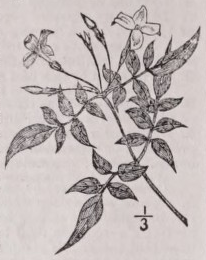
Jasmine
Encyclopedia Britannica
JASMINE, or Jessamine, botanicallyJhsτn⅛ιiW2, a genus of shrubs or climbers constituting the principal part of the natural order Jasminaceae, and comprising about sixty species, of which forty or more occur in the gardens of Britain. The plants of the genus are mostly natives of the warmer regions of the Old World, but there are one or two South American species. The leaves are pinnate or ternate, or sometimes apparently simple, consisting of one leaflet, articulated to the petiole. The flowers, usually white or yellow, are arranged in terminal or axillary panicles, and have a tubular 5- or 8-cleft calyx, and a cylindrical corollatube, with a spreading limb, two included stamens, and a two-celled ovary....
The name is derived from the Persian ydsmin. Linnaeus obtained a fancied etymology from ια, violets, and οσpη, smell, but the odour of its flowers bears no resemblance to that of the violet; it is in fact so peculiar as to be incomparable, and is probably the only floral perfume which cannot be imitated by art. The common white jasmine, Jasminum officinale, one of the best known and most highly esteemed of British hardy ligneous climbers, is said to be a native of India, and to have been introduced about the middle of the 16 th century. In the centre and south of Europe it is thoroughly acclimatized. Although it grows to the height of 12 and sometimes 20 feet, its stem is feeble and requires support; its leaves are opposite, pinnated, and dark green, the leaflets are in three pairs, with an odd one, and are pointed, the terminal one larger and with a tapering point. The fragrant white flowers bloom from June to October; and, as they are found chiefly on the young shoots, the plant should only be pruned in the autumn. Varieties with golden and silver-edged leaves and one with double flowers are known.
The Zambak or Arabian jasmine, <7asmiηum Sambac, is an evergreen white-flowered climber, 6 or 8 feet high, introduced into Britain in the latter part of the 17th century. Two varieties introduced somewhat later are respectively 3-leaved and double-flowered, and these, as well as that with normal flowers, bloom throughout the greater part of the year. On account of their exquisite fragrance the flowers are highly esteemed in the East, and are frequently referred to by the Persian and Arabian poets. An oil obtained by boiling the leaves is used to anoint the head for complaints of the eye, and an oil obtained from the roots is used medicinally to arrest the secretion of milk. The flowers of one of the double varieties, known as “Moogree,” are held sacred to Vishnu, and used as votive offerings in Hindu religious ceremonies. In China the flowers of this plant, under the name of “Mo-le-hwa,” are used for scenting tea. The Spanish, or Catalonian jasmine, J. grandi-flomιm (fig. 2), which grows wild on the island of Tobago, is very like J. officinale, but differs in the size of the leaflets; the branches are shorter and stouter, and the flowers very much larger, and reddish underneath. By grafting it on two-year-old plants of J. officinale, an erect bush about 3 feet high is obtained, requiring no supports. In this way it is very extensively cultivated at Cannes and Grasse, in the south of France; the plants are set in rows, fully exposed to the sun; they come into full bearing the second year after grafting; the blossoms, which are very large and intensely fragrant, are produced from July till the end of October, but those of August and September are the most odoriferous. An acre of land is said to yield about 500 tt> of blossoms during the season, value £25 to £35. The aroma is extracted by the process known as “enfleurage,” i.e., absorption by a fatty body, such as purified lard or olive oil. Square glass trays framed with wood about 3 inches deep are spread over with grease about half an inch thick, in which ridges are made to facilitate absorption, and sprinkled with freshly gathered flowers, which are renewed every morning during the whole time the plant remains in blossom; the trays are piled up in stacks to prevent the evaporation of the aroma; and finally the pomade is scraped off the glass, melted at as low a temperature as possible, and strained. When oil is employed as the absorbent, coarse cotton cloths previously saturated with the finest olive oil are laid on wire-gauze frames, and repeatedly covered in the same manner with fresh flowers; they are then squeezed under a press, yielding what is termed “huile antique au jasmin.” 3 lb of flowers will perfume 1 lb of grease,—this is exhausted by maceration in 1 pint of rectified spirit to form the “extract.”
An essential oil is distilled from jasmine in Tunis and Algeria, but its high price prevents its being used to any extent. The East Indian oil of jasmine is a compound largely contaminated with sandalwood-oil. The distinguishing characters of J. odoratissimum consist principally in the alternate, obtuse, ternate, and pinnate leaves, the 3-flowered terminal peduncles, and the 5-cleft yellow corolla with obtuse segments. The flowers have the advantage of retaining when dry their natural perfume, which is suggestive of a mixture of jasmine, jonquille, and orange-blossom. In China the J. paniculatum is cultivated as an erect shrub, known as Sieu-hinghwa; it is valued for its flowers, which are used with those of J. Sambac, in the proportion of 10 lb of the former to 30 lb of the latter, for scenting tea—40 ft> of the mixture being required for 100 lb of tea. The “narrow leaved jasmine,” <Λ angustifolium, is a beautiful evergreen climber 10 to 12 feet high, found in the Coromandel forests, and introduced into Britain during the present century. Its leaves are of a bright shining green; its large terminal flowers are white with a faint tinge of red, fragrant, and blooming throughout the year. The bitter root, ground small and mixed with lime-juice and root of Acorus Calamus, is considered in India a good remedy for ringworm and herpes. In Cochin China a decoction of the leaves and branches of J∙ nervosum is taken as a blood-purifier; and the bitter leaves of J^. floribundum (called in Abyssinia “Habbez-zelim ”) mixed with Kousso is considered a powerful anthelmintic, especially for tape-worm; the leaves and branches are added to some fermented liquors to increase their intoxicating quality. In Sierra Leone a poultice made with the leaves of J. ηoctiflorum is applied to ulcers. The leaves of J. hirsutum boiled in oil are applied in India and China in cases of ophthalmia, and its root is said to be a really good remedy for snake bites. In Catalonia and in Turkey the wood of the jasmine is made into long, slender pipestems, highly prized by the Moors and Turks. Syrup of jasmine is made ⅛>y placing in a jar alternate layers of the flowers and sugar, covering the whole with wet cloths and standing it in a cool place; the perfume is absorbed by the sugar, which is converted into a very palatable syrup.
The plant known in America as the “Carolina jasmine” (fig. 2) is not a true jasmine (see Gelsemium). Other hardy species commonly cultivated in gardens are the low or Italian yellow-flowered jasmine, J. humile, an erect shrub 3 or 4 feet high, with angular branches, alternate and mostly ternate leaves, blossoming from June to September; the common yellow jasmine, J∖ fruticans, a hardy deciduous shrub, 10 to 12 feet high, with weak, slender stems requiring support, and bearing yellow, odourless flowers from spring to autumn; and J. nudiflorurn, which flowers before the leaves appear. (j. ch. s.)
9th ed. Encyclopædia Britannica, vol. 13, p. 594
[1,313 words — estimated reading time: 8 minutes]
[1,313 words — estimated reading time: 8 minutes]
No thesaurus entries found for "jasmin".
No Bible verses found for "jasmin".