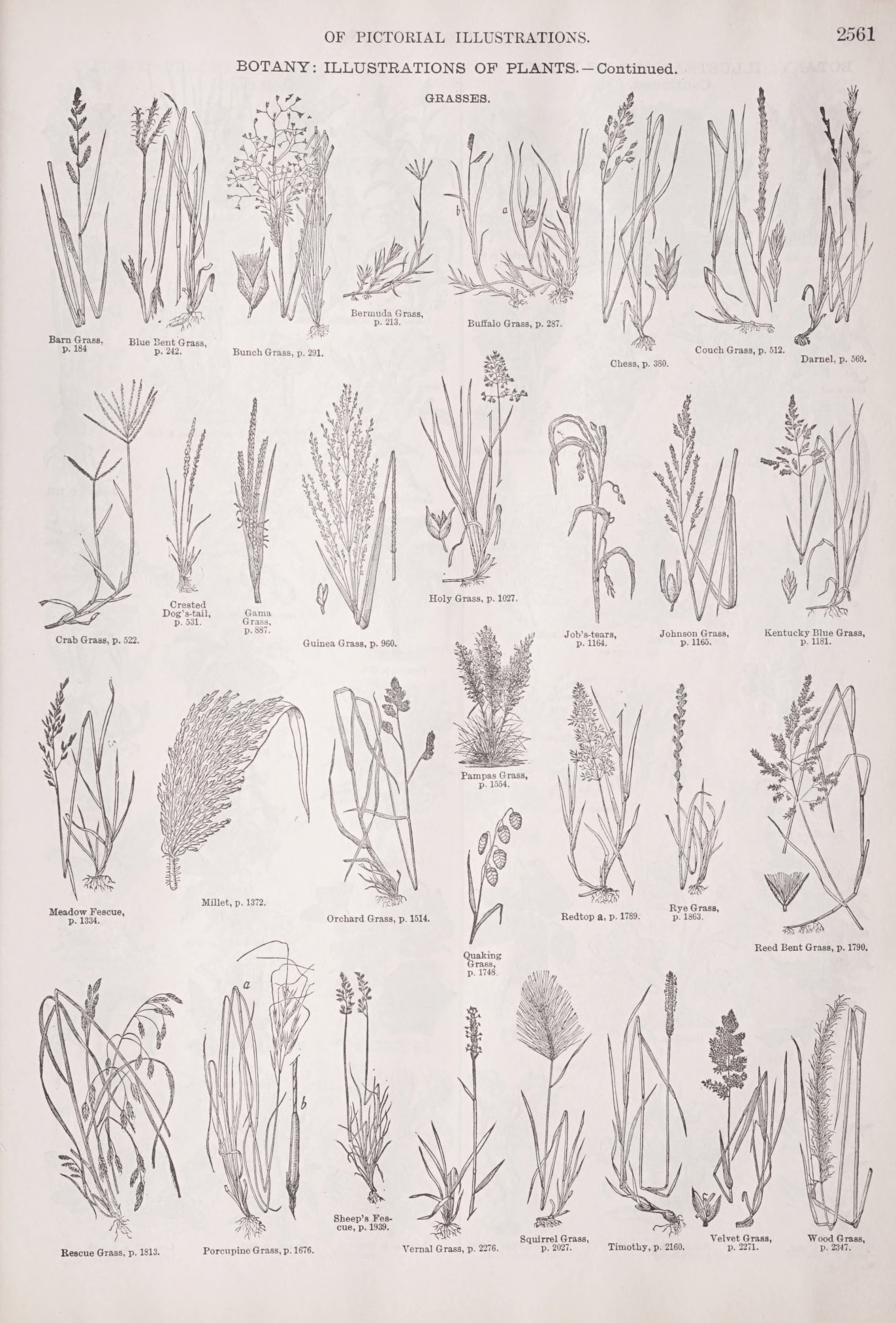
Yet the first attempts at a classification of plants recognized and separated a group—considered even of primary value—of Gramina, and this, though bounded by nothing more definite than habit and general appearance, contained the Gramineoe of modern botanists. The older group, however, even with such systematists as Ray (1703), Scħeuchzer (1719), and Micheli (1729), embraced in addition the Cyperaceoe, Juncaceoe, and some other monocotyledons with inconspicuous flowers. Singularly enough, the sexual system of Linnaeus (1735) served to mark off more distinctly the true grasses from these allies, since very nearly all of the former then known fell under his Triandria Digynia, whilst the latter found themselves under other ôf his artificial classes and orders....
I. Structure. —The general type of true grasses is familiar in the cultivated cereals of temperate climates— wheat, barley, rye, oats, and in the smaller plants which make up our pastures and meadows and form a principal factor of the turf of natural downs. Less familiar are the grains of warmer climes—rice, maize, millet, and sorgho, or the sugar cane. Still further removed are the bamboos of India and America, the columnar stems of which reach to the height of forest trees. All are, however, formed on a common type, which we proceed to examine.
Hoot.— Most cereals and many other grasses are annual, and possess a tuft of very numerous slender root-fibres, much branched, and of great length. The greater part of the order are of longer duration, and have the roots also fibrous, but fewer, thicker, and less branched. In such cases they are very generally given off from just above each node (often in a circle) of the lower part of the stem or rhizome, perforating the leaf-sheaths. In some bamboos they are very numerous from the lower nodes of the erect culms, and pass downwards to the soil around them, whilst those from the upper nodes shrivel up and form circles of spiny fibres.
Stem.— The root-stock of perennial grasses is usually well developed, and often forms very long creeping or subterranean rhizomes, with elongated internodes and sheathing scales; it is also frequently short, with the nodes crowded. The very large root-stock of the bamboos (fig. 1) is a striking example of “definite” growth; it is much branched, the short thick curved branches being given off below the apex of the older ones and at right angles to them, the whole forming a series of connected arched axes, truncate at their ends which were formerly continued into leafy culms. The root-stock is always solid, and has the usual internal structure of the monocotyledonous stem.
The aerial leaf-bearing branches (Culms) are a characteristic feature of grasses. They are generally numerous, erect, cylindrical (rarely flattened), and conspicuously jointed with evident nodes. The nodes are solid, a strong plate of tissue passing across the stem, but the internodes are commonly hollow, although examples of completely solid stems are not uncommon (many Andropogons, sugarcane). The general character is thus not unlike that of Pmbelliferae. The exterior of the culms is more or less concealed by the leaf-sheaths; it is usually smooth and often highly polished, the epidermal cells containing an amount of silica sufficient to leave after burning a distinct skeleton of their structure. Tabasheerisa white substance mainly composed of silica, found in the joints of several bamboos. A few of the lower internodes may become enlarged and sub-globular, forming nutriment-stores, and grasses so changed are termed “bulbous” (Arrhenatherum, Poa bulbοsa, &c.). In internal structure grass-culms, save in being hollow, conform to that usual in monocotyledons; the vascular bundles run parallel in the internodes, but a horizontal interlacement occurs at the partitions. Nearly all grasses branch to some extent, and many extensively; the branches are strictly distichous, and many buds are abortive, or the resulting branches short and stunted. In many bamboos they are long and spreading or drooping and copiously ramified, in others reduced to hooked spines. Diηochloa is truly scandent, and climbs over trees 100 feet or more in height. Clyra latifolia is also a climber on a humbler scale.
Grass-culms grow with great rapidity, as is most strikingly seen in bamboos, where a height of over 100 feet is attained in from two to three months, and many species grow two, three, or even more feet in twenty-four hours. Silicic hardening does not commence till the full height is nearly attained. The largest bamboo recorded is 170 feet, and the diameter is usually reckoned at about 4 inches to each 50 feet. A specimen in the British Museum is over 8 inches in diameter. In the same collection are some remarkable monstrosities, in which the septa are oblique and the internodes triangular or rhomboidal; Kurz has also figured one in the Calcutta Museum in which the cavities are confluent into a continuous spiral.
Leaves.— These present special characters usually sufficient for ordinal determination. They are always solitary at each node and strictly distichous, and consist of two distinct portions, the sheath and the blade. The sheath is often of great length, and generally completely surrounds the culm; as a rule it is split down its whole length, thus differing from that of Cyperaceoe, which is almost invariably (Erwspora is an exception) a complete tube. In a few grasses (Melica, Browns') the edges are soldered together as in the latter order. The sheaths are much dilated in Alopecnrus vaginatus and in a species of Potmaochloa, in the latter serving as floats. At the summit of the sheath, above the origin of the blade, is the ligule, a usually membranous process of small size (occasionally reaching an inch in length) erect and pressed around the culm. It is rarely quite absent, but may be represented by a tuft of hairs (very conspicuous in Pariana). Melica uniflora possesses, in addition to the ligule, a green erect tonguelike process, from the line of junction of the edges of the sheath.
The blade is frequently wanting or small and imperfect in the basal leaves, but in the rest is long and set on to the sheath at an angle. The usual form is familiar,—sessile, more or less ribbon-shaped, tapering to a point, and entire at the edge. The chief modifications are the articulation of the (deciduous) blade on to the sheath, which occurs in all the Bambuseoe (except Plaηotia) and in Sp>artinα stricta, and the interposition of a petiole between the sheath and the blade, as in Leptaspis, Pharus, Pariana, Lophatherum, &c. In the latter case the form of the leaf usually becomes oval, ovate, or even cordate or sagittate, but these forms are found in sessile leaves also (Olyra, Panicum). The venation is strictly parallel, the midrib usually strong, and the other ribs more slender. In Anomochloa there are several nearly equal ribs, and in some broad-leaved grasses (Bambusece, Phams, Leptaspis) the venation becomes tesselated by transverse connecting veins. The thick prominent veins in Agropyrum occupy the whole upper surface of the leaf. Epidermal appendages are rare, the most frequent being marginal, saw-like, cartilaginous teeth, usually minute, but occasionally (Danthoηia scabra, Panicum serratum) so large as to give the margin a serrate appearance. Alopecurus lanatus and one or two Panicums have woolly leaves.
Inflorescence.— This possesses an exceptional importance in grasses, since, their floral envelopes being much reduced and the sexual organs of very great uniformity, the characters employed for classification are mainly derived from the arrangement of the flowers and their investing bracts. The subject also presents unusual difficulties from the various interpretations which have been given to these glumaceous organs and the different terms employed for them by various writers. It may, however, be now considered as settled that the whole of the bodies known as glumes and paleae, and distichously arranged externally to the flower, form no part of the floral envelopes, but are of the nature of bracts. These are so arranged round the small flowers as to form spikelets (locustae), and each spikelet may contain one, two, three, or a greater number of flowers (in some species of Eragrostis nearly 60). The flowers are, as a rule, placed laterally on the axis (rachis) of the spikelet, but in uniflorous spikelets they appear to be terminal, and are probably really so in Anthoxanthum (fig. 9, 2) and in two anomalous genera, Anomochloa and Streptochaete.
In immediate relation with the flower itself, and often entirely concealing it, is the palea or pale (“upper pale” of most systematic agrostologists; “paleola interior,”
Dumortier; “spathella,” Doll). This organ (fig. 3, 1) is peculiar to grasses among Hlumtferae, and is almost always present, certain Oryzeae and Phalarideae being the only exceptions. It is of thin membranous consistence, usually obtuse, often bifid, and possesses no central rib or nerve, but is furnished with two lateral ones, one on either side; the margins are frequently folded in at the ribs, which thus become placed at the sharp angles. This structure points to the fusion of two organs, and the pale was by R. Brown considered to represent two portions soldered together of a trimerous perianth-whorl, the third portion being the “lower pale,” to be immediately mentioned. By Bentham the homology of the organ is suggested to be with the two bracteoles found in Hypolytrum pungens and Platyleρis, and with the perigynium of the female flower of Carex in Cyperaceoe. It is rarely (fΓriachyrum, Diachy-rium) found split into two separate organs.
The flower with its pale is sessile, and is placed in the axil of another bract in such a way that the pale is exactly opposed to it, though at a slightly higher level, It is this second bract which has been generally called by systematists the “lower pale,” and with the “upper pale" considered to form an outer floral envelope (“calyx,” Jussieu; “perianthium,” Brown; “stragulum,” Palisot de Beauvois; “glumella,” Dumortier). In the writings of most botanists even though this view is not held, yet, where the term “flower” is employed, it includes these organs. It is, however, certain that the two bracts are on different axes, one secondary to the other, and cannot therefore be parts of one whorl of organs. This was made out from the study of so-called “viviparous” grasses, in which the lower pales become transformed into ordinary foliage leaves, first by Von Mohl in 1845, and more clearly by Germain de St Pierre in 1852, who terms the lower pale the “glume fertile.” Doll and Bentham hate also independently arrived at the same result, and the latter in 1858 first published the terminology here adopted, and used for the same organ the name flowering glume. The two bracts are usually quite unlike one another, but in some genera (e.y., most Festucaceae) they are considerably similar in shape and appearance.
The flowering glume has generally a more or less boatshaped form, is of firm consistence, and possesses a well-marked central midrib and frequently several lateral ones. The midrib in a large proportion of genera extends into an appendage termed the awn (fig. 10, 2), and the lateral veins more rarely extend beyond the glume as sharp points le.g., Pappoρhorum). The form of the flowering-glume is very various, this organ being plastic and extensively modified in different genera. In Leρtaspis it is formed into a closed cavity by the union of its edges, and encloses the flower, the styles projecting through the pervious summit. Valuable characters are obtained from the awn. This presents itself variously developed from a mere subulate point to an organ several inches in length, and when complete (as in Andropogoneoe, Aveneoe, and Stipeoe) consists of two well-marked portions, a lower twisted part and a terminal straight portion, usually set in at an angle with the former sometimes trifid and occasionally beautifully feathery. The lower part is most often suppressed, and in the large group of the Paniceoe awns of any sort are very rarely seen. The awn may be either terminal or may come off from the back of the flowering-glume, and Duval Jouve’s observations have shown that it represents the blade of the leaf of which the portion of the flowering-glume below its origin is the sheath; the twisted part (so often suppressed) corresponds with the petiole, and the portion of the glume extending beyond the origin of the awn (very long in some species, e.g., of Danthoηif) with the ligule of the developed foliage-leaf. When terminal the awn has three fibro-vascular bundles, when dorsal only one; it is covered with stomate-bearing epidermis.
The flower with its palea is thus sessile in the axil of a floriferous glume, and in a few grasses (Leeτsia (fig. 2), Coleαnthus, Nardus) the spikelet consists of nothing more, but usually (even in uniflorous spikelets) other glumes are present. Of these the two placed distichously opposite each other at the base of the spikelet never bear any flower in their axils, and are called the basal or empty glumes (fig. 10, 1). They are the “glumes” of most writers (“paleae” of Dumortier), and together form what was called the “gluma” by R. Brown (“tegmen,” Palisot de Beauvois). They rarely differ much from one another, but one may be smaller or quite absent (Ρaηicum (fig. 8, 2), Vulpia, Paspal·iim, Lolium), or both be altogether suppressed, as above noticed. They are commonly firm and strong, often enclose the spikelet, and are rarely provided with long points or imperfect awns. Generally speaking they do not share in the special modifications of the flowering glumes, and but rarely themselves undergo modification, chiefly in hardening of portions (Sclerachne, Manisuris, Anteρhora, Peltophorum), so as to afford greater protection to the flowers or fruit. But it is usual to find, besides the basal glumes, a few other empty ones, and these are in two-or more-flowered spikelets (fig. 11, 2) at the extremity (numerous in Lσphatherum), qt in uniflorous ones (fig. 8, 2) below, interposed between the floral glume and the basal pair. Descriptive writers have been accustomed to call these empty glumes “barren” or “neutral flowers,” a misleading use of terms.
The axis of the spikelet, when short and rounded, has been termed the callus, when long the rachillus. It is frequently jointed and breaks up into articulations above each flower. Tufts or borders of hairs are frequently present {Calamagrostis, Phragmites, Aηdropogon), often so long as to surround and conceal the flowers. The axis is often continued beyond the last flower or glume as a bristle or stalk.
Involucres or organs outside the spikelets are not unfrequent, the morphology of which is various. Thus in Setaria, Pennisetum, <fcc., the one or more circles of simple or feathery hairs represent abortive branches of the inflorescence; in Ceηchrus these become consolidated, and the inner ones flattened out so as to form a very hard globular spiny case to the spikelets. The cup-shaped involucre of Cornucopice is a dilatation of the axis into a hollow receptacle with a raised border. In Cynosurus the pectinate involucre which conceals the spikelet is a barren or abortive spikelet. True bracts of a more general character subtending branches of the inflorescence are singularly rare in Gramineoe, in marked contrast with Cyperaccoe, where they are so conspicuous. They however occur in a whole section of Andropogon, in Anomochloa, and at the base of the spike in Sesleriα, The remarkable ovoid involucre of Coix, which becomes of stony hardness, white, and polished (then known a3 “Job’s tears”), is also a modified bract or leaf-sheath. It is entirely closed except at the apex, and contains the female spikelet, the stalks of the male inflorescence and the long styles emerging through the smdl apical orifice.
Any number of spikelets may compose the inflorescence, and their arrangement is very various. In the spicate forms, with sessile spikelets on the main axis, the latter is often dilated and flattened {Paspalum), or is more or less thickened and hollowed out {Stenotaphrum, Rottboellia, Tripsacum), when the spikelets are sunk and buried within the cavities. Every variety of racemose and paniculate inflorescence obtains, and the number of spikelets composing those of the large kinds is often immense. Rarely the inflorescence consists of very few flowers; thus Lygeum Spartum, the most anomalous of European grasses, has but two or three large uniflorous spikelets, which are fused together at the base, and have no basal glumes, but are enveloped in a large hooded spathe-like bract.
Flower.— This is characterized by remarkable uniformity. The perianth is represented by very rudimentary, small, fleshy, hypogynous scales called lodicules (“squamulae,”
Kunth; “nectarium,” Schreber); they are elongated or truncate, sometimes fringed with hairs, and are in contact with the ovary. Their usual number is two, and they are placed collaterally at the anterior side of the flower, that is, within the flowering glume. They are generally considered to represent the inner whorl of the ordinary monocotyledonous (liliaceous) perianth, the outer whorl of these being suppressed as well as the posterior member of the inner whorl. This latter is present almost constantly in Stipece and Bambuseoe, which have three lodicules, and in the latter group they are occasionally more numerous (five, spreading and persistent in Pseudostachyum ; six to ei^ht in Beesha). In Anomochloa they are represented by hairs. In Streptochoete, according to Doll, there are six lodicules, alternately arranged in two whorls. They are often quite absent. In some cases lodicules are of the nature of stipules to the palea, and appear as though split off from its sides at the base. Such stipular lodicules often co-exist along with the perianthial ones, and are then either free from oτ combined with the two anterior ones.
Sexual Organs.— Grass-flowers are usually hermaphrodite, but there are very many exceptions. Thus it is very common to find one or more imperfect (usually male) flowers in the same spikelet with bisexual ones, and their relative position is important in classification. Holcus and Arrhen-aiherum are examples in English grasses; and as a rule in species of temperate regions separation of the sexes is not carried further. In warmer countries monoecious and dioecious grasses are more frequent. In such cases the male and female spikelets and inflorescence may be very dissimilar, as in the maize, Job’s tears, Euchloena, Spinifex, <fcc.; and in some dioecious species this dissimilarity has led to the two sexes being referred to different genera {e.g., Antephora axilliβora, Steud., is the female of Buchloe dactyloides, Engelm., and Neurachne paradoxa, Br., of a species of Spinifex'). In other grasses, however, with the sexes in different plants (e.g., Brizopyrum, Distichlis, Eragrostis capitata, Gynerium), no such dimorphism obtains. Amphicarpum is remarkable in having cleistogamic flowers borne on long radical subterranean peduncles which are fertile, whilst the conspicuous upper paniculate ones, though apparently perfect, never produce fruit. Something similar occurs in Leersia oryzoides, where the fertile spikelets are concealed within the leaf-sheaths.
Androecium.— In the vast majority there are three stamens alternating with the lodicules, and therefore one anterior, i.e., opposite the flowering glume, the other two being posterior and in contact with the palea. They are hypogynous, and have long and very delicate filaments, and large, linear or oblong two-celled anthers, dorsifixed and ultimately very versatile, deeply indented at each end, and commonly exserted and pendulous. Suppression of the anterior stamen sometimes occurs (p.g., Aηthoxanthum), or the two posterior ones may be absent (fjniola, Cinna, Phippsia, Festuca bromoides). On the other hand there is in some genera {0ryza, most Bambuseoe) another row of three stamens, making six in all (fig. 3, 3); and Anomochloa and Tetrarrhena possess four. The stamens become numerous (ten to forty) in the male flowers of a few monoecious genera {Pariana·, Luziola). In Beesha they vary from seven to thirty, and in Gigantochloa they are monadelphous.
Gynoecium.— There is but little variation here from a bicarpellary pistil, with a small rounded one-celled ovary containing a single laterally attached or ascending ovule, capped by two styles quite distinct or connate at the base, and with densely hairy or feathery stigmas (fig. 4). Occasionally there is but a single style {Nardus, Lygeum), and this may attain to a great length (6 inches in the maize); or three styles may be present (some Bambuseoe, Leptaspis, Streptochoete). Nees has described a case in which three complete carpels were found in Schedonorus elatior.
We thus see that, comparing the flower of Gramineae with the normal liliaceous plan (fig. 5), it differs in the complete suppression of the outer row...