
A fowl of the genus Falco, or hawk kind; called also stannel and windhover. It builds in hollow oaks, and feeds on quails and other small birds.
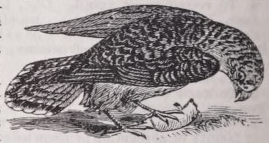
KESTREL (French Cresserelle or Crec i erdle, Old French Qιιercerelle and Quercelle, in Burgundy Cristel), the English name for one of the smaller Falcons, originating probably from its peevish and languid cry. This bird, though in the form of its bill and length of its wings one of the true Falcons, and by many ornithologists placed among them under its Linnaean name of Falco tinnunculus, is by others referred to a distinct genus Tinnunculus as T. alaudarius— the last being an epithet wholly inappropriate. We have here a ease in which the propriety of the custom which requires the establishment of a genus on structural characters may seem open to question. The differences of structure which separate Tinnunculus from Falco are of the slightest, and, if insisted upon, in the way some systematists have done, must lead to including in the former birds which obviously differ from Kestrels in all but a few characters arbitrarily chosen; and yet, if structural characters be set aside, the Kestrels form an assemblage readily distinguishable by several peculiarities from all other Falconidae, and an assemblage that the instinct of real ornithologists (though this is treading upon dangerous ground) does not hesitate to separate from the true Falcons of the genus Falco, withits subsidiary groups Aesalon, IIypotriorchis, and the rest (see Falcon, voh ix. p. 2). Scarcely any one outside the walls of an ornithological museum or library would doubt for a moment whether any bird shewn to him were a Kestrel or not; and Mr Gurney believes (Ibis, 1881, p. 277) that the aggregation of species placed by Mr Sharpe (Cat. Birds Brit. Museum, i. pp. 423-448) under the generic designation of Cerchneis (which should properly be Tinnunculus) includes “three natural groups sufficiently ...distinct to be treated as at least separate subgenera, bearing the name of Dissodectes, Tinnunculus, and Frythropus. ’ ' Of these we may say that the first and last are not at all Kestrels, but are perhaps rather related to the Hobbies (Hypotriσrchis).
The ordinary Kestrel of Europe, Falco tinnunculus or Tinnunculus alaudarius, is by far the commonest bird of prey in the British Islands, and is too common and well-kuown a bird to need any description. It is almost entirely a summer migrant, coming from the south in early spring and departing in autumn, though examples (which are nearly always found to be birds of the year) occasionally occur iu winter, some arriving on the eastern coast in autumn. It is most often observed while practising its habit of hanging in the air for a minute or two in the same spot, by means of short and rapid beats of its wings, as, with head pointing to windward and expanded tail, it is looking out for prey,—which consists chiefly of mice, but it will at times take a small bird, and the remains of frogs, insects, and even earth-worms have been found in its crop. It generally breeds in the deserted nest of a Crow or I’ie, but frequently in rocks, ruins, or even in hollow trees— laying four or five eggs, mottled all over with dark brownish-red, sometimes tinged with orange and at other times with purple. Though it may occasionally snatch up a young Partridge or Pheasant, the Kestrel is quite the most harmless bird-of-prey, if it be not, from its destruction of mice and cockchafers, a most beneficial species. It is a species of very wide range, extending over nearly the whole of Europe from 68° N. lat., and the greater part of Asia— though the form which inhabits Japan and is abundant in north-eastern China has been by some writers deemed distinct and called T. jαponicus— and it also pervades the greater part of Africa, becoming, however, scarce in southern latitudes, and unknown beyond Fantee on the west and Mombasa on the east coast (Ibis, 1881, p. 457). The southern countries of Europe have also another and smaller species of Kestrel, T. tinnunculoides (the T. cenchris and T. ηaumanni of some writers), which is widely spread in Africa and Asia, though specimens from India and China are distinguished as T. pekinensis.
Three other species are found in Africa as well— Τ. rupicola, T. rupicoloides, and T. aloρex— the first of which is a common bird in the Cape Colony, while the others occur in the interior. Some of the islands of the Ethiopian region have peculiar species of Kestrel, as the T. ηewtoηi of Madagascar, T. punctatus of Mauritius, and T. gracilis of the Seychelles; while, on the opposite side, the Kestrel of the Cape Verd Islands has been separated as T. neglectus.
The next species deserving of notice is that of America, T. sparverius, commonly known in Canada and the United States as the “Sparrow-Hawk”—a beautiful little bird, though not more courageous than the rest of its relations. Various attempts have been made to recognize several species, more or less in accordance with locality, but the majority of ornithologists seem unable to accept the distinctions which have been elaborated chiefly by Mr Sharpe {ut supra) and Mr Ridgway {North American Birds, iii. pp. 159-175), the former of whom recognizes six species, while the latter now admits but three, T. sparverius, T. leucophrys, and T. sparverioides, with five geographical races of the first, viz., the typical T. sparverius from the continent of North America, except the coast of the Gulf of Mexico; T. australis from the continent of South America, except the North Atlantic and Caribbean coasts; T. isabellinus, inhabiting continental America from Florida to Cayenne; T. domiηicensis from the Lesser Antilles as far northwards as St Thomas; and lastly T. cinnamominus from Chili and western Brazil. T. leucophrys is said to be from Hispaniola and Cuba; and T. sparverioides peculiar to Cuba only. This last has been generally allowed to be a good species, though Dr Gundlach, the best authority on the birds of that island, in his latest work, published in 1876 {Contribution ά la Ornitologia Cubana, p. 48) will not allow its validity. More recently it has been found {Ibis, 1881, pp. 547-564) that T. australis and T. cinnamominus cannot be separated, that Mr Ridgway’s T. leucophrys should properly be called T. dominiceηsis, and his T. dominicensis T. antillarum, while that gentleman has recorded the supposed occurrence of T. sparverioides in Florida. Of other Kestrels it remains to say that T. moluccensis is widely spread throughout the islands of the Malay archipelago, while T. ceηchroides seems to inhabit the whole of Australia, and has occurred in Tasmania {Proc. Roy. Soc. Tasmania, 1875, pp. 7, 8). No Kestrel is found in New Zealand, but an approach to the form is made by the very peculiar Hieracidea (or Harpe) novae-zelandiae (of which a second race or species has been described, H. brunnea or H. ferox) the “Sparrow-Hawk,” “Quail-Hawk,” and “Bush-Hawk” of the colonists—a bird of much higher courage than any Kestrel, and perhaps exhibiting the more generalized and ancestral type from which both Kestrels and Falcons may have descended. (a. n.)