1. To deprive of life, animal or vegetable, in any manner or by any means. To kill an animal or a plant, is to put an end to the vital functions, either by destroying or essentially injuring the organs necessary to life, or by causing them to cease from action. An animal may be killed by the sword or by poison, by disease or by suffocation. A strong solution of salt will kill plants.
2. To butcher; to slaughter for food; as, to kill an ox.
3. To quell; to appease; to calm; to still; as, in seamen's language, a shower of rain kills the wind.
2. A channel or arm of the sea; a river; a stream; as, the channel between Staten Island and Bergen Neck is the Kill van Kull, or the Kills; -- used also in composition; as, Schuylkill, Catskill, etc.
KILLARNEY, a market-town of Ireland, county of Kerry, is situated on a branch line of the Dublin and Cork Railway, 180 miles south-west from Dublin and 47 miles north from Cork. On account of the beautiful scenery in the neighbourhood, the town is much frequented by tourists. Within late years it has been greatly improved in appearance, and the streets are now spacious and well-paved, while many good houses and several imposing public buildings have been erected. The principal buildings are the court-house, the Roman Catholic cathedral and bishop’s palace, designed by Pugin, the episcopal church lately rebuilt, the lunatic asylum, erected at a cost of £30,000, and the railway hotel. Adjoining the town is the fine mansion of the earl of Kenmare. The only manufacture of any importance now carried on at Killarney is that of fancy articles from the wood of the arbutus; but it owed its origin to iron-smelting works, for which abundant fuel was obtained from the neighbouring forests....
The lakes of Killarney, about a mile and a half distant from the town, are situated in a basin between several lofty mountain groups, some rising abruptly from the water’s edge, and all clothed with trees and shrubbery almost to their summits. The lower lake, or Lough Leane, which has an area of 5001 acres, is studded with finely wooded islands, on the largest of which, Ross Island, are the ruins of Ross castle, an old fortress of the O’Donoghues; and on another island, the “sweet Innisfallen” of Moore, are the picturesque ruins of an abbey founded by St Finian the leper at the close of the 6th century. Between the lower lake and the middle or Tore lake, which is 680 acres in extent, stands Muckross Abbey, built by the Franciscans about 1440. With the upper lake, which is 430 acres in extent, thickly studded with islands, and closely shut in by mountains, the lower and middle lakes are connected by the Long Range, a winding and finely wooded channel, 2∣ miles in length, and commanding magnificent views of the mountains. Midway in its course is a famous echo caused by the Eagle’s Nest, a lofty pyramidal rock. The population of the urban sanitary district in 1881 was 6546.
9th ed. Encyclopædia Britannica, vol. 14, p. 75 [383 words — estimated reading time: 3 minutes]
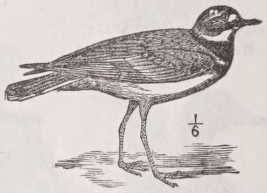
KILLDEER, a common and well-known American Plover, so called in imitation of its whistling cry, the Charadrius vociferιisoi Linnaeus, and the Aegialitis vocifera of modern ornithologists. About the size of a Snipe, it is mostly sooty-brown above, but showing a bright buff on the tail coverts, and in flight a white bar on the wings; beneath it is pure white except two pectoral bands of deep black. It is one of the finest as well as the largest of the group commonly known as Ringed Plovers or Ring Doterels, forming the genus Aegialitis of Boie. Mostly wintering in the south or only on the sea-shore of the more northern States, in spring it spreads widely over the interior, breeding on the newly-ploughed lands or on open grass-fields. The nest is made in a slight hollow of the ground, and is often surrounded with small pebbles and fragments of shells. Here the hen lays her pear-shaped, stone-coloured eggs, four in number, and always arranged with their pointed ends touching each other, as is indeed the custom of most Limicoline birds. The parents exhibit the greatest anxiety for their offspring on the approach of an intruder: the lien runs off with drooping wings and plaintivecries, while the cock sweeps around, gesticulating with loud and angry vociferations. It is the best-known bird of its Family in the United States, throughout which it is found in all suitable districts, but less abundantly in the north-east than further south or west. In Canada it does not range further to the northward than 56° N. lat., and it is not known to occur in Greenland, or hardly in Labrador, though it is a passenger in Newfoundland every spring and autumn. In winter it finds its way to Bermuda and to some of the Antilles, but it is not recorded from any of the islands to the windward of ...Porto Rico. However, in the other direction it goes very much further south, travelling down the Isthmus of Panama and the west coast of South America to Peru. The Killdeer has several other congeners in America, among which may be noticed Ae. semipalmata, so curiously resembling the ordinary Ringed Plover of the Old World, Ae. hiaticula, except that it has its toes connected by a web at the base; and Ae. nivosa, a bird inhabiting the western parts of both the American continents, which in the opinion of some authors is only a local form of the widely-spread Ae. alexandrνna or cantiana, best known by its English name of Kentish Plover, from its discovery near Sandwich towards the end of the last century, though it is far more abundant in many other parts of the Old World. The common Ringed Plover, Ae. hiaticula, has many of the habits of the Killdeer, but is much less often found away from the sea-shore, though a few colonies may be found in dry warrens in certain parts of England many miles from the coast, and in Lapland at a still greater distance. In such localities it has the curious habit of paving its nest with small stones (whence it is locally known by the name of “Stone-hatch”), a habit almost unaccountable unless regarded as an inherited instinct from shingle-haunting ancestors.
About thirty species all apparently referable with propriety to the genus Aegialitis have been described, but probably so many do not exist. Some, as the Kentish Plover above named, have a very extended distribution, for that, letting alone its supposed American habitat, certainly occurs in greater or less numbers on the coasts of China, India, and Africa generally. On the other hand there is one, the Ae. sanctae-helenae, which seems to be restricted to the island whence it takes its scientific name, and where it is called the “Wire-bird” (Ibis, 1873, p. 260). Nearly allied to Aegialitis are two genera peculiar to the New Zealand subregion— Thinornis, which does not call for any particular remark, ànd the extraordinary Anarhynchus, which deserves a few words. Of this there is but one species, Ae. frontalis, the Wrybill, so called from its bill being congenitally bent in the middle and diverted to the right side—a formation supposed to give the bird greater facility in seeking its food, chiefly arthropods that lurk under stones, round which it may be seen running from left to right. Mr Buller (Ji. Hew Zealand, p. 219) connects with this habit the curious fact that the black pectoral band worn by the bird is “narrower and of a less decided colour on the left side of the breast,” whence he infers that “the law of natural selection has operated to lessen the colouring on the side of the bird more exposed to Hawks and other enemies while the Anarhyηchus is hunting for its daily food.” Be that as it may, it does not detract from the wonderful nature of this asymmetry of the bill, which is comparable indeed with that found in so large a number of Cetaceans among mammals, but with nothing known among birds, for in the Crossbills (g ’.v.) the bones of the mandibles are not affected, and in certain Owls (Hyctala) the distortion of the ear-bones is not externally visible. (a. n. )
9th ed. Encyclopædia Britannica, vol. 14, p. 76 [887 words — estimated reading time: 6 minutes]
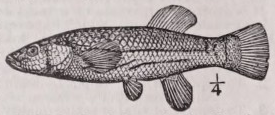
Any one of several small American cyprinodont fishes of the genus Fundulus and allied genera. They live equally well in fresh and brackish water, or even in the sea. They are usually striped or barred with black. Called also minnow, and brook fish. See Minnow.
KILLIZ, or Kilis, a town of Syria, in the Turkish vilayet of Aleppo, in 37° 2' N. lat. and 37° 2' E. long., 60 miles north of the city of Aleppo. It is situated in an extremely fertile plain or plateau, completely surrounded with olive groves, the produce of which is reckoned the finest oil of all Syria; and its position on the regular route from Birejik on the Euphrates to southern Caramania gives it considerable traffic. The bazaars are unusually fine, and gunmaking is a common craft in the town. The population, variously estimated at 12,000 and 6000, consists largely of Arabs, the town lying just on the northern rim of· the Arab territory.
9th ed. Encyclopædia Britannica, vol. 14, p. 76 [116 words — estimated reading time: 1 minute]
V.kill, put to death, slay, shed blood, murder, assassinate, butcher, slaughter, victimize, immolate, massacre, take away life, deprive of life, make away with, put an end to, despatch, dispatch, burke, settle, do for, strangle, garrote, hang, throttle, choke, stifle, suffocate, stop the breath, smother, asphyxiate, drown, saber, cut down, cut to pieces, cut the throat, jugulate, stab, run through the body, bayonet, eviscerate, put to the sword, put to the edge of the sword, shoot dead, blow one's brains out, brain, knock on the head, stone, lapidate, give a deathblow, deal a deathblow, give a quietus, give a coupe de grace, behead, bowstring, electrocute, gas, hunt, shoot, cut off, nip in the bud, launch into eternity, send to one's last account, sign one's death warrant, strike the death knell of, give no quarter, pour out blood like water, decimate, run amuck, wade knee deep in blood, imbrue one's hands in blood, die a violent death, welter in one's blood, dash out one's brains, blow out one's brains, commit suicide, kill oneself, make away with oneself, put an end to oneself, put an end to it all
And Cain talked with Abel his brother: and it came to pass, when they were in the field, that Cain rose up against Abel his brother, and slew him.
Then Cain said to his brother Abel, “Let us go out to the field.” And while they were in the field, Cain rose up against his brother Abel and killed him.
Behold, thou hast driven me out this day from the face of the earth; and from thy face shall I be hid; and I shall be a fugitive and a vagabond in the earth; and it shall come to pass, that every one that findeth me shall slay me.
Behold, this day You have driven me from the face of the earth, and from Your face I will be hidden; I will be a fugitive and a wanderer on the earth, and whoever finds me will kill me.”
And the LORD said unto him, Therefore whosoever slayeth Cain, vengeance shall be taken on him sevenfold. And the LORD set a mark upon Cain, lest any finding him should kill him.
“Not so!” replied the LORD. “If anyone slays Cain, then Cain will be avengedsevenfold.” And the LORD placed a mark on Cain, so that no one who found him would kill him.
And Adam knew his wife again; and she bare a son, and called his name Seth: For God, said she, hath appointed me another seed instead of Abel, whom Cainslew.
And Adam again had relations with his wife, and she gave birth to a son and named him Seth, saying, “God has granted me another seed in place of Abel, since Cain killed him.”
Therefore it shall come to pass, when the Egyptians shall see thee, that they shall say, This is his wife: and they will kill me, but they will save thee alive.
and when the Egyptians see you, they will say, ‘This is his wife.’ Then they will kill me but will let you live.
That be far from thee to do after this manner, to slay the righteous with the wicked: and that the righteous should be as the wicked, that be far from thee: Shall not the Judge of all the earth do right?
Far be it from You to do such a thing—to kill the righteous with the wicked, so that the righteous and the wicked are treated alike. Far be it from You! Will not the Judge of all the earth do what is right?”
And the men of the place asked him of his wife; and he said, She is my sister: for he feared to say, She is my wife; lest, said he, the men of the place should kill me for Rebekah; because she was fair to look upon.
But when the men of that place asked about his wife, he said, “She is my sister.” For he was afraid to say, “She is my wife,” since he thought to himself, “The men of this place will kill me on account of Rebekah, because she is so beautiful.”
And Esauhated Jacob because of the blessing wherewith his father blessed him: and Esau said in his heart, The days of mourning for my father are at hand; then will I slay my brother Jacob.
Esau held a grudge against Jacob because of the blessing his father had given him. And Esau said in his heart, “The days of mourning for my father are at hand; then I will kill my brother Jacob.”
And these words of Esau her elder son were told to Rebekah: and she sent and called Jacob her younger son, and said unto him, Behold, thy brother Esau, as touching thee, doth comfort himself, purposing to kill thee.
When the words of her older son Esau were relayed to Rebekah, she sent for her younger son Jacob and told him, “Look, your brother Esau is consoling himself by plotting to kill you.
Come now therefore, and let us slay him, and cast him into some pit, and we will say, Some evil beast hath devoured him: and we shall see what will become of his dreams.
“Come now, let us kill him and throw him into one of the pits. We can say that a vicious animal has devoured him. Then we shall see what becomes of his dreams!”
O my soul, come not thou into their secret; unto their assembly, mine honour, be not thou united: for in their anger they slew a man, and in their selfwill they digged down a wall.
May I never enter their council; may I never join their assembly. For they kill men in their anger, and hamstring oxen on a whim.
And he said, When ye do the office of a midwife to the Hebrew women, and see them upon the stools; if it be a son, then ye shall kill him: but if it be a daughter, then she shall live.
“When you help the Hebrew women give birth, observe them on the birthstools. If the child is a son, kill him; but if it is a daughter, let her live.”
And he said, Who made thee a prince and a judge over us? intendest thou to kill me, as thou killedst the Egyptian? And Moses feared, and said, Surely this thing is known.
But the man replied, “Who made you ruler and judge over us? Are you planning to kill me as you killed the Egyptian?” Then Moses was afraid and thought, “This thing I have done has surely become known.”
This site uses cookies to remember your display preferences (search sources and editions, Bible version, auto-link, images, light/dark theme). No personal data whatsoever is collected. Privacy Policy