
Right of going foremost; precedence. [Not used.]
Word of the Day: Catachrestical
1. A pace; a step, as in a dance.
2. Right of going foremost; precedence.
Pas de calais
Encyclopedia Britannica
PAS DE CALAIS, a maritime department of northern France, formed in 1790 of nearly the whole of Artois and the northern maritime portion of Picardy, including the Boulonnais, Calaisis, Ardrésis, and the districts of Langle and Bredenarde, lies between 50° 2' and 51° N. lat. and 1 35' and 3° 10' E. long., and is bounded N. by the Straits of Dover (“Pas de Calais”), E. by the department of Nord, S. by that of Somme, and W. by the English Channel. The distance from England is only 21 miles. Nord, which separates Pas de Calais from Belgium, is at one place only 3 miles wide, and from Arras (the chief town) to Paris in a direct line is about 100 miles. Except in the neighbourhood of Boulogne, with its côtes de fer or “iron coasts,” the seaboard of the department, which measures 65 miles, consists of dunes. From the mouth of the Aa (the limit towards Nord) it trends west-southwest to Gris Nez, the point of France nearest to England; in this section lie the port of Calais, Cape Blanc Nez, rising 440 feet above the sandy shores, and the port of Wissant (Wishant). Beyond Gris Nez the direction is due south; in this section are the port of Ambleteuse, Boulogne at the mouth of the Liane, and the two bays formed by the estuaries of the Canche and the Authie (the limit towards Somme). The highest point in the department (700 feet) is in the west, between Boulogne and St Omer. From the uplands in which it is situated the Lys and Scarpe flow east to the Scheldt, the Aa north to the German Ocean, and the Slack, Wimereux, and Liane to the Channel. Farther south are the valleys of the Canche and the Authie, running from east-south-east to west-northwest, and thus parallel with the Somme. Vast plains, open and monotonous, but extremely fertile and well cultivated, occupy most ...of the department. The greenest and most picturesque valleys are in the west. To the north of the hills running between St Omer and Boulogne, to the south of Gravelines and the south-east of Calais, lies the district of the Wattergands, fens now drained by means of canals and dykes, and turned into highly productive land. The climate is free from extremes of heat and cold, but damp and changeable. At Arras the mean annual temperature is 47°; on the coast it is higher. The rainfall in the one case is 22 inches, in the other 31.
With a total area of 2550 square miles, the department has 1899 square miles (more than two-thirds) of arable land, while woods and pasture land each occupy only about a twentieth. The live stock in 1880 comprised 76,224 horses, 9642 asses or mules, 156,060 cows, 35,272 calves, 5080 bulls or oxen, 256,031 sheep, 131,722 pigs, 26,760 goats. The sheep in 1880 yielded 857 tons of wool, worth £57,398. The national sheepfolds of Tingry are in Pas de Calais. The 22,260 beehives of the department yielded in 1878 1753 tons of honey and 39⅜ tons of wax. No department except Somme breeds fowls so extensively. Wheat, beetroot, and oil seeds are the principal crops. In 1882 wheat gave 9,855,483 bushels, meslin 920,023 bushels; in 1879, rye 781,150 bushels, barley 2,362,133 bushels, oats 9,421,818 bushels, beetroot 1,576,355 tons (almost entirely consumed by the sugar works), potatoes 7,250,813 bushels, vegetables 581,727, and colza seed 30,263. Besides there were considerable quantities of poppy-seed, flax (of excellent quality), hops, hemp, and tobacco (1275 tons). There are two great coalfields, that of Pas de Calais proper, a continuation of the coal-field of Valenciennes and Hainault, and that of Boulonnais. The former contains a total area of 134,270 acres; the latter is about a tenth of that size. Taken together they number 72 pits, 57 of which are active. In 1882 5,036,455 tons of coal were extracted and 1,378,818 consumed in the department; the industry gives employment to 22,925 persons. Peat (to the amount of 375,034 tons in 1882) is obtained in the valleys of the Scarpe and the Aa. Iron-mines in the arrondissement of Boulogne employ 162 workmen (26,674 tons); the stone and marble quarries 2130 workmen; and about 800 are engaged in obtaining phosphates of lime (295,566 tons), which are exported for manure. Blast furnaces, foundries, engineering works, naileries, boiler-works, agricultural implement factories, and steelpen works are all carried on in the department. In 1883 305 tons of iron, 16,355 tons of steel, 65,025 tons of cast iron were manufactured; and the average production of pens is 400,000,000 per annum. The establishments at Biache St Vaast melt, refine, and roll copper and zinc, and also work lead and auriferous silver. The shipyards do not launch any large vessels, but in 1881 they built eighty luggers or sloops, with an aggregate burden of 2456 tons. The eighty-nine sugar-works in 1880 produced 42,121 tons of sugar and 29,730 of molasses; the distilleries 4,658,984 gallons of spirits; the oil works 15 tons of hempseed oil, 389 tons of linseed oil, 3066 tons of poppyseed, rapeseed, and cameline oil, &c., and 797 tons of colza oil. There are 553 breweries in the department. Cotton-spinning and weaving employ 116,364 spindles and 625 looms; woolspinning 26,300 spindles; and the flax, hemp, and jute manufacture 35,700 spindles and 497 looms. St Pierre-lès-Calais carries on the weaving of tulles in linen, cotton, and silk, employing 10,000 hands, and producing with its 1506 looms goods to the value of £2,400,0 0 per annum. There are besides in the department establishments for the manufacture of paper and cardboard, hosiery, embroidery, boots and shoes (for exportation), flooring, pipes, glass wares, chemical products, pottery, chicory, starch, biscuits (300 to 400 workmen), and gin. The national powder-mills of Esquerdes are among the largest in France. The port towns fit out a considerable number of vessels for the mackerel, cod, and herring fishing—a growing industry. In 1882 Boulogne and Etaples had 340 boats (13,919 tons) and 4586 fishermen, and Calais 37 boats (265 tons) and 281 fishermen, and their united take was 2356 tons. There is a large export of sugar, spirits, calves, sheep, and eggs to England. In 1882 the port of Boulogne had a movement of 3614 vessels and that of Calais 4436, with a total burden for the two ports of 2,212,920 tons. In 1878 404,769 travellers passed by this way between France and England. Calais is emphatically a transit port; Boulogne has besides an export trade in local products such as marble, freestone, minerals, and Boulogne horses, remarkable for size and strength. The roads of the department (national, departmental, &c. ) make a length of 9393 miles, the waterways 105⅜ miles, the railways 546 miles, and the industrial railways 60 miles. The canal system comprises part of the Aa, the Lys, the Scarpe, the Deule (a tributary of the Lys passing by Lille), the Lawe (a tributary of the Lys passing by Bethune), and the Sensée (an affluent of the Scheldt), as well as the various canals proper from Aire to La Bassée, Neuffossé, Calais, &c., and in this way a line of communication is formed from the Scheldt to the sea by Bethune, St Omer, and Calais, with branches to Gravelines and Dunkirk in Nord. The total tonnage of the whole inland navigation was 2,124,442 tons in 1878.
In 1881 Pas de Calais had 819,022 inhabitants (311 per square mile), ranking sixth among the departments in density of population. It forms the diocese of Arras in the archbishopric of Cambrai, belongs to the district of the first (or Lille) corps d’armée, and is within the jurisdiction of the Douai court of appeal. There are six arrondissements bearing the names of their chief towns— Arras (27,041 inhabitants), Bethune (10,374), Boulogne (44,842), Montreuil (3352), St Omer (20,479), and St Pol (3694). Other places of importance are St Pierre-lès-Calais (30,786 inhabitants), the industrial town of Calais (13,529), Lens (10,515), Lievin (8281), Carvin (6430)—the last three with important coal-mines, and Aire (5000), formerly a fortified place.
9th ed. Encyclopædia Britannica, vol. 18, p. 339
[1,423 words — estimated reading time: 9 minutes]
[1,423 words — estimated reading time: 9 minutes]
Pascal
Encyclopedia Britannica
PASCAL, Blaise (1623-1662), was born at Clermont Ferrand on the 19th June 1623. His father was Étienne Pascal, president of the Court of Aids at Clermont; his mother’s name was Antoinette Bégon. The Pascal family were Auvergnats by extraction as well as residence, and they had for many generations held posts in the civil service. They were ennobled by Louis XI. in 1478, but, as in many other cases, no attempt seems to have been made to assume the privileged particle de. The earliest anecdote of Pascal is a singular story recorded by his niece, Marguerite Perier (the heroine of the Holy Thorn miracle), of his being bewitched, and freed from the spell by the witch with strange ceremonies. His mother died when he was ab®ut four years old (the exact date is differently stated), and left him with two sisters—Gilberte, who afterwards married Μ. Perier, and Jacqueline. Both sisters are of importance in their brother’s history, and both are said to have been beautiful and accomplished. When Pascal was about seven years old, his mother having been already dead for some time, Étienne Pascal the father gave up his official post at Clermont, and betook himself to Paris for the education of his children and for his own indulgence in scientific society. It does not appear that Blaise, who went to no school, but was taught by his father, was at all forced, but rather the contrary. Nevertheless he has a distinguished place in the story of precocious children, and in the much more limited chapter of children whose precocity has been followed by great performance at maturity, though he never became what is called a learned man, perhaps did not know Greek, and was pretty certainly indebted for most of his miscellaneous reading to Montaigne. How, purposely kept from books, he ...worked out the more elementary problems of geometry for himself; how at sixteen he wrote a treatise on conic sections which Descartes refused to believe in except as the work of a master and not of a student; how he wrote treatises on acoustics at twelve, and began elaborate calculating machines when he was still á boy,—are things dwelt upon in all biographies of him. In this notice his attainments in mathematical and physical science, except those which have some special connexion with his life and history, will be dealt with separately and later.
The Pascal family, some years after settling in Paris, had to go through a period of adversity. Étienne Pascal, on leaving Clermont, had bought certain of the Hôtel de Ville rentes, almost the only regular investment open to Frenchmen at the time. Richelieu reduced the interest and the investors protested, Pascal amongst them. But the great cardinal did not understand such protests, and to escape the Bastille Pascal had to go into hiding. He was, according to the story, restored to favour owing to the good acting and graceful appearance of his daughter Jacqueline in a representation of Scudéry’s Amour Tyrannique before Richelieu. Indeed Jacqueline, who was only fourteen, herself gives the account in a pleasant letter which is extant, and which contains an allusion to her brother’s mathematical prowess. Madame d’Aiguillon’s intervention in the matter was perhaps as powerful as Jacqueline’s acting, and Richelieu not only relieved Étienne Pascal from the necessity of keeping out of the way, but gave him (in 1641) the important and lucrative though somewhat troublesome intendancy of Rouen. The family accordingly removed to the Norman capital, though Gilberte Pascal shortly after, on her marriage, returned to Clermont. At Rouen they became acquainted with Corneille, and Blaise Pascal pursued his studies with such vehemence that he already showed signs of an injured constitution. Nothing, however, of importance happened till the year 1646. Then Pascal the elder was confined to the house by the consequences of an accident on the ice, and was visited by certain gentlemen of the neighbourhood who had come under the influence of St Cyran and the Jansenists. It does not appear that up to this time the Pascal family had been contemners of religion, but they now eagerly embraced the creed, or at least the attitude of Jansenism. One of the more immediate results of this conversion has rather shocked some modern admirers of Pascal, who forget that toleration, except of the Gallio kind, is an idea which had no place in men’s minds in Pascal’s day. He came into contact with a Capuchin known as Père St Ange, but whose real name was Forton, and who seems to have entertained some speculative ideas on theological points which were not strictly orthodox. Thereupon Pascal with some of his friends lodged an information against the heretic with the representative of the archbishop of Rouen. There seems to have been no lack of zeal about the accusers, but the accused made no difficulty whatever in making profession of orthodoxy, and the judge appears to have been by no means anxious to push the matter home. No doubt Pascal was perfectly sincere, and like most of his contemporaries held the opinion attributed to a great English nonconformist contemporary of his, that, while it was very shocking that men who were in the right should not be tolerated, it was almost equally shocking that men who were in the wrong should be.
His bodily health was at this time very far from satisfactory, and he appears to have suffered, not merely from acute dyspepsia, but from a kind of paralysis. He was, however, except when physicians positively forbade study, and probably sometimes when they did so forbid, indefatigable in his mathematical work. In 1647 he published his Nouvelles Expériences sur le Vide, and in the next year the famous experiment with the barometer on the Puy de Dome was carried out for him by his brother-in-law Perier, and repeated on a smaller scale by himself at Paris, to which place by the end of 1647 he and his sister Jacqueline had removed, to be followed shortly by their father. In a letter of Jacqueline’s dated the 27th of September, an account of a visit paid by Descartes to Pascal is given, which, like the other information on the relations of the two, gives strong suspicion of mutual jealousy. Descartes, however, gave Pascal the very sensible advice to stay in bed as long as he could (it may be remembered that the philosopher himself never got up till eleven) and to take plenty of beef tea. But the relations of Pascal with Descartes belong chiefly to the scientific achievements of the former. He had, however, other relations, both domestic and miscellaneous, which had nothing to do with science. As early as May 1648 Jacqueline Pascal was strongly drawn to Port Royal, and her brother frequently accompanied her to its church. She desired indeed to join the convent, but her father, who at the date above mentioned returned to Paris with the dignity of counsellor of state (his functions at Rouen having ceased), disapproved of the plan, and took both brother and sister to Clermont. Pascal stayed in Auvergne for the greater part of two years, but next to nothing is known of what he did there. Fléchier, in his account of the Grands Jours at Clermont many years after, speaks of a “belle savante” in whose company Pascal had frequently been—a trivial mention on which, as on many other trivial points of scantily known lives, the most childish structures of comment and conjecture have been based. It is sufficient to say that at this time, despite the Rouen “conversion,” there is no evidence to show that Pascal was in any way a recluse, an ascetic, or in short anything but a young man of great intellectual promise and performance who was not indifferent to society, but whose aptitude both for society and study was affected by weak health and the horse-doctoring of the time. He, his sister, and their father returned to Paris in the late autumn of 1650, and in September of the next year Étienne Pascal died. Almost immediately afterwards Jacqueline fulfilled her purpose of joining Port Royal— a proceeding which led to some soreness, finally healed, between herself and her brother and sister as to the disposal of her property. Perhaps this difference, but more probably the mere habitual use of the well-known dialect of Port Royal, led Jacqueline to employ in reference to her brother expressions which have led biographers into most unnecessary excursions of fancy. For these they have seemed to find further warrant in similar phrases used by the Periers, mother and daughter. It has been supposed that Pascal, from 1651 or earlier to the famous accident of 1654, lived a dissipated, extravagant, worldly, luxurious (though admittedly not vicious) life with his friend the Duc de Roannez and others. His Discours sur les Passions de ΓAmour, a striking and characteristic piece, only recently discovered and printed, has also been assigned to this period, and has been supposed to indicate a hope less passion for Charlotte de Roannez, the duke’s sister. It cannot be too decidedly said that all this is sheer romancing. The extant letters of Pascal to the lady show no trace of any affection (stronger than friendship) between them. As to Pascal’s worldly life, it might be thought that only the completest ignorance of the usual dialect of the stricter religious sects and societies (and it may be added of Port Royal in particular) could induce any one to lay much stress on that. A phrase of Jacqueline’s about the “horribles attaches” which bound her brother to the world may pair off with hundreds of similar expressions from Bunyan downwards. It is, however, certain that in the autumn of 1654 Pascal’s second “conversion” took place, and that it was lasting. He betook himself at first to Port Royal, and began to live a recluse and austere life there. Madame Perier simply says that Jacqueline persuaded him to abandon the world. Jacqueline represents the retirement as the final result of a long course of dissatisfaction with mundane life. But there are certain anecdotic embellishments of the act which are too famous to be passed over, though they are in part apocryphal. It seems that Pascal in driving to Neuilly was run away with by the horses, and would have been plunged in the river but that the traces fortunately broke. To this, which seems authentic, is usually added the late and more than doubtful tradition (due to the Abbé Boileau) that afterwards he used at times to see an imaginary precipice by his bedside or at the foot of the chair on which he was sitting. Further, from November 23, 1654, dates the singular document usually known as “Pascal’s amulet,” a parchment slip which he wore constantly about him, and which bears the date followed by some lines of incoherent and strongly mystical devotion.
But, whatever may have been the immediate cause of Pascal’s conversion and (for a time) domestication at Port Royal, it certainly had no evil effect on his intellectual or literary powers. Indeed, if he had been drowned at Neuilly he would hardly be thought of now as anything but an extraordinarily gifted man of science. It must also be noted that, though he lived much at Port Royal, and partly at least observed its rule, he never actually became one of its famous solitaries. But for what it did for him (and for a time his health as well as his peace of mind seems to have been improved) he very soon paid the most ample and remarkable return that any man of letters ever paid to any institution. At the end of 1655 Arnauld, the chief light of Port Royal, was condemned by the Sorbonne for a letter which he had published expressing doubt whether the famous five propositions were to be found in Jansen, and, as much was made of this condemnation, it was thought important by the Jansenist and Port Royal party that steps should be taken to disabuse the popular mind on the whole controversy. Arnauld would have undertaken the task himself, but his wiser friends knew that his style was anything but popular, and overruled him. It is said that he personally suggested to Pascal to try his hand, and that the first of the famous Provincial Letters (this familiar name, or rather misnomer, is an abbreviation from the proper title of Lettres Écrites par Louis de Montalte à un Provincial de ses Amis') was written in a few days, or, less probably, in a day. It was printed on the 23d January 1656, and, being immensely popular and successful, was followed by others to the number of eighteen, in which not merely the special points at issue but the whole ethical and doctrinal system of the Jesuits was pulled to pieces.
In the Provinciales Pascal, who it must be remembered published under a strict incognito, denies that he belongs to Port Royal, and in fact, though during the last years of his life he was wholly devoted to its interests, he was never a regular resident there, and usually abode in his own house at Paris. Shortly after the appearance of the Provinciales, on May 24, 1656, occurred the miracle of the Holy Thorn, a fragment of the crown of Christ preserved at Port Royal, which cured the little Marguerite Perier of a fistula lacrymalis. The Jesuits were much mortified by this Jansenist miracle, which, as it was officially recognized, they could not openly deny. Pascal and his friends rejoiced in proportion. But the details of his later years after this incident are somewhat scanty, and as recorded by his sister and niece they tell of increasing ill health, and of ascetic practices and beliefs increasing still more. One curious incident, contrasting equally with this state of things and with Pascal’s studious character and renown, is what Madame Perier calls “l’affaire des carrosses,” a scheme of the Duc de Roannez and others for running omnibuses in Paris, which was actually carried out, of which Pascal was in some sort manager, and from which he derived some profit. This, however, is an exception. Otherwise, for years before his death, we hear only of acts of charity and of, as it seems to modern ideas, extravagant asceticism. Thus Madame Perier tells us that he disliked to see her caress her children, and would not allow the beauty of any woman to be talked of in his presence. What may be called his last illness began as early as 1658, after which year he never seems to have enjoyed even tolerable health, and as the disease progressed it was attended with more and more pain, chiefly in the head. In June 1662, having given up his own house to a poor family who were suffering from small-pox, and being unwilling that his sister should expose herself to infection, he went to her house to be nursed, and never afterwards left it. His state was, it seems, mistaken by his physicians, who to the last maintained that there was little danger— so much so that the offices of the church were long put off. He was able, however, to receive the eucharist, and soon afterwards died in convulsions on August 19th. A post mortem examination was held, which showed not only grave derangement in the stomach and other organs, but a serious lesion of the brain.
Eight years after Pascal’s death appeared, in a small volume, the book which has given most trouble to all students of Pascal, and most pleasure to some of them. It purported to be Pascal’s Pensées, and a preface by his nephew Perier gave the world to understand that these were fragments of a great projected apology for Christianity which the author had in conversation with his friends planned out years before. The editing of the book was peculiar. It was submitted to a committee of influential Jansenists, with the Duc de Roannez at their head, and, in addition, it bore the imprimatur of numerous unofficial approvers who testified to its orthodoxy. It does not appear that there was much suspicion of the garbling which had been practised,—garbling not unusual at the time, and excused in this case by the fact of a lull in the troubles of Port Royal and a great desire on the part of its friends to do nothing to disturb that lull. But as a matter of fact no more entirely fictitious book ever issued from the press. The fragments which it professed to give were in themselves confused and incoherent enough, nor is it easy to believe that they all formed part of any such single and coherent design as that referred to above. But the editors omitted, altered, added, separated, combined, and so forth entirely at their pleasure, actually making some changes which seem to have been thought improvements of style. As an instance of their anxiety to avoid offence, it may be noticed that they rejected, apparently as too outspoken, Madame Perier’s invaluable life of her brother, which was written to accompany the second edition of the Pensées, but did not actually appear with them till 1684.
This rifacimento remained the standard text with a few unimportant additions for nearly two centuries, except that by a truly comic revolution of public taste Condorcet in 1776 published, after study of the original, which remained accessible in manuscript, another garbling, conducted this time in the interests of unorthodoxy. It was not till 1842 that Victor Cousin drew attention to the absolutely untrustworthy condition of the text, nor till 1844 that Μ. Faugère edited that text from the MS. in something like a condition of purity, though, as subsequent editions have shown, not with absolute fidelity. But even in its spurious condition the book had been recognized as remarkable and almost unique. Its contents, as was to be expected, are of a very chaotic character—of a character so chaotic indeed that the reader is almost at the mercy of the arrangement, perforce an arbitrary arrangement, of the editors. But the subjects dealt with concern more or less all the great problems of thought on what may be called the theological side of metaphysics :— the sufficiency of reason, the trustworthiness of experience, the admissibility of revelation, free will, foreknowledge, and the rest. The peculiarly disjointed and fragmentary condition of the sentiments expressed by Pascal aggravates the appearance of universal doubt which is present in the Pensées, just as the completely unfinished condition, from the literary point of view, of the work constantly causes slighter or graver doubts as to the actual meaning whibh the author wished to express. Accordingly the Pensées have always been a favourite exploring ground, not to say a favourite field of battle, to persons who take an interest in the problems. Speaking generally, their tendency is towards the combating of scepticism by a deeper scepticism, or, as Pascal himself calls it, Pyrrhonism, which occasionally goes the length of denying the possibility of any natural theology. Pascal explains all the contradictions and difficulties of human life and thought by the doctrine of the fall, and relies on faith and revelation alone to justify each other. Comparison of the Pensées with the Provinciales is, considering the radical differences of state (the one being a finished work deliberately issued from the master’s hands, the other not even a rough draught, scarcely even “heads” or “outlines,” but a collection of loose and uncorrected notes settled neither as to the exact form of each nor as to the relation of each to any whole), impossible. But it may be said that no one can properly perceive how great a man of letters Pascal was from the Pensées alone, and that no one can perceive how deep if not wide a thinker he was from the Provinciales alone. An absolute preference of either argues a certain onesidedness in the relative estimate of matter and form. The wiser mind distinctly prefers both, and recognizes that if either were lacking the greatness of Pascal would fail to be perceived, or at least to be perceived fully.
Excluding his scientific attainments, which, as has been noted above, will be the subject of separate notice, Pascal presents himself for comment in two different lights, the second of which is, if the expression be permitted, a composite one. The first exhibits him as a man of letters, the second as a philosopher, a theologian, and a man. If this last combination seems to be audacious or clumsy, it can only be said that in hardly any thinker are theological thoughts, and thoughts more strictly to be called philosophical or metaphysical, so intimately, so inextricably blended as in Pascal, and that in none is the colour of the theology and the philosophy more distinctly personal. This latter fact adds to the difficulty of the problem; for, though Pascal has written not a little, and though a vast amount has been written about him, it...
9th ed. Encyclopædia Britannica, vol. 18, p. 333
[6,730 words — estimated reading time: 40 minutes]
[6,730 words — estimated reading time: 40 minutes]
An egg stained and presented to young persons, about the time of Easter. [Local.]
Of or pertaining to the passover, or to Easter; as, a paschal lamb; paschal eggs.
Paschal controversy
Encyclopedia Britannica
PASCHAL CONTROVERSY. See Easter, vol. vii. p. 614.
9th ed. Encyclopædia Britannica, vol. 18, p. 339
[8 words — estimated reading time: 1 minute]
[8 words — estimated reading time: 1 minute]
Paschal i
Encyclopedia Britannica
PASCHAL I., pope from 817 to 824, a native of Rome, was raised to the pontificate by popular acclamation, shortly after the death of Stephen IV., and before the sanction of the emperor (Louis the Pious) had been obtained—a circumstance for which it was one of his first cares to apologize. His relations with the imperial house, however, never became cordial; and he was also unsuccessful in retaining in Rome itself the popularity to which he had owed his election. He died at Rome while the imperial commissioners were investigating the circumstances under which two important officers of Lothair, the eldest son of Louis, had been seized at the Lateran, blinded, and afterwards beheaded; Paschal had shielded the murderers but denied all personal complicity in their crime. The Roman people refused him the honour of burial within the church of St Peter, but he now holds a place in the Roman calendar (May 16). Like one or two of his more immediate predecessors he was liberal in his donations to several churches of the city, St Cecilia in Trastevere having been restored and St Maria in Domnica rebuilt by him; he also built the church of St Prassede. The successor of Paschal I. was Eugenius II.
9th ed. Encyclopædia Britannica, vol. 18, p. 338
[207 words — estimated reading time: 2 minutes]
[207 words — estimated reading time: 2 minutes]
Paschal ii
Encyclopedia Britannica
PASCHAL II., pope from 1099 to 1118, was the successor of Urban II. Of his early history nothing is known except that his proper name was Rainieri, that he was of Tuscan origin, and that in early life he became a monk, probably of Cluny. He was raised to the cardinalate by Gregory VII. about 1076, and was elected to the papal chair on August 13, 1099. In the long struggle with the imperial power about Investiture (q.vf he zealously carried on the Hildebrandine policy, but hardly with Hildebrandine success. One of his first acts was to expel from Rome the antipope Clement III., otherwise known as Guibert of Ravenna, and to renew his predecessor’s sentence of excommunication against the emperor Henry IV., by the help of whose rebellious son it seemed at one time as if the claims of the church were to become wholly triumphant. But Prince Henry, who succeeded to the purple in 1106 (see Henry V.), proved a still more active and persistent opponent of papal pretensions than ever his father had been. Paschal was courteously invited to Germany to assist in arranging definitely the affairs of the empire (1107), but, while the pope delayed his journey, the emperor proceeded actually to exercise all the rights of investiture to the fullest extent, and, having disposed of various wars in Bohemia, Hungary, and Poland, announced in 1110 the intention of proceeding to Rome to be crowned and to re-establish order in Italy. From Arezzo he sent ambassadors to Rome, and the pope after negotiation agreed to his coronation on the footing that the church should surrender all the possessions and royalties it had received of the empire and kingdom of Italy from the days of Charlemagne, while Henry on his side gave up the form of investiture. But on Henry’s arrival in Rome (Feb. 1111), ...where feeling was strong against this pact, Paschal was slow to implement it, and the emperor ultimately found it necessary to withdraw from the city,—not, however, until he had compelled the pope and many of the cardinals to accompany him. After two months the pope yielded; the coronation took place in the church of St Peter on April 13, and forthwith the emperor withdrew beyond the Alps after exacting a promise that no revenge should be taken for what had passed. The Lateran council, however, held in March 1112, repudiated as void, under penalty of excommunication, the concessions that had been extorted by the violence of Henry; and a council held at Vienne some months afterwards actually excommunicated him, the pope himself ratifying the decree. On the death of the Countess Matilda of Tuscany, who had bequeathed her whole possessions to the church (1115), the emperor at once laid claim to them as imperial fiefs, and, descending into Italy, drove the pope first to Monte Casino and then to Benevento. Paschal returned to Rome, after the emperor’s withdrawal, in the beginning of 1118, but died within a few days (January 21, 1118). His successor was Gelasius II.
9th ed. Encyclopædia Britannica, vol. 18, p. 339
[511 words — estimated reading time: 3 minutes]
[511 words — estimated reading time: 3 minutes]
Pasco
Encyclopedia Britannica
PASCO. See Cerro de Pasco, vol. v. p. 347.
9th ed. Encyclopædia Britannica, vol. 18, p. 339
[9 words — estimated reading time: 1 minute]
[9 words — estimated reading time: 1 minute]
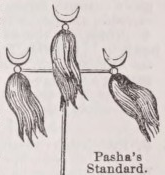
An honorary title given to officers of high rank in Turkey, as to governers of provinces, military commanders, etc. The earlier form was bashaw.
Alt. of Pasigraphical
Of or pertaining to pasigraphy.
A system of universal writing, or a manner of writing that may be understood and used by all nations.
Term Roget’s Thesaurus §71
N. term, rank, station, stage, step, degree, scale, remove, grade, link, peg, round of the ladder, status, position, place, point, mark, pas, period, pitch, stand, standing, footing, range
V. hold a place, occupy a place, find a place, fall into a place, 3, collective order
Repute Roget’s Thesaurus §873
N. distinction, mark, name, figure, repute, reputation, good repute, high repute, note, notability, notoriety, eclat, "the bubble reputation", vogue, celebrity, fame, famousness, renown, popularity, aura popularis, approbation, credit, succes d'estime, prestige, talk of the town, name to conjure with, glory, honor, luster, illustriousness, account, regard, respect, reputableness, respectability, good name, good report, fair name, dignity, stateliness, solemnity, grandeur, splendor, nobility, majesty, sublimity, rank, standing, brevet rank, precedence, pas, station, place, status, position, position in society, order, degree, baccalaureate, locus standi, caste, condition, greatness, eminence, height, importance, preeminence, supereminence, high mightiness, primacy, top of the ladder, top of the tree, elevation, ascent, superaltation, exaltation, dignification, aggrandizement, dedication, consecration, enthronement, canonization, celebration, enshrinement, glorification, hero, man of mark, great card, celebrity, worthy, lion, rara avis, notability, somebody, classman, man of rank, pillar of the state, pillar of the church, pillar of the community, chief, first fiddle, cynosure, mirror, flower, pink, pearl, paragon, choice and master spirits of the age, elite, star, sun, constellation, galaxy, ornament, honor, feather in one's cap, halo, aureole, nimbus, halo of glory, blaze of glory, blushing honors, laurels, memory, posthumous fame, niche in the temple of fame, immortality, immortal name, magni nominis umbra
V. be conscious of glory, be proud of, exult, be vain of, be distinguished, shine, shine forth, figure, cut a figure, make a dash, make a splash, rival, surpass, outshine, outrival, outvie, outjump, emulate, eclipse, throw into the shade, cast into the shade, overshadow, live, flourish, glitter, flaunt, gain honor, acquire honor, play first fiddle, bear the palm, bear the bell, lead the way, take precedence, take the wall of, gain laurels, win laurels, gain spurs, gain golden opinions, take one's degree, pass one's examination, make a noise, make some noise, make a noise in the world, leave one's mark, exalt one's horn, blow one's horn, star it, have a run, be run after, come into vogue, come to the front, raise one's head, enthrone, signalize, immortalize, deify, exalt to the skies, hand one's name down to posterity, consecrate, dedicate to, devote to, enshrine, inscribe, blazon, lionize, blow the trumpet, crown with laurel, confer honor on, reflect honor on, shed a luster on, redound to one's honor, ennoble, give honor to, do honor to, pay honor to, render honor to, honor, accredit, pay regard to, dignify, glorify, sing praises to, lock up to, exalt, aggrandize, elevate, nobilitate
Adj. distinguished, distingue, noted, of note, honored, popular, fashionable, in good odor in, favor, in high favor, reputable, respectable, creditable, remarkable, notable, notorious, celebrated, renowned, ion every one's mouth, talked of, famous, famed, far-famed, conspicuous, to the front, foremost, in the front rank, in the ascendant, imperishable, deathless, immortal, never fading, aere perennius, time honored, illustrious, glorious, splendid, brilliant, radiant, bright, full-blown, honorific, eminent, prominent, high, in the zenith, at the head of, at the top of the tree, peerless, of the first water, superior, supereminent, preeminent, great, dignified, proud, noble, honorable, worshipful, lordly, grand, stately, august, princely, imposing, solemn, transcendent, majestic, sacred, sublime, heaven-born, heroic, sans peur et sans reproche, sacrosanct
Phr. one's name being in every mouth, one's name living for ever, sic itur ad astra, fama volat, aut caesar aut nullus, not to know him argues oneself unknown, none but himself could be his parallel, palmam qui meruit ferat, "above all greek above all roman fame", - cineri gloria sera est, "great is the glory for the strife is hard", honor virtutis praemium, immensum gloria calcar habet, "the glory dies not and the grief is past", vivit post funera virtus
King James Bible KJV Bible
Berean Standard Bible BSB Bible
1,312 KJV and 535 BSB verses contain “pas” — showing the first 20. Show all 1,521 verses (searchable)
And it came to pass, when men began to multiply on the face of the earth, and daughters were born unto them,
Now when men began to multiply on the face of the earth and daughters were born to them,
And it came to pass after seven days, that the waters of the flood were upon the earth.
And after seven days the floodwaters came upon the earth.
And God remembered Noah, and every living thing, and all the cattle that was with him in the ark: and God made a wind to pass over the earth, and the waters asswaged;
And it shall come to pass, when I bring a cloud over the earth, that the bow shall be seen in the cloud:
Whenever I form clouds over the earth and the rainbow appears in the clouds,
And it came to pass, when he was come near to enter into Egypt, that he said unto Sarai his wife, Behold now, I know that thou art a fair woman to look upon:
As he was about to enter Egypt, he said to his wife Sarai, “Look, I know that you are a beautiful woman,
Therefore it shall come to pass, when the Egyptians shall see thee, that they shall say, This is his wife: and they will kill me, but they will save thee alive.
and when the Egyptians see you, they will say, ‘This is his wife.’ Then they will kill me but will let you live.
And it came to pass in the days of Amraphel king of Shinar, Arioch king of Ellasar, Chedorlaomer king of Elam, and Tidal king of nations;
In those days Amraphel king of Shinar, Arioch king of Ellasar, Chedorlaomer king of Elam, and Tidal king of Goiim
And said, My Lord, if now I have found favour in thy sight, pass not away, I pray thee, from thy servant:
“My lord,” said Abraham, “if I have found favor in your sight, please do not pass your servant by.
And I will fetch a morsel of bread, and comfort ye your hearts; after that ye shall pass on: for therefore are ye come to your servant. And they said, So do, as thou hast said.
And I will bring a bit of bread so that you may refresh yourselves. This is why you have passed your servant’s way. After that, you may continue on your way.” “Yes,” they replied, “you may do as you have said.”
And it came to pass, when they had brought them forth abroad, that he said, Escape for thy life; look not behind thee, neither stay thou in all the plain; escape to the mountain, lest thou be consumed.