Plane
[Noun]
Webster's Dictionary 1828
1. In geometry, an even or level surface, like plain in popular language.
2. In astronomy, an imaginary surface supposed to pass through any of the curves described on the
celestial sphere; as the plane of the
ecliptic; the plane of a planet's orbit; the plane of a great circle.
4. In
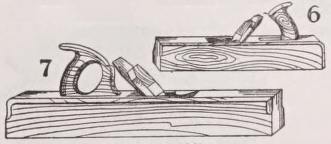
joinery and cabinet work, an instrument consisting of a smooth piece of wood, with an aperture, through which passes obliquely a piece of edged steel or
chisel, used in paring or smoothing boards or wood of any kind.
Plane
[Verb transitive]
Webster's Dictionary 1828
1. To make smooth; to
pare off the
inequalities of the surface of a board or other piece of wood by the use of a plane
Plane
[Adjective]
Webster's Dictionary 1913
1. Without elevations or depressions; even; level; flat; lying in, or constituting, a plane; as, a plane surface.
2. A surface, real or imaginary, in which, if any two points are taken, the straight line which joins them lies wholly in that surface; or a surface, any section of which by a like surface is a straight line; a surface without curvature.
3. An ideal surface, conceived as coinciding with, or containing, some designated astronomical line, circle, or other curve; as, the plane of an orbit; the plane of the
ecliptic, or of the equator.
4. A block or plate having a perfectly flat surface, used as a standard of flatness; a surface plate.
5. A tool for smoothing boards or other surfaces of wood, for forming moldings, etc. It consists of a smooth-soled stock, usually of wood, from the under side or face of which projects slightly the steel cutting edge of a
chisel, called the iron, which inclines backward, with an apperture in front for the escape of shavings; as, the
jack plane; the smoothing plane; the
molding plane, etc.
6. To make smooth; to level; to
pare off the
inequalities of the surface of, as of a board or other piece of wood, by the use of a plane; as, to plane a
plank.
Having opposite surfaces exactly plane and parallel, as a piece of glass.
A tree of the genus
Platanus. The oriental plane-tree is a native of Asia; it rises with a straight smooth branching stem to a great
highth, with
palmated leaves and long
pendulous peduncles,
sustaining several heads of small close sitting flowers. The seeds are
downy, and collected into round, rough, hard balls. The
occidental plane-tree which grows to a great
highth, is a native of noun America; it is called also
button-wood.
Planed
[Participle passive]
Webster's Dictionary 1828
Made smooth with a plane; leveled.
Planer
[Noun]
Webster's Dictionary 1913
1. One who, or that which, planes; a planing machine; esp., a machine for planing wood or metals.
2. A wooden block used for forcing down the type in a form, and making the surface even.
A small-leaved North American tree (Planera aquatica) related to the
elm, but having a wingless, nutlike fruit.
Planet
[Noun]
Webster's Dictionary 1828
A
celestial body which revolves about the sun or other center, or a body revolving about another planet as its center. The planets which
revolve about the sun as their center, are called primary planets; those which
revolve about other planets as their center, and with them
revolve about the sun, are called secondary planets, satellites or moons. The primary planets are named Mercury, Venus, Earth,
Mars, Jupiter,
Saturn and Herschell. Four smaller planets,
denominated by some,
asteroids, namely,
Ceres,
Pallas,
Juno and
Vesta, have recently been discovered between the orbits of
Mars and Jupiter.
Mars, Jupiter,
Saturn and Herschell, being without the earth's orbit, are sometimes called the superior planets; Venus and Mercury, being within the earth's orbit, are called inferior planets. The planets are
opake bodies which receive their light from the sun. They are so named from their motion or revolution, in distinction from the fixed stars, and are distinguished from the latter by their not
twinkling.
Planet
[Noun]
Webster's Dictionary 1913
1. A
celestial body which revolves about the sun in an orbit of a moderate degree of
eccentricity. It is distinguished from a
comet by the absence of a
coma, and by having a less
eccentric orbit. See Solar system.
2. A star, as influencing the fate of a men.
Affected by the influence of planets; blasted.
Affected by the influence of planets; blasted.
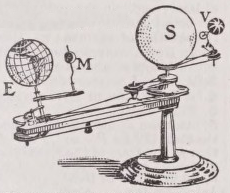
An astronomical machine which, by the movement of its parts, represents the motions and orbits of the planets, agreeable to the
Copernican system.
Planetary
[Adjective]
Webster's Dictionary 1828
1. Pertaining to the planets; as planetary inhabitants; planetary motions.
2. Consisting of planets; as a planetary system.
3. Under the dominion or influence of a planet; as a planetary hour. [
Astrology.]
4. Produced by planets; as planetary plague or influence.
5. Having the nature of a planet;
erratic or revolving.
6. Planetary days, the days of the week as shared among the planets, each having its day, as we name the days of the week after the planets.
Planetary
[Adjective]
Webster's Dictionary 1913
1. Of or pertaining to the planets; as, planetary inhabitants; planetary motions; planetary year.
2. Consisting of planets; as, a planetary system.
3. Under the dominion or influence of a planet.
4. Caused by planets.
5. Having the nature of a planet;
erratic; revolving; wandering.
Pertaining to planets. [Not used.]
Of or pertaining to planets.
A body resembling a planet; an
asteroid.