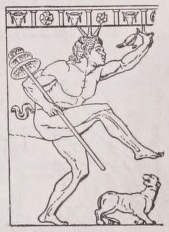
In mythology, a sylvan deity or demi-god, represented as a monster, half man and half goat, having horns on his head, a hairy body, with the feet and tail of a goat. Satyrs are usually found in the train of Bacchus, and have been distinguished for lasciviousness and riot. They have been represented as remarkable for their piercing eyes and keen raillery.
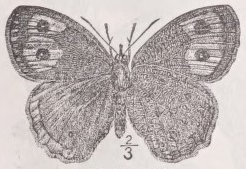
2. Any one of many species of butterflies belonging to the family Nymphalidae. Their colors are commonly brown and gray, often with ocelli on the wings. Called also meadow browns.
SATYR. In ancient Greek mythology the satyrs were spirits, half-human half-bestial, that haunted the woods and mountains, companions of Pan and Dionysus. Fancy represented them as strongly built, with flat noses, pointed ears, and the tails of horses or goats. They were a roguish and wanton but faint-hearted folk, lovers of wine and women, ever roaming the wild to the music of pipes and cymbals, castanets and bagpipes, dancing with the nymphs or pursuing them, striking terror into men, whose cattle they killed and whose women they made love to. In the earlier Greek art they appear as old aud ugly, much like wild apes; but in later art, especially in works of the Attic school, this savage character is softened into a more youthful and graceful aspect. There is a famous statue supposed to be a copy of a work of Praxiteles, representing a graceful satyr leaning against a tree with a flute in his hand. In Attica there was a species of drama known as the Satyric drama; it parodied the legends of gods and heroes, and the chorus was composed of satyrs. Euripides’s play of the Cyclops is the only extant example of this kind of drama. The symbol of the shy and timid satyr was the hare. In some districts of modern Greece the spirits known as Calicantsars offer points of resemblance to the ancient satyrs; they have goats’ ears and the feet of asses or goats, are covered with hair, and love women and the dance. The herdsmen of Parnassus believe in a demon of the mountain who is lord of hares and goats....
In the Authorized Version of Isa. xiii. 21, xxxiv. 14 the word “satyr” is used to render the Hebrew sè'îirîm, “hairy ones.” A kind of demon or supernatural being known to Hebrew folk-lore as inhabiting waste places is meant; a practice of sacrificing to the se'îrîm is alluded to in Lev. xvii. 7,'where E. V. has “devils.” They correspond to the “shaggydemon of the mountain-pass” (azabb al-'akaba) of old Arab superstition. But the satyrs of the gloomy Semitic deserts, faith in which is not yet extinct, are much more terrible than those of Greece.
9th ed. Encyclopædia Britannica, vol. 21, p. 322 [376 words — estimated reading time: 3 minutes]
But wild beasts of the desert shall lie there; and their houses shall be full of doleful creatures; and owls shall dwell there, and satyrs shall dance there.
But desert creatures will lie down there, and howling creatures will fill her houses. Ostriches will dwell there, and wild goats will leap about.
The wild beasts of the desert shall also meet with the wild beasts of the island, and the satyr shall cry to his fellow; the screechowl also shall rest there, and find for herself a place of rest.
The desert creatures will meet with hyenas, and one wild goat will call to another. There the night creature will settle and find her place of repose.
This site uses cookies to remember your display preferences (search sources and editions, Bible version, auto-link, images, light/dark theme). No personal data whatsoever is collected. Privacy Policy