
An animal or quadruped of the genus Capra. The horns are hollow, turned upwards, erect and scabrous. Goats are nearly of the size of sheep, but stronger, less timid and more agile. They delight to frequent rocks and mountains, and subsist on scanty coarse food. The milk of the goat is sweet, nourishing and medicinal, and the flesh furnishes provisions to the inhabitants of countries where they abound.
Word of the Day: Catachrestical
Goat
Encyclopedia Britannica
GOAT. All the species of the genus Capra may be divided into two classes, the one being represented by the ibex (see Icex) and the other the goat. The latter class is subdivided into the aegagrus or wild goat (C⅛>ra aegagrus) and the domestic goat {Capra hircus), of which there are many varieties....
The Wild Goat, or Paseng of the Persians {Capra oegagrus, Pall.), is an inhabitant of the mountainous regions of Central Asia from the Caucasus to the Himalayas, and is occasionally met with in troops at great elevations. It stands somewhat higher than any of the domesticated varieties of the goat, from which it further differs in its stouter limbs and more slender body. Its neck is short, and is thus fitted to bear the enormous horns, which in the male are larger proportionally than in any other ruminant animal. These measure nearly three feet in length, are obscurely triaugular in form, transversely ridged, and are bent backward as in the domestic varieties. The wild goat of the Himalayas, according to Darwin, when it happens to fall accidentally from a height, makes use of its massive horns by bending forward its head and alighting on them, thus breaking the shock. In the female the horns are exceedingly diminutive, or are altogether awarding. The fur, which over the greater part of the body is short, is of a greyish-brown colour, with a black line running along the entire length of the back; the short tail and the muzzle are also black, while the under surface of the neck, and the beard, which is present in both sexes, are of a brown colour. The paseng is exceedingly wary of the approach of man, and as its agility is no less remarkable there has been little opportunity of studying it closely. The concretions known as l>ezoar-stones, which were formerly much used in medicine and as antidotes of poison, are believed to have been originally obtained from the intestines of this species.
Considerable diversity of opinion-has been expressed by naturalists as to the original stock of the domestic goat, which is met with in nearly every quarter of the globe,— the now prevalent and the most probable opinion being that the various domestic breeds are severally descended from wild stock now extinct. Both the ibex and the aegagrus interbreed freely with the common goat, though the produce is not always fertile. Instances of this are not unusual in the Alps and Pyrenees, where goats abound in a semi-domesticated state. Hybrids between the goat and the sheep are also known to have occurred, but are rare.
The following are the chief domestic breeds, possessing distinct characteristics :—the Common Goat, the Maltese, the Syrian, the Angora, the Cashmere, the Nubian or Egyptian, and the Dwarf Goat of Guinea.
The Common Goat.— This has many varieties which differ from each other in length of hair, in colour, and slightly in the configuration of the horns. The ears are more or less upright, sometimes horizontal, but never actually pendent, as in some Asiatic breeds. The horns are rather flat at the base and not unfrequently corrugated; they rise vertically from the head, curving to the rear, and are more or less laterally inclined. The colour varies from a dirty white to a dark-brown, but never black, which indicates Eastern blood. Most of the European countries possess more than one description of the common goat. In the British Isles there are two distinct types, one short and the other long haired. In the former case the lιair is thick and close, with frequently an undercoat resembling wool. The horns are large in the male, and of moderate size in the female, flat at the base and inclining outwards. The head is short and tapering, the forehead flat and wide, and the nose small; the legs strong, thick, and well covered with hair. The colour varies from white or grey to black, but is frequently fawn, with a dark line down the spine and across the shoulders. The other variety owns a shaggy coat, generally of a reddish-black hue, though sometimes grey or pied and occasionally white. The head is long, heavy, and ugly, the nose coarse and prominent, the horns are situated close together, and often continue parallel almost to the extremities, being also large, corrugated, and pointed. The legs are long, and the sides flat, the animal itself being generally gaunt and thin. This breed is peculiar to Ireland, the Welsh being of a similar description, but more often white. The short-haired goat is the English goat proper. From the constant crossing however that takes place between these native breeds and imported foreign specimens, one meets in England with animals possessing very great diversity of form. Both the British breeds and those from abroad are frequently ornamented with two peculiar tassel-like appendages, which hang near together under the throat. It is supposed by many that these ornaments are traceable to some foreign origin; but although there are foreign breeds that possess them, they appear to pertain quite as much to the English native breeds as to those of distant countries, and indeed the peculiarity referred to is mentioned in very old works that describe the goats of the British Islands. The milk produce in the common goat as well as other kinds varies very greatly with individuals. Irish goats often yield a quantity of milk, but the quality is comparatively poor. The goats of France are very similar to those of Britain, varying in length of hair, colour, and character of horns. A French writer describes them as possessing “a particularly neat and compact head, small mouth, horns corrugated, and inclining upwards and outwards, a thin neck, narrow chest, and long body, long but muscular legs, and in colour white, black, fawn, or pied.” The Norway breed is frequently pure white with long hair; it is rather small in size, with small bones, a short rounded body, head small with a prominent forehead, and short, straight, corrugated horns. The facial line is concave. The horns of the male are very large, and curl round after the manner of the wild goat, with a tuft of hair between and in front.
The Maltese Goat has its ears long and wide and perfectly pendulous, hanging down below the jaw. The hair is long and cream-coloured. Specimens of this kind are usually hornless, which is perhaps the cause of it having been called the “Hornless Variety.” It would appear, however, that the absence of these appendages is simply a freak of nature, and not the peculiar characteristic of a particular species.
The Syrian Goat.— This breed is met with in various parts of the East, in Lower Egypt, on the shores of the Indian Ocean, and in the island of Madagascar. Both its hair and ears are excessively long, the latter so much so that they are sometimes dipt to prevent their being torn by stones or thorny shrubs. Its horns are somewhat erect and spiral, with an outward bend.
The Angora Goat is often confounded with the Cashmere, but is in reality quite distinct from it. The principal feature of this breed, of which there are two or three varieties, is the length and quantity of its hair, which has a particularly soft and silky texture, covering the whole body and a great part of the legs with close matted ringlets. The horns of the male differ from those of the female, being directed vertically and in shape spiral, whilst in the female they have a horizontal tendency, somewhat like those of a ram. The face has a sheepish expression. The coat is composed of two kinds of hair, the one short and coarse and of the character of hair, which lies close to the skin, the other long and curly and of the nature of wool, forming the outer covering. Both are used by the manufacturer, but the exterior portion, which makes up by far the greater bulk, is much the more valuable. The process of shearing takes place in early spring, and is conducted with the utmost care; the average amount of wool yielded by each animal is about 2⅜ lb. The best quality comes from castrated males, the females producing the next best. The annual export of wool from Angora is estimated at about 2,000,000 lb, and its value at £200,000. Large herds are shipped at Constantinople and sent to Cape Colony, where this breed thrives well and is largely propagated, the climate being specially suitable to the perfect development of the wool. A very valuable consignment of these animals arrived in London in May 1879 for transshipment to the Cape, having been procured from different parts of Asia Minor, by means of great personal exertion, by Mr J. B. Evans, a SouthAfrican goat farmer. The wool, or mohair, as it is technically termed, of these goats was remarkably long, fine, and heavy, the average weight of the produce of the herd being reckoned at 6 11) per head. So highly is this breed esteemed by the Turkish farmers that it was with the greatest reluctance they were induced to sell them, and then only at exorbitant prices, some of the males costing £250 and females £150. £50 and £60 are common prices for these goats at Angora. Fig. 1 is from a photograph of the finest male of the flock, the fleece of which was estimated to weigh when shorn full 15 lb. The breed was introduced at the Cape about 1864. In 1878, according to the customs returns, 1,300,585 lb weight of mohair was exported, of the value of £105,313. The Angora is a bad milker and an indifferent mother, but its flesh is better eating than that of any other breed, and in its native country is preferred to mutton. The kids are born very small, but grow fast, and arrive early at maturity. This variety of the goat approaches nearest in its nature, form, and habits to the sheep, even the voice having a strong resemblance.
The Cashmere Goat.— This animal has a delicate head, with semi-pendulous ears, which are both long and wide. The hair varies in length, and is coarse and of different colours according to the individual. The horns are very erect, and sometimes slightly spiral, inclining inwards and to such an extent in some cases as to cross. The coat is composed, as in the Angora, of two materials; but in this breed it is the under coat that partakes of the nature of wool and is valued as an article of commerce. This undergrowth, which is of a uniform greyish-white tint, whatever the colour of the hair may be, is beautifully soft and silky, and of a fluffy description resembling down. It makes its appearance in the autumn, and continues to grow until the following spring, when if not removed, it falls off naturally; its collection then commences, occupying from eight to ten days. The animal undergoes during that time a process of combing by which all the wool and a portion of the hair, which of necessity comes with it, is removed. The latter is afterwards carefully separated, when the fleece in a good specimen weighs about half a pound, being worth between half to three quarters of a rupee. It is sold by the “turruk” of 12 lb. This is the material of which the far-famed and costly shawls are made, which at one time had such a demand that, it is stated, “16,000 looms were kept in constant work at Cashmere in their manufacture.” Those goats having a short, neat head, very long, thin ears, a delicate skin, small bones, and a long heavy coat, are for this purpose deemed the best. There are several varieties possessing this valuable quality, but those of Cashmere, Thibet, and Mongolia are the most esteemed. About the year 1816 a small herd of Cashmeres was introduced into France with a view to acclimatize and breed them for the sake of their wool, but the enterprise failed. A few were purchased and brought over to England by Mr C. T. Tower, who, by careful treatment, so far succeeded with them that, in course of time, he had a shawl made from their fleece, which turned out to be of good quality. At the death of the owner some years later, the herd, which had then deteriorated through in-breeding, was presented to the Queen and placed in Windsor Park.
The Nubian Goat, which is met with in Nubia, Upper Egypt, and Abyssinia, differs greatly in appearance from all those previously described. The coat is in the female extremely short, almost like that of a race-horse, and the legs are very long. This breed therefore stands considerably higher than the common goat. One of its peculiarities is the strongly convex shape of the face, the forehead being very prominent and the nostrils sunk in, the nose itself extremely small, and the lower lip projecting from the upper. The ears are long, broad, and thin, and hang down by the side of the head like a “double lop ’’ rabbit. The horns are quite black, slightly twisted, and very short, flat at the base, pointed at the tips, and recumbent on the head. But little was known of this breed in Europe—in the West at least—until some ten or twelve years ago, when some were imported into France by the Société d’Acclimatation of Paris, who found its milking qualities to surpass those of all other breeds. Among the goats that are met with in England a good many show unmistakable signs of a more or less remote cross with this breed, derived probably from specimens brought from the East on board ships for supplying milk during the voyage. It is no doubt on this account that they often go by the name of “Indian” goats.
The N^epaul Goat appears to be a variety of the last breed, it having the same arched facial line, pendulous ears, and long legs. The horns, however, are more spiral. The colour of the hair, which is longer than in the Nubian, is black, grey, or white, with black blotches.
The Guinea Goat is a dwarf species originally from the coast whence its name is derived. There are three varieties. Besides the commonest (Capra recurva, Linn.), there is a rarer breed (Capra depressa, Linn.), inhabiting the Mauritius and the islands of Bourbon and Madagascar. The other variety is met with along the White Nile, in Lower Egypt, aud at various points on the African coast of the Mediterranean. Some of these dwarf goats may be seen at the Jardin d’Acclimatation in Paris.
Habits and Management.— The milch goat has been aptly described as the “poor man’s cow ”—a designation it well merits, for with a couple of these animals the cottager may at an almost nominal expense enjoy the same advantages in a domestic point of view as the rich man with his “Alderney.” Comparatively few are kept in England, because the advantages of goat-keeping are but very imperfectly known, and also on account of the large proportion of land under cultivation. The goat in a state of nature frequents hills and mountainous places, and in a domesticated condition it generally gives preference to elevated situations; but it is a mistake to suppose that it will not thrive on low ground. Being naturally adapted to rocks and dry soils, however, it should not be exposed in marshy places, as this brings on disease of the feet and general ill health; otherwise there is no animal more uniformly hardy. The common varieties will stand heat and cold equally well, but have a decided objection to storms of wind and rain; when they are left to roam loose, therefore, a rough shed should be erected to shelter them from the weather. Under this arrangement a goat may be left out day and night the whole year round; but, if it is kept for the sake of its milk, the yield is greater and it thrives better if housed during winter. Owing to the troublesome propensity of these animals to bark trees and destroy shrubs by nipping off all young and tender shoots, they should not be allowed to roam loose—except on a common—unless proper protection is afforded by wire netting or some such arrangement.
The goat breeds, generally speaking, but once a year. If well housed and under liberal treatment, it will bring forth young twice in twelve months; but this is not advisable. As a rule, at the first birth one kid only is produced, but afterwards two and sometimes three. One has been known for three consecutive years to drop four at a birth; but this is rare and by no means desirable, as the progeny are sure to be small and thrive badly,—the dam in most cases having insufficient milk for so large a family.
The goat propagates at a very early period of its life. The male is generally capable of engendering at seven months; and, in the case just referred to of four at a birth, the father on one occasion was barely six months old. One is sufficient for a hundred females. The latter bring forth at twelve months, and sometimes earlier. For the sake of the future growth and productiveness of the animal, however, it is unwise to permit intercourse between the sexes earlier than at eighteen or at least sixteen months. It is owing to the baneful practice of letting them breed as soon as they will, uuder the mistaken idea that a more rapid return is obtained, that so many diminutive specimens are met with, both dam and progeny being spoiled in consequence.
The best kind for milch purposes are those with long and deep bodies, not necessarily so broad at the chest as about the haunches, the belly ample, and the legs tolerably short; head fine and tapering, with prominent eyes, ears long, thin, wide, and inclining horizontally, horns short and not corrugated, neck thick, and coat close and short. The udder above all must be not only large but soft and elastic, with nice pointed teats. Hornless specimens are often the best milkers.
The goat has 32 teeth, and by these the age up to five years may be pretty accurately ascertained. The lower jaw possesses 12 molars aud 8 incisors, and the upper 12 molars alone. The kid at its birth has G molars but no incisors; the latter, however, are generally all cut in about three weeks, the first cut molar being visible at three months. At a year or fifteen months old the two front “milk teeth,” as the first set of incisors are called, fall, and are replaced by permanent ones; the next two at from two years to thirty months, the third pair from two and a half to three and a half years, and the fourth and last at from three and a half to four and a half years. When all are changed the mouth is said to be “full.”
Between two and five years old the she-goat gives the best return in milk, continuing productive often for eight or nine years; its length of life is on an average from ten to fifteen. These animals vary very greatly in the quantity of milk they yield. An ordinary specimen gives from 2 to 3 pints, a superior one 2 quarts, and occasionally first-rate individuals are found supplying 3 quarts a day. The Nubian breed surpasses the common goat in this respect, as the following table from the French work of M. du Plessis will show, in which the yield of a Nubian is compared with that of a half-bred, itself a superior milker. [table]
The litre being as near as possible 1£ pints, the return in English measure is accordingly—from the half-bred 31 pints, or an average per day of 3 quarts, and from the pure Nubian 40 pints, or nearly 4 quarts daily, the richness of the quality being proportionately greater.
Milking slιould be performed at regular hours, morning and night; but with heavy milkers three times daily is better for the first two or three months, as the oftener the udder is emptied when once full the quicker it is replenished, a sufficient supply of food being of course provided. It is a good planto accustom the animal to jump on a platform whilst being milked; the teats are thus more easily manipulated, and more command is obtained over the goat and the pail. Feeding and milking should always be carried on at the same time.
Many persons are under the wrong impression that the milk of the she-goat,—which by the way has no strong hircine scent attaching to her like the male, another common error,—possesses a flavour peculiar to itself; but this is quite a mistake. Out of dozens kept by the present writer, only one has been found to yield milk differing from that of the...
9th ed. Encyclopædia Britannica, vol. 10, p. 708
[3,699 words — estimated reading time: 25 minutes]
[3,699 words — estimated reading time: 25 minutes]
Goat
Watson's Biblical & Theological Dictionary
עו. There are other names or appellations given to the goat, as, 1. השופ, 1 Kings xx, 27, which means the _ram-goat_, or leader of the flock. 2. עתודים, a word which never occurs but in the plural, and means, _the best prepared_, or choicest of the flock; and metaphorically _princes_, as, Zech. x, 3, “I will visit the goats, saith the Lord,” that is, I will begin my vengeance with the princes of the people. “Hell from beneath is moved for thee, to meet thee at thy coming; it stirreth up the dead for thee, even all the great goats of the earth,” Isaiah xiv, 9; all the kings, all the great men. And Jeremiah, speaking of the princes of the Jews, says, “Remove out of the midst of Babylon, and be as the he-goats before the flocks,” Jer. 1, 8. 3. צפיר, a name for the goat, of Chaldee origin, and found only in Ezra vi, 17; viii, 35; Daniel viii, 5, 21. 4. עואול, from עו, _a goat_, and אול, _to wander about_, Leviticus xvi, 8, “the scape-goat.” 5. שער, _hairy_, or _shaggy_, whence שעירים, “_the shaggy ones_.” In Lev. xvii, 7, it is said, “And they shall no more offer their sacrifices unto devils,” (_seirim_, “hairy ones,”) “after whom they have gone a whoring.” The word here means idolatrous images of goats, worshipped by the Egyptians. It is the same word that is translated _satyrs_, in Isaiah xiii, 21; where the LXX render it δαιμόνια, _demons_. But here they have ματαιοίς, _to vain things_ or _idols_, which comes to the same sense. What gives light to so obscure a passage is what we read in Maimonides, that the Zabian idolaters worshipped demons under the figure of goats, imagining them to appear in that form, whence they called them by the names of _seirim_; and that this custom, being spread ...among other nations, gave occasion to this precept. In like manner we learn from Herodotus, that the Egyptians of Mendes held goats to be sacred animals, and represented the god Pan with the legs and head of that animal. From those ancient idolaters the same notion seems to have been derived by the Greeks and Romans, who represented their Pan, their fauns, satyrs, and other idols, in the form of goats: from all which it is highly probable, that the Israelites had learned in Egypt to worship certain demons, or sylvan deities, under the symbolical figure of goats. Though the phrase, “after whom they have gone a whoring,” is equivalent in Scripture to that of committing idolatry, yet we are not to suppose that it is not to be taken in a literal sense in many places, even where it is used in connection with idolatrous acts of worship. It is well known that Baal-peor and Ashtaroth were worshipped with unclean rites, and that public prostitution formed a grand part of the worship of many deities among the Egyptians, Moabites, Canaanites, &c. The goat was one of the clean beasts which the Israelites might both eat and offer in sacrifice. The kid, גרי is often mentioned as a food, in a way that implies that it was considered as a delicacy. The אקו, or _wild goat_, mentioned Deut. xiv, 5, and no where else in the Hebrew Bible, is supposed to be the _tragelaphus_, or “goat-deer.” Schultens conjectures that this animal might have its name, _ob fugacitatem_, from its shyness, or running away. The word יעל, occurs 1 Sam. xxiv, 3; Job xxxix, 1; Psalm civ, 18; Prov. v, 19: and various have been the sentiments of interpreters on the animal intended by it. Bochart insists that it is the _ibex_, or “rock-goat.” The root whence the name is derived, signifies _to ascend_, _to mount_; and the ibex is famous for clambering, climbing, and leaping, on the most craggy precipices. The Arab writers attribute to the _jaal_ very long horns, bending backward; consequently it cannot be the chamois. The horns of the _jaal_ are reckoned among the valuable articles of traffic, Ezek. xxvii, 15. The ibex is finely shaped, graceful in its motions, and gentle in its manners. The female is particularly celebrated by natural historians for tender affection to her young, and the incessant vigilance with which she watches over their safety; and also for ardent attachment and fidelity to her mate.
Watson's Biblical & Theological Dictionary
[726 words — estimated reading time: 5 minutes]
[726 words — estimated reading time: 5 minutes]
An insect, a kind of beetle.
In ornithology, a fowl of the genus Caprimulgus, so called from the opinion that it would suck goats. It is called also the fern-owl. In Bailey, it is called a goat-milker.
A fish of the Mediterranean.
A fish of the genus Upeneus, inhabiting the Gulf of Mexico. It is allied to the surmullet.
One whose occupation is to tend goats.
One who tends goats.
1. Resembling a goat in any quality; of a rank smell.
2. Lustful.
In botany, a plant of the genus Tragopogon.
A plant of the genus Galega.
The greater goat's stones is the Satyrium; the lesser, the Orchis.
A plant of the genus Astragalus.
The skin of a goat.
Made of the skin of a goat.
The skin of a goat, or leather made from it.
One of several species of insectivorous birds, belonging to Caprimulgus and allied genera, esp. the European species (Caprimulgus Europaeus); -- so called from the mistaken notion that it sucks goats. The European species is also goat-milker, goat owl, goat chaffer, fern owl, night hawk, nightjar, night churr, churr-owl, gnat hawk, and dorhawk.
Goatsucker
Encyclopedia Britannica
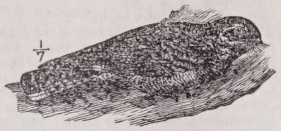
GOATSUCKER, a bird from very ancient times absurdly believed to have the habit implied by the common name it bears in many European tongues besides our own— as testified by the Greek hΛyoθfha<s, the Latin Caprimulgus, Italian Succiacapre, Spanish Chotαcabras, French Tettechèvre, and German Ziegenmelker. The common Goatsucker (Caprimulgus europoeus, Linn.), is admittedly the type of a very peculiar and distinct Family Caprimul- gidoe, a group remarkable for the flat head, enormously wide mouth, large eyes, and soft, pencilled plumage of its members, which vary in size from a Lark to a Crow. Its position has been variously assigned by systematists. Though of late years judiciously removed from the Passeres, in which Linnaeus placed all the species known to him, Professor Huxley considers it to form, with two other Families—the Swifts (Cypselidcd) and Humming-birds (Trochil·idce), the division Cypselomorphoe of his larger group Aegidhognathoe, which is equivalent in the main to the Linnaeau Passeres There are two ways of regarding the Caprimulgidoe — one including the genus Pοdargus and its allies, the other recognizing them as a distinct Family, Podargidce. As a matter of convenience we shall here comprehend these last in the Caprimulgidoe, which will then contain two subfamilies, Caprimulginoe and Podar-giηce ; for what, according to older authors, constitutes a third, though represented only by Sleatomis, the singular
Oil-bird, or Guacharo, certainly seems to require separation as an independent Family (see Guacharo)....
Some of the differences between the Caprimulginoe and Podargince have been pointed out by Mr Sclater (Proc. Zοol. Soc., 1866, p. 123), and are very obvious. In the former, the outer toes have four phalanges only, thus presenting a very uncommon character among birds, and the middle claws are pectinated; while in the latter the normal number of five phalanges is found, and the claws are smooth, and other distinctions more recondite have also been indicated by him (tom. cit., p. 582). The Caprinvulginae may be further divided into those having the gape thickly beset by strong bristles, and those in which there are few such bristles or none—the former containing the genera Capri mulgus, Antrostomus, Nyctidromus, and others, and the tatter Podager, Chordiles, Lyncornis, and a few more.
The common Goatsucker of Europe (C cziropoeus) arrives late in spring from its winter retreat in Africa, and its presence is soon made known to us by its habit of chasing its prey, consisting chiefly of moths and cockchafers, in the evening-twilight. As the season advances the song of the cock, from its singularity, attracts attention amid all rural sounds. This song seems to be always uttered when the bird is at rest, though the contrary has been asserted, and is the continuous repetition of a single burring note, as of a thin lath fixed at one end and in a state of vibration at the other, and loud enough to reach in still weather a distance of halfa-mile or more. On the wing, while toying with its mate, or performing its rapid evolutions round the trees where it finds its food, it has the habit of occasionally producing another and equally extraordinary sound, sudden and short, but somewhat resembling that made by swinging a thong in the air, though whether this noise proceeds from its mouth is not ascertained. In general its flight is silent, but at times when disturbed from its repose, its w ings may be heard to smite together. The Goatsucker, or, to use perhaps its commoner English name, Nightjar, passes the day in slumber, crouching on the ground or perching on a tree —in the latter case sitting not across the branch but lengthways, with its head lower than its body. In hot weather, however, its song may sometimes be heard by day and even at noontide, but it is then uttered, as it were, drowsily, and without the vigour that characterizes its crepuscular or nocturnal performance. Towards evening the bird becomes active, and it seems to pursue its prey throughout the night uninterruptedly, or only occasionally pausing for a few seconds to alight on a bare spot—a pathway or road— and then resuming its career. It is one of the few birds that absolutely make no nest, but lays its pair of beautifully-marbled eggs on the ground, generally where the herbage is short, and often actually on the soil. So light is it that the act of brooding, even where there is some vegetable growth, produces no visible depression of the grass, moss, or lichens on which the eggs rest, and the finest sand equally fails to exhibit a trace of the parental act. Yet scarcely any bird shows greater local attachment, and the precise site chosen one year is almost certain to be occupied the next. The young, covered when hatched with dark-spotted down, are not easily found, nor are they more easily discovered on becoming fledged, for their plumage almost entirely resembles that of the adults, being a mixture of reddish-brown, grey, and black, blended and mottled in a manner that passes description. They soon attain their full size and power of flight, and then take to the same manner of life as their parents. In autumn all leave their summer haunts for the south, but the exact time of their departure has hardly been ascertained. The habits of the Nightjar, as thus described, seem to be more or less essentially those of the whole Subfamily—the differences observable being apparently less than are found in other groups ot birds of similar extent.
A second species of Goatsucker (C ’. mιficollis'), which is somewhat larger, and has the neck distinctly marked with rufous, is a summer visitant to the south-western parts of Europe, and especially to Spain and Portugal. The occur, rence of a single example of this bird at Killingworth, near Newcastle-on-Tyne, in October 185G, has been recorded by Mr Hancock (Ibis, 1862, p. 39); but the season of its appearance argues the probability of its being but a casual straggler from its proper home. Many other species of Caprimulgus inhabit Africa, Asia, and their islands, while one (C. macrurus) is found in Australia. Very nearly allied to this genus is Antrostοnus, an American group containing many species, of which the Chuck-wilΓs-widow (A. carol inensis') and the Whip-poor-will (A. voci-ferus) of the eastern United States (the latter also reaching Canada) are familiar examples. Both these birds take their common name from the cry they utter, and their habits seem to be almost identical with those of the Old-World Goatsuckers. Passing over some other forms which need not here be mentioned, the genus Nyctidrοmus, though consisting of only one species (E. albicollis') which inhabits Central and part of South America, requires remark, since it has tarsi of sufficient length to enable it to run swiftly on the ground, while the legs of most birds of the Family are so short that they can make but a shuffling progress. Heleothrep>tfs, with the unique form of wing possessed by the male, needs mention. Notice must also be taken of two African species, referred by some ornithologists to as many genera (Macrodl·pteryx and Cos-metornis), though probably one genus would suffice for both. The males of each of them are characterized by the wonderful development of the ninth primary in either wing, which reaches in fully adult specimens the extraordinary length of 17 inches or more. The former of these birds, the C. macrodipterus of Afzelius, is considered to belong to the west coast of Africa, and the shaft of the elongated remiges is bare for the greater part of its length, retaining the web, in a spatulate form, only near the tip. The latter, to which the specific name of vexillarius was given by Mr Gould, has been found on the east coast of that continent, and is reported to have occurred in Madagascar and Socotra. In this the remigial streamers do not lose their barbs, and as a few of the next quills are also to some extent elongated, the bird, when flying, is said to look as though it had four wings. Specimens of both are rare in collections, and no traveller seems to have had the opportunity of studying the habits of either so as to suggest a reason for this marvellous sexual development.
The second group of Caprimulginoe, those which are but poorly or not at all furnished with rictal bristles, contains about five genera, of which there is here only room to particularize Lyncornis of the Old World and Chοrdiles of the New. The species of the former are remarkable for the tuft of feathers which springs from each side of the head, above and behind the ears, so as to give the bird an appearance like some of the “Horned” Owls—those of the genus Scops, for example; and remarkable as it is to find certain forms of two Families, so distinct as are the Strigidoe and the Caprimulgidoe, resembling each other in this singular external feature, it is yet more remarkable to note that in some groups of the latter, as in some of the former, a very curious kind of dimorphism takes place. In either case this has been frequently asserted to be sexual, but on that point doubt may fairly be entertained. Certain it is that in some groups of Goatsuckers, as in some groups of Owls, inclivi duals of the same species are found in plumage of two entirely different hues—rufous and grey. The only explanation as yet offered of this fact is that the difference is sexual, but, as just hinted, evidence to that effect is conflicting. It must not, however, be supposed that this com mon feature, any more than that of the existence of tufted forms in each group, indicates any close relationship between them. The resemblances may be due to the same causes, concerning which future observers may possibly enlighten us, but at present we must regard them as analogies not homologies. The species of Lyncornis inhabit the Malay Archipelago, one, however, occurring also in China Of Chordiles the best known species is the Night-hawk of North America (C*. virginianus or C. popetud), which has a wide range from Canada to Brazil. Others are found in the Antilles and in South America. The general habits of all these birds agree with those of the typical Goatsuckers.
We have next to consider the birds forming the genus Podargus and those allied to it, whether they be regarded as a distinct Family, or as a Subfamily of Caprimulgidoe. As above stated, they have feet constructed as those of birds normally are, and their sternum seems to present the constant though comparatively trivial difference of having its posterior margin elongated into two pairs of processes, while only one pair is found in the true Goatsuckers. Podargus includes the bird [P. cuνieri) known from its cry as Morepork to Tasmanian colonists, and several other species, the number of which is doubtful, from Australia and New Guinea. They have comparatively powerful bills, and it would seem feed to some extent on fruits and berries, though they mainly subsist on insects, chiefly Cicadoe and Phasmidoe. They also differ from the true Goatsuckers in having the outer toes partially reversible, and they are said to build a flat nest on the horizontal branch of a tree for the reception of their eggs, which are of a spotless white. Apparently allied to Podargus, but differing among other respects in its mode of nidification, is Aegotheles, which belongs also to the Australian Subregion; and further to the northward, extending throughout the Malay Archipelago and into India, comes Batrachostomus, wherein we again meet with species having aural tufts somewhat like Lyηcomis. The Podar-gin<x are thought by some to be represented in the New World by the genus Nyctibius, of which several species occur from the Antilles and Central America to Brazil. Finally, it maybe stated that none of the Caprimulgidoe seem to occur in Polynesia or in New Zealand, though there is scarcely any other part of the world suited to their habits in which members of the Family are not found, (a. n.)
9th ed. Encyclopædia Britannica, vol. 10, p. 711
[2,055 words — estimated reading time: 12 minutes]
[2,055 words — estimated reading time: 12 minutes]
Leap Roget’s Thesaurus §309
N. leap, jump, hop, spring, bound, vault, # saltation, ance, caper, curvet, caracole, gambade|, gambado|, capriole, demivolt, buck, buck jump, hop skip and jump, falcade, kangaroo, jerboa, chamois, goat, frog, grasshopper, flea, buckjumper, wallaby
V. leap, jump up, jump over the moon, hop, spring, bound, vault, ramp, cut capers, trip, skip, dance, caper, buck, buck jump, curvet, caracole, foot it, bob, bounce, flounce, start, frisk, jump about, trip it on the light fantastic toe, trip the light fantastic, dance oneself off one's legs, dance off one's shoes
Adv. on the light fantastic toe
Phr. di salto in salto
Libertine Roget’s Thesaurus §962
N. libertine, voluptuary, rake, debauchee, loose fish, rip, rakehell, fast man, intrigant, gallant, seducer, fornicator, lecher, satyr, goat, whoremonger, paillard, adulterer, gay deceiver, lothario, don juan, bluebeard, chartered libertine, adulteress, advoutress, courtesan, prostitute, strumpet, harlot, whore, punk, fille de joie, woman, woman of the town, streetwalker, cyprian, miss, piece, frail sisterhood, demirep, wench, trollop, trull, baggage, hussy, drab, bitch, jade, skit, rig, quean, mopsy, slut, minx, harridan, unfortunate, unfortunate female, unfortunate woman, woman of easy virtue, wanton, fornicatress, jezebel, messalina, delilah, thais, phryne, aspasia, lais, lorette, cocotte, petite dame, grisette, demimonde, chippy*, sapphist, spiritual wife, white slave, concubine, mistress, doxy, chere amie, bona roba, pimp, procurer, pander, pandar, bawd, conciliatrix, procuress, mackerel, wittol|, 5, institutions
King James Bible KJV Bible
Berean Standard Bible BSB Bible
132 KJV and 155 BSB verses contain “goat” — showing the first 20. Show all 160 verses (searchable)
And he said unto him, Take me an heifer of three years old, and a she goat of three years old, and a ram of three years old, and a turtledove, and a young pigeon.
And the LORD said to him, “Bring Me a heifer, a goat, and a ram, each three years old, along with a turtledove and a young pigeon.”
And she put the skins of the kids of the goats upon his hands, and upon the smooth of his neck:
She also put the skins of the young goats on his hands and on the smooth part of his neck.
And he removed that day the he goats that were ringstraked and spotted, and all the she goats that were speckled and spotted, and every one that had some white in it, and all the brown among the sheep, and gave them into the hand of his sons.
This twenty years have I been with thee; thy ewes and thy she goats have not cast their young, and the rams of thy flock have I not eaten.
I have been with you for twenty years now. Your sheep and goats have not miscarried, nor have I eaten the rams of your flock.
Two hundred she goats, and twenty he goats, two hundred ewes, and twenty rams,
200 female goats, 20 male goats, 200 ewes, 20 rams,
And Judah said, Let her take it to her, lest we be shamed: behold, I sent this kid, and thou hast not found her.
“Let her keep the items,” Judah replied. “Otherwise we will become a laughingstock. After all, I did send her this young goat, but you could not find her.”
Your lamb shall be without blemish, a male of the first year: ye shall take it out from the sheep, or from the goats:
Your lamb must be an unblemished year-old male, and you may take it from the sheep or the goats.
An altar of earth thou shalt make unto me, and shalt sacrifice thereon thy burnt offerings, and thy peace offerings, thy sheep, and thine oxen: in all places where I record my name I will come unto thee, and I will bless thee.
You are to make for Me an altar of earth, and sacrifice on it your burnt offerings and peace offerings, your sheep and goats and cattle. In every place where I cause My name to be remembered, I will come to you and bless you.
And blue, and purple, and scarlet, and fine linen, and goats hair,
blue, purple, and scarlet yarn; fine linen and goat hair;
And thou shalt make curtains of goats’ hair to be a covering upon the tabernacle: eleven curtains shalt thou make.
You are to make curtains of goat hair for the tent over the tabernacle—eleven curtains in all.
And blue, and purple, and scarlet, and fine linen, and goats’ hair,
blue, purple, and scarlet yarn; fine linen and goat hair;