HARE, the common name of all the species, excepting the rabbit, of Leporidoe, a family of rodent mammals, distinguished from the rest of that order by the possession of four incisor teeth in the upper jaw, two in front, which are well developed and longitudinally grooved, and two exceedingly small ones behind. The molars are formed for the mastication of vegetable food, an uneven surface being produced by the presence of transverse enamel plates which are worn down more slowly than the intermediate dentine. The teeth are without permanent roots, and thus the constant waste at the surface is compensated for by continuous growth at the opposite extremity. Hares all possess long ears, and in most species the hind legs are much longer than those in front. They are without exception timid, defenceless animals, although during the breeding season two males have been known to fight together for possession of the female until one was killed; while all the species are protectively coloured. They form a single genus {Lepus), containing from thirty-five to forty species according as certain forms are regarded as independent species, or merely as geographical varieties. They occur in all the great zoological regions of the world, but are especially characteristic of the northern and temperate areas of both hemispheres....
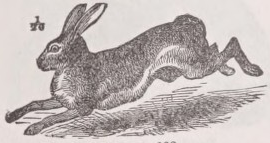
The common hare {Lepus timidus, fig. 1) is a typical example of the family. The ears in this species are longer than the head, and its hind legs are so long in comparison with those in front, that it is only by descending a hill diagonally that it can avoid overbalancing itself. It is found in all parts of Europe except the north of Russia, the Scandinavian peninsula, and Ireland, and is specially abundant in those countries in which it enjoys the protection of game laws. Its fur is usually of a tawny grey colour above and white beneath, with the upper surface of the short tail and the tips-of the ears black. The colour of the fur, however, differs-considerably in different latitudes and at different seasons of the year, showing, for example, a tendency to become-white during winter in northern countries, while assuming a reddish-yellow hue in the more genial climate of southern Europe. On the strength mainly of such outward differences various species have been described, but these have been found to be so linked together by intermediate forms as to satisfy most naturalists that they are merely climatal varieties of one species. The hare is a night-feeding animal,, remaining during the day on its “Torrn,” as the slight depression is called which it makes in the open field,, usually among grass. This it leaves at nightfall to seek the fields of young wheat and other cereals whose tender herbage forms its favourite food. It is also fond of gnawing the bark of young trees, and thus often does great damage-to plantations. In the morning it returns to its form,, where it finds considerable protection in the close approach which the colour of its fur makes to that of its surroundings should it thus fail, however, to elude observation it depends for safety on its extraordinary fleetness. On the first alarm of danger it is said to sit erect and to reconnoitre, when it either seeks concealment by clapping close to the ground, or takes to instant flight. In the latter case its great speed,, and the cunning endeavours it makes to outwit its canine pursuers, form the chief attractions of coursing. The hare takes readily to the water, where it swims well; and Yarrell records an instance in which one was observed crossing an arm of the sea about a mile in width. Hares are remarkably prolific. They pair when scarcely a year old, and the female brings forth several broods in the year, each consisting of from two to five leverets (from the French lièvre), as. the young are called. These have their sight at birth, and after being suckled for a month they are able to look after themselves. In Europe this species has never been known to breed in confinement. The hare was well known to theancient Greeks and Romans.
In those parts where the common hare does not occur,, its place is taken by the varying or mountain hare {Lepus variabilis, fig. 2). It is found throughout the entirenorthern portion of the great Palaearctic region, from Ireland eastward to Japan, while it also occurs on the Pyrenees, the-Alps, the highlands of Bavaria and the Caucasus, although altogether absent in the less elevated regions which connect those mountain ranges. Its presence in such isolated situations in company with many truly arctic plants is regarded as one of the many proofs of a former glacial epoch, during which boreal plants and animals were spread all over southern and central Europe. On the advent, however, of milder climatic conditions, this northern flora and fauna retired towards the Arctic Circle, leaving a few species, such as the varying hare, behind on the various mountain ranges, where by ascending to a sufficient altitude the iiecessary boreal conditions could be obtained. The mountain hare differs from the preceding species in its ears .being shorter than its head, and in its fur becoming in most cases white in winter,—a change of colour which renders it almost invisible in the snow. Along the southern limit of its range, or in districts where the temperature is from any cause exceptionally mild, this change of colour either does not take place at all, as in Ireland, or is only partial, as in many parts of Scotland. In this respect it resembles the ermine, which it further resembles in having a part of its fur always remaining black; in the hare, however, it is the tips of the ears, and not the point of the tail, which thus remain unaltered. In Scotland, where it is known as the “blue hare,” it occurs plentifully throughout the hilly regions north of the Forth, where it descends to the low grounds in winter; while in Ireland it is the only hare found. Owing to the mildness of the climate, however, in the “Green Isle,” the colour of the fur undergoes little or no alteration in winter, and on this account it was until recently regarded by many as a distinct species {Lepus luibernicus). Throughout the Arctic regions of North America a closely allied species, the polar hare {Lepus glacialis), occurs. Naturalists have hitherto had considerable difficulty in distinguishing this from the preceding species, the chief difference being in the colour of the fur, which in the Polar hare is white all the year round, with the exception of the tips of the ears. Considerable light has, however, been thrown on this point by the observations of the naturalists attached to the late Arctic Expedition under Sir George Nares, who found this species inhabiting the shores of Grinnell Land, and obtained evidence in footprints on the snow of its existence in latitude 83° 10', about 20 miles north of the nearest land. Unlike all other hares, and resembling in this respect the rabbit, the polar hare would seem to occupy a burrow—“a hole,” says Captain Feilden, “4 feet in length, scraped horizontally into a snow drift.” “I have no doubt,” he continues, “the same burrow is regularly occupied, as this one was discoloured by the feet of the animal, and a quantity of hair was sticking to the sides.” Another point of importance in establishing the specific distinctness of this species from -the former lies in the difference in the number of young composing a brood in each of these species. The number of young found in gravid females by the naturalists already referred to varied from seven to eight, while in the varying hare of Europe the number does not exceed five. According to Captain Lyon, the polar hare is by no means a shy animal, as during his cruise in the Arctic seas hares were in the habit of coming out on the ice to his ships to feed on the tea leaves which were thrown overboard. This species has thus been found inhabiting the highest northern lands yet visited by man, where it also attains its normal weight of from 8 to 10 tt>., subsisting on the stoneworts and other hardy plants which form the scanty vegetation of circumpolar valleys. The American varying hare {Lepus amencanus) is one of the most widely distributed species of this family, extending, in one or other of its four geographical varieties, from the borders of the Arctic barren grounds southwards to New Mexico. It differs from the mountain hare of Europe in its smaller size and relatively smaller ears, but resembles it in the change of colour in the fur, especially of the northern varieties, during winter. It is exceedingly abundant on the banks of the Mackenzie River, where it is killed in great numbers by the Hare Indians. A favourite device among the Indians for catching it, according to Darwin, is to walk spirally round and round it, when on its form, especially at midday when the shadow of the hunter is shortest. It has still more implacable enemies, however, in the wolves, gluttons, and lynxes of those regions, of the last of which it is said to form the principal food. The fur of this species is imported into Great Britain, but it is of little value. In the swampy district of the south-eastern portion of the United States, the swamp hare {Lepus aquaticus) and the marsh hare {Leρus palustris) occur. These take readily to the water, and are said to dive for some distance, their legs being less thickly clothed with hair than are those of the less amphibious species. They feed chiefly on aquatic plants. Only one species of hare {Lepus brasiliensis) occurs in South America. It is found throughout Brazil, and on various parts of the Andes in Bolivia and Peru. Fossil remains of several species of Leporidae have been found in the Post-Glacial deposits and the bone-caves of Europe, while the remains of many extinct species have been lately discovered in the Miocene deposits of Dakota and Colorado. (j. gi.)
HARE, Julius Chakles (1795-1855), theological writer, was born at Valdagno, near Vicenza, in Italy, on the 13th of September 1795. He came to England with his parents in 1798, but in 1804-5 spent a winter with them at Weimar, where he met Goethe and Schiller, and received a bias to German literature which influenced his style and sentiments throughout his whole career. On the death of his mother in 1806, Julius was sent home to the Charterhouse in London, where he remained till 1812, when he entered Trinity College, Cambridge. There he became fellow in 1818, and after some time spent abroad he began to read law in London in the following year. In 1822 he was appointed assistant-tutor at Trinity College, which position he retained for ten years. Turning his attention from law to divinity, Hare took priest’s orders in 1826; and, on the death of his uncle in 1832, he succeeded to the rich family living of Hurstmonceaux in Sussex, where he accumulated a library of some 12,000 volumes, especially rich in German literature. Before taking up residence on his parish he once more went abroad, and made in Rome the acquaintance of the Chevalier Bunsen, who afterwards dedicated to him part of his work, Hippolytus and his Age. In 1840 Hare was appointed archdeacon of Lewes, and in the same year preached a course of sermons at Cambridge {The Victory of Faith), followed in 1846 by a second, The Mission of the Comforter. Neither series when published attained any great popularity. Archdeacon Hare married in 1844. In 1851 he was collated to a prebend in Chichester; and in 1853 he became one of the queen’s chaplains. He died January 23, 1855.
Julius Hare belonged to what has been called the “Broad Church party,” though some of his opinions approach very closely to those of the Evangelical Arminian school, while others again seem vague and undecided. He was one of the first of his countrymen to recognize and come under the influence of German thought and speculation, and, amidst an exaggerated alarm of German heresy, did much to vindicate the authority of the sounder German critics. His writings, which are chiefly theological and controversial, are largely formed of charges to his clergy, and sermons on different topics; but, though valuable and full of thought, they lose some of their force by the cumbrous German structure of the sentences, and by certain orthographical peculiarities in which the author indulged. In 1827 Guesses at Truth by Two Brothers appeared. Hare assisted Thirl wall, afterwards bishop of St David’s, in the translation of the 1st and 2d volumes of Niebuhr’s History of Rome (1828 and 1832), and published a Vindication of Niebuhr's History in 1829. He wrote many similar works, among which is a Vindication of Luther against his recent English Assailants, 1854. In 1848 he edited the Remains of John Sterling, who had formerly been his curate. Carlyle’s Life of John Sterling was written through dissatisfaction with the “Life” prefixed to Archdeacon Hare’s book. Memorials of a Quiet Life, published in 1872, contain accounts of the Hare family.