1. SHE , pronoun personal of the femininegender. [ She is perhaps the Heb. a woman or wife. Latin quoe .]
2. A pronoun which is a substitute for the name of a female, and of the femininegender; the word which refers to a female mentioned in the preceding or following part of a sentence or discourse.
An African sapotaceous tree (Bassia, / Butyrospermum, Parkii), from the seeds of which a substance resembling butter is obtained; the African butter tree.
2. A quantity of the stalks and ears of wheat, rye, or other grain, bound together; a bundle of grain or straw.
3. Any collection of things bound together; a bundle; specifically, a bundle of arrows sufficient to fill a quiver, or the allowance of each archer, -- usually twenty-four.
After the feast of the passover the Jews brought a sheaf into the temple, as the first fruits of the barley harvest, Lev. xxiii, 10, 12; and these were the ceremonies that were then performed. On the 16th of the month Nisan, in the evening, when the feast day of the passover was ended, and the second day was begun, which was a working day, the house of judgment deputed three men to go in solemnity, and gather the sheaf of barley. The inhabitants of the neighbouring cities came together, to be present at the ceremony. The barley was gathered in the territory of Jerusalem. The deputies demanded three times successively if the sun was set; and were as often answered that it was. Then they demanded three times if they might be permitted to cut the sheaf, and permission was as often granted. They reaped it out of three different fields, with three different sickels, and put the ears into three boxes to carry to the temple. This sheaf was threshed in the court; and of the grain they took a full omer, and after it had been winnowed, parched, and bruised, they sprinkled oil over it, and added a handful of incense; then the priest who received the offering, waved it before the Lord to the four quarters of the world, crosswise; he cast part of it upon the altar, and the rest was his own. After this every one might begin to reap the harvest.
2. To cut or clip something from the surface with an instrument of two blades; to separate any thing from the surface by shears, scissors or a like instrument; as, to shear sheep; to shear cloth. It is appropriately used for the cutting of wool from sheep on their skins, for clipping the nap from cloth, but may be applied to other things; as, a horse shears the ground in feeding much closer than an ox.
2. To become more or less completely divided, as a body under the action of forces, by the sliding of two contiguous parts relatively to each other in a direction parallel to their plane of contact.
5. To produce a change of shape in by a shear. See Shear, n., 4.
6. A pair of shears; -- now always used in the plural, but formerly also in the singular. See Shears.
7. A shearing; -- used in designating the age of sheep.
8. An action, resulting from applied forces, which tends to cause two contiguous parts of a body to slide relatively to each other in a direction parallel to their plane of contact; -- also called shearing stress, and tangential stress.
9. A strain, or change of shape, of an elastic body, consisting of an extension in one direction, an equal compression in a perpendicular direction, with an unchanged magnitude in the third direction.
A fowl. [ Larus niger .] A species of petrel, ( Procellaria puffinus , Linn.) found on the coasts of Great Britain and Ireland. The cut-water, ( Rhryncops nigra .)
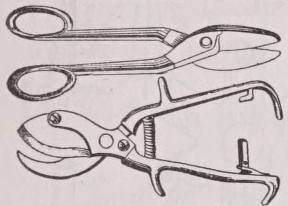
2. An instrument consisting of two blades with a bevel edge, movable on a pin, used for cutting cloth and other substances by interception between the two blades. shears differ from scissors chiefly in being larger.
3. Fate urg'd the shears and cut the sylph in twain. Pope .
4. Something in the form of the blades of shears
5. Wings. [ Not in use .]
6. An engine for raising heavy weights. [See Sheers .]
7. The denomimation of the age of sheep from the cutting of the teeth; as sheep of one shear , two shear , etc. [ Local .]
2. An instrument consisting of two blades, commonly with bevel edges, connected by a pivot, and working on both sides of the material to be cut, -- used for cutting cloth and other substances.
3. A similar instrument the blades of which are extensions of a curved spring, -- used for shearing sheep or skins.
4. A shearing machine; a blade, or a set of blades, working against a resisting edge.
5. Anything in the form of shears.
6. A pair of wings.
7. An apparatus for raising heavy weights, and especially for stepping and unstepping the lower masts of ships. It consists of two or more spars or pieces of timber, fastened together near the top, steadied by a guy or guys, and furnished with the necessary tackle.
8. The bedpiece of a machine tool, upon which a table or slide rest is secured; as, the shears of a lathe or planer. See Illust. under Lathe.
Phr. "a perfect woman nobly planned", "a lovely lady garmented in white", das ewig-weibliche zieht uns hinan, "earth's noblest thing, a woman perfected", es de vidrio la mujer, "she moves a goddess and she looks a queen", "the beauty of a lovely woman is like music", varium et mutabile semper femina, "woman is the lesser man"
And when the woman saw that the tree was good for food, and that it was pleasant to the eyes, and a tree to be desired to make one wise, she took of the fruit thereof, and did eat, and gave also unto her husband with her; and he did eat.
When the woman saw that the tree was good for food and pleasing to the eyes, and that it was desirable for obtaining wisdom, she took the fruit and ate it. She also gave some to her husband who was with her, and he ate it.
And Adam knew his wife again; and she bare a son, and called his name Seth: For God, said she, hath appointed me another seed instead of Abel, whom Cainslew.
And Adam again had relations with his wife, and she gave birth to a son and named him Seth, saying, “God has granted me another seed in place of Abel, since Cain killed him.”
In the selfsame day entered Noah, and Shem, and Ham, and Japheth, the sons of Noah, and Noah’s wife, and the three wives of his sons with them, into the ark;
On that very day Noah entered the ark, along with his sons Shem, Ham, and Japheth, and his wife, and the three wives of his sons—
But the dove found no rest for the sole of her foot, and she returned unto him into the ark, for the waters were on the face of the whole earth: then he put forth his hand, and took her, and pulled her in unto him into the ark.
But the dove found no place to rest her foot, and she returned to him in the ark, because the waters were still covering the surface of all the earth. So he reached out his hand and brought her back inside the ark.
And surely your blood of your lives will I require; at the hand of every beast will I require it, and at the hand of man; at the hand of every man’s brother will I require the life of man.
And surely I will require the life of any man or beast by whose hand your lifeblood is shed. I will demand an accounting from anyone who takes the life of his fellow man:
And Shem and Japheth took a garment, and laid it upon both their shoulders, and went backward, and covered the nakedness of their father; and their faces were backward, and they saw not their father’s nakedness.
Then Shem and Japheth took a garment and placed it across their shoulders, and walking backward, they covered their father’s nakedness. Their faces were turned away so that they did not see their father’s nakedness.
And he said, Blessed be the LORD God of Shem; and Canaan shall be his servant.
He also declared: “Blessed be the LORD, the God of Shem! May Canaan be the servant of Shem.
This site uses cookies to remember your display preferences (search sources and editions, Bible version, auto-link, images, light/dark theme). No personal data whatsoever is collected. Privacy Policy