HERA, a word of which many different derivations have been proposed, is the name of a Greek goddess, corresponding to the Latin Juno, who according to the conventional type is the wife of Zeus and queen among the gods of Olympus. In the literature of the Greeks Hera fills a very conspicuous place—the strong, haughty, and rebellious character, full of intense hatreds and likings, which was associated with her, made her a picturesque and dramatic figure. According to this conception of her, she was daughter of Cronus and Rhea, and at once sister and wife of Zeus. She was always the bitter enemy of all the heroines who were the successive objects of her husband’s love, and her persecution of them and of their children often forms the theme of poets from the Iliad (xxiii. 119) downwards. This type, which is the familiar one in all literature, bad never any real existence in religion; but had been gradually elaborated by poets fron» the actual deity worshipped in various parts of Greece, and from the legends transmitted to the Greeks from earlier races....
The most characteristic and fundamental point in the worship of Hera is the iepoς γάμος, her marriage with Zeus; and from this any explanation of the conception involved in the goddess must start. Again in Greek legend we learn that a close connexion exists between Hera and the cow, and that probably she was originally thought to have the form of a cow. These facts at once direct us to the ancient Aryan idea, described in detail by Gubernatis (Zoolog. Mythoi., i), that the divine power as the origin of all life is embodied in a pair of gods male and female, whose fertility leads to the conception of them as a bull and a cow. This pair, the bull and the cow, appear in various fantastic developments in Greek legend. For example, Zeus himself in the form of a bull carries off Europa; and we learn from Hesychius that Europia is an epithet of Hera. Looking at the matter from this point of view, we find that the question so much disputed among mythologers, whether the naturalistic conception out of which the Greek goddess has developed be earth or moon, is a mere matter of words, and that there is no real discrepancy between the two views. The free and vague conceptions of primitive men refuse to be shut into the precise circumscribed terminology of modern thought. Ideas which to us are very different were once expressed by the same root (see Curtius, Grunds., iii. 284, No. 415). Thus we have in the Pig Veda, vi. 51, 5, a clear trace of the view so common in all mythologies, whether in the theogony of Hesiod or of the New-Zealanders, that Heaven and Earth are the primitive pair of deities, parents of all existence and first of the gods. This view is of peculiar importance in old Roman religion (cf. Schwegler, Pom. Gesch., i. 328, 422, <fcc.), and also among the older Pelasgic tribes of Greece. But this same divine power the primitive Aryans beheld in all the great operations of nature; in each they saw the prototype of all earthly works, and in seeking here the origin of life, they found it in the same divine pair, the bull and the cow. In particular, the various alternations of light and darkness appealed to their minds most strongly, and occupy great port of their mythology. In the transitions between light and darkness, and especially in the struggle between night and day, the idea of a pair is not so prominent; and in legends the marriage of moon and sun does not figure very conspicuously. Yet we sometimes find the marriage of the moon and sun described exactly in the way of this iepos γάρ,ος. In Pig Veda, x. 85, it is the type of all earthly marriage (see Weber, Ind. Stud., v. 178). A Slavonic story makee the marriage of moon and sun annual: they part every winter and meet again in the first days of spring; and a Lettish song makes the marriage of moon and sun in spring (Mannhardt in Zft. f. Ethnoh, 1875, p. 316). The moon too is often symbolized as a cow. The mystic union takes place in the spring when life returns to the earth, and the voice of the cuckoo is heard in the land. Hence in the legend Zeus, enamoured of his sister Hera, is said to have flown to her in the form of a cuckoo dripping wet, and to have been in pity received into her bosom. In various parts of Greece where traces of the ruder tribes are strongest, there remains a coarser conception of this union, and in the popular accounts the marriage customs of the country are reflected (see Weicker, Gr. G'otterl., i. 364∕ ’.). Lectum in the Trojan Ida and Ocha in Euboea, on the summits of which this union is placed by the legends of the countries, received their names from it. As we might expect, this idea is too purely naturalistic to form any part of the moral Olympian religion. Hera appears there as the wife of Zeus, but all deeper meaning has disappeared. The old tale remains in the mythological legends, which always clung as a degrading appendage to this religion, and we find it in Homer (Il., xiv. 294) transformed into an incident of the Trojan war. In the popular religion, however, Hera, as first the virgin, then the sacred bride, and finally the lawful wife of Zeus and the patron of all marriage, is a very prominent figure. Every year the festival of Hera was celebrated with special reference to this union in Argos, Samos, Elis, Plataea, and many other parts of Greece. The festival took place in a month named Vαpηλai)v at Athens, Ήραίοςΐη some other parts of Greece. Hence we have such epithets of Hera as Νύμφη, wμ-φeυομevη, τeλPα, γaμηλ ’ a; and the bridal veil is one of her most frequent attributes. Hera was married to Zeus in early youth, and knew no other marriage. Hence she is the patron goddess of all married women, the protectress of the sanctity of marriage; and she demands the utmost purity from her votaries. In this respect Hera approaches closely to Demeter Thesmophoros. As the winter is a time of barrenness and separation, so we have in Arcadian, Argive, and Samian legend the angry Hera, the widow Hera, separated from her husband.
Other points in Hera again point directly to the moon. Like all other forms of the moon-goddess (see Hecate), she presided over child-birth, and under the epithet elλdθvιa was invoked by women in labour. This idea arises from the moon’s use as measurer of time and numberer of the months. Then the epithet became gradually developed as a daughter, or set of daughters, of Hera, named Eileithyiae. Beauty is another characteristic of all moon-goddesses, and of Hera also. In her festival at Lemnos prizes were assigned after a contest to the most beautiful woman. Large eyes were part of the artistic type, and βοωπιs is one of her most constant epithets in literature.
Eubcea, the very word being an epithet of the goddess, was one of the chief seats of the worship of Hera. So in Boeotia, her temples both at Thespiae and at Plataea were famous. In the Iliad, Argos, Sparta, and Mycenae are the cities which she specially protects and loves. Argos was always one of the chief seats of her worship, and the Heraion there was one of the chief temples of Greece. At Olympia also was a very ancient temple, the Heraion, the ruins of which have been recently brought to view by the German exploring expedition. At the Lacinian promontory Hera was the patroness of the union first of the Achaean cities and afterwards of a wider circle of the Greek colonies. But the Hera of Samos was perhaps the most famous and most characteristic appearance of the goddess. There the Greek goddess was amalgamated with another, who was worshipped by the kindred tribes among whom the Greeks settled, and who is clearly the same as the Artemis of Ephesus or Clazomenae; and so on coins of Samos we find Hera standing with the sun and moon on either side of her head, exactly like Artemis on coins of Ephesus.
We find such rude images of Hera as a plank at Samos, or a branch at Thespiae. A very ancient statue by Smilis stood in her temple at Samos; the goddess, veiled, stood erect, clad in a long chiton, holding in each of her outstretched hands a φιάλη. In the earlier vase-paintings she is hardly to be distinguished from Artemis. She appears, just like Artemis, carrying torch and bow, and wearing the kalathos or the Stephanos; and several figures which others consider to be Artemis, are by Overbeck explained as Hera. In representations of the Judgment of Paris there is often nothing to distinguish her from Aphrodite. Her characteristic symbols are the veil or sceptre, and she often carries a fruit. Numerous vase-paintings, representing a bridal procession, which Forster {Ζcτιs und Hera's Hochzeit) believes to represent the iepδs yaμos, are by Jahn and Overbeck shown to be an earthly marriage escorted. by deities. Overbeck {Hera, p. 174) maintains that only three certain representations of this scene exist. The colossal statue by Polycletus in the Heraion at Argos showed her enthroned, wearing the στΐφάνη, holding in one hand a pomegranate and in the other a sceptre, on the top of which was a cuckoo. There is no evidence to determine what was the character of the face, nor what share it had in determining the ideal type of Hera (Overbeck, Z.c., p. 51). The Farnese bust at Naples represents a type more antique than the style of Polycletus. Praxiteles made three great statues of Hera, at Megara, Mantinea, and Plataea. The last, which represented Hera Teleia standing, is known to us by many imitations in the Vatican and elsewhere. From the works of these two great artists we may suppose that the highest type of Hera was elaborated in the Athenian school about the middle of the 4th century, and in the famous bust of the Villa Ludovisi it is probable that we have the actual work in which this type was first attained. This bust, which has been often described, and especially by Goethe, was probably once the head of a colossal seated statue. (W. Μ. B A. )
[1,771 words — estimated reading time: 11 minutes]
HERACLEA, or Heracleia (in French, Heraclee), the name of several ancient cities in various parts of the area of Greek colonization, so called in honour of Heracles or Hercule3....
I. Heraclea, a city of Magna Graecia, which lay between the rivers Aciris and Siris, not far from the shores of the Gulf of Tarentum, near the site of the modern village of Policoro. It appears to have been a joint colony of the Tarentine3 and the Thurians, and to have risen after the destruction of the neighbouring city of Siris. That it attained to no small prosperity and became the seat of the great politico-religious assembly of the Italian Greeks is nearly all that can be said of its earlier history. By Alexander of Epirus it was deprived of this privilege in favour of Thurii. Pyrrhus was victorious in its vicinity in the first battle he fought with the Romans, 280 b.c., and two years later the city formed an alliance on advantageous terms with the conquerors. In the time of Cicero it was still comparatively prosperous. The Tabulas Heracleenses, found at Luce near the ruins of the city in 1753, are two bronze tablets, or rather fragments of tablets, containing on one surface a Greek inscription relating to temple domains and on the other surface a copy of the famous Lex Julia Municipalis published by Julius Caesar in 45 b.c. They are preserved in the Museo Nazionale at Naples, and one of them is distinguished as the Aes Britannicum and the other as the Aes Neapolitanum, Both inscriptions are given in Mazzocchi, Commentaria in Regii Herculanensis Musei aeneas tabulas Heracleenses (Naples, 1754-55), and the Latin one will be found in Muratori, Inscriptiones (vol. ii.), and Haubold, Monumenta legalia. See also Savigny, Zeitschrift für geschieht. Rechtswiss. (vol. ix.) and Vermischte Schriften (vol. iii., Berlin, 1850).
II. Heraclea, a city of Sicily, at the mouth of the Halycus (the modern Platani), not far from the promontory now known as Capo Eianco. It was distinguished from the other Heracleas by the surname of Minoa, which was explained as referring to its foundation by Minos of Crete. Its name frequently occurs in connexion with the Carthaginian occupation of Sicily, and it was in the neighbouring sea that the Carthaginian fleet was routed by Regulus and Manlius in 256 b.c. The Romans introduced a colony.
III. Heraclea Pontica, a city on the coast of Phrygia in Asia Minor, easily identified with the modern Bender Eregli or Erekli, at the mouth of the Kilidj-su on the Black Sea. It was founded by a Megarian colony, which soon subjugated the native tribe of the Mariandynians, and extended its power over a considerable territory. The prosperity of the city, rudely shaken by the Galatians and the Bithynians, was utterly destroyed by Aurelius Cotta in the Mithridatic war. It was the birthplace of Heraclides Ponticu3, The modern town is best known for its coal mines, from which Constantinople receives a good part of its supply. See Polsberw, De Rebus Heracleoe, Brandenburg, 1833; and O. Kümmel, Heracleotica : Beiträge zur alten Gesch. der griech. Colonisation im nordl. Klein-Asien (Progr. des Gymn. zu Plauen, 1869).
IV. Heraclea Sintica, a town in Thracian Macedonia, to the south of the Strymon, the site of which is marked by the village of Zervôkhori, and identified by the frequent discovery of local coins.
V. Heraclea, a town on the borders of Caria and Ionia, near the foot of Mount Latmus, whence it is usually distinguished as the Latmian. In its neighbourhood was the burial cave of Endymion. See Rayet and Thomas, Milet et le Golfe Latmique, Paris, 1877.
For Heraclea Trachinia see Trachis, and for Heraclea Perinthus see Perinthus.
Heraclea was also the name of one of the Sporades, between Naxos and los, which is still called Raklia, and bears traces of a Greek township with temples to Tyche and Zeus Lophites. See Baumeister in Philologiis, vol. ix.
[664 words — estimated reading time: 4 minutes]
HERACLEON, a Gnostic who flourished about 125 A.D., probably in the south of Italy or in Sicily, is generally classed by the early heresiologists with the Valentinian school of heresy. In his system he appears to have regarded the divine nature as a vast abyss in whose ρleroma were aeons of different orders and degrees,—emanations from the source of being. Midway between the supreme God and the material world was Demiurgus, who created the latter, and under whose jurisdiction the lower, animal soul of man proceeded after death, while his higher, celestial soul returned to the pleroma whence at first it issued. Heracleon seems to have received the ordinary Christian Scriptures; and Origen has preserved fragments of a commentary by him on St John’s gospel, while Clement of Alexandria quotes from him what appears to to be a passage from a commentary on St Luke’s gospel. These writings are remarkable for their intensely mystical and allegorical interpretations of the text. The portions of the commentary on St John’s gospel have been brought together by Grabe in the second volume of his Spicilegium.
[187 words — estimated reading time: 2 minutes]
HERACLES. See Hercules.
[3 words — estimated reading time: 1 minute]
HERACLIDES, surnamed Ponticus, a Greek miscellaneous writer who flourished in the 4th century b.c., was born at Heraclea in Pontus. Removing to Athens, he is said to have been a disciple successively of Speusippus, Plato, and Aristotle. According to Suidas, the second of these philosophers, on departing for Sicily, left his scholars in the charge of Heraclides. The latter part of his life was spent at Heraclea. Of his private history we have few authentic details. He is said to have been vain and fat, and to have maintained such state in Athens that the wits changed his surname into Pompicus, or the Showy. Various idle stories are related about him. On one occasion, for instance, Heraclea was afflicted with famine, and the Pythoness at Delphi, bribed by Heraclides, assured his inquiring townsmen that the dearth would be stayed if they granted a golden crown to that philosopher. This was done; but just as Heraclides was receiving his honour in a crowded assembly, he was seized with apoplexy, while the dishonest priestess perished at the same moment from the bite of a serpent. On his death-bed he is said to have requested a friend to hide his body as soon as life was extinct, and, by putting a serpent in its place, induce his townsmen to suppose that he had been carried up to heaven. The trick was discovered, and Heraclides received only ridicule insteιd of divine honours.
He wrote on a great variety of subjects, but only one fragment, On Statecraft, is now extant. This was published with the Varia Historia of Aelian at Rome in 1545; but the best editions are those of Koller (Halle, 1804), Coray (Paris, 1805), and Müller. See Fr. W. Schmidt, De Hcraclidoe Pontici et Dicoearchi Messenii dialogis deperditis, Breslau, 1867.
[301 words — estimated reading time: 2 minutes]
HERACLITUS of Ephesus, one of the most subtle and profound of the metaphysicians of ancient Greece, has only of late years had his true position assigned to him in the history of philosophy. To this the obscure and epigrammatic character of his style and the fragmentary condition of his works have in the main contributed, together with the fact that not only his immediate disciples but also his critics, including even Plato, have systematically laid stress upon those features of his doctrines which are least indicative of his real point of view. The true position of Heraclitus is that of the founder of an independent metaphysical system, which sought to get rid of the difficulty, so prominent in the Eleatic philosophy, of overcoming the contradiction between the one and the phenomenal many, by enunciating, as the principle of the universe, “Becoming,” implying, as it does, that everything is and at the same time, and in the same relation, is not.
The descendant of a family of leading importance in Ephesus, Heraclitus was born about 535 b.c. His cast of mind was so intensely aristocratic that, filled with contempt for the councils and capacities of his fellow-citizens, he made over the hereditary office of ∕3ασιλeι⅛, which had fallen to him in right of his birth, in favour of his younger brother, and betook himself to a life of solitary meditation. The date of his death was probably about 475 B.c....
To appreciate the significance of the doctrines of Heraclitus, it must be borιιe in mind that to Greek philosophy the sharp distinction between subject and object which pervades modern thought was foreign, a consideration which suggests the conclusion that, while it is a great mistake to reckon Heraclitus with the materialistic cosmologists of the Ionic schools, it is, on the other hand, going too far to treat his theory, with Hegel and Lassalle, as one of pure Panlogism. Accordingly, when he denies the reality of Being, and declares Becoming, or eternal flux and change, to be the sole actuality, Heraclitus must be understood .to enunciate not only the unreality of the abstract notion of being, except as the correlative of that of not-being, but also the physical doctrine that all phenomena are in a state of continuous transition from non-existence to existence, and vice versa, without either distinguishing these propositions or qualifying them by any reference to the relation of thought to experience. “Everything is and is not;” all things are, and nothing remains. With Heraclitus the principle of continuity is opposed to the principle of discretion taught by the Eleatics, and consequently for him “Being and Nothing,” as well as “Union and Separation,” are logically and physically incapable of distinction. This being so,he naturally enough selects Fire, according to him the most complete embodiment of the process of Becoming, as the principle of empirical existence, out of which all things, including even the soul, grow by way of a quasi condensation, and into which all things must in course of time be again resolved. But this primordial fire is in itself that divine rational process, the harmony of which constitutes the law of the universe. Real knowledge consists in comprehending this all-pervading harmony as embodied in the manifold of perception, and the senses are “bad witnesses,” because they apprehend phenomena, not as its manifestation, but as “stiff and dead.” In like manner real virtue consists in the subordination of the individual to the laws of this harmony as the universal reason λvherein alone true freedom is to be found. ‘ ‘ The law of things is a law of Reason Universal, but most men live as though they had a wisdom of their own.” Ethics here stands to sociology in a close relation, similar, in many respects, to that which we find in Hegel and in Comte. For Heraclitus the soul approaches most nearly to perfection when it is most akin to the fiery vapour out of which it was originally created, and as this is most so in death, “while we live our souls are dead in us, but when we die our souls are restored to life.” The doctrine of immortality comes prominently forward in his ethics, but whether this must not be reckoned with the figurative accommodation to the popular theology of Greece which pervades his ethical teaching, is very doubtful.
The only extant work, purporting to have been written by Heraclitus, which can be regarded as genuine, is the treatise ∏∈p't φvσeωs, which has come down in a fragmentary condition. It has been edited by Bywater (Heracliti Ephesii Reliquiae, Clarendon Press, 1877). The Epistles are in all probability spurious.
The school of disciples founded by Heraclitus flourished for long after his death, the chief exponent of his teaching being Cratylus. A good deal of thö information in regard to his doctrines has been gathered from the later Greek philosophy, which was deeply influenced by it.
By far the most complete exposition of his system is that of Lassalle (Die Philosophie Herakleitos des Dunkeln von Ephesos, Berlin, 1858), although his interpretation is decidedly too strongly dominated by modern Hegelian conceptions. See also Hegel, Gesch. d. Phil.·, Zeller, Gesch. d. Phil. d. Griechen·, Bernays, Die Heraclitischen Briefe, Berlin, 1869; and Schuster, Heraklit von Ephesus, Leipsic, J873.
[888 words — estimated reading time: 6 minutes]
HERACLIUS(c. 575-641), emperor of the East, was boni in Cappadocia about 575. He was brought into notice by his heading a successful revolt against the emperor Phocas in 610, when he usurped the usurper’s throne. At that period the eastern provinces of the empire were being ravaged by the triumphant armies of Chosroes (Khosru) II., which in the first twelve years of Heraclius’s reign continued their unresisted progress to the Bosphorus and the Nile, pillaging Asia Minor and Syria, and reducing Constantinople to the utmost distress by cutting off its Egyptian corn supplies. In 618 the public distributions of grain, which had been carried on since Constantine had instituted them as a bribe to attract citizens to his new city in 330, were suspended; and the bankrupt emperor was hardly dissuaded by the almost imperative prayers of his people from quitting his capital in shame and fear for Carthage. Taking courage, Heraclius appears to have set himself to the task of reorganizing both state and army, a labour which had probably occupied him since his accession. He was menaced on the west by the fierce tribe of the Avars, who were casting longing eyes on the riches of the imperial city; but in 620 he succeeded in making a treaty with them, and interposed a human barrier against their further encroachments by inviting the Serbs and Croats to settle in the intervening regions, which they have never since left. In 621 Heraclius led an army into camp in Asia Minor, and devoted himself with ardour to the drilling of his inexperienced troops. Every military manoeuvre, every useful exercise and even hardship, was ordered and shared by the emperor. He kindled the enthusiasm of his soldiers by his stirring words, and excited their admiration and affection by his deeds. Next year ...he led his forces against Persia, and within five years, in a series of brilliant campaigns that place him side by side with the greatest generals of the world, he overthrew the pride of that empire, drove its monarch a fugitive from his throne, and enriched his exulting troops with untold wealth. Siroes, the son of Chosroes, revolting against his unhappy father, put him to death in 628, and speedily made a peace with Heraclius, according to which the Persian empire retired to its former limits, prisoners were mutually given up, and the true cross, carried from Jerusalem by the Persians, was restored to Christian hands. Heraclius returned in triumph to Constantinople, which had in his absence two years before successfully repulsed a combined assault by the Avars and Persians; and in 629 he proceeded to Jerusalem to restore solemnly the holy relic to its ancient place. But he was not long to enjoy the peaceful fruits of victory. A mighty power had been steadily growing up in the hot sands of Arabia, and was now coming to measure its strength with that of the Roman empire. In 632 the Mahometans invaded Syria; and, overthrowing the armies sent to oppose them, in six years they made themselves masters of the country. Egypt next fell before Islam, and in 640 that fair province of the empire was Mahometan. The people of Asia Minor alone successfully resisted the advancing Saracens. Heraclius seems meanwhile to have sunk into a sort of lethargy, as though his efforts in'Persia had completely exhausted him. While bis generals and armies were being cut to pieces he was engaged at Constantinople, whither he had retreated in 634, with speculative theological questions. In 638 his Ectlιesis appeared, which, tinctured with the heresy of Monothelism, was probably drawn up by the patriarch Sergius. The energy of his earlier life never returned, and in 641 he sank under a long-continued disease. He had been twice married; the second time to his niece Martina, an illicit union which he compelled ths reluctant Sergius to celebrate. His eldest son, Heraclius, succeeded him, taking the title of Constantine III.
The character of Heraclius is a curious riddle, which it is not easy to solve. Personally brave, and possessed of tried ability as a diplomatist and a general, in his latter years hë passively allowed his empire to fall to pieces before his eyes,—presenting in the periods of his life a contrast that would almost seem to argue the possession of not merely contrary but contradictory qualities. But we must not forget that our information regarding the inner details of his latter reign is very imperfect, and that possibly there may be some reason, though hardly an excuse, for his conduct. It would have been better for his fame if he had died immediately after his Persian campaigns.
See Gibbon’s Decline and Fall of the Roman Empire ; Le Beau’s Histoire du Bas-Empire ; and the works of George of Pisidia (cf. vol. X. p. 429).
[810 words — estimated reading time: 5 minutes]
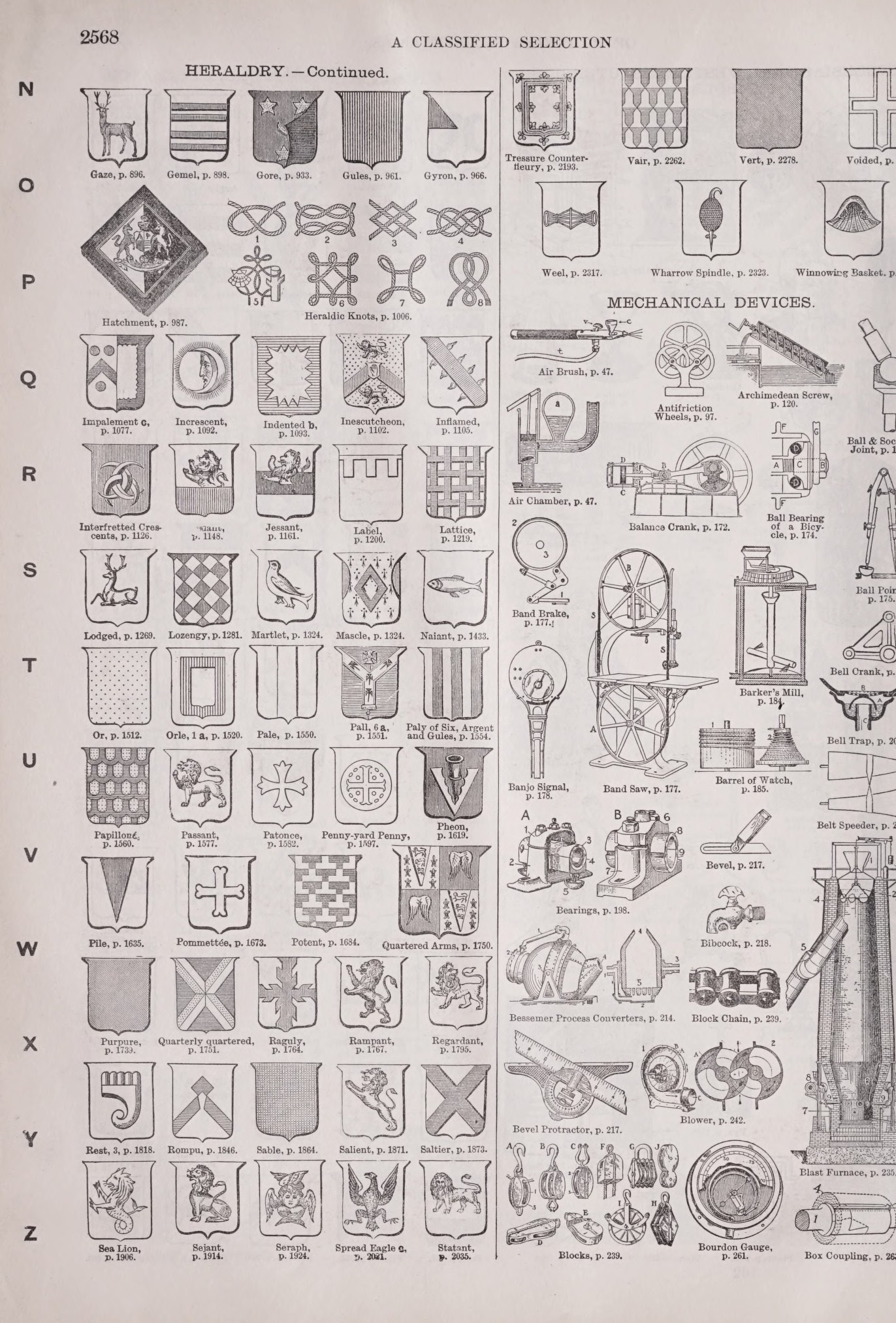
HERALDRY, though etymologically denoting all the business of the herald, has long in practice been restricted to one part of it only, and may be defined as the art of blazoning or describing in proper terms armorial bearings. It treats also of their history, of the rules observed in their employment and transmission, of the manner in which by their means families and certain dignities are represented, and of their connexion with genealogies and titular rank.
Particular symbols have in all ages been assumed by the various families of mankind, civilized and uncivilized. Such were the lion of the tribe of Judah, the S. P. Q. R. upon the standards of ancient Rome and the eagle surmounting them, the tattoo marks of the savages of America and the Pacific, the Danish raven, and the white horse of Saxony, which still remains carved upon the chalk downs of western England. Heraldry, however, is a purely feudal institution, coeval with close armour, devised possibly in Germany, adopted and improved in France, Spain, and Italy, and imported into England by the Norman invaders and settlers. Its figures have little or nothing to do with the older symbols, though these have occasionally been incorporated into its charges, and an apparent connexion thus established between them. These symbols, as has been well said, were the precursors and not the ancestors of heraldic bearings. The supposed connexion, however, misled the credulous heraldic writers of the 16th and 17th centuries, and caused them to attribute coats of arm3 to the heroes of sacred and profane history, who were certainly as ignorant of hèraldry as ever was Adam of genealogy....
“Arms” or “armories,” so called because originally displayed upon defensive armour, and “coats of arms” because formerly embroidered upon the surcoat or camise worn over the armour, are supposed to have been first used at the great German tournaments, and to have reached England, though to a very moderate extent, in the time of Henry II. and Coeur de Lion. To “blazon,” now meaning to describe a coat of arms, is the German “blasen,” to blow as with the horn, because the style and arms of each knight were so proclaimed on public occasions. The terms employed in heraldry are, however, mostly French or of French origin. Though now matters of form and ceremonial, and subject to the smile which attaches to such in a utilitarian age, armorial bearings were once of real use and importance, and so continued as long as knights were cased in plate, and their features thus concealed. At that time leaders were recognized in the field by their insignia alone, and these—both figures and colours—became identified with their fame, from personal became hereditary, were subject to certain rules of descent, and to the laws of property and the less certain rules of honour.
Froissart mentions a case in which a knight of the Scrope family could with difficulty be restrained from putting to death a prisoner because he wore the same bearings with himself. The last De Clare owed his death on the field of Bannockburn to his having neglected to wear his cotte d’armes; had he been recognized, his great value as a prisoner would have saved him. Also the loss of the battle of Barnet was in part attributed to the similarity between the royal cognizance of a sun and that of John de Vere, a star with streamers,—Warwick charging Oxford by mistake for the king.
The best if not the only absolutely safe evidence for the origin of armorial bearings is that afforded by seals. Seals were in common use both before and after the introduction of armorial bearings, and they are not so likely as rolls of arms or monumental effigies to be the work of a later age. There are said by Courcelles to be extant, appended to charters of 1030 and 1037 a.d., two seals of Adalbert, duke of Lorraine, which bear on a shield an eagle with wings closed. This however wants confirmation; but Anna Comnena, describing the shields of the French knights who visited Constantinople about 1100, gives their surfaces as of metal only, polished but plain; nor have any decided traces of arms been discovered among the early crusaders. Louis le Jeune, who seems first of the French kings to have used the fleur-de-lys, caused it to be represented in gold over the azure mantle and chaussures worn by his son at his coronation. Also, in 1180, he seals with a fleur -de-lys, but it is placed in a circle, not upon a shield. Planché cites two seals of Philip, count of Flanders, one plain, in 1157, and another in 1164 charged with a lion, their subsequent bearing. Seton mentions the seal of John de Mundegumbri in 1170 as bearing a fleur-de-lys, which, like that of Louis, has two intermediate flower-stems, as seen on Florentine coins. He also gives the seal of Falconer (1170) as bearing a falcon; and that of Corbet bore two ravens perched upon a fleur-de-lys, while his brother bore them upon a tree. This indeed was at a period when fleurs-de-lys, stars, and various animals were commonly represented as mere ornaments on seals, but the peculiarity of the instances named is that the falcon and the raven, like the fleur-de-lys of France, were afterwards the heraldic bearings of those families. The seals of the close of the 12th century, though not generally heraldic, certainly betray many of the elements of heraldry. No doubt, when once introduced, armorial bearings were felt to supply a real and serious want, and came rapidly into use, but Wace, the poet of the reign of Henry II., although he tells us that
“N’i a riche home ne Baron, Ki n’ait lez li son gonfanon, U gonfanon u altre enseigne,”
can scarcely be seriously held to mention armorial bearings.
It is uncertain at what period armorial bearings found their way into England. The Conqueror and his successors certainly did not use them; they do not appear upon their seals, nor are they shown upon the banners of the Bayeux tapestry. The monk of Marmoutier, probably a contemporary, describes Henry I., upon the marriage of his daughter to Geoffrey of Anjou in 1122, as hanging about the bridegroom’s neck a shield adorned with small golden lions, “leonculos aureos;” and, making mention of a combat in which Geoffrey was engaged, he describes him as “pictos leones praeferens in clypeo.” It is true that the number, attitude, and position of these lions on the shield are not specified, but considering that not long afterwards two lions became the arms of Plantagenet, and so of England, this may fairly be taken as their introduction. Stephen is said to have used a centaur, Sagittarius, as an emblem, because he landed in England when the sun was in that sign, but on his great seal his shield is quite plain, save a ridge down the .centre, evidently a part of its construction. On the seals of the Conqueror, Rufus, and Henry I., only the hollow or under side of the shield is shown; so there probably was no design upon the front. There is no seal of Duke Robert, but William, earl of Flanders, his son, shows a plain shield on his seal. His monumental effigy (1128) bears a large pavesse shield, and upon it an escarbuncle, apparently a highly ornamented clamp. The seal of Henry II. also shows the hollow of the shield. The first great seal of Richard I. bears a lion rampant, who from his position may be inferred to be fighting with a similar lion upon the sinister and concealed half of the shield, blazoned in a MS. cited by Mr Way as “two lion3 confrontés.”
Up to this time the kings, though represented on horseback and in full armour, have the face uncovered, and therefore their persons would be known. The seal of Richard I. in 1189 shows a close helmet, and upon the shield two lions passant gardant in pale, “leones lopardés,” as they were then or soon after called. On a later seal, after his return from captivity in 1194, Richard added a third lion. John, while earl of Mortaine, sealed with two lions, but his seal as king bears three, and the coat has so remained. That the two lions were more than a mere ornament is evident from their having been adopted by John’s natural son, Richard de Warren, who seals with two lions passant regardant. The seals of the great barons show the growth of the practice. Richard, constable of Chester, contemporary with Stephen, bears a shield covered over with small plates, tegulated, like his armour; but Stephen, earl of Richmond, as early as 1137, seals with seven fleurs-de-lys, a very early heraldic seal. Waleran, earl of Meulan (died 1166), also used an heraldic seal. Duchesne gives a seal of Bouchard de Montmorenci (1182), a contemporary of Louis le Jeune, with a cross between four alerions on his shield, and another in whch the cross is charged with roundels. Mathieu, his son, seals also with the cr0s3 and alerions, which had evidently become, as they remained, hereditary. In England, William, earl of Essex (died 1190), seals with the escarbuncle of his family. In 1187 Gervase Paganel, a great Anglo-Norman baron, seals with two lions passant, which his family continued to bear.
With the 13th century arms came rapidly into use. The second seal of Mathieu de Montmorenci in 1209 has them introduced upon his horse furniture, but this practice does not appear upon the seals of the kings of England until the second seal of Edward I. Baldwin de Bethune, earl of Albemarle (died 1214), sealed with three martlets in chief, and many other early examples of regular heraldic seals occur at this period attached to extant charters. The earliest roll of arms is of the reign of Henry III.; of a second of the same reign a copy is preserved in the Harleian collection; and a third, in the next reign, is the roll of Caerlavrock, 1300 ad. So that for the reign of Henry and his son the evidence for armorial bearings is copious and excellent. Other rolls exist carrying the practice through the 14th and 15th centuries, before the middle of which there is no known work on heraldry, nor any trace of heraldic regulations save what may be deduced from recorded practice.
Coats of arms were not at first strictly hereditary, nor even always permanent in the same person. Thus William de Ferrars, 6th earl of Derby (died 1216), seems to have borne “argent, 6 fers de cheval, or horse shoes, 3, 2, 1, sable.” William, his son, in consequence of a match with Peveril, who bore “vair,” changed his bearing to “vair, or and gules, on a border azure 8 horse shoes argent.” Robert his son, 8th earl (died 1278), dropped the horse shoes, and bore “vair, or and gules.”
“Ferrars his tabard with rich vair yspread.”
After the match with Quincy, the Ferrarses laid aside their own coat and bore that of Quincy, “gules, 7 mascles conjoined 3, 3, 1, or.” Their male heir through a younger branch, —Ferrers of Baddesley-Clinton,—commemorates these various changes by bearing “quarterly,—(1st) vair, or and gules; (2d) sable, 6 horse shoes, 3, 2, 1, argent; (3d) gules, i mascles, 3, 3, 1, or, a canton ermine.” Hugh Lupus, earl of Chester (died 1101), is fabled to have borne a wolf’s head, and not improbably his surname arose from some such emblem. Richard, his son, is said to have borne “azure, semée of crosslets or, a wolf’s head erased argent” Ranulph Meschines, 3d earl (died 1128), was sister’s son to the first earl, and to him is assigned “or, a lion rampant gules.” Hugh Cyfeliøc, 5th earl (died 1180), certainly bore “azure 6 garbs of wheat, 3, 2, 1, or;” and Ranulph Blondevile, his son, bore “azure, 3 garbs or.” With him the line failed, but as the wheat-sheaf is a common Cheshire bearing, it is probable that arms came into general use in the palatinate, in the time of the last two earls.
Sir Nicholas Carru (died 1283) seals with a tricorporate lion, but at Caerlavrock in 1300 is found with a
“Banière et jaune bien passable, O trois passans lyons de sable/’ the arms of the Carews of our day. The fess and label of Saher de Quincy, earl of Winchester, in 1170, were changed by Roger his son for the mascles by which they were best known, and which he repeats upon his housings. The fact is that, at the close of the 13th century, arms, though on the whole hereditary, had not quite acquired that fixed character that belonged to them half a century later. That the changes were the exception rather than the rule is, however, clear from the roll of Henry IΠ., and from the arms of the forty great barons which he caused to be painted on the walls of Westminster Abbey, almost all of which, so far as they are on record, are the same with those borne or quartered by their representatives. There exist also in England a few families of Norman origin, the period of whose arrival in England is known, and whose arms are the same with those of the present stock in the parent country. Such are Harcourt of Ankerwyke and D’Aubigny, who therefore bore their arms before the separation from Normandy under Henry III.
Early bearings were usually very simple, the colours in strong contrast, and their form and outline such as could readily be distinguished even in the dust and confusion of a battle. They are mostly composed of right lined figures known in heraldry as ordinaries. The favourite beast is the lion.
The earliest and most valuable records relating to English armorial bearings are undoubtedly the rolls of arms of the reigns of Henry III and the first three Edwards, which have been well edited by Sir II. Nicolas. That of Henry III. known as Glover’s roll, drawn up between 1243 and 1246, describes or blazons 218 coats of arms, and therefore shows very sufficiently the heraldry of the period. Of these coats nearly one-half are composed solely of the ordinaries and subordinaries, and other simple lines and figures. About two score of them exhibit lions, chiefly rampant, and leo-pardés, a form of the sune animal. The only other beast is the “teste de sanglier” borne by Swinburne. Of birds there are but the eagle and the papagay, several martlets, and single examples of the raven, the cock, the heron, and the horiole. The luce or pike is the only fish. The cinquefoil and sexfoil, the fleurde-lys, the rose, and the wheat-sheaf, used very sparingly, represent the vegetable world. For the rest there are annulets, barnacles, crescents, estoiles, escallops, fers de cheval, mullets, and water budgets. There is one ray of the sun, and one whirlpool.
The coat of Mortimer “barré, a chef palée,a corner geren-née d’or et d’azur, a ung escucheon d’argent,”—or, in modern terms, “harry, a chief paly, its corners gyronny or and azure, an escutcheon argent ’’ (fig. 63),—is the only one at all of a complex character, and this is composed of ordinaries and subordinaries'; and though many of the ordinaries bear the smaller charges, or are placed between them, there are very few examples of an ordinary so charged also placed between charges, a common usage in later coats. An exception is Chandos, who bears three estoiles on a pile, which again is placed between six others; but this stands alone.
The roll of Edward II. blazons 957 coats of the bannerets of England, so that the use of arms had increased considerably. The lions have risen to 225, the eagles to 43; and there are 102 crosses of various kinds. Of new beasts, fabulous or real, there are the griffin, the wyvern, the stag, wolf, goat, and greyhound: of new birds, the falcon ; of fishes, the dolphin. Of other objects the additions are the millrind, buckle, covered cup, chaplet, gauntlet, arrow, trumpet, hammer, battle-axe, palmer’s staff, pots, winnowing fans or vans, pens, cushions, and chessrooks. The character of the arms remains very simple, and the blazon employed agrees in the main with that still in use, and is in general perfectly intelligible. These rolls give various examples of changes of coats, either altogether or by the introduction of a difference to distinguish members of the same∣ family; and it is observable that when the figures are altered the colours are usually adhered to, as though it were considered undesirable to change them. Thus Gilbert de Segrave (died 1254) bore “sable, 3 garbs argent.” Of his grandsons John and Nicholas, John bore the paternal coat, but Nicholas, at Caerlavrock, had exchanged the garbs for a lion. This afterwards became the family bearing as “sable, a lion rampant argent, crowned or,” the colours being retained.
No sooner had the great barons assumed arms for themselves than they began to grant them to their followers. Arms so granted commonly bore some resemblance to those of the grantor, and hence certain charges prevailed in certain districts. Thus the chevron of De Clare was common in South Wales, in the Honours of Gloucester and Clare, and about Tonbridge. The garb or wheat-sheaf was found in Cheshire; the cinquefoils of the Bellomonts in Leicestershire; the annulets of Vipont in Westmoreland; the lion all over England, and the tressure in Scotland, both from the royal arms. Some of these grants remain; others can with certainty be inferred. Stephen Curzon, who held under the earls of Derby, bore “vair, with a border of 8 popinjays argent,” and Richard, his brother, bore “vair, on a fess 3 horse-shoes.” Hubert, earl of Kent, bore “7 lozenges vair;” and Anselm de Guise, on taking under him lands in Berks and Gloucester, assumed the same coat, with the addition of a canton or, charged with a mullet sable. In 1349 Robert Morle granted to Robert de Corby and his heirs the arms “d’argent, ove un saltier engrailé de sable,” which he himself had inherited from Baldwin de Manoirs. In 1356-7 William, baron of Greystock, who bore “harry of 6 argent and azure, 3 chaplets gules,” granted to Adam de Blencowe and his heirs for ever “an escutcheon sable with a bend closetted [or barred] argent and azure, with 3 chaplets gules.” In 1391-2 Thomas Grendale granted to William Morgue his heirs and assigns, “argent, on a cross azure 5 garbs or,” which, as cousin and heir, he himself hid inherited from John Beaumeys. Finally, in 1442, Humphrey, earl of Stafford, who bore “or, a chevron gules,’ granted to Robert Whitgreaves “un escue d’azure, a quatre points d’or, quatre chevrons de gules,” to him and hi3 heirs, of lineage,—in modern terms “azure, a cross quarter-pierced or, on each limb a chevron gules.” A coat o. arm3 was not only heritable, subject to certain heraldic customs, but could, be willed or granted away, wholly or in part, like chattel property.
The crusades, by bringing together soldiers of different nations, tended to produce a certain assimilation in their heraldries, but their influence upon the arms themselves has been exaggerated. The stories as to bearings adopted to commemorate feats of arms in Palestine are mostly inventions. The cross no doubt was a crusading bearing, but it was so because it was the emblem of Christianity, and primarily popular as such. The stars, torteaux, water budgets, and other charges attributed to the crusaders, were of earlier date and of independent origin. There is no evidence that the crosses pâtée of the Berkeleys, or the crosslets of Beauchamp, Clinton, Windsor, and Howard, were added to their simpler bearings in token of services in the Holy Land. The star of De Vere, always attributed to an adventure there, was evidently a mark of cadency, adopted by Robert de Vere, brother of Alberic, 2d earl of Oxford. The fact appears to be that most of the additions to or alterations in the earlier coats of arms were made for some genealogical reason, to commemorate a match with some great family or to distinguish between the several branches from the parent tree. After, usually long after, the period of the crusades, arms were invented for “fabled knights in battles feigned,” and but few of the Saracens’ heads which figure so formidably in many coats of arms are contemporary with any Saracenic war.
The diversion of the tournament did even more than actual war to promote the glories of heraldry. On these occasions the presence of spectators, and especially of ladies, encouraged all sorts of heraldic display. At a tournament at Calais in 1381 Richard Beauchamp, earl of Warwick, one of the most accomplished knights of the reigns of Richard II., Henry IV., and Henry V., suspended on three shields three several coats of arms, as representing three several knights who professed to be ready successively to meet all comers. Three Frénch...

[36,800 words — estimated reading time: 3.6 hours]
HERAT is a city of great interest both historically and geographically, and is of even greater interest politically, its importance at the present day being indicated by its popular designation of the “key of India.” Its origin is lost in antiquity. The name first appears in the list of primitive Zoroastrian settlements contained in the Vendiddd Sadé, where, however, like most of the names in the same list,—such as Sughdu (Sogdia), Mouru (Merv or Mar-gπs), Haraquiti (Arachotus or Arghend-ab), Haetumaηt (Etymander or Helmand), and Pagha (or Argha-stân),—it seems to apply to the river or river-basin, which was the special centre of population. This name of Haroyu, as it is written in the Vendiddd, or Hariwa, as it appears in the inscriptions of Darius, is a cognate form with the Sanskrit Sarayu, which signifies “a river,” and its resemblance to the ethnic title of Aryan (Sans. Aryα) is purely fortuitous; though from the circumstance of the city being named “Aria Metropolis” by the Greeks, and being also recognized as the capital of Ariana, “the country of the Arians,” the two forms have been frequently confounded. Of the foundation of Herat (or Heri, as it is still often called) nothing is known. We can only infer from the colossal character of the earth-works which surround the modern town, that, like the similar remains at Bost on the Helmand and at Ulân Robât of Arachosia, they belong to that period of Central-Asian history which preceded the rise of Achaemenian power, and which in Grecian romance is illustrated by the names of Bacchus, of Hercules, and of Semiramis....
The natural advantages of Herat are mainly due to its river, which, rising in the high uplands 350 miles to the eastward, where the Koh-i-BàbA, the prolongation of the Hindû-kush, bifurcates into the two parallel ranges of the Sufid-koh or “white mountains” to the north and the Siyâh-koh or “black mountains” to the south, passes in the upper part of its course through a succession of rolling downs of the finest pasture-land, and lower down traverses a more contracted valley, enlivened, however, throughout with smiling villages and orchards, till it reaches the eastern limit of the alluvial plain of Herat. Here at the present day nine large canals (in former times there were twenty) carry off the waters of the Heri-rιid for the irrigation of the circumjacent plain, which on a rough calculation may be said to contain nearly 400 square miles of land available for cultivation. M. Khanikoff, who visited Herat in 1858, observes that nowhere in the East,—not even at Samarcand or Bokhara or Ispahan, where the art of canalization is supposed to be carried to perfection,—had he seen watercourses constructed with so much skill, or maintained with so much care, as in the valley of the Heri-rùd; and he adds that, although at the period of his visit nine-tenths of the villages of the plain, which in ordinary times amount to nearly 500, were partially in ruins and the adjoining fields laid waste, the cereal produce of the remaining lands was still far in excess of the wants of the settled inhabitants. The Heri rιid, passing between 3 and 4 miles to the south of Herat, where it is spanned by a magnificent bridge of twenty-three arches, called the Pul-i-Malan, continues its course westward to the extremity of this rich and fertile plain; it then turns north through an arid country for some 200 miles to Sarakhs, receiving two small streams from the west, the Ab-i-Jàm and Âb-i-Meshed, and forming the territorial boundary between Persia and Afghanistan. As the Heri-rιid is formed of the converging drainage of the Sufid-koh and Siyâh-koh ranges, and its volume thus depends on the extent of snow that falls in the mountains, it is impossible to define with any exactitude the limit of its northern course; but in ordinary seasons water is rarely found in the river bed beyond Sarakhs, and never does the stream penetrate to the northward of a line uniting Abiverd and Merv; and it is of the more importance to note this geographical feature, as in many of our modern maps the line of the Heri-rùd, or Tejend, as it is called in its lower course, is prolonged through the desert 200 miles to the north-westward of Sarakhs.
The city of Herat is in 34° 22' N. lat. and 62° 9' E. long. It is very centrically situated, great lines of communication radiating from it in all directions—southward to Seistan (200 miles), south-eastward to Kandahar (370 miles), eastward to Cabul (550 miles), northward by Mymeneh to Bokhara (600 miles) and by Merv to Khiva (700 miles), while to the westward four routes lead into Persia by Turbat to Meshed (215 miles), and by Birjend to Kermàn (400 miles), to Yezd (500 miles), or to Ispahan (600 miles). The city forms a quadrangle of nearly a mile square (more accurately about 1600 yards by 1500 yards); on the western, southern, and eastern faces the line of defence is almost straight, the only projecting points being the gateways, but on the northern face the contour is broken by a double outwork, consisting of the Arl· or citadel, which is built of sun-dried brick on a high artificial mound within the enceinte, and a lower work at its foot, called the Ark-i-now, or “new citadel,” which extends 100 yards beyond the line of the city wall. That which distinguishes Herat from all other Oriental cities, and at the same time constitutes its main defence, is the stupendous character of the earthwork upon which the city wall is built. This earthwork averages 250 feet in width at the base and about 50 feet in height, and as it is crowned by a wall 25 feet high and 14 feet thick at the base, supported by about 150 semi-circular towers, and is further protected by a ditch 45 feet in width and 16 in depth, it presents an appearance of imposing strength. Whether the place is really as strong as it looks has been differently estimated. General Ferrier, who resided for some time in Herat in 1846, states that the city is nothing more than an immense redoubt, and gives it as his opinion that as the line of wall is entirely without flanking defences, the place could not hold out for twenty days against a European army; and M. Khanikoff, who, though not a professional soldier, was a very acute observer, further remarks that the whole interior of the city is dominated from the rising ground at the north-east angle, while the water supply both for the ditch and the city would be at the mercy of an enemy holding the outside country, the wells and reservoirs inside the wall, which would then be alone available, being quite inadequate to the wants of the inhabitants; but on the other hand all experience testifies to the defensibility of the position. Not to speak of the sieges which Herat sustained at the hands of Jenghiz Khan, of Timur, and of Ahmed Shah, we have only to remember that in 1837 the Afghans of Herat beat off the continuous attack for nearly ten months of a Persian army of 35,000 regular troops, supported by 50 pieces of artillery, and in many cases directed and even commanded by Russian officers. The truth seems to be that Herat, though in its present state quite unfit to resist a European army, possesses great capabilities of defence, and might by a skilful adaptation of the resources of modern science be made almost impregnable. A British engineer officer, Major Sande⅛rs, calculated in 1840 that at an outlay of sixty or seventy thousand pounds, which would include the expense of deepening the ditch, clearing the glacis and esplanade, providing flanking defences and repairing the walls, <fcc., throughout, Herat might be rendered secure against any possible renewal of the attack by Persia; but of course if an attack by a well-appointed European army were anticipated, more extensive preparations for defence would be required, including probably the erection of two independent forts on the high ground at Mosallâ and Thaleh-bengi.
The city possesses five gates, two on the northern face, the Kutab-chak near the north-east angle of the wall, and the Malik at the re-entering angle of the Ark-i-now; and three others in the centres of the remaining faces, the Irâk gate on the west, the Kandahar gate on the south, and the Khushk gate on the east face. Four streets called the Chaharsiik, and running from the centre of each face, meet in the centre of the town in a small domed quadrangle. The principal street runs from the south or Kandahar gate to the market in front of the citadel, and is covered in with a vaulted roof through its entire length, the shops and buildings of this bazaar being much superior to those of the other streets, and the merchants’ caravanserais, several of which are spacious and well built, all opening out on this great thoroughfare. Near the central quadrangle of the city is a vast reservoir of water, the dome of which is of bold and excellent proportions. It is stated by General Ferrier to have been constructed by command of Shah Abbas, and to be a chef d? oeuvre of its kind. It is supposed to contain above a twelve months’ supply of water for the entire city, but, as M. Khanikoff observes, it is within easy mortar range of the high ground at the north-east angle of the city, and might thus be destroyed by a few well-directed shells, in which case the ruins of the dome would fill up the basin and the water supply would be lost. The only other public building of any consequence in Herat is. the great mosque or Mesjid-i-Jumα, which comprises an area of 800 yards square, and must have been a most magnificent structure. It was erected towards the close of the 15th century, during the reign of Shah Sultan Hussein of the family of Timur, and is said when perfect to have been 465 feet long by 275 feet wide, to have had 408 cupolas, 130 windows, 444 pillars, and 6 entrances, and to have been adorned in the most magnificent manner with gilding, carving, precious mosaics, and other elaborate and costly embellishments. Now, however, it is falling rapidly into ruin, the ever-changing provincial governors who administer Herat having neither the means nor the inclination to undertake the necessary repairs. Neither the palace of the Chxrbagh within the city wall, which was the residence of the British mission in 1840-41, nor the royal quarters in the citadel deserve any special notice. At the present day, with the exception of the Chalvar-stik, where there is always a certain amount of. traffic, and where the great diversity Of race and costume imparts much liveliness to the scene, Herat presents a very melancholy and desolate appearance. The mud houses in rear of the bazaars are for the most part uninhabited and in ruins, and even the burnt brick buildings are becoming everywhere dilapidated. The city is besides one of the filthiest in the East, as there are no means of drainage or sewerage, and garbage of every description lies in heaps in the. open streets.
With regard to the population, it fluctuates so rapidly, according to the circumstances of the period, that it is impossible to give any estimate of its normal strength. When Christie visited the city in 1809 it was in a very prosperous condition, having been undisturbed for fifty years, and was supposed to contain 100,000 inhabitants. A. Conolly in 1828 reduced the numbers to 45,000. Before the Persian siege in 1837 the population was estimated at 70,000, but at the close of the war 6000 or 7000 were all that remained. In 1845, at the time of General Ferrier’s visit, the numbers had increased again to 22,000, and continued to increase to the time of the capture of the place by Dost Mahomed Khan in 1863, when there were at least 50,000 inhabitants within the walls. Since that time Herat has been a mere provincial city governed from Cabul, and its average population has ranged between 20,000 and 30,000, within which, limits must be confined its present estimate.
The maximum population of which the enceiute would seem to be capable may be put at Christie’s estimate of 100,000, and it is manifest therefore that when Herat contained a population of a million and a half, as is testified by so many contemporary authorities, the present city could have been only the citadel of this vast metropolis, the great mass of buildings lying along the slopes of the northern hills, where for a space of some 4 miles in length by 3 miles in breadth the surface of the plain, strewed over its whole extent with pieces of pottery and crumbling bricks, is also broken here and there by earthen mounds and rained walls, the debris of palatial structures λvhich at one time were the glory and wonder of the East. Of these structures indeed some have survived to the present day in a sufficiently perfect state to bear witness to the grandeur and beauty of the old architecture of Herat. The mosque of the Mosella, for instance, originally built in the 12th century, but restored or rather rebuilt at the end of the 15th century, and intended for the reception of the body of the Imam Reza which Shah Sultan Hussein wished to remove from Meshed to Herat, is, even in its present state of rain and decay, one of the most imposing and elegant structures to be seen in Asia. “The mosque,” says General Ferrier, “is completely covered with a mosaic of glazed bricks in varied and beautiful patterns, and the cupola is of amazing dimensions. Several arcades supported by pillars in brick equal the proportions of the arch of Ctesiphon, and the seven magnificent minarets that surround it may be said to be intact, for the upper part of them only is slightly injured.” Scarcely inferior in beauty of design and execution, though of more moderate dimensions, is the tomb of the saint Abdullah Ansari, in the same neighbourhood. This building, which was erected by Shah Rokh Mirza, the grandson of Timur, nearly 500 years ago, contains some exquisite specimens of sculpture in the best style of Oriental art. Adjoining the tomb also are numerous marble mausoleums, the sepulchres of princes of the house of Timur; and especially deserving of notice is a royal building tastefully decorated by an Italian artist named Geraldi, who was in the service of Shah Abbas the Great. The locality, which is further enlivened by gardens and running streams, is named Gαzir-gdh, and is a favourite resort of the Herâtis. It is held indeed in high veneration by all classes, and the famous Dost Mahomed Khan is himself buried at the foot of the tomb of the saint.. Two other royal palaces named respectively Bagh-i-Shah and Takht-i-Sefer, are situated on the same rising ground somewhat further to the west. The buildings are now in ruins, but the view from the pavilions, shaded by splendid plane trees on the terraced gardens formed on the slope of the mountain, is said to be very beautiful.
The population of Herat and the neighbourhood is of a very mixed character. The original inhabitants of Ariana were no doubt of the Aryan family, and immediately cognate with the Persian race, but they were probably intermixed at a very early period with the Sacae and Massagetae, who seem to have held the mountains from Cabul to Herat from the first dawn of history, and to whom must· be ascribed—rather than to an infusion of Turco-Tartaric blood introduced by the armies of Jenghiz and Timur—the peculiar broad features and flatfish countenance which distinguish the inhabitants of Herat, Seistan, and the eastern provinces of Persia from their countrymen further to the west. Under the government of Herat, however, there are a very large number of tribes, ruled over by separate and semi-independent chiefs, and belonging probably to different nationalities. The principal group of tribes is called the Chahar-Ainidk, or “four races,” the constituent parts of which, however, are variously stated by different authorities both as to strength and nomenclature. Mountstuart Elphins.tone, by far the best general authority on Afghan questions, gives the original four tribes as the Taimenis, the Hazarehs, the Taiιnuris, and Zûris; Khanikoff, on the other hand, whose forte was ethnography, and who made his inquiries on the spot, describes the Chahar-ALmâk as the Kipchaks (100,000 families), the Jamshidis (12,000), the Taimenis (60,000), and the Firoz-kohis (10,000 to 12,000); while Pöttinger substitutes the Sooni Hazarehs of Kileh-now for the Kipchaks of Khanikoff, and raises the Firoz-kohi Aimaks to 30,000 families. These tribes all dwell in the mountains to the north-east, the east, and the south-east of Herat, and number in the aggregate perhaps a million souls. Major Taylor, who made special inquiries on the subject in 1856, found that the governor of Herat could raise for fighting purposes from these tribes and the allied Turcomans of Merv 47,000 horse and 23,000 foot, but matters have very much changed since Herat came under the government of Cabul in 1863, the recent policy being to lower the fighting force of the semi-independent chiefs, and to substitute infantry regiments raised and paid by the central authority. At present there arc perhaps ten such regiments, which can be supplemented by about 10,000 horse and 10,000 irregular foot.
The trade of Herat is also subject to great fluctuation. From its central geographical position it must naturally be an emporium of commerce between Persia, Turkestan, Afghanistan, and India, while owing to the richness of the valley, which can usually furnish supplies for 150,000 men over and above the consumption of the fixed inhabitants, as well as to the mineral wealth of the adjoining mountains and the industrial activity of the city population, especially in regard to silk and woollen manufactures (the carpets of Herat being famous throughout the East), the country rapidly recovers from the effects of war, and its normal condition may be said to be that of prosperity and abundance.
In actual territory Herat extends east and west from near the sources of the Heri-rud about 300 miles to the Persian frontier beyond Ghoriân, and north and south from the Merv boundary, in about 36° lat., 200 miles to the northern limit of Seistan. The inhabitants of the city of Herat are for the most part Shiahs, and in regard to language and habits, as well as religion, are Persians rather than Afghans. There are, however, both in the town and in the neighbouring villages a certain number of Afghan colonists, who have been settled there—the greater part by Nadir Shah—during the last 150 years, as well as Hazarehs, Jamshidis, and Taimenis, with a fair sprinkling of Hindus and some forty families of Jews. The net revenue of the valley and its immediate dependencies in ordinary times is under £100,000 per annum, but the vizier Yar Mahomed Khan is supposed in the plenitude of his power, and when he had for a time brought a great part of Seistan under his sway, to have realized double that amount from the entire province.
To trace in any detail the fortunes of Herat would be to write the modern history of the East, for there has hardly been a dynastic revolution, or a foreign invasion, or a great civil war in Central Asia since the time of the Prophet, in which Herat has not played a conspicuous part and suffered accordingly. Under the Tahirides of Khorassan, the Soffarians of Seistan, and the Samanides of Bokhara, it flourished for some centuries in peace and progressive prosperity; but during the succeeding rule of the Ghaznevide kings its metropolitan character was for a time obscured by the celebrity of the neighbouring capital of Ghazni, until finally in the reign of Sultan Sanjar of Merv about 1157 the city was entirely destroyed by an irruption of the Ghoz, the predecessors, in race as well as in habitat, of the modern Turcomans. Herat gradually recovered under the enlightened Ghoride kings, who were indeed natives of the province, though they preferred to hold their court amid their ancestral fortresses in the mountains of Ghor, so that at the time of Jenghiz Khan’s invasion it equalled or even exceeded in populousness and wealth its sister capitals of Balkh, Merv, and Nishapoor, the united strength of the four cities being estimated at three millions of inhabitants. But this Moghul visitation was most calamitous; forty persons, indeed, are stated to have alone survived the general massacre. of 1232, and as a similar catastrophe overtook the city at the hands of Timur in 1398, when the local dynasty of Kurt which had succeeded the Ghorides in eastern Khorassan was put an end to, it is astonishing to find that early in the 15th century Herat was again flourishing and...
[3,987 words — estimated reading time: 25 minutes]