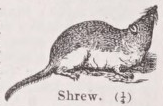
SHREW, a general term applied to the species of the family Soricidae, order Insectivora (see vol. xv. p. 403), but in the British Isles more particularly to the common and to the lesser shrew (Sorex vulgaris, L., and S. pygmaeus, Pall.)....
The common shrew is, in England at least, by far the commoner of the two. It is a small animal about the size of the common mouse, which it somewhat resembles in the shape of its body, tail, and feet. But here the resemblance ends, for, unlike the mouse, it possesses a remarkably long and slender muzzle, with prominent nostrils, which project far beyond the lower lip; the eyes are very small and almost concealed by the fur; the ears are wide and short, scarcely rising above the long hairs surrounding them, and are provided internally with a pair of deep folds, capable, when laid forward, of closing the entrance; the tail, which is slightly shorter than the body (without the head), is quadrangular in shape and clothed more or less densely with moderately long hairs, terminating in a short pencil (in old individuals these hairs become worn away, so that in some specimens the tail is almost quite naked); the feet are five-toed, the toes terminating in slender, acutely pointed, non-retractile claws. The dentition is very peculiar and characteristic: there are in all thirty-two teeth, tipped with deep crimson; of these twelve only (the number is characteristic, with one exception only, of the family) belong to the lower jaw; of the remaining twenty ten occupy each side of the upper jaw, and of these the first three, as they are implanted in the premaxillary bone, are termed incisors. The first incisor is a large tooth with a long anterior caninelike cusp and a small posterior one; then follow two small unicuspidate teeth; these are succeeded by three similar progressively smaller teeth, whereof the first has been called a canine and the other two premolars; the next tooth, also a premolar, is a large multicuspidate tooth; and this is followed by three molars, of which the third is small with a triangular crown. In the lower jaw we find on each side anteriorly three teeth corresponding to the seven anterior teeth above, of which the first is almost horizontal in direction, its upper surface being marked by three notches, which receive the points of the three upper front teeth with which they come in contact when the jaws are closed; then follow two small teeth and three molars. The body is clothed with closely set uniformly long fur, very soft and dense, varying in colour from light reddish to dark brown above, rarely speckled over or spotted or even banded with white. The under surface of both the body and the tail is greyish; the basal four-fifths of all the hairs above and beneath are dark bluish grey; the hairs of the tail are less densely set and coarser. On each side of the body, at a point about one-third of the distance between the elbow and the knee, may be found, especially in the rutting season, a cutaneous gland covered by two rows of coarse inbent hairs. This gland secretes a peculiar fluid, on which the unpleasant cheesy odour of the animal depends, and which is evidently also protective, rendering it secure against the attacks of many predaceous animals.
The lesser shrew (S. pygmaeus) is much less abundant in England and Scotland, but comparatively common in Ireland, where the common shrew has not yet been found. It appears at first sight to be a diminutive variant of that species, which it closely resembles in external form. It was said to differ in having the tail longer than the body (without the head), whereas in the common shrew the body (without the head) is longer than the tail, and in the last unicuspidate upper molar tooth being comparatively larger and more external than in the other species. But the present writer has found these characters so exceedingly liable to variation as to be almost worthless; he has therefore discovered reliable points of distinction as follows:— in S. pygmaeus the third upper incisor (when the teeth are unworn) is shorter, or at least not longer than the next following tooth, whereas in S. vulgans it is always longer, and the length of the forearm and hand combined is very constantly 13 m.m. in the former species, while in the latter it is 17 m.m.
The habits of both the common and the lesser shrew correspond. They live generally in the neighbourhood of woods, making their nests under the roots of trees or in any slight depression, occasionally even in the midst of open fields, inhabiting the disused burrows of field-mice. Owing to their very small size, dark colour, rapid movements, and chiefly nocturnal habits they easily escape observation. They seek their food, which consists of insects, insect larvae, small worms, and slugs, under dead leaves, fallen trees, and in grassy places. Like the mole, they are very pugnacious, and if two or more are confined together in a limited space they invariably fight fiercely, the fallen becoming the food of the victorious. They also, like the mole, are exceedingly voracious, and soon die if deprived of food; and it is probably to insufficiency of food in the early dry autumnal season that the well-known immense mortality amongst these animals at that time of the year is due. The breeding season extends from the end of April to the beginning of August, and five to seven, more rarely ten, young may be found in their nests; they are naked, blind, and toothless at birth, but soon run about snapping at everything within reach, the anterior pair of incisors in both jaws quickly piercing the gum, followed by the last pair of upper premolars, which at birth form prominent elevations in the gum.
The alpine shrew (S. alpinus, Schinz), restricted to the alpine region of Central Europe, is slightly longer than the common shrew and differs from it conspicuously in its much longer tail, which exceeds the length of the head and body, in the colour of the fur, which is dark on both surfaces, and in the large size of the upper antepenultimate premolar.
The water-shrew (Crossopus fodiens, Pall.), the third and last species inhabiting England, differs from the common shrew in being considerably larger with a shorter and much broader muzzle, comparatively smaller eyes, and larger feet adapted for swimming,—the sides of the feet and toes being provided with comb-like fringes of stiff hairs. The tail is longer than the body (without the head) and possesses a well-developed swimming fringe of moderately long regularly ranged hairs, which extend along the middle of its flat under surface from the end of its basal third to its extremity. The fur of the body is long and very dense, varying much in colour in different individuals, and this has given rise to descriptions of many nominal species; the prevailing shades are dark, almost black, brown above, beneath more or less bright ashy tinged with yellowish; occasionally, sometimes in the same brood, we find some individuals with the under surface more or less dark coloured. In the number as well as in the shape of the teeth the water-shrew differs from the common shrew: there is a premolar less on each side above; the bases of the teeth are muck more prolonged posteriorly; and their cusps are much less stained brown, so that in old individuals with worn teeth they often appear altogether white. This species resembles the otter in its aquatic habits, swimming and diving with great agility. It frequents rivers and lakes, making its burrows in the overhanging banks, from which when disturbed it escapes into the water. Its food consists of the different species of water-insects and their larvae, small crustaceans, and probably the fry of small fishes. It is generally distributed throughout England, is less common in Scotland, but as yet it has not been recorded in Ireland.
The geographical range of the common shrew is exceedingly wide, extending eastwards through Europe and Asia (north of the Himalayas) to North America. The lesser shrew extends concomitantly through Europe and Asia to Saghalin Island; and specimens of the water-shrew have been brought from different parts of Europe and from Asia as far east as the Altai range. In Siberia the common shrew is abundant in the snow-clad wastes about the Olenek river within the arctic circle. Indeed the hardiness of this little animal, as well as of other species of red-toothed shrews, is very remarkable. In Dr C. H. Merriam’s Mammals of the Adirondack Region we find the following note on the habits of a common North American species (Blarina brevicauda) of an allied genus:—“The rigors of our northern winters seem to have no effect in diminishing its activity, for it scampers about on the snow during the severest weather, and I have known it to be out when the thermometer indicated a temperature of - 20° Fahr. It makes long journeys over the snow, burrowing down whenever it comes to an elevation that denotes the presence of a log or stump, and I am inclined to believe that at this season it must feed largely upon the chrysalides and larvae of insects that are always to be found in such places.” Other species of red-toothed shrews are restricted chiefly to North America, where they are found in much greater variety than in the Old World, though Crossopus is not represented. Its place is taken by two species of the genus Sorex (S. palustris, Richardson, east of the Rocky Mountains, and S. hydrodromus, Dobson, from Unalaska Island), provided, like the water-shrew, with pedal swimming fringes, but with the unfringed tail and dentition of the common shrew,—the first-named being about as large as the water-shrew, while the Unalaska species scarcely exceeds the size of the lesser shrew. Of the American forms S. bendiri, Merriam, is by far the largest known species of the genus. In it, as in many others inhabiting North America, the canine shows a tendency to diminish in size, which is more pronounced in S. richardsonii, Bachm., and in S. vagrans, Cooper ; in S. hoyi, Baird, it is rudimentary, and in S. crawfordi, Baird, altogether absent. The diminutive S. personatus, Geoff., widely distributed throughout temperate North America, resembles S. pygmaeus in its small size. Other red-toothed shrews belonging to the allied genus Blarvna, distinguished from Sorex by their dentition and by the remarkable shortness of the tail, are very common on and characteristic of the North American continent. All the red-toothed shrews (except the aquatic forms) closely resemble one another in habits, and Dr Merriam has made the highly interesting discovery that the common short-tailed North American shrew supplements its insectivorous fare by feeding on beech-nuts, which will account for the generally very worn state of the teeth in this species. In destroying great numbers of slugs, insects, and insect larvae they greatly aid the farmer in the preservation of his crops and merit protection. Although their penetrating odour renders them in a great measure safe from the attacks of rapacious mammals, they are destroyed in large numbers by nocturnal birds of prey.