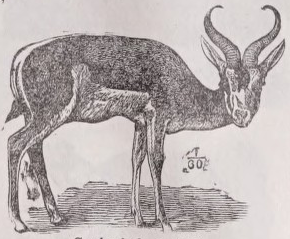
SPRINGBOK. See Antelope, vol. ii. p. 101.
[7 words — estimated reading time: 1 minute]
SPRINGFIELD, a city of the United States, capital of Illinois and the county seat of Sangamon county, 185 miles south-west of Chicago and 95 north-east of St Louis, at the intersection of the main lines of the. Chicago and Alton and the Wabash, St Louis, and Pacific Railways. It is situated in 39° 48' N. lat. and 89° 33' W. long., on a plateau 4 miles south of the Sangamon river. The State capitol (1868-1886) is constructed of Joliet marble in the form of a Greek cross, with porticos of granite; it is 385 feet long and 296 wide, and has a central dome surmounted by a lantern with a ball on the pinnacle (360 feet). It contains a general library, a law library, geological and agricultural museums, and a memorial hall of the Civil War, as well as the usual Government offices. Other buildings of note are the United States executive mansion, custom-house and post-office (1866-68), and the house formerly occupied by Lincoln. In Oak Ridge cemetery, adjacent to the city, is the Lincoln monument (1874), beneath which that president was buried. The monument, designed by Larkin G. Mead, consists of a granite obelisk, reaching a height of 98 1 / 3 feet from the centre of a spacious basement (119 ½ feet long and 72 ½ wide), which contains a catacomb and a memorial hall,—the latter a museum of Lincolniana. A bronze statue of Lincoln and four groups of figures in bronze, symbolizing the army and navy of the United States, are arranged round the foot of the obelisk. The town has a public library, two hospitals, two orphanages, and various other charitable institutions. Extensive deposits of bituminous coal occur in and near Springfield, which is the seat of extensive iron-rolling mills, watch factories, railway machine shops, plough works, and woollen, paper, and flour mills. It ...is also the headquarters of six of the principal live-stock associations of the country. The population was 4533 in 1850, 9820 in 1860, 17,364 in 1870, 19,743 (1328 coloured) in 1880, and in 1887 it was estimated at 25,000.
Laid out in 1822, Springfield was selected as State capital in 1837, and was made a city in 1840.
SPRINGFIELD, a city of the United States, the county seat of Hampden county, Massachusetts, on the east bank of Connecticut river, opposite West Springfield, with which it is connected by road and railway bridges. By rail it is 98 miles west by south of Boston on the route to Albany, and it forms a very important railway junction. The western part of Springfield is built on low and level ground, the eastern on the ascent from the river valley. The streets are wide and well shaded with elm and maple. A United States arsenal (founded 1777) and armoury (1794), employing some 460 hands, is the largest in the republic. The Springfield breech-loading rifle of 45 calibre has been the regulation pattern in the United States army since 1873. A pistol-factory, car-works, manufactories of cotton and silk goods, buttons, needles, envelopes, paper, watches, skates, and brass-work may be mentioned among the industrial establishments. The city hall (1855), a Romanesque building with an audience-room capable of holding 2700 persons; the city free library (1871), a Gothic building of brick, which contains 56,000 volumes and a museum; the granite court-house; the Roman Catholic cathedral of St Michael; Christ Church, Episcopal; the Church of the Unity, a fine Gothic structure in brown stone; the South Congregational church; the office of the Boston and Albany Railroad, a massive granite block; and the high school are among the chief architectural features of the city. Races are held in Hampden Park by the river side. The population was 15,199 in 1860, 26,703 in 1870, 33,340 in 1880 (775 coloured), and 37,577 in 1885.
Springfield was settled in 1636 by William Pynchon and emigrants from Roxbury,—the determination of the founder being to limit the “town” to forty or at most fifty families. The name was at first Agawam; but the present designation was adopted in 1641 in memory of Springfield (Essex), Pynchon’s residence in his native country, England, to which he was obliged to return in 1652 to escape the clerical persecution called forth by his book on the Meritorious Price of Christ's Redemption. The town was burned by the Indians in 1675; and in 1787 the arsenal was attacked by Shays’s rebels. The opening of the Boston and Albany Railroad in 1839 was the beginning of rapid development, and the town was made a city in 1852. The manufacture of firearms carried on here during the Civil War, 1861-65, gave the city a great impulse.
SPRINGFIELD, a city of the United States, county seat of Greene county, Missouri, occupies a pleasant and healthy site on the Ozark Hills, 238 miles by rail southwest of St Louis by the St Louis and San Francisco Railroad, which here joins with the Kansas City, Fort Scott, and Gulf Railroad. Springfield is the chief commercial centre of south-west Missouri, one of the great lead and zinc mining districts of the States. It contains a number of factories (cotton, wool, waggons, furniture, tobacco, &c.), and is the seat of a court-house and of Drury College (1873), which provides scientific and classical training and has a musical conservatory attached. The population was 5555 in 1870, 6522 in 1880, and in 1886 was estimated at 18,000.
Originally an Indian trading post and frontier village, Springfield was incorporated in 1830 and began to be a prosperous place at the close of the Civil War, during which it had several times changed hands and been the scene of hostilities.
SPRINGFIELD, a city of the United States, county seat of Clarke county, Ohio, lies at the confluence of Mad river and Lagonda Creek (sub-tributaries of the Ohio through the Miami), 84 miles north-east of Cincinnati, It has a large trade in the agricultural produce of the fertile and populous district in which it is pleasantly situated, and is the seat of a very large manufactory of agricultural machinery, which turns out 75,000 reapers and mowers per annum, besides grain-drills, steam-engines, cider-mills, and a great variety of articles. In 1870 the population of the city was 12,652, in 1880 20,730 (township, 24,455), and 33,484 in 1886. Among the public institutions are Wittenberg College (Lutheran), founded in 1845, and a small public library.
[375 words — estimated reading time: 3 minutes]