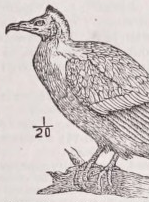
A genus of fowls, belonging to the order of Accipiters. The bill is straight, but hooked at the end, and covered at the base by a cere of skin. The head is naked. There are thirteen species, all carnivorous and rapacious. The vultur is one of the largest kinds of fowls, and the Condor of South America, one of this family, is the largest species of flying animals that has been discovered.
VULTURE, the name of certain birds whose best-known characteristic is that of feeding upon carcases, and these birds, owing to this obscene habit, are in many hot countries regarded with favour as useful scavengers. The genus Vultur, as instituted by Linnaeus, is now restricted by ornithologists to a single species, V. monachus, of which more presently, the other species included therein by him, or thereto referred by succeeding systematists, being elsewhere relegated (cf. Lämmergeyer); but the most important taxonomic change that has been introduced is that by Prof. Huxley (Proc. Zool. Society, 1867, pp. 462-464), who pointed out the complete structural difference between the Vultures of the New World and those of the Old, regarding the former as constituting a distinct Family, Cathartidae (which, however, would be more properly named Sarcorhamphidse), while he united the latter with the ordinary diurnal Birds-of-Prey as Gypaetidae. This arrangement seems to overlook the signification of some considerable distinctions, and to the present writer it would appear more reasonable to recognize the existence of a Family Vulturidae, confined to the true Vultures of the Ancient Continent, equal in rank to the Falconidae, while fully admitting the claim made on behalf of the New-World forms for the same standing....
The American Vulture may be said to include four genera :—(1) Sarcorhamphus, the gigantic Condor, the male distinguished by a large fleshycomb and wattles; (2) Gypagus, the King-Vulture, with its gaudily-coloured head and nasal caruncle; (3) Catharista, containing the so-called Turkey-Buzzard of English-speaking Americans with its allies; and (4) Pseudogryphus, the great Californian Vulture—of very limited range on the western slopes of North America, and threatened with speedyextinction through the use of poison. Though all these birds are structurally so different from the true Vultures of the Old World, in habits the Vulturidae and Sarcorhamphidae are much alike, and of several of the latter—
particularly of the Condor and the Turkey-Buzzard—we possess rather elaborate accounts by excellent observers, as Darwin, Alexander Wilson, and Mr Gosse—whose works are readily accessible.
The true Vultures of the Old World, Vulturidae in the restricted sense, are generally divided into five or six genera, of which Neophron has been not unjustifiably separated as forming a distinct Subfamily, Neophroninae,— its members, of comparatively small size, differing both in structure and habit considerably from the rest One of them is the so-called Egyptian Vulture or Pharaoh’s Hen, N. percnopterus, a bird whose delicacy of build and appearance contrast forcibly with its choice of the most filthy kind of food. It is a well-known species in some parts of India, and thence westward to Africa, where it has an extensive range. It also occurs on the northern shores of the Mediterranean, and on three occasions has strayed to such a distance from its usual haunts as to have twice suffered capture in England, and once even in Norway. Of the genera composing the other Subfamily, Vulturinae, space is wanting to say much. Gyps numbers seven or eight local species and races, on more than one of which the English name Griffon has been fastened. The best known is G. fulυus, which by some authors is accounted “British,” from an example having been taken in Ireland, though under circumstances which suggest its appearance so far from its nearest home in Spain to be due to man’s intervention. The species, however, has a wider distribution on the European continent (especially towards the north-east) than the Egyptian Vulture, and in Africa nearly reaches the Equator, extending also in Asia to the Himalaya; but both in the Ethiopian and Indian Regions its range inosculates with that of several allied forms or species. Pseudogyps with two forms—one Indian, the other African—differs from Gyps by having 12 instead of 14 rectrices. Of the genera Otogyps and Lophogyps nothing here need be said; and then we have Vultur, with, as mentioned before, its sole representative, V. monachus, commonly known as the Cinereous Vulture, a bird which is found from the Straits of Gibraltar to the sea-coast of China. Almost all these birds inhabit rocky cliffs, on the ledges of which they build their nests.
The question whether Vultures in their search for food are guided by sight of the object or by its scent has long excited much interest, and the advocates of either opinion have warmly contended in its behalf. Without denying to them the olfactory faculty, it seems to be now generally admitted, notwithstanding the assertions to the contrary of Waterton and a few more, that the sense of sight is in almost every case sufficient to account for the observed facts. It is known that, directly a camel or other beast of burden drops dead, as the caravan to which it belonged is making its way across the desert, Vultures of one sort or another appear, often in considerable numbers, though none had before been observed by the ordinary traveller, and speedily devour the carcase over which they are gathered together. The mode in which communication is effected between the birds, which are soaring at an immense height, seems at first inexplicable, but Canon Tristram has suggested (Ibis, 1859, p. 280) the following simple solution of the supposed mystery :—
“The Griffon who first descries his quarry descends from his elevation at once. Another, sweeping the horizon at a still greater distance, observes his neighbour’s movements and follows his course. A third, still further removed, follows the flight of the second; he is traced by another; and so a perpetual succession is kept up so long as a morsel of flesh remains over which to consort. I can conceive no other mode of accounting for the number of Vultures which in the course of a few hours will gather over a carcase, when previously the horizon might have been scanned in vain for more than one, or at the most two, in sight.”
The Canon goes on to suppose that in this way may be explained the enormous congregation of Vultures in the Crimea during the siege of Sevastopol, where they had before been scarce :—“the habit of watching the movements of their neighbours” may “have collected the whole race from the Caucasus and Asia Minor ”—he might have added the Balkans—“to enjoy so unwonted an abundance.” Doubt may be entertained whether the last supposition be correct, but none as to the accuracy of the first. (a. n.)
9th ed. Encyclopædia Britannica, vol. 24, p. 301 [1,086 words — estimated reading time: 7 minutes]
דאה, and ראה, Lev. xi, 14; Isa. xxxiv, 15; a large bird of prey, somewhat resembling the eagle. There are several birds of the vulturine kind, which, though they differ much in respect to colour and dimensions, yet are all easily distinguished by their naked heads, and beaks partly straight and partly crooked. They are frequent in Arabia, Egypt, and many parts of Africa and Asia. They have a most indelicate voracity, preying more upon carrion than live animals. They were declared unclean in the Levitical constitution.
V. be -severe, assume, usurp, arrogate, take liberties, domineer, bully, tyrannize, inflict, wreak, stretch a point, put on the screw, be hard upon, bear a heavy hand on, lay a heavy hand on, be down upon, come down upon, ill treat, deal hardly with, deal hard measure to, rule with a rod of iron, chastise with scorpions, dye with blood, oppress, override, trample under foot, tread under foot, tread upon, trample upon, tread down upon, trample down upon, crush under an iron heel, ride roughshod over, rivet the yoke, hold a tight hand, keep a tight hand, force down the throat, coerce, give no quarter
And these are they which ye shall have in abomination among the fowls; they shall not be eaten, they are an abomination: the eagle, and the ossifrage, and the ospray,
Additionally, you are to detest the following birds, and they must not be eaten because they are detestable: the eagle, the bearded vulture, the black vulture,
There shall the great owl make her nest, and lay, and hatch, and gather under her shadow: there shall the vultures also be gathered, every one with her mate.
There the owl will make her nest; she will lay and hatch her eggs and gather her brood under her shadow. Even there the birds of prey will gather, each with its mate.
Their horses also are swifter than the leopards, and are more fierce than the evening wolves: and their horsemen shall spread themselves, and their horsemen shall come from far; they shall fly as the eagle that hasteth to eat.
Their horses are swifter than leopards, fiercer than wolves of the night. Their horsemen charge ahead, and their cavalry comes from afar. They fly like a vulture, swooping down to devour.
And they answered and said unto him, Where, Lord? And he said unto them, Wheresoever the body is, thither will the eagles be gathered together.
“Where, Lord?” they asked. Jesus answered, “Wherever there is a carcass, there the vultures will gather.”
This site uses cookies to remember your display preferences (search sources and editions, Bible version, auto-link, images, light/dark theme). No personal data whatsoever is collected. Privacy Policy