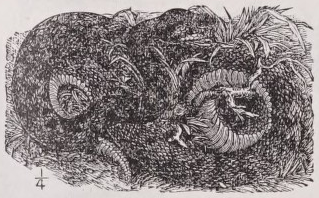
VIPER. The vipers constitute a family (Viperidae) of Old-World, poisonous, viviparous snakes, which have a single movable poison fang on either side of the upper jaw, without any excavation or pit between the eye and the nostril,—thus differing from the Crotalidae. They have a post-frontal and a maxillary bone, which latter is swollen and upright, articulating with the pre-frontal by a ginglymus, and short—not reaching the premaxilla. Vipers are mostly more or less thick-bodied and short-tailed, the head being entirely covered above with small scales, except in a single species. The nose is often recurved, and some scales of the head are elongated so as to form “horns” in several species. The main points in the anatomy of the group have been already described in the article Reptiles, and their zoological relations stated in the article Snakes.
The Viperidae thus consist of three genera, which are distinguished as follows :—
[table]...
The common viper (V. berus) is easily distinguished from the harmless ring-snake by the black and white (or yellow) band behind the head, which is generally conspicuous in the latter animal. It is also distinguishable (apart from individual varieties) from the snake Coronella, rare in England, by having a dark V-shaped mark on its head and a dark zig-zag line down the back. It is this viper which has the top of the head covered by shields (which may be regular or irregular in outline) instead of small scales only. It is one of the most widely distributed of snakes, being found from northern Spain eastwards to the island of Saghalin, and from the northern boundary of Persia to beyond the Arctic Circle in Scandinavia, though it is not found in Ireland. It inhabits all sorts of situations, though it prefers a dry soil, and it may be met with at an elevation of 9000 feet above the sea. It seeks its prey at night, and penetrating the burrows of mice will eat their nestlings. Its bite is sometimes fatal to large dogs, and occasionally to weakly children. It brings forth in April and May from five to fourteen young, which are hatched as they are born.
The other European vipers are V. aspis, V. ammodytes, and V. latastii. V. aspis is very like the common viper, save as to the scales on the head and the fact that its snout is somewhat turned up. It inhabits France, Switzerland, and Italy. V. ammodytes is a somewhat larger species, with a singular pointed process extending upwards from the snout end. It is found in Egypt, Syria, Asia Minor, Turkey, Greece, southern Austria, and Italy. V. latastii is a species intermediate between V. aspis and V. ammodytes. It inhabits Spain, Portugal, Morocco, and Algiers. Thus, of the four European vipers, two are also found in Africa and one in both Africa and Asia. There are three exclusively Indian vipers,— V. xanthina, V. persica, and V. russellii. V. xanthina is an animal about 2½ feet long. As in all the other non-European vipers, the body scales are strongly keeled. It is found in Asia Minor, Syria, and Persia. V. persica is, as its name implies, a Persian animal. The scales above each eye are so modified as to form a horn. V. russellii is hornless, but very large: it is said to attain a length of more than 6 feet. It is widely distributed, inhabiting India, Burmah, Siam, Ceylon, Sumatra, and Java.
Two vipers are common to Asia and Africa. One of these, V. mauritanica, extends from Algiers to Persia. It may be nearly 5 feet long. The other species, V. cerastes, is a much smaller snake, never being much more than 20 inches in length. It is remarkable for two long pointed horns (which stand up over either eye), and is widely distributed in North Africa and Arabia. All the other species of the genus Vipera are exclusively African, and only one is found north of the Sahara. This is V. avizennae. It has no horns, and only attains a length of about 16 inches. V. superciliaris is also a small snake, but it has a large rugose supraorbital plate. It comes from Mozambique. The puff-adder (V. arietans) is a large thick snake, which may be 4 feet long. It is a very deadly animal, and is widely distributed over southern and central Africa, extending to both the east and west coast of that continent. It is without horns. V. nasicornis is a beautifully coloured, large, and bulky snake, which may be upwards of 6 feet long. Two horns project obliquely forwards from just in front of either nostril. It inhabits southern Africa. It is a very venomous animal. V. rhinoceros is another large snake, which comes from both the east and west coasts. It has a pair of horns upstanding between its nostrils, each clothed with but a single shield. V. cornuta has scaly prominences, which are hardly “horns,” and which consist each of a group of four or five large upright distinct scales placed above one of the eyes. It is a small snake, hardly ever more than 20 inches long. It inhabits western, southern, and eastern Africa. V. caudalis is a still smaller snake, which has a single scale extending upwards over either eye. It comes from southern Africa, as also does V. schneideri, which is like the last species, save that it has nothing at all representing horns. V. inornata is also hornless, though it has the supraorbital region somewhat elevated. It is a very small snake, only about 15 inches long. It is a South-African species, as also are V. atropos and V. atropoides, which are both hornless and are about 2 feet long.
The genus Echis consists of but one species (E. carinata), which has been noticed and figured in the article Snakes (see vol. xxii. p. 198). It is a viper-like snake, which inhabits desert lands or dry plains, and extends from India through Abyssinia and North Africa to Senegal.
The genus Atheris is made up of several more or less problematical species of snakes, all of which present a great contrast to the other Viperidae, in that they have long, slender, and laterally compressed bodies with prehensile tails—being altogether adapted for arboreal life. Nevertheless the head is decidedly viperine, sharply marked off from the neck, broad behind, and heart-shaped when looked at from above. These animals are assisted in climbing, not only by their prehensile tails, but also the strongly keeled scales beneath the lower jaw. All the so-called species are inhabitants of tropical Africa,— A. burtoni, A. squamigera, and A. chloroechis being found on the west coast. Two new species have been lately discovered, A. anisolepis and A. caeviceps,— both from the Congo.
The genus Acanthophis is sometimes classed with the vipers, but is here excluded on account of its large, truly colubrine head shields. See Snakes, vol. xxii. p. 198.
The Viperidae are geographically distributed as follows :— Palaearctic Region. — V. berus, V. aspis, V ammodytes, V. latastii, V. xaηthiηa, V. persica, V. mauritanica, V. cerastes, V. avizennae, E. carinata.
Ethiopian Region.— V. superciliaris, V. arietans, V. nasicornis, V. rhinoceros, V. cornuta, V. caudalis, V. schneideri, V. inornata, V. atropos, V. atropoides, A. burtoni, A. squamigera, A. chloroechis.
Indian Region.— V. russellii, E. carinata. (ST G. Μ.)