
A large esculent root growing in tropical climates.
Word of the Day: Catachrestical
A large, esculent, farinaceous tuber of various climbing plants of the genus Dioscorea; also, the plants themselves. Mostly natives of warm climates. The plants have netted-veined, petioled leaves, and pods with three broad wings. The commonest species is D. sativa, but several others are cultivated.
Yam
Encyclopedia Britannica
YAM, a term usually applied to the tubers of various species of Dioscorea. These are plants with thick rootstocks, from which protrude long slender, climbing stems, bearing alternate or opposite, entire or lobed leaves and unisexual flowers in long clusters. The flowers are generally small and individually inconspicuous, though collectively showy. Each consists of a greenish bell-shaped or flat perianth of six pieces, enclosing six or fewer stamens in the case of the male flowers, and a three-celled, threewinged ovary in that of the female flowers. The ovary ripens into a membranous capsule, bursting by three valves to liberate numerous flattish or globose seeds. The species are natives of the warmer regions of both hemispheres, and many of them are important on account of the large amount of starch contained in their tubers. According to Prof. Church’s analysis of the Chinese yam, it contains more nutritive or nitrogenous matter, but less starch, than potatoes: in 100 parts there are of water 82∙6, starch 13∙1, albumen 2∙4, fat 0∙2, woody fibre 0∙4, and mineral matter 1∙3 parts.
D. sαtivα and D. alata are the species most widely diffused in tropical and sub-tropical countries. D. aculeata, grown in India, Cochin China, and the South Sea Islands, is esteemed one of the best varieties. D. japonica, the Chinese yam, is hardy in Great Britain, but the great depth to which its enormous tubers descend renders its cultivation unprofitable; the tubers of D. alata sometimes attain a weight of 100 lb. Most of the yams contain an acrid principle, which is dissipated in cooking....
The only European Dioscorea is that known as D. pyrenaica, found in 1845 in the Pyrenees, a remarkable instance of a species growing at along distance from all its congeners. True yams must not be confounded with the sweet potato, Convolvulus Batatas (see vol. xix. p. 597), as they sometimes are in London markets. The common black briony (Tamus communis) of hedges in England is closely allied to the yams of the tropics, and has a similar rootstock, which is reputed to be poisonous.
9th ed. Encyclopædia Britannica, vol. 24, p. 727
[355 words — estimated reading time: 3 minutes]
[355 words — estimated reading time: 3 minutes]
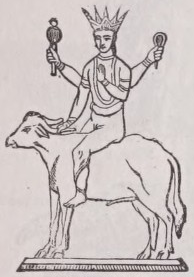
The king of the infernal regions, corresponding to the Greek Pluto, and also the judge of departed souls. In later times he is more exclusively considered the dire judge of all, and the tormentor of the wicked. He is represented as of a green color, with red garments, having a crown on his head, his eyes inflamed, and sitting on a buffalo, with a club and noose in his hands.
Yambo
Encyclopedia Britannica
YAMBO, or Yembo, more properly Yanbo', a town of Arabia on the Red Sea, in 24° 4' N. lat. Having the best harbour on this coast, it has taken the place of Al-Jâr (which lay to the south and is now ruined) as the port of Medina, and is visited by steamships in connexion with the pilgrim traffic and for the import of grain. The town is surrounded by dilapidated walls, and the fixed population probably does not exceed 4000 (Von Maltzan). The Johaina Arabs are the dominant element, though there is a Turkish officer and guard who maintain a certain authority within the walls. Six or seven hours’ journey inland at the base of the mountains (Jebel Radwâ) is the fruitful valley of Yanbo' al-Nakhl, with palm-groves, several hamlets of the Johaina, and country houses of the merchants of the port. This inland town, or group of villages, is the Yanbo' of the old Arab geographers, and lies on the route of the Egyptian pilgrim caravan, one night’s journey from the famous battlefield of Bedr. The port is sometimes distinguished as Yanbo' al-Bahr (Yanbo' on the Sea).
9th ed. Encyclopædia Britannica, vol. 24, p. 727
[194 words — estimated reading time: 2 minutes]
[194 words — estimated reading time: 2 minutes]
An umbelliferous plant (Carum Gairdneri); also, its small fleshy roots, which are eaten by the Indians from Idaho to California.
Vegetable Roget’s Thesaurus §367
N. vegetable, vegetable kingdom, flora, verdure, plant, tree, shrub, bush, creeper, herb, herbage, grass, annual, perennial, biennial, triennial, exotic, timber, forest, wood, woodlands, timberland, hurst, frith, holt, weald, park, chase, greenwood, brake, grove, copse, coppice, bocage, tope, clump of trees, thicket, spinet, spinney, underwood, brushwood, scrub, boscage, bosk, ceja, chaparral, motte, arboretum, bush, jungle, prairie, heath, heather, fern, bracken, furze, gorse, whin, grass, turf, pasture, pasturage, turbary, sedge, rush, weed, fungus, mushroom, toadstool, lichen, moss, conferva, mold, growth, alfalfa, alfilaria, banyan, blow, blowth, floret, petiole, pin grass, timothy, yam, yew, zinnia, foliage, branch, bough, ramage, stem, tigella, spray, leaf, flower, blossom, bine, flowering plant, timber tree, fruit tree, pulse, legume
Adj. vegetable, vegetal, vegetive, vegitous|, herbaceous, herbal, botanic, sylvan, silvan, arborary, arboreous, arborescent, arborical|, woody, grassy, verdant, verdurous, floral, mossy, lignous, ligneous, wooden, leguminous, vosky, cespitose, turf-like, turfy, endogenous, exogenous
Phr. "green-robed senators of mighty woods", "this is the forest primeval"
No Bible verses found for "yam".