
A thorny evergreen shrub (Ulex Europaeus), with beautiful yellow flowers, very common upon the plains and hills of Great Britain; -- called also gorse, and whin. The dwarf furze is Ulex nanus.
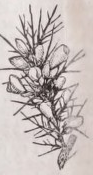
FURZE, Gorse, or Whin, Ulex, Linn. (German, Stechginster ; French, Ajonc), a genus of thorny papilionaceous shrubs, of few species, confined to west and central Europe and north-west Africa. The leaves, except those of seedling plants, which are trifoliate, are exstipulate, and have the form of prickles; the flowers are axillary, yellow, and sweet-scented, and have a coloured calyx deeply divided into two concave segments, the upper bi-serrate and the lower tri-serrate at the apex, the carina and alae obtuse, stamens united into a sheath, style smooth, and stigma capitale. The pods are few-seeded; their crackling as they burst may often be heard in hot weather. Common furze, U. europceu⅛ Linn., is found on heaths and commons in western Europe from Denmark to Italy, and in the Canaries and Azores, and is abundant in nearly all parts of the British Isles. It grows to a height of 2-6 feet; it has hairy stems, and the smaller branches end each in a spine; the leaves, sometimes lanceolate on the lowermost branches, are mostly represented by spines from 2 to 6 lines long, and branching at their base; and the flowers, about ∣-inch in length, have a shaggy, yellowish-olive calyx, with two small ovate bracts at its base, and appear in early spring and late autumn. This species comprises the varieties U. vulgaris, or U. europaeus proper, which has spreading branches, and strong, many-ridged spines, and U. strictus (Irish furze), with erect branches, and slender 4-edged spines. Its seeds, according to Babington (Man. Brit. Bot., p. 80, 6th ed,, 1867), produce either U. europaeus or U. strictus. The other British species of furze is U. nanus, Forst., an inmate of Belgium, Spain, and the west of France; it is a procumbent plant, less hairy than U. europaeus, with smaller and ...more orangecoloured flowers, which spring from the primary spines, and have a nearly smooth calyx, with minute basal bracts. From ü. nanus have been formed the subspecies U. eu- nanus (Dwarf Furze), common in the south of England, and U. Galli, of Planchon, confined in Britain to the western counties, with the exception of Northumberland. During the winter of 1837-38 the furze perished wholly above ground, not only around London, but even in South Wales, Cornwall, and Devonshire; the double U. europaeus was observed to be more hardy than the wild species, and U. strictus suffered more than either. (See Trans. Hort. Soc. Lond., 2d ser., ii. p. 225.) Furze, or gorse, is sometimes employed for fences. On its use as a forage-plant see Agriculture, vol. i. p. 378. In various parts of England it is cut for fuel. The ashes contain a large proportion of alkali, aud are a good manure, especially for peaty land.