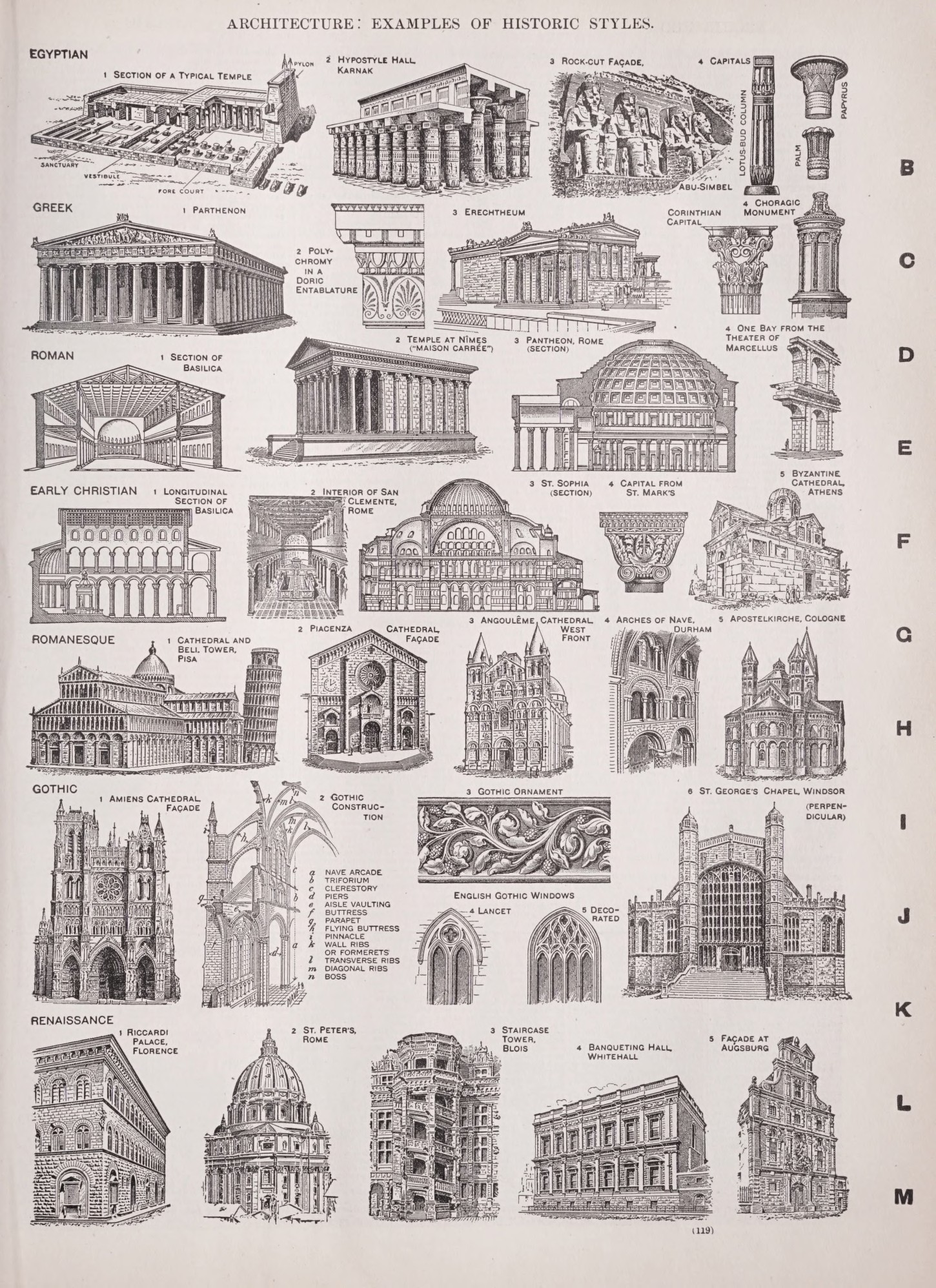
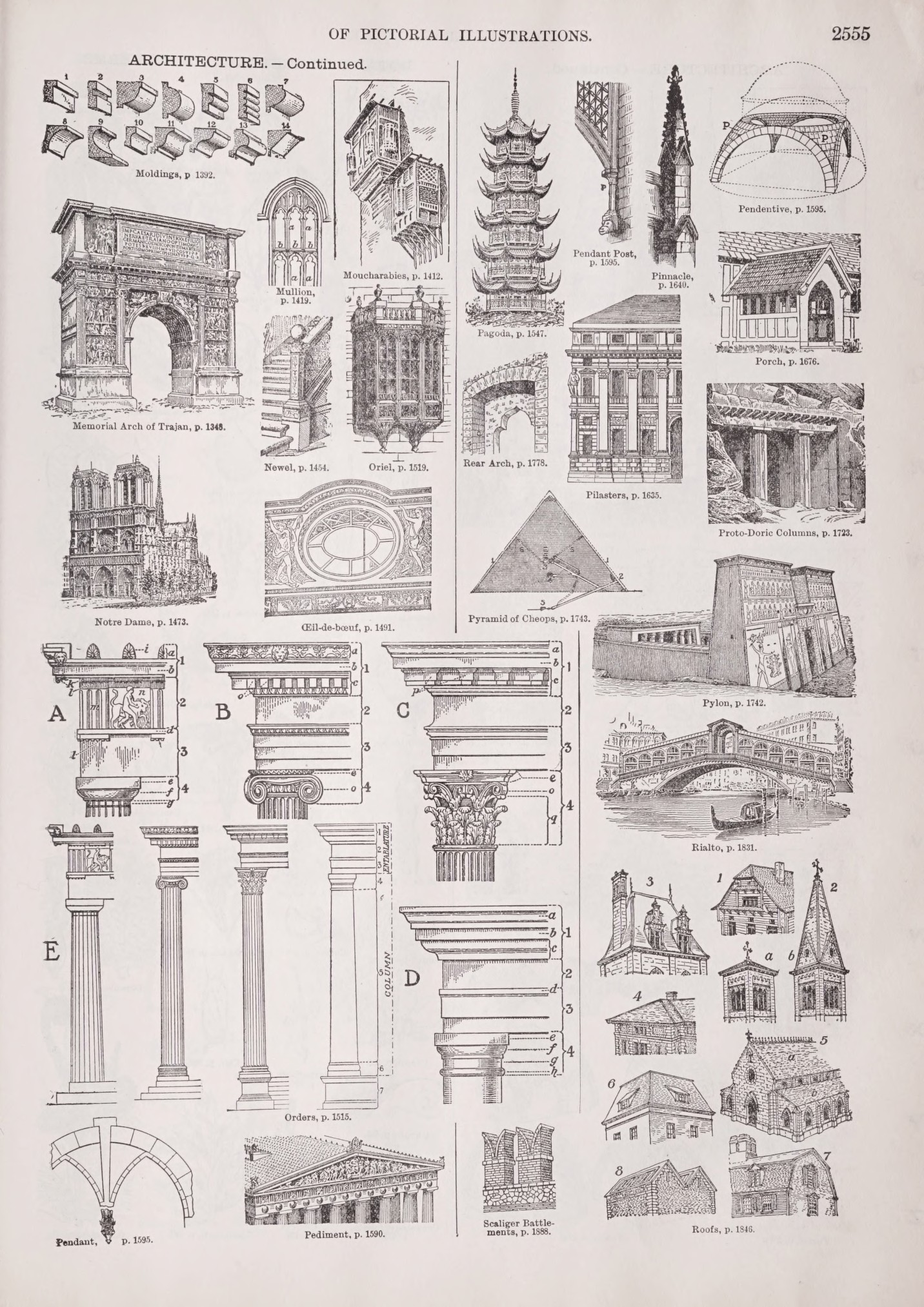
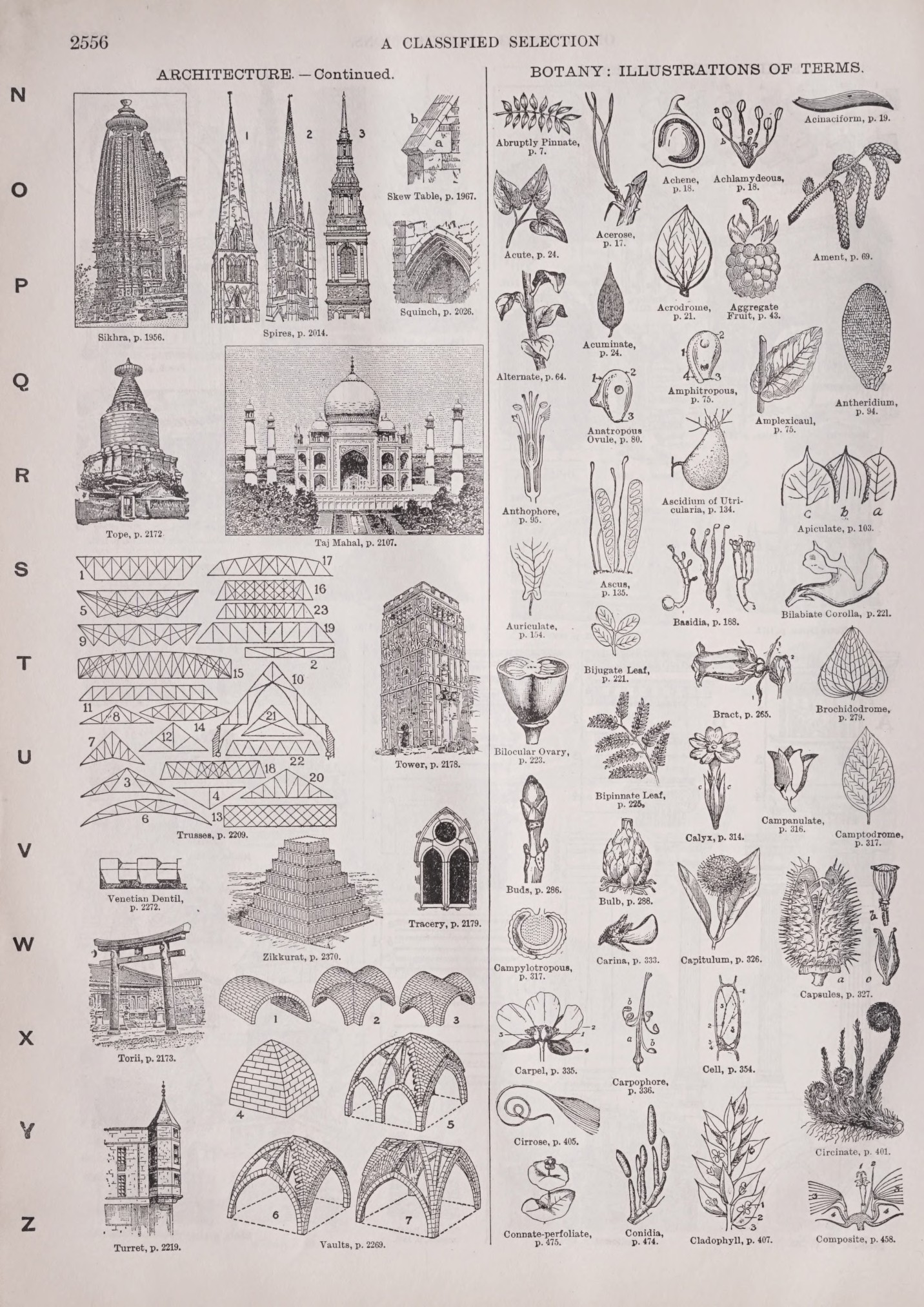
ARCHITECTURE (Latin architectura, from the Greek αpχιτeκτωv, a master-builder) is the art of building according to principles which are determined, not merely by the ends the edifice is intended to serve, but by considerations of beauty and harmony. It cannot be defined as the art of building simply, or even of building well. The end of building as such is convenience, use, irrespective of appearance; and the employment of materials to this end is regulated by the mechanical principles of the constructive art. The end of architecture as an art, on the other hand, is so to arrange the plan, masses, and enrichments of a structure as to impart to it interest, beauty, grandeur, unity, power. Architecture thus necessitates the possession by the builder of gifts of imagination as well as of technical skill, and in all works of architecture properly so called these elements must exist, and be harmoniously combined. The combination of technical with imaginative features removes architecture from the precise position occupied by painting, sculpture, and music, but does this more in appearance than in reality, since the greatest works of the architect must always be those in which the imagination of the artist is most plainly seen....
Like the other arts, architecture did not spring into existence at an early period of man’s history. The ideas of symmetry and proportion which are afterwards embodied in material structures could not be evolved until at least a moderate degree of civilisation had been attained, while the efforts of primitive man in the construction of dwellings must have been at first determined solely by his physical wants. Only after these had been provided for, and materials amassed on which his imagination might exercise itself, would he begin to plan and erect structures, possessing not only utility, but also grandeur and beauty. Before proceeding to inquire into the history of architecture, it may be well to enumerate briefly the elements which in combination form the architectural perfection of a building. These elements have been very variously determined by different authorities. Vitruvius, the only ancient writer on the art whose works have come down to us, lays down three qualities as indispensable in a fine building, viz., Firmitas, Utilitas, Venustas, stability, utility, beauty. In an architectural point of view the last is the principal, though not the sole element; and, accordingly, the theory of architecture is occupied for the most part with aesthetic considerations, or the principles of beauty in designing. Of such principles or qualities the following appear to be the most important: size, proportion, harmony and symmetry, ornament, and colour. All other elements may be reduced under one or other of these heads.
With regard to the first quality, it is clear that, as the feeling of power is a source of the keenest pleasure, size, or vastness of proportion, will not only excite in the mind of man the feelings of awe with which he regards the sublime in nature, but will impress him with a deep sense of the majesty of human power. It is, therefore, a double source of pleasure. The feelings with which we regard the Pyramids of Egypt, the vast monoliths at Rome, the massive templee of Sicily and the Parthenon, and the huge structures of Stonehenge, sufficiently attest the truth of this principle.
The qualities in the general disposition of the parts of a building which are calculated to give pleasure to the beholder, are proportion, harmony, and symmetry. To obtain a clear idea of the general plan in order to appreciate these qualities, the best method is to contemplate the building under conditions that prevent the mind from being disturbed by the consideration of the details—at a distance, for instance, or by moonlight, when its outlines may be seen standing boldly out against the sky. Thus the mass of a Gothic cathedral, the proportion of its parts, the outline of tower, nave, choir, and lady-chapel, the deep shadows which show the projection or recess of its various parts, are in themselves beautiful even when there is not fight enough to distinguish mouldings, carvings, or tracery.
Proportion itself depends essentially upon the employment of mathematical ratios in the dimensions of a building. It is a curious but significant fact that such proportions as those of an exact cube, or of two cubes placed side by side —dimensions increasing by one-half (e.g., 20 feet high, 30 wide, and 45 long)—or the ratios of the base, perpendicular, and hypotenuse of a right-angled triangle (e.g., 3, 4, 5, or their multiples)—please the eye more than dimensions taken at random. No defect is more glaring or more unpleasant than want of proportion. The Gothic architects appear to have been guided in their designs by proportions based on the equilateral triangle.
By harmony is meant the general balancing of the several parts of the design. It is proportion applied to the mutual relations of the details. Thus, supported parts should have an adequate ratio to their supports, and the same should be the case with solids and voids. Due attention to proportion and harmony gives the appearance of stability and repose which is indispensable to a really fine building. Symmetry is uniformity in plan, and, when not carried to excess, is undoubtedly effective. But a building too rigorously symmetrical is apt to appear cold and tasteless. Such symmetry of general plan, with diversity of detail, as is presented to us in leaves, animals, and other natural objects, is probably the just medium between the excesses of two opposing schools.
Next to general beauty or grandeur of form in a building comes architectural ornament. Ornament, of course, may be used to excess, and, as a general rule, it should be confined to the decoration of constructive parts of the fabric; but, on the other hand, a total absence or a paucity of ornament betokens an unpleasing poverty. Ornaments may be divided into two classes—mouldings and the sculptured representation of natural or fanciful objects. Mouldings, no doubt, originated, first, in simply taking off the edge of anything that might be in the way, as the edge of a squaro post, and then sinking the chamfer in hollows of various forms; and thence were developed the systems of mouldings we now find in all styles and periods. Each of these has its own system; and so well are their characteristics understood, that from an examination of them a skilful architect will not only tell the period in which any building has been erected, but will even give an estimate of its probable size, as professors of physiology will construct an animal from the examination of a single bone. Mouldings require to be carefully studied, for nothing offends an educated eye like a confusion of mouldings, such as Roman forms in Greek work, or Early English in that of the Tudor period. The same remark applies to sculptured ornaments. They should be neither too numerous nor too few, and, above all, they should be consistent. The carved ox skulls, for instance, which are appropriate in a temple of Vesta or of Fortune, would be very incongruous on a Christian church.
Colour must be regarded as a subsidiary element in architecture, and although it seems almost indispensable and has always been extensively employed in interiors, it is doubtful how far external colouring is desirable. Some contend that only local colouring, i.e., the colour of the materials, should be admitted; but there seems no reason why any colour should not be used, provided it be employed with discretion and kept subordinate to the form or outline. This subject is of too much importance to be dismissed summarily here, and will be treated in a supplementary notice at the end of this article.
As has been already pointed out, the origin of the art is to be found in the endeavours of man to provide for his physical wants. A picturesque account of the early stages in its progress is given by Vitruvius. According to him, man in his primitive savage state began to imitate the nests of birds and the lairs of beasts, and constructed arbours with twigs of trees. To these arbours succeeded huts with walls composed of dried turf, strengthened with reeds and branches. From huts to houses the progress is gradual and easy. Other writers have endeavoured to trace three orders of primitive dwellings—the cave, the hut, and the tent—constructed severally by the tribes who devoted themselves to hunting and fishing, to agriculture, and to a pastoral and nomadic life. There can be no doubt that climate and surrounding circumstances affected not only the form of the primitive, buildings but also the materials employed. Thus, where trees abounded, stone was probably a material seldom used, as it entailed a much greater amount of labour than timber; but as stone would neither burn nor rot, it was preferred for all durable purposes. Where wood was plentiful, as in Greece and in Lycia, stone architecture exhibits traces of an original timber construction. The columns were originally posts, and the architraves and triglyphs beams resting on each other. The Lycian tomb in the British Museum furnishes a strong proof that there the art of the carpenter preceded that of the mason, and suggested forms, which became conventional, and from which the latter could not venture to depart. On the other hand, in the plains of Egypt, where building timber is scarce, and where there is abundance of large stone in the mountains, the mason element seems to have prevailed. In such plains as those of Nineveh and Babylon artificial stone was made from lumps of dried or burnt clay. Finally, in vast sandy deserts, where there are neither trees nor stones, the skins of beasts, sewed together and supported by sticks, formed the earliest shelter. This soon grew into the tent, and its form still influences the architecture of the Chinese and the Tartars. Much ingenuity has been expended in the inquiry whether it was timber or stone that first gave birth to the art of architecture; the probability is, that the hut, the cairn, and the tent, all contributed their share in different countries.
No traces remain of the steps by which the beautiful temples of Egypt or the magnificent halls of Persia and Assyria were developed from these rude beginnings. The earliest known structures of those countries belong to an age already considerably advanced in civilisation and in the art of construction. And the history of architecture from its earliest specimens in Egypt is not one continuous line of progress. We can indeed show how from these early structures sprang the art of Greece; how that was modified by the Romans; and finally, how the Pointed architecture of the 13th century arose. But the development is not gradual; it proceeds by a series of steps, and one style does not shade imperceptibly into another. No doubt the architects of each country borrowed somewhat (in detail more especially) from the designs of the adjacent countries; but, nevertheless, each country originated forms peculiar to itself, and in all its artistic efforts continued to repeat and elaborate them. So definite are the characteristics of the styles of different nations, that from the mere form, carving, or decoration of any structure, its age and its architects can, usually, be fairly determined.
PREHISTORIC STRUCTURES.
The numerous relics of structures left by primeval man have generally little or rio architectural value. The only interesting problem regarding them, the determination of their date and purpose, and of the degree of civilisation which they manifest, falls within the province of archaeology.
The principal specimens of such prehistoric erections may be classified thus—
(1.) Monoliths (Maenhir, from Maen, a stone, hir, high), or single upright stones (fig. 1). The best example is at Carnac, in Brittany. This huge stone, when perfect, was 63 feet high, and 14 feet in diameter at its widest -part. It is rudely shaped to a circular form, and weighs about 260 tons.
(2.) Cromlechs, table-stones, generally consisting of one large flat stone supported by others which are upright (fig. 2). The cromlech is also named Dolmen, from Taal, or Daul, a table, and Maen, a stone. A good example of the cromlech is the structure known as “Kit’s Coity House,” near Maidstone. Other examples occur in different parts of Great Britain and
Ireland, and numerous specimens are found in Algeria, in India, in the country east of the Jordan, in Guernsey, and near Saumur, on the Loire.
(3.) Circles of Stone.— The most important specimen of these in Britain is Stonehenge (fig. 3). Others are found at Avebury, in Wiltshire (fig. 4); at Stanton Drew, in Somersetshire; at Stennis, in Orkney; and at Callernish, in Lewis; and several have been discovered in the districts around Mount Sinai and Aden. In some circles, as at Stonehenge, as well as separately, are found trilithons (fig. 1), which appear to be a modification of the dolmen.
(4.) Tumuli.— These include the heehiυe huts, so called from their shape, found scattered throughout Cornwall, Wales, and Scotland (fig. 5). Similar, but superior, edifices are to be met with in Ireland; and of these, New Grange, near Drogheda, apparently a burial mound, is the finest specimen (fig. 6). The design of the
“nurhags” (fig. 7), which are found in great numbers in the island of Sardinia, has greatly puzzled archaeologists. It has been conjectured that they were sepulchres, the dead being exposed on their summits. Of the so-called “Picts’ houses” of the Orkney Islands, some are chambered tumuli, while others may be more properly described as underground dwellings (fig. o).
(5.) Wooden huts, the submerged remains of which have been recently discovered in the lakes of Switzerland, as well as in Sweden, in Italy, and in Ireland. These erections, which rose on piles just above the surface of the water, present no features of architectural interest.
Λ specimen of prehistoric sculpture, on stone, taken from ruins in the island of Gozo, in the Mediterranean, is given in fig. 11.
Prehistoric remains are separated by a wide gulf from those which now fall to be noticed, inasmuch as, whether or not they led, by improvement in their forms, to anything really architectural, no evidence remains of such progress, and they must therefore be regarded as practically dissociated from anything that we have now to describe.
Egyptian Architecture.
For the beginnings of the art—its earliest efforts* grand even in their infancy—we must turn to Egypt.
A short description of the general configuration of the country may be useful here. Its habitable land is a narrow strip a few miles wide, extending from the Nile, on one or both its banks, to the rocks or desert. About 100 miles up the river is Cairo, and close to it Memphis, the old capital of Lower Egypt, Heliopolis, and the great pyramids of Ghizeh, Abooseer, Sakkara, and Dashour; 450 miles higher up th© river is the site of the great Thebes, with Karnak and Luxor on the right or eastern bank, and Medinet Haboo on the west. Beyond this in succession are Esne, Edfoo, Elephantina, Syene, and Philae, close to the first cataract. Higher up (in Nubia) are the great caves of Aboosimbel, and at a still greater distance the pyramids of Meroë, or Dankelah. The rock is generally limestone up to Thebes, sandstone and breccia to Syene, where the well-known variety of granite, with hornblende, is found; these with the addition of unburnt brick, are the chief materials used in the construction of the Egyptian architectural monuments. The granite was principally supplied by the quarries at Elephantina and Syene, for which the Nile offered a ready mode of conveyance, although it appears that the obelisks and other enormous blocks were sent by land. Some species were brought down the river from Ethiopia^ but we do not find that the materials were brought from any other foreign country. It may be remarked, too, that in the earliest structures the common grès or sandstone ia principally employed. Excepting the obelisks and some few of the propylaea, all the temples at Thebes are of that material. In Lower Egypt, on the contrary, and in the works of later date generally, almost everything is constructed of granite.
It seems quite certain that Egyptian art is original and not derived from that of India; and it may be concluded with great probability that the structures of Egypt are the oldest specimens of architecture in the world. The origin of the structures themselves has been matter of some discussion. By several writers it has been thought that the rockcut caves of Upper Egypt were the earliest efforts of architectural design, and furnished models for the enormous piles raised along the banks of the Nile. An examination of these caves, however, will show clearly that the very reverse is the case, and that the carvings of the excavations are imitated from the above-ground buildings.
The oldest works of the Egyptians, according to Herodotus, were the embankment of the Nile by Menes, the foundation of the city of Memphis, and the commencement of a temple to Vulcan. Next we learn from Manetho, as cited by Eusebius, that Venephes, the fourth king of the first dynasty, built some pyramids at a place called Cocho-men, but this is all we know of them. Eusebius further records that Tosorthus, or Sosorthus, the second king of the third dynasty, found out how to build with polished or smooth stone (και την διa ζeστωv λίθων οικοδομήν evpeτo).
The next structure of which we have notice is the Great Pyramid, the most gigantic work in the world—one which never has been, and perhaps never will be surpassed. At this time the Egyptians must have reached a proficiency in the mechanical arts of which we can form no conception. They seem to have been able to quarry rocks of the hardest stone, even granite—to transport them to great distances —to raise huge blocks, vast monolith obelisks, that would puzzle our engineers with their best tackle—and, more wonderful still, they appear to have had the power not only of polishing granite, but of carving on that most stubborn material with the utmost facility, large surfaces and even huge statues being covered with hieroglyphics of the most minute kind and of the highest finish. It is impossible to discover how this was done, for though Herodotus (ii. 124, 125) tells us they had iron tools, it was long before the conversion of that metal into steel had been found out; and with all the best modern tools of steel, it is difficult and costly to carve even plain letters in granite. According to the account of Herodotus, the occasion of the erection of this great work was tho caprice of a king, Cheops, who is supposed to be the Suphis of Syncellus, and the Chembes of Diodorus. This king was a tyrant of the very worst kind; he closed all the temples throughout Egypt, forbade every sort of religious observance, and forced all his subjects to labour for him as he pleased. Among other whims, he determined to build this pyramid as a tomb for himself. The stones wero quarried in the Arabian mountains, and none were less than 30 feet long. They were then conveyed by the Nile to a newly-constructed road, three-quarters of a mile long, GO feet broad, and in a cutting of 48 feet. This road, of polished stone, and carved with figures, took ten years to complete. Twenty years were spent in building the pyramid itself.
The site of this extraordinary structure is at Ghizeh, in the neighbourhood of Cairo. The base was, Herodotus tells us, 8 plethra (about 808 English feet) square, and the height the same. This, however, is not the case, the Greek author having probably measured the sloping edge. The dimensions are variously given by the various persons who have measured it. Μ. Nouet, who was of the French commission in Egypt, and had perhaps the best means of ascertaining the truth, states its base to be a square whose side is 716 French or 768 English feet, and gives the height as 421 French or 452 English feet. The dimensions of the pyramid in its original state, as given by Colonel Vyse, are 764 feet length of base, 720 feet slant side, and 480 feet high. According to Sir Henry James {Notes cn the Great Pyramid, 1869), the side of the base is 760 feet: while Professor Piazzi Smyth gives this as 763 81, and the height as 486 ’ 2567. The pyramid thus covers upwards of 13 acres, and is about 150 feet higher than St Paul’s cathedral. As compared with the largest building in the world, St Peter’s, Rome, the Great Pyramid covers an area which is as 58 to 22, or nearly three times as much, and is 50 feet higher. Like almost all the other pyramids, its sides face the cardinal points, and it is entered from the north...