
a canton lying beyond Jordan, in the half tribe of Manasseh, and in the country of Bashan, one of the most fruitful on the other side of Jordan. In the region of Argob there were sixty cities, called Bashan-havoth-Jair, which had very high walls and strong gates, without reckoning many villages and hamlets, which were not inclosed, Deut. iii, 4–14; 1 Kings iv, 13. But Argob was more peculiarly the name of the capital city of the region of Argob, which Eusebius says was fifteen miles west of Gerara.
[89 words — estimated reading time: 1 minute]
ARGOL, the commercial name under which the crude tartar of commerce is known. It is a semi-crystalline deposit which forms on wine vats, and is either grey or red according to the colour of the wine from which it separates.
[41 words — estimated reading time: 1 minute]
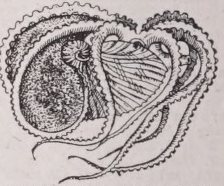
ARGONAUTS, in Greek Legend, a band of heroes who sailed in the ship “Argo” from Iolcus, in Thessaly, to Aea, in Colchis, on the further shore of the Black Sea, to fetch the golden fleece, which was there guarded by a dragon in a grove sacred to Mars. This task had been imposed on Jason that he might prove himself by a perilous adventure worthy of the throne of Iolcus, which he claimed from the usurper Pelias, at whose hands he and his father Aeson had suffered persecution. To accompany him, Jason, when the “Argo” was ready, called upon the principal heroes of his own race, the Minyae, whose distant voyages and colonisation in very early times seem to have suggested the legend of this expedition. Of these Acastus the son of Pelias, Admetus of Pherae, Euphemus (represented as connected with the colonisation of Thera and Cyrene), Periclymenus, Erginus, and Tiphys the steersman, joined him. So far the crew appears well fitted to conduct the “Argo” to Colchis, leaving Jason to reserve his strength for the culminating act, in which also they had mostly, apart from their friendship for Jason, a special interest, because of previous events connected with the golden fleece, the story of which was as follows. Jason’s uncle Athamas had by his wife Nephele two children, Phrixus and Helle. The mother died, and her place was taken by Ino, a daughter of Cadmus, who from hatred of her step-children persuaded Athamas, by means of a false oracle, to offer his son Phrixus as a sacrifice, in consequence of a famine which she had caused by having the grain secretly roasted before it was sown. But before the sacrifice the shade of Nephele appeared to Phrixus, bringing a ram with a golden fleece, on which he and his sister Helle were to escape over the sea. Helle fell off and ...was drowned in the strait, which thence took the name of Hellespont. Phrixus reached the other side, and proceeding on land to Colchis, sacrificed the ram, and hung up its fleece in the grove of Mars. With the family of Athamas the original crew of the “Argo” were more or less connected. But in the later versions of the story it is clear that such a voyage could not in after times be conceived without a variety of adventures, for which other and better known heroes had to be added. Of these the chief were Hercules, Castor and Pollux, Orpheus, Mopsus, and the sons of Boreas, Calais and Zetes. The outward course of the “Argo” was the same as that of the Greek traders, whose settlements as early as the 6th century b.c. dotted the southern shore of the Black Sea. The first landing-place was Lemnus, which the Argonauts found occupied only by women who, at the instigation of Aphrodite, had slain their husbands, fathers, &c. Here some stay was made, and Hypsipyle bore Jason a son, Euneos, who afterwards traded with the Greeks before Troy and with the Phoenicians. That the Minyae had at a very early period formed settlements in Lemnus is known from Herodotus (iv. 145). They landed at Cyzicus next, and here occurred the incident of Hercules and Hylas. The former having broken an oar after they started, went into a wood to cut a new one, Hylas accompanying him to fetch water. Some nymphs admiring the beauty of the youth carried him off. Hercules followed his cries, but could not find him. Nor was he ever found, though the hero exacted hostages till this should be done. On reaching the modern Scutari, they again landed to get water, and were challenged by the king, Amycus, to match him with a boxer. Pollux came forward, and in the end overpowered his adversary, and bound him to a tree. At the entrance to the Black Sea they met Phineus, the blind and aged king whose food was being constantly polluted by the Harpies. He knew the course to Colchis, and offered to tell it, if the Argonauts would free him from the Harpies. This was done by the winged sons of Boreas, and Phineus now told them their course, and that the way to pass through the Symplegades —two cliffs which moved on their bases and crushed whatever sought to pass—was first to fly a pigeon through, and when the cliffs, having closed on the pigeon, began to retire to each side, to row the “Argo” swiftly through. His advice was successfully followed. The next place they landed at, and the last before reaching Colchis, was Heraclea, where the steersman Tiphys died. To the early Greeks Colchis was the eastern extremity of the earth, as the Pillars of Hercules were the western. Behind both was the Oceanus, into which the river Phasis flowed at Colchis. At Colchis was the rising of the sun, and Aeetes the king was a sen of Helios; while his daughter Medea was, by her knowledge of witchcraft, connected with the worship of the moon. Aeetes required of Jason that he should first yoke to a plough his bulls which snorted fire and had hoofs of brass, and with them plough the field of Mars. That done, the field was to be sown with dragons’ teeth, from which armed men were to spring. Successful so far by means of the mixture which Medea had given him as proof against fire and sword, Jason was next allowed to approach the dragon which watched the fleece; Medea soothed the dragon with another mixture, and Jason became master of the fleece. Then the voyage homeward began, Medea accompanying Jason, and Aeetes pursuing them. To delay him and obtain escape, Medea dismembered her young brother Absyrtus, whom she had taken with her, and cast the limbs about in the sea for his father to pick up. In another report Absyrtus had grown to manhood then, and met his death in an encounter with Jason, in pursuit of whom he had been sent. Of the homeward course various accounts are given. In the oldest existing account, the “Argo” sailed along the river Phasis into the Oceanus, thence to the mythical lake Tritonis, after being carried twelve days over land through Libya, and thence again to Iolcus. Hecataeus of Miletus suggested that from the Oceanus it may have sailed into the Nile, and so to the Mediterranean. Others, like Sophocles, described the return voyage as differing from the outward course only in taking the northern instead of the southern shore of the Black Sea. Some supposed that the Argonauts had sailed up the river Tanais, passed into another river, and by it reached the North Sea, returning to the Mediterranean by the Straits of Gibraltar. And again, others laid down the course as up the Danube (Istros), from it into the Adriatic by a supposed mouth of that river, and on to Corcyra, where a storm overtook them. Next they sailed up the Eridanus into the Rhodanus, passing through the country of the Celts and Ligurians, and reaching the Tyrrhenian Sea and the island of Circe, who absolved them from the murder of Absyrtus. Then they passed safely through Scylla and Charybdis, past the Sirens, through the Planctae, over the island of the Sun, Trinacria, and on to Corcyra again, the land of the Phaeacians, where Jason and Medea held their nuptials. They had sighted the coast of the Peloponnesus when a storm overtook them and drove them to the coast of Libya, where they were saved from a quicksand by the local nymphs. The “Argo” was now carried twelve days and twelve nights to the Hesperides, and thence to lake Tritonis, whence Triton conducted them to the Mediterranean. At Crete the brazen Talos, who would not permit them to land, was killed by the Dioscuri. At Anaphe they were saved from a storm by Apollo. Finally they reached Iolcus, and the “Argo” was placed in a grove sacred to Neptune on the isthmus of Corinth. Jason’s death, it is said, was afterwards caused by part of the stern giving way and falling upon him. (a. s. μ.)
[1,356 words — estimated reading time: 8 minutes]
ARGONNE, a rocky and forest-clad plateau in the north-east of France, extending along the borders of Lorraine and Champagne, and forming part of the departments of Ardennes and Meuse. The famous defence of the French frontier by Dumouriez in 1792 is called the Argonne Campaign.
[47 words — estimated reading time: 1 minute]
ARGOS. The most important city of this name was situated in the eastern part of the Peloponnesus, about 3 miles from the sea. By the Greeks themselves it was regarded as the most ancient of all their cities, and as the local habitation of many of their earlier heroes. Here Inachus and his descendants had reigned for many generations, until the arrival of Danaus the Egyptian, with his fifty daughters, whose dynasty, glorious with the names of Perseus the Gorgon-slaycr, and Eurystheus the master of Hercules, held sway over Argos, and Tiryns, and Mycenae, till it, in its turn, was succeeded by the still more important dynasty of Pelops. The Dorian invasion and conquest followed, and Argos became the head of a Dorian confederation, extending its authority over a large portion of the neighbouring territory. Between this region (Argolis) and Sparta, however, there were no natural boundaries, and a conflict arose between the two states about the border land of Cynuria. For a time, under the despotic management of Pheidon, Argos maintained its ground; but Sparta ultimately established its claim in spite of the dubious result of the famous duel of the 600, which was fought for the decision of the dispute, and the strength of the Argives was completely crushed by Cleomenes at the battle of Tiryns. A temporary ascendency of the serfs in Argos, an extension of the franchise, and a permanent adoption of a more democratic constitution, seem to have been the consequences of this national exhaustion and the subsequent reaction. During the Persian war Argos was indifferent and neutral, but in the contest for power which ensued between Athens and Sparta, the old antipathy against the latter was sufficient to make the Argives stanch allies of the former. In the 4th century b.c., the ...democratic constitution of the city degenerated into a reign of terror (2κυταλισ/ζόΐ), which in its turn gave place to a series of tyrannies, from which escape was ultimately found in the Achaean League and the Roman domination. Pyrrhus perished in an unsuccessful attack on the city in 272 b.c. In the 13th century of our era, Argos fell into the possession of the Franks, from whom it passed into the hands of the Byzantine despots; and in 1463 it was taken by the Ottoman troops. Here in the darkest period of Greek ignorance lived one of the few representatives of the ancient learning, Theodosius Zigomali (Crusius’s Turcogrcecia). In the time of Pausanias the number of temples in Argos and its neighbourhood was remarkable, the most important of them being the Heraeum, or temple of Hera, the ruins of which, visible from the acropolis of Argos, but nearer to Mycenae, were discovered in 1831 by Colonel Gordon of Cairness (see plan in Leake’s Peloponnesiaca, 1846). Within the city the greatest was the temple of Apollo Lyceus. Remains still exist of the cyclopean architecture of the acropolis, of the theatre, which was of great extent, and of an aqueduct which can be traced for miles to the north-west. In the 5th century b.c., Argos was the seat of a great school of statuary under Ageladas, but it did not contribute to the long roll of Greek literature more than the names of Telesilla and Sacadas, of whom the latter was better known, as a musician. The limits of Argolis varied at different times, but it was only under the Romans that they were understood to embrace the districts of Phlius, Cleonae, Epidaurus, Troezen, and Cynuria.
[588 words — estimated reading time: 4 minutes]
ARGOSTOLI, the capital of Cephalonia, one of the Ionian islands, and the seat of a bishop of the Greek Church. It possesses an excellent harbour, a quay a mile in length, and a fine bridge. In 1870 the imports were of the value of 8,347,522 drachmas, or £296,94L Near at hand are the ruins of Cranii, affording fine examples of the military architecture of the Greeks; and at the west side of the harbour there is a curious stream, flowing from the sea, which is employed to drive mills. (Sir C. Fellows’s Joumal of an Excursion in Asia Minor in 1838, and WiebeΓs Die Insel Kephalonia und die Meermuhlen von Argostoli, Hamburg, 1873.) Shipbuilding and silk-spinning are carried on. Population, 9000.
[127 words — estimated reading time: 1 minute]