
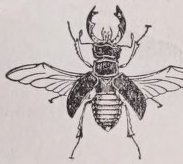
BEETLE, a name commonly applied to those insects which form the order Coleopt'era (“sheathwinged ”), and which are readily distinguished from all others by the nature of the two upper wings. These are formed of a hard, horny substance known as chitin; and, although useless in flight, they serve as shields for the protection of the delicate wings underneath, while in many cases their hardness protects the beetle itself from the attacks of insectivorous birds. In some instances the elytra, as those upper wings are called, are firmly soldered together, and such species are thus rendered incapable of flight. Owing to the beauty of many of the exotic species, and the ease with which they can be preserved, beetles have been collected with great diligence by entomologists, so that nearly 80,000 species, it is estimated, have already been described. Among the members of so large a group it need hardly be said that the greatest diversity exists in form and habits. They are all, however, provided with a masticatory mouth; and in such predatory species as the Tiger Beetles, the mandibles are largely developed, and often armed with acute teeth. Many of them are carnivorous, feeding on other insects, and on decaying animal matter; but the larger proportion live on the fruits, leaves, and stems of plants, in many instances doing great damage to cereal crops and forest trees. In Germany, in the year 1783, a million and a half of trees are said to have been destroyed in the Harz Forest alone by means of two small species of wood-boring beetles; and in North America at the present time the potato crop is being annually blighted by the devastations of the larvae of what is known as the Potato Beetle (Doryphora decemlineata'). Beetles undergo complete metamorphosis, passing from the ...larva to the pupa stage, in which they sometimes remain for several years before emerging as full-formed insects; others, however, undergo all the changes from egg to beetle in a few months. Many of those insects, such as the Goliath and Hercules Beetles, attain gigantic proportions, measuring often 6 inches long, exclusive of antennae, and 2 inches broad; and many bear on the upper surface of their bodies curious horn-like projections. Others, as the Diamond Beetle of Brazil, are adorned with the most brilliant colours, showing a beautiful metallic lustre; and the elytra of such species are now largely used by jewellers in the manufacture of personal ornaments. See Coi.eoptera aud Insects.
[417 words — estimated reading time: 3 minutes]
חרגל. It occurs only Lev. xi, 22. A species of locust is thought to be there spoken of. The word still remains in the Arabic, and is derived from an original, alluding to the vast number of their swarms. Golius explains it of the locust without wings. The Egyptians paid a superstitious worship to the beetle. Mr. Molyneaux, in the “Philosophical Transactions,” says, “It is more than probable that this destructive beetle we are speaking of was that very kind of scarabæus, which the idolatrous Egyptians of old had in such high veneration as to pay divine worship unto it, and so frequently engrave its image upon their obelisks, &c, as we see at this day. For nothing can be supposed more natural than to imagine a nation, addicted to polytheism, as the Egyptians were, in a country frequently suffering great mischief and scarcity from swarms of devouring insects, should, from a strange sense and fear of evil to come, (the common principle of superstition and idolatry,) give sacred worship to the visible authors of these their sufferings, in hopes to render them more propitious for the future. See FLY and LOCUST.
[192 words — estimated reading time: 2 minutes]