
1. The nave of a wheel; a solid piece of timber in which the spokes are inserted.
Word of the Day: Catachrestical
1. The central part, usually cylindrical, of a wheel; the nave. See Illust. of Axle box.
2. The hilt of a weapon.
7. A block for scotching a wheel.
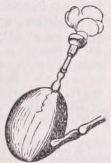
A tobacco pipe, so arranged that the smoke passes through water, making a bubbling noise, whence its name. In India, the bulb containing the water is often a cocoanut shell.
Huber
Encyclopedia Britannica
HUBER, François (1750-1831), an eminent Swiss naturalist, especially distinguished by the originality and reach of his researches into the life history of the honey-bee, was born at Geneva, July 2,1750. He belonged to a family which had already made its mark in the literary and scientific world: his great-aunt, Marie Huber (1695-1753), was known as a voluminous writer on religious and theological subjects, and as the translator andepitomizer of The Spectator (Redaction du Spectateur Anglais à ce qu'il renferme de meilleur, Amst., 3 vols. 1753); and his father Jean Huber (1721-1786), who had served for many years as a soldier, was a prominent member of the coterie at Ferney, distinguishing himself both by the rare skill with which he could reproduce the likeness of Voltaire by clipping paper and by other unpromising devices, and by the publication of a valuable series of Observations sur le vol des oiseaux (Geneva, 1784). From an early age François Huber displayed a dangerous ardour for study; and he was only fifteen years old when he began, in consequence of his ill-judged assiduity, to suffer from an affection of the eyes which gradually resulted in total blindness. Happily at once for his comfort and his fame he had secured the affection of Marie Aimée Lullin. Having patiently waited till she was legally of age, she married the husband of her choice, and ministered to his wants till her death with such unceasing devotion that it was only, he said, when he lost her that he really felt he was blind. For many years her efforts were seconded by François Bumens, a servant, whom Huber had inspired with something of his own love of nature. The results of the investigations which were conducted by this happily assorted trio, at once surprised and delighted the world. So ...skilfully did the blind man devise his experiments, and so carefully did his assistants conduct and register their observations, that the work Nouvelles Observations sur les abeilles (Geneva, 1792; Paris, 1796; new ed., Paris, 1814; English translation, Edinburgh, 1806 and 1821) laid the foundation of all our scientific knowledge of the subject. Huber assisted Senebier in his Mém. sur Vinfluence de Pair, <bc., dans la germination (Geneva, 1800); and we also have from his pen “Mém. sur l’origine de la cire”' {Bibliothèque Britannique, tome xxv.), a “Lettre à Μ. Pictet sur certains dangers que courent les abeilles” (Bib. Brit., xxvii.), and “Nouvelles observ. rel. au sphinx Atropos” (Bib. Brit., xxvii.). He died at the age of eighty-one, December 22, 1831. De Candolle gave his name to a genus of Brazilian trees— H uberia laurina. Pierre Huber (1777-1840) followed in his father’s footsteps. His best known work is Recherches sur les moeurs des fourmis indigènes (Geneva and Paris, 1810; newed., Geneva, 1861), but he also contributed papers on various entomological subjects to several scientific periodicals.
See the account of François Huber by De Candolle in Bibl. Universelle, 1832; and the notice of Pierre in Bibl. Univ., 1866; also Haag, La France Protestante.
HUBER, Johann (1830-1879), a philosophical and theological writer whose name is intimately connected in Germany, and indeed throughout Europe, with the Old Catholic and other recent movements towards freedom and enlightenment, was born in very humble circumstances, on August 18, 1830, at Munich, where, originally destined for the priesthood, he early began the study of theology. By the writings of Spinoza and Oken, however, he was strongly drawn to philosophical pursuits, and it was in philosophy that he “habilitated” (1854), and ultimately became professor (extraordinarius in 1859 and ordinarius in 1864). Along with Döllinger and others he attracted a large amount of public attention in 1869 by the challenge to the Ultramontane promoters of the Vatican council in the treatise Der Papst u. der Koncil, which appeared under the pseudonym of “Janus,” and also in 1870 by a series of letters (“Römische Briefe ”), which were published in the Allgemeine Zeitung. The nature of the numerous controversies in which he became involved both before and after this main episode of his life may be gathered from the subjoined list of his published writings. He died suddenly of heart disease at Munich on March 20, 1879.
His treatise Ueber dieWillensfreiheit (1858) was followed in 1859by Die Philosophie der Kirchenväter, which was promptly placed by the Roman authorities upon the Index, and which led to the prohibition of all Catholic students from attending his lectures; Johannes Scotus Erigena, 1861; Idee der Unsterblichkeit, 1864; Studien, 1865; Der Proletarier: zur Orientirung in der socialen Frage, 1865; Der Jesuitenorden nach Verfassung u. Doktrin, Wissenschaft u. Geschichte, 1873; Der Pessimismus, 1876; Die Forschung nach der Materie, 1877; Zur Philosophie der Astronomie, 1878; Das Gedächtniss, 1878. He also published adverse criticisms on Darwin, Strauss, Hartmann, and Haeckel; pamphlets on Das Papstthum u. der Staat, 1870, and on Die Freiheiten der französischen Kirche, 1871; and a volume of Kleine Schriften, 1871.
9th ed. Encyclopædia Britannica, vol. 12, p. 327
[519 words — estimated reading time: 3 minutes]
[519 words — estimated reading time: 3 minutes]
Hubert
Encyclopedia Britannica
HUBERT or Hugubrecht, “the Bright-witted ”), St, bishop of Liège, was son of Bertrand, duke of Guienne, and held a prominent place in the court of the Frankish king Theodoric, and afterwards in that of Pippin of Heristal. He was passionately fond of the chase, but with the death of his wife Floribane all his taste for mundane enjoyments disappeared, and following the counsels of his friend and teacher, Bishop Lambert of Maestricht, he retired to the monastery of Stavelot, whence he afterwards undertook a pilgrimage to Rome, on occasion of which he was by pope Sergius I. appointed bishop of Tongern. In 708 he succeeded Lambert in the see of Maestricht and Liege, to whose memory he erected a cathedral in the latter city. His death occurred in 727, and in 825 his remains (which, it is alleged, suffered no decay for many years) were removed to a Benedictine cloister in the Ardennes, which thenceforth bore his name, and ultimately became a considerable resort of pilgrims. St Hubert’s day is November 3, but the date and circumstances of his canonization are not stated. His conversion, represented as having been brought about, while he was hunting on Good Friday, by a miraculous appearance of a stag bearing between his horns a beaming cross or crucifix, has frequently been made the subject of artistic treatment. He is the patron of hunters, and is also invoked in cases of hydrophobia and demoniac possession. Several orders of knighthood have been under his protection; among these may be mentioned the Bavarian, the Bohemian, and that of the electorate of Cologne....
9th ed. Encyclopædia Britannica, vol. 12, p. 328
[310 words — estimated reading time: 2 minutes]
[310 words — estimated reading time: 2 minutes]
Hubli
Encyclopedia Britannica
HUBLI, a town in Dhârwâr district, Bombay, 15° 20' N. lat., 75° 12' E. long., situated 13 miles south-east of Dhârwâr, on the main road from Poona to Harihar; it is 230 miles south-east from Poona, 142 miles from Bellâri (Bellary), 90 miles from Kârwar, and 97 miles from Kumpta (Coompta). Population (1872) 37,961. Situated on the main lines of communication to Harihar, Kârwâr, and Kumpta, the town has become the centre of the cotton trade of the southern Marhattâ country. Besides raw cotton and silk fabrics, a general trade in copper vessels, grain, salt, and other commodities is conducted on a large scale. Hubli was formerly the seat of an English factory, which in 1673, with the rest of the town, was plundered by Sivaji, the Marhattâ leader.
9th ed. Encyclopædia Britannica, vol. 12, p. 328
[140 words — estimated reading time: 1 minute]
[140 words — estimated reading time: 1 minute]
Circularity Roget’s Thesaurus §247
N. circularity, roundness, rotundity, circle, circlet, ring, areola, hoop, roundlet, annulus, annulet, bracelet, armlet, ringlet, eye, loop, wheel, cycle, orb, orbit, rundle, zone, belt, cordon, band, contrate wheel, crown wheel, hub, nave, sash, girdle, cestus, cincture, baldric, fillet, fascia, wreath, garland, crown, corona, coronet, chaplet, snood, necklace, collar, noose, lasso, lassoo, ellipse, oval, ovule, ellipsoid, cycloid, epicycloid, epicycle, semicircle, quadrant, sextant, sector, sphere
V. make round, round, go round, encircle, describe a circle
Adj. round, rounded, circular, annular, orbicular, oval, ovate, elliptic, elliptical, egg-shaped, pear-shaped, cycloidal, spherical
Phr. "i watched the little circles die"
Convexity Roget’s Thesaurus §250
N. convexity, prominence, projection, swelling, gibbosity, bilge, bulge, protuberance, protrusion, camber, cahot, thank-ye-ma'am, swell, intumescence, tumour, tumor, tubercle, tuberosity, excrescence, hump, hunch, bunch, boss, embossment, hub, hubble tooth, knob, elbow, process, apophysis, condyle, bulb, node, nodule, nodosity, tongue, dorsum, bump, clump, sugar loaf, bow, mamelon, molar, belly, corporation|, pot belly, gut, withers, back, shoulder, lip, flange, pimple, zit, wen, wheel, papula, pustule, pock, proud flesh, growth, sarcoma, caruncle, corn, wart, pappiloma, furuncle, polypus, fungus, fungosity, exostosis, bleb, blister, blain, boil, airbubble, blob, papule, verruca, papilla, nipple, teat, tit, titty, boob, knocker, pap, breast, dug, mammilla, proboscis, nose, neb, beak, snout, nozzle, schnoz, peg, button, stud, ridge, rib, jutty, trunnion, snag, cupola, dome, arch, balcony, eaves, pilaster, relief, relievo, cameo, bassorilievo, mezzorilevo, altorivievo, low relief, bas relief, high relief, hill, cape, promontory, mull, forehead, foreland, point of land, mole, jetty, hummock, ledge, spur, naze, ness
V. be prominent, project, bulge, protrude, pout, bouge|, bunch, jut out, stand out, stick out, poke out, stick up, bristle up, start up, cock up, shoot up, swell over, hang over, bend over, beetle, render prominent, raise 307, emboss, chase, belly out
Adj. convex, prominent, protuberant, projecting, bossed, embossed, bossy, nodular, bunchy, clavate, clavated, claviform, hummocky, moutonne, mammiliform, papulous, papilose, hemispheric, bulbous, bowed, arched, bold, bellied, tuberous, tuberculous, tumous, cornute, odontoid, lentiform, lenticular, gibbous, club shaped, hubby, hubbly, knobby, papillose, saddle-shaped, selliform, subclavate, torose, ventricose, verrucose, salient, in relief, raised, repousse, bloated &c, (expanded) 194
Rotation Roget’s Thesaurus §312
N. rotation, revolution, spinning, gyration, turning about an axis, turning around an axis, circulation, roll, circumrotation, circumvolution, circumgyration, volutation, circination|, turbination, pirouette, convolution, verticity|, whir, whirl, eddy, vortex, whirlpool, gurge, countercurrent, maelstrom, charybdis, ixion, cyclone, tornado, whirlwind, dust devil, spin-out, axis, axis of rotation, swivel, pivot, pivot point, axle, spindle, pin, hinge, pole, arbor, bobbin, mandrel, axle shaft, gymbal, hub, hub of rotation, helix, helical motion, angular momentum, angular velocity, revolutions per minute, rpm, centrifugal force, surge, vertigo, dizzy round, coriolus force, carousel, merry-go-round, ferris wheel, top, dreidel, teetotum, gyroscope, turntable, lazy suzan, screw, whirligig, rolling stone, water wheel, windmill, wheel, pulley wheel, roulette wheel, potter's wheel, pinwheel, gear, roller, flywheel, jack, caster, centrifuge, ultracentrifuge, bench centrifuge, refrigerated centrifuge, gas centrifuge, microfuge, drill, augur, oil rig, wagon wheel, wheel, tire, tyre, trochilics, whirling dervish
V. rotate, roll along, revolve, spin, turn round, circumvolve, circulate, gyre, gyrate, wheel, whirl, pirouette, twirl, trundle, troll, bowl, roll up, furl, wallow, welter, box the compass, spin like a top, spin like a teetotum|, spin out
Adj. rotating, rotary, rotary, circumrotatory, trochilic, vertiginous, gyratory, vortical, vorticose
Adv. head over heels, round and round, like a horse in a mill
King James Bible KJV Bible
Berean Standard Bible BSB Bible
0 KJV and 2 BSB verses contain “hub”