
The nose; the beak of a fowl; the bill; the mouth.
Word of the Day: Catachrestical
Same as Bablh.
A genus of small marine Crustacea, considered the type of a distinct order (Nebaloidea, or Phyllocarida.)
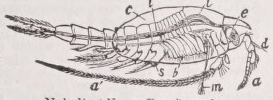
Nebo
Watson's Biblical & Theological Dictionary
the name of an idol of the Babylonians: Bel boweth down, Nebo stoopeth,” Isaiah xlvi, 1. The word _Nebo_ comes from a root that signifies to prophesy,” and therefore may stand for an oracle. There is some probability in the opinion of Calmet, that Bel and Nebo are but one and the same deity, and that Isaiah made use of these names as synonymous. The god Bel was the oracle of the Babylonians. The name Nebo, or Nabo, is found in the composition of the names of several princes of Babylon; as Nabonassar, Nabopolassar, Nebuchadnezzar, Nebuzar-adan, Nebushasban, &c.
Watson's Biblical & Theological Dictionary
[98 words — estimated reading time: 1 minute]
[98 words — estimated reading time: 1 minute]
Nebraska
Encyclopedia Britannica
NEBRASKA, a central State of the American Union, lies between 40° and 43° N. lat.; the Missouri flows along its eastern side, the most easterly point being 95° 25' W. long., and the boundary line separating it from Wyoming on the west is 104° W. long. It is bounded on the S. by Colorado and Kansas, on the E. by Missouri and Iowa, on the N. by Dakota, and on the W. by Wyoming and Colorado. The width of the State from north to south is 208∣ miles, the length from east to west 413 miles, and the area 76,647 square miles, or 49,054,080 acres.
The greater part of Nebraska is a plateau. The lowest point is at the mouth of the Nemaha, in the south-eastern part of the State, where the elevation is 880 feet; the highest spot is Scott’s Bluffs, in the extreme western part of the State (6000 feet). The eastern half of the State has an average elevation of 1400 feet; and the whole State averages 2312 feet above the sea....
There are no mountains, but in the northern and western parts there are some ridges and a few lofty hills. Generally the slopes are gentle, but occasionally precipitous, and in rare cases there are canons with perpendicular sides. The lands of three-fourths of the State are gently rolling. The surface owes its present form mainly to erosion. Between all the forms of upland surface the transition is gradual. The bottom lands and valleys are the most conspicuous modifying features of the surface. They are huge shallow troughs, varying in breadth from a quarter of a mile on the smaller streams to 23 miles on the Platte and the Missouri. Their numerous terraces, like broad steps, gradually lead to the bordering uplands, which in turn are varied in height and form. Occasionally it is hard to determine where the bottom ends and the bordering bluffs begin, but generally both forms are clearly outlined. The innumerable tributaries that creep quietly into the main bottoms greatly complicate and beautify the forms of landscape. The number of these valleys is very great, the Republican alone having more than four hundred tributaries. Not less than 25 per cent, of the entire surface of the State is composed of well-watered valleys. The few destitute of water are regaining the streamlets of former times through the climatic changes brought on by the settlement of the State. Most of these bottom lands, though composed of the richest vegetable mould and alluvium modified by loess materials, are perfectly dry, and rarely subject to overflow. A clear conception of the topography can only be obtained by crossing the State at right angles to the courses of the valleys. The rolling lands bordering the valleys gradually disappear as the divide is approached which separates one drainage system from the next. Here the land swells out into a gently undulating plain that varies in extent from 1 to 30 miles. Some of these higher uplands have a great number of shallow basin-like depressions where soil and grasses closely resemble those of the bottom lands. They are the sites of small lakes that recently existed here, and some of them still retain this character, being filled with fresh water from 1 to 15 feet in depth. South of the valley of the Niobrara, and commencing in 100° W. long., are the noted sand-hills. They vary in height from a few yards to several hundred feet. Almost every form of wind sculpturing is found, but the conical predominates. Though formerly naked, these hills have recently become covered with grasses which are fixing the sands, and preserving Blue, the Great and Little Nemaha, and Salt Creek. The water-power of the State is enormous. Though the streams meander through broad bottoms, places can be found every few miles where the fall is from 3 to 10 feet to the mile.
Nebraska is the meeting-place of two rather distinct floras— that of dry regions from the west, and their relatives from the moister east. Even many native Rocky Mountain plants have crept down to the plains of Nebraska. Of plants indigenous to the State 2000 species have been collected; among these, 1671 species are flowering plants. The Compositae are represented by the largest number of species, there being 244 within the State. The sedges are represented by 151 species, though there are comparatively few individuals. The grasses are the leading vegetable forms in the number of individuals, though as yet only 147 species have been detected. Originally the short buffalo grass (Buchloe dactyloides) was everywhere abundant, but it has almost entirely disappeared from the eastern half of the State and from large sections in its western portions, the taller blue-joint (Andropogon furcatus, &c. ) grasses taking its place. Nothing can surpass the beauty of the prairies during the summer season when covered with rank grasses and myriad flowers. Of forest trees 71 species are native. The leading variety in the number of individuals and forests is the cotton-wood (Populus monilifera), which grows luxuriantly on river bottoms and many uplands. The ash-leaved maple, soft maple, elms, various species of ash, lindens, and willows are in various parts of the State about equal in abundance. The most valuable tree is the noble black walnut, which is extremely hardy and grows luxuriantly. The red cedar is abundant in some sections, and grows well everywhere. Two species of spruce and two of pine are found on tributaries of the Niobrara and Loup, and in the extreme western part of the State. Shrubs are represented by 91 species. Wild fruits abound, among which plums and grapes are most conspicuous, the former represented by three species and an endless number of varieties. The grapes are limited to timber belts, where they sometimes grow so luxuriantly as to make an almost impenetrable thicket of vines. The smaller wild fruits are widely distributed over the State.
Before the advent of the white man Nebraska was a paradise for wild animals,—the buffalo, elk, deer, antelope, beaver, wolves, lynx, foxes, &c. The buffalo has been banished, but the rest are still found in the sparsely settled sections of the State. The bird fauna is well developed, being rich in genera (156); the species number at least 261. Many species of fish, molluscs, and a few reptiles are present in the streams. During a few years, and notably in 1874, 1876, and 1877, the migrating locust (Caloptenus spretus), whose native habitat is beyond Nebraska, did considerable damage. It does not appear on the average more than once in a decade, and owing to the continually increasing area brought under cultivation the damage from its visitations is continually growing less. Comparatively little damage has yet been experienced from other insect pests.
No Archaean rocks are found in situ in the State. The Palaeozoic system is represented only by rocks of Carboniferous age, which are found in south-eastern Nebraska, and cover an area of about 2500 square miles. These represent only the Upper Carboniferous, and are mainly yellowish micaceous sandstone, drab, greenish, lead-coloured, ash-coloured, and brownish clays, and indurated, hard, greyish and yellowish limestones. No thick beds of coal have yet been discovered. The lower coal horizon is about 800 feet below the surface along the Missouri as far south as Richardson county, where the upper strata indicate a possible lower level geologically than is exposed elsewhere in the State. Thin beds of coal, from 6 to 18 inches thick, are found near the surface in Cass, Otoe, Nemaha, Johnson, Pawnee, and Richardson counties; in the last occurs the best coal yet found in the State.
At Aspinwall and on the State boundary it is 24 inches thick in places. In the south-western part of the county a bed occurs from 20 to 28 inches thick, from which at least half a million bushels have been taken within two years to supply local demands. This bed has been traced from east to west about 20 miles, and from north to south 4 miles. The coal is of good quality. On the west side of the Carboniferous formation, and commencing at the mouth of Salt Creek, is a narrow strip of Permian rocks which on the Kansas line is about 15 miles broad. The rocks are mainly variously-coloured magnesian limestone, full of geode cavities, the entire thickness ranging from 20 to 100 feet. The Jura Trias is entirely wanting in eastern Nebraska. Resting conformably on the Permian are the various strata of the basal-members of the Cretaceous system. Variegated clays are overlaid by reddish brown conglomerates and sandstones which form the Dakota group, whose thickness ranges from 20 to 300 feet. Above this group occur blackish and ash-coloured shales; then a yellowish limestone; then a layer of whitish limestone full of shells called the Inoceramus bed; and then on top towards north-eastern Nebraska a great thickness of impure chalk rock varying in hue from greyish white to a blueish pink and yellow. These beds constitute the Colorado group, or the Fort Benton and Niobrara groups of Meek and Hayden, and vary in thickness from 100 to 500 feet. Next above occur the shales containing selenite that constitute the Fort Pierre Cretaceous, which are only found in Nebraska in Holt county and on the upper Republican river. At the close of the Fort Pierre epoch Nebraska was again a dry land surface, and remained so through the Fox Hills (Upper Cretaceous) epoch. In extreme south-western Nebraska a small area is covered in isolated spots by the shales and sandstones of the Laramie, or transition group between the Cretaceous and Tertiary. No Eocene beds exist in Nebraska. Miocene beds exist in the north-western part of the State, but during this period the remainder of Nebraska continued to be a land surface which supported a gigantic forest vegetation and an abιrndant mammalian animal life. The deposits in the Miocene section are mainly indurated grits, silicates of lime, sandstones, conglomerates, and tabular limestones. Towards the close of the Miocene a further subsidence of the region of the plains inaugurated the Pliocene epoch. The great lake now extended as far east as Columbus, covering at least three-fifths of the State and an immense tract outside of its present boundaries. The Pliocene beds are made up of sandstones, conglomerates, marls, and variously-coloured clays. Between the Niobrara and the Loup rivers there are in many places immense quantities of loosely compacted sands, which some geologists, from the abundance of the fossils, have called the Equus beds. On the Republican river curious beds of flour-like geyserite occur. During Pliocene times this was a great geyser region whose activity commenced in the Cretaceous and continued through the Tertiary into the Quaternary. This flour-like material equals for polishing purposes the best tripoli. The thickness of the Pliocene beds in Nebraska ranges from 10 to 700 feet. There is evidence of increasing cold in the upper deposits of the epoch: warm-temperate were gradually displaced by cold-temperate vegetable forms. The lake itself was drained before the end of the Pliocene.
The memorials of the Glacial epoch are here undoubted. Along the lower Platte, and on the Missouri wherever hard limestone constitutes the surface rocks, they are worn smooth and crossed by glacial scratches in a direction averaging 17° east of south. On the surface rock occur—(1) blue clay from 1 to 30 feet thick; (2) modified drift, gravel, and clay from 1 to 9 feet thick; (3) gravel and boulders 1 to 6 feet thick; (4) occasionally black soil containing large quantities of silicified wood; (5) gravel, sand, and drift boulders; (6) calcareous sand; (7) loess from 2 to 200 feet thick; (8) black surface soil from 1 to 30 feet thick. On the return of mild conditions at the close of “the Great Ice Age” a freshwater lake covered much of Nebraska and the adjoining region on the east and south-east. The sediments brought down by the Missouri in the course of ages filled it up. Thus originated the loess deposits which are the source of the great agricultural wealth of the State. The rising of the land or the removal of barriers effected the drainage of the loess lake. Through the old lake bed the present rivers commenced to cut channels which at first filled the whole of their present valleys. That the loess was a subaqueous deposit is evident from the vast number of freshwater shells entombed in it. It is composed of 81 per cent, of èxtremely fine siliceous matter, over 3 per cent, of ferric oxide, 10 per cent, of the carbonates and phosphates of lime, and a small amount of carbonates of magnesia, soda, and potash, clay, and organic matter. It forms one of the best soils in the world, and can never be exhausted until the hills and valleys of which it is composed are worn away. The loess and alluvium of the river valleys have a larger amount of organic matter combined with them, especially at the top, where the black soil is frequently from 5 to 30 feet thick, than is found on the uplands, where it ranges from 2 to 5 feet. The source of this black soil is the swampy condition that prevailed here towards the close of the loess age. The rivers often stood long at the same level before tlιe upward movement was resumed, and thus the many terraces were formed that characterize the valleys.
That, as explained above, the soils of the State are among the best in the world, chemical analysis and experience alike confirm. Experience has not yet settled the question whether the alluvium of the valleys or the loess of the uplands is the more valuable. Grasses and corn (maize) are the principal products. Corn, especially, is a rarely failing crop. The root crops that grow in temperate latitudes thrive amazingly. Eastern Nebraska is eminently adapted to the growth of apples, which here attain a size, colour, and flavour rarely equalled elsewhere. Grapes, plums, and cherries do equally well. Peaches, though not so sure as the former, are successfully grown south of the Platte. The strawberry nowhere reaches a better size or more luscious flavour than here. Other small fruits do almost equally well. The spontaneous growth of nutritious grasses, the ease with which cultivated varieties are grown, and the enormous yield of corn render the State peculiarly adapted for the raising of cattle, horses, sheep, and hogs. The stock industry is growing rapidly, and is at present doing most to enrich the people. No industry promises better results, however, than the planting of new forests, to which many people are devoting themselves with the most gratifying success.
The assessed valuation of the State in 1882 (being only one-third of the real value) was $98,537,475. The cereals produced in 1882 were—wheat, 16,405,500 bushels; maize, 82,995,146; oats, 13,437,950; barley, 1,919,880. The following amount of stock was reported (a few counties not being returned):—cattle, 815,933; sheep, 376,257; hogs, 821,049; horses, 232,942; mules, 31,314. Tree culturels reported thus:—fruit trees, 2,038,111; grape vines, 305,389; forest trees, 40,502,584. Many of the lesser products of the State are not included in this statement.
By the completion of the Union Pacific Railroad in 1869 a highway was made to the Pacific across Nebraska. The Burlington and Missouri River Railroad, begun in the same year, was completed to its junction with the Union Pacific at Kearney in 1872. It extended its mainline during 1882 through the Republican valley to Denver, Colorado. In connexion with both these main lines there are important branches; and in 1883 2000 miles of railway had been constructed in the State. Before the Union Pacific was made, freighting across the plains was a large and profitable business. Omaha was conspicuous for its energy in securing this traffic, and grew to be the first city in Nebraska, and has ever since led the State in commerce and in manufacturing enterprises.
A basis for a free school system was laid by Congress in the Act constituting Nebraska a Territory, by which two sections of land (1280 acres) in each township were set aside for this purpose. The State constitution of 1875 provided that all fines, penalties, and licence moneys arising under the general laws of the State should be transferred to the school fund, and that the legislature should provide for the free instruction in the common schools of the State of all persons between the ages of five and twenty-one years. The census of 1880 shows that only 2 ’ 5 per cent, of the population of Nebraska over ten years of age are unable to read—a smaller proportion of illiteracy than that of any State in the Union, with one exception (Iowa, 2 ’ 4 per cent.).
A State normal school was established at Peru in 1867, and a State school for the deaf and dumb in Omaha in the same year. The State institution for the blind was established in Nebraska City in 1875; a regular course of study, extending from eight to ten years, is provided. A State university and agricultural college was established in 1869 at Lincoln, a building being erected at a cost of $150,000, and opened in September 1871, when the population of the State was only 133,000. It provides classical, scientific, and literary courses of instruction. Provision has just been made to open a medical department with a three years’ course in October 1883. The higher State institutions of learning, as well as the common schools, are open to both sexes, and free. The Insane Hospital was opened at Lincoln in December 1870; the present building, exclusive of the wings approaching completion, cost $165,000. The State penitentiary, established at Lincoln in 1870, •was erected at a cost of $312,000?
The population of the State in 1880 was 452,402 (249,241 males, 203,161 females). In 1870 it was 122,993; in 1860, 28,846. Of the population in 1880, 95,790 were born in Nebraska, 259,198 in other States of the Union, and 97,414 in other lands—the largest number of immigrants being from Canada, Bohemia, Scandinavia, and Germany. In 1860 the population per square mile was 0 ‘4; in 1870, 1'6; in 1880, 5 - 9. The population has been increasing so rapidly since 1880 that the lowest estimates do not make it less than 675,000 by the end of 1883.
The following are the chief towns and their populations in 1880: —Omaha, 30,518; Lincoln (the State capital), 13,083; Nebraska City, 4183; Plattsmouth, 4175; Beatrice, 3386; Grand Island, 3550; and Hastings, 2817. All these towns have greatly increased, and some of them, like Hastings, have doubled their populations since 1880.
History. — Nebraska was probably first visited by Europeans in 1541, in July of which year the Spanish general and explorer Coronado penetrated from New Mexico to a country which he called Quivira, and described as lying about the 40th parallel, and abounding in buffalo, which corresponds with the region of the Platte. It was then occupied by powerful Indian tribes, whose chief ruler was Tatarax. It was subsequently revisited by Padilla, a Franciscan friar who had accompanied Coronado, and who here lost his life. No more records of visits to this region are chronicled for two hundred years. About the middle of the 18th century French missionaries from Canada came to the Missouri, and still later a few traders found their way here. It constituted a portion of the Louisiana territory which was purchased by Jefferson from France in 1803. At that time Indian tribes still occupied the whole region. At some earlier period a more civilized race lived here who made pottery and skilful carvings, built houses and fortifications, and reared mounds which often contain the ashes of their dead. When Nebraska came into possession of the United States the Sioux Indians were most numerous. The Pawnees, Otoes, and Omahas were next in numbers and in importance. These powerful tribes have all become reduced in numbers by disease, constant wars, and privations. The Sioux, who early gained the ascendency over the other tribes, resided in north-eastern Nebraska. The eastern part of the South Platte region was occupied by the Otoes, and the western part by the Pawnees, between which tribes there were constant boundary disputes.
The first settlement by whites was made in 1847 at Bellevue on the Missouri, 9 miles south of Omaha. Here a trading post of the American Fur Company was conducted by Colonel Peter A. Sarpy, a Frenchman distinguished by his knowledge of the Indians, his courage, and his enterprise. The Mormon emigration, begun in 1847, traversed several paths, one of which lay through Nebraska, which thus first became generally known throughout the country. During the overland traffic to California that commenced in 1849, dépôts of supply were established at Bellevue, Plattsmouth, Nebraska City, and in the interior at Fort Kearney.
The Act constituting Nebraska a distinct Territory, and opening its lands to settlement, was approved May 30, 1854. Its area then embraced 351,558 square miles, extending from...
9th ed. Encyclopædia Britannica, vol. 17, p. 306 — signed S. A.
[4,059 words — estimated reading time: 25 minutes]
[4,059 words — estimated reading time: 25 minutes]
Nebuchadnezzar
Encyclopedia Britannica
NEBUCHADNEZZAR is the familiar form, transcribed from the Hebrew of the name of the great BabyIonian king who carried the Jews captive, and whose reign marks the highest point of the Chaldaean empire. Another Biblical form of the word is Nebuchadrezzar (Jer. xlix. 28), and similarly Greek authors write Ναβουκοδρόσοροζ. These forms are nearer to the original name as it is found on the cuneiform monuments, viz., Nabu-kudurri-usur, “Nebo, defend the crown.” To what has been said of Nebuchadnezzar in the article Babylonia (vol. iii. p. 188; comp. Daniel and Israel) it may be added that a fragment of a cylinder with an inscription relating to a war with Egypt in the thirty-seventh year of his reign has been published by Schrader (Aegypt. Ztschr., 1879; K.A.T., 2d ed., p. 363 sq.}, that an inscription of Nebuchadnezzar has been observed by Say ce on the north bank of Nahr al-Kalb near Beyrιit (Proc. Soc. Bib. Arch., 1881), and that two large inscriptions have also been found by Pognon in Wâdi Brissa, near Hermel, in the Lebanon (see Cl. Ganneau in The Times, December 29, 1883).
9th ed. Encyclopædia Britannica, vol. 17, p. 308
[191 words — estimated reading time: 2 minutes]
[191 words — estimated reading time: 2 minutes]
Nebuchadnezzar
Watson's Biblical & Theological Dictionary
THE GREAT, son and successor of Nabopolassar, succeeded to the kingdom of Chaldea, A. M. 3399. Some time previously to this, Nabopolassar had associated him in the kingdom, and sent him to recover Carchemish, which had been conquered from him four years before by Necho, king of Egypt. Nebuchadnezzar, having been successful, marched against the governor of Phenicia, and Jehoiakim, king of Judah, who was tributary to Necho, king of Egypt. He took Jehoiakim, and put him in chains in order to carry him captive to Babylon; but afterward left him in Judea, on condition of paying a large tribute. He took away several persons from Jerusalem; among others Daniel, Hananiah, Mishael, and Azariah, all of the royal family, whom the king of Babylon caused to be carefully instructed in the language and in the learning of the Chaldeans, that they might be employed at court, Dan. i. Nabopolassar dying about the end of A. M. 3399, Nebuchadnezzar, who was then either in Egypt or in Judea, hastened to Babylon, leaving to his generals the care of bringing to Chaldea the captives whom he had taken in Syria, Judea, Phenicia, and Egypt; for, according to Berosus, he had subdued all those countries. He distributed these captives into several colonies; and deposited the sacred vessels of the temple of Jerusalem, and other rich spoils in the temple of Belus. Jehoiakim, king of Judah, continued three years in fealty to King Nebuchadnezzar; but being then weary of paying tribute, he threw off the yoke. The king of Chaldea sent troops of Chaldeans, Syrians, Moabites, and Ammonites, who harassed Judea during three or four years, and at last Jehoiakim was besieged and taken in Jerusalem, put to death, and his body thrown to the birds of the air, according to the predictions of Jeremiah. See JEHOIAKIM. ...In the mean time, Nebuchadnezzar being at Babylon in the second year of his reign, had a mysterious dream, in which he saw a statue composed of several metals, a head of gold, a breast of silver, belly and thighs of brass, legs of iron, and feet half of iron and half clay; and a little stone rolling by its own impulse from the mountain struck the statue and broke it. This dream gave him great uneasiness, yet it faded away from his memory, and he could not recover more than the general impression of it. He ordered all his diviners and interpreters of dreams to be sent for; but none could tell him the dream or the interpretation: and, in wrath, he sentenced them all to death, which was about to be put in execution, when Daniel was informed of it. He went immediately to the king, and desired him to respite the sentence a little, and he would endeavour to satisfy his desire. God in the night revealed to him the king’s dream, and also the interpretation: Thou,” said Daniel, art represented by the golden head of the statue. After thee will arise a kingdom inferior to thine, represented by the breast of silver; and after this, another, still inferior, denoted by the belly and thighs of brass. After these three empires,” which are the Chaldeans, Persians, and Greeks, will arise a fourth, denoted by the legs of iron,” the Romans. Under this last empire God will raise a new one, of greater strength, power, and extent, than all the others. This last is that of the Messiah, represented by the little stone coming out from the mountain and overthrowing the statue.” Then the king raised Daniel to great honour, set him over all the wise men of Babylon, and give him the government of that province. At his request he granted to Shadrach, Meshach, and Abednego, the oversight of the works of the same province of Babylon. In the same year, as Dr. Hales thinks, in which he had this dream, he erected a golden statue, whose height was sixty cubits, and breadth six cubits, in the plains of Dura, in the province of Babylon. Having appointed a day for the dedication of this statue, he assembled the principal officers of his kingdom, and published by a herald, that all should adore this image, at the sound of music, on penalty of being cast into a burning fiery furnace. The result, as to the three Jews, companions of Daniel, who would not bend the knee to the image, is stated in Dan. iii. Daniel probably was absent. The effect of the miracle was so great that Nebuchadnezzar gave glory to the God of Shadrach, Meshach, and Abednego; and he exalted the three Hebrews to great dignity in the province of Babylon, Dan. iv. Jehoiachin, king of Judah, having revolted against Nebuchadnezzar, this prince besieged him in Jerusalem, and forced him to surrender. Nebuchadnezzar took him, with his chief officers, captive to Babylon, with his mother, his wives, and the best workmen of Jerusalem, to the number of ten thousand men. Among the captives were Mordecai, the uncle of Esther, and Ezekiel the prophet. He took, also, all the vessels of gold which Solomon made for the temple, and the king’s treasury, and he set up Mattaniah, Jehoiachin’s uncle by his father’s side, whom he named Zedekiah. This prince continued faithful to Nebuchadnezzar nine years: being then weary of subjection, he revolted, and confederated with the neighbouring princes. The king of Babylon came into Judea, reduced the chief places of the country, and besieged Jerusalem: but Pharaoh-Hophra coming out of Egypt to assist Zedekiah, Nebuchadnezzar overcame him in battle, and forced him to retire into his own country. After this he returned to the siege of Jerusalem, and was three hundred and ninety days before the place before he could take it. But in the eleventh year of Zedekiah, A. M. 3416, the city was taken. Zedekiah attempted to escape, but was taken and brought to Nebuchadnezzar, who was then at Riblah in Syria. The king of Babylon condemned him to die, caused his children to be put to death in his presence, and then bored out his eyes, loaded him with chains, and sent him to Babylon. Three years after the Jewish war Nebuchadnezzar besieged the city of Tyre, which siege held thirteen years. But during this interval, he made war, also, on the Sidonians, Moabites, Ammonites, and Idumeans; and these he treated in nearly the same manner as the Jews. Josephus says these wars happened five years after the destruction of Jerusalem, consequently in A. M. 3421. The city of Tyre was taken in A. M. 3432. Ithobaal, who was then king, was put to death, and Baal succeeded him. The Lord, as a reward to the army of Nebuchadnezzar, which had lain so long before Tyre, gave up to them Egypt and its spoils. Nebuchadnezzar made an easy conquest of it, because the Egyptians were divided by civil wars among themselves: he enriched himself with booty, and returned in triumph to Babylon, with a great number of captives. Being now at peace, he applied himself to the adorning, aggrandizing, and enriching of Babylon with magnificent buildings. To him some ascribe those famous gardens, supported by arches, reckoned among the wonders of the world; and also the walls of Babylon, though many give the honour of this work to Semiramis. About this time Nebuchadnezzar had a dream of a great tree, loaded with fruit. Suddenly, an angel descending from heaven, commanded that the tree should be cut down, but that the root should be preserved in the earth, Dan. iv. The king sent for all the diviners in the country, but none could explain his dream, till Daniel, by divine revelation, showed that it represented his present greatness, his signal approaching humiliation, and his restoration to reason and dignity. A year after, as Nebuchadnezzar was walking on his palace at Babylon, he began to say, Is not this great Babylon, which I have built for the house of the kingdom, by the might of my power, and for the honour of my majesty?” and scarcely had he pronounced these words, when he fell into a distemper or distraction, which so altered his imagination that he fled into the fields and assumed the manners of an ox. After having been seven years in this state, God opened his eyes, his understanding was restored to him, and he recovered his royal dignity. Nebuchadnezzar died, A. M. 3442, after having reigned forty-three years. Megasthenes, quoted by Eusebius, says, that this prince having ascended to the top of his palace, was there seized with a fit of divine enthusiasm, and cried out, O Babylonians, I declare to you a misfortune, that neither our father Belus, nor Queen Baltis has been able to prevent. A Persian mule shall one day come into this country, who, supported by the power of your gods, shall bring you into slavery. He shall be assisted by the Mede, the glory of the Assyrians.” This Persian mule is Cyrus, whose mother was a Mede, and whose father was a Persian. The Mede who assisted Cyrus was Cyaxares, or Darius the Mede. This story at least shows that the Heathens had traditions of an extraordinary kind respecting this monarch, and that the fate of Babylon had been the subject of prophecy. NEBUZAR-ADAN, a general of Nebuchadnezzar’s army, and the chief officer of his household. He managed the siege of Jerusalem, and made himself master of the city, while his sovereign was at Riblah in Syria, 2 Kings xxv; Jer. xxxix; xl; lii.
Watson's Biblical & Theological Dictionary
[1,588 words — estimated reading time: 10 minutes]
[1,588 words — estimated reading time: 10 minutes]
Nebula
Encyclopedia Britannica
NEBULA. See Astronomy, vol. ii. p. 820.
9th ed. Encyclopædia Britannica, vol. 17, p. 309
[7 words — estimated reading time: 1 minute]
[7 words — estimated reading time: 1 minute]
Nebular theory
Encyclopedia Britannica
NEBULAR THEORY. The nebular theory is a famous hypothesis which has been advanced with the view of accounting for the origin of the solar system. It is emphatically a speculation; it cannot be demonstrated by observation or established by mathematical calculation. Yet the boldness and the splendour of the nebular theory have always given it a dignity not usually attached to a doctrine which has so little direct evidence in its favour. It will also be admitted that from the very nature of the case a theory of the origin of the solar system must be devoid of direct testimony. All we could expect to find would be features in that system whose existence the theory would account for; or possibly by looking at other systems we might observe them in phases suggesting the early phases of our own system. It is hard to see what other kind of evidence would be attainable. Now as a matter of fact our system does present many most striking features which could be accounted for by the nebular theory, and the theory also derives as much corroboration from the study of other systems as we could reasonably expect. Hence, as all attainable evidence is on the whole in favour of the nebular theory (though here and there there are exceptional phenomena), astronomers have generally regarded this theory with considerable approval....
There are very remarkable features in the solar system which point unmistakably to some common origin of many of the different bodies which it contains. We must at once put the comets out of view. It does not appear that they bear any testimony on either side of the question. We do not know whether the comets are really indigenous to the solar system or whether they may not be merely imported into the system from the depths of space. Even if the comets be indigenous to the system, they may, as many suppose, be merely ejections from the sun, or in any case their orbits are exposed to such tremendous perturbations from the planets that it is quite unsafe from the present orbit of a comet to attempt any estimate of what that orbit may have been countless ages ago. On all these grounds we must put the comets on one side for the present, and discuss the nebular theory without any reference thereto. But even with this omission we still muster in the solar system from two to three hundred bodies, almost every one of which pronounces distinctly, though with varying emphasis, in favour of the nebular theory. The first great fact to which we refer is the common direction in which the planets revolve around the sun. This is true not only of the great planets Mercury, Venus, the Earth, Mars, Jupiter, Saturn, Uranus, and Neptune; it is also true of the host of more than two hundred small planets. All these bodies perform their revolution in the same direction. It is also extremely remarkable that all the great planets and many of the small ones have their orbits very nearly in the same plane, and nearly circular in form. Viewed as a question in probabilities, we may ask what the chance is that out of two hundred and fifty bodies revolving around the sun all shall be moving in one direction. If the direction of movement were merely decided by chance, the probability against such an arrangement is of stupendous magnitude. It is represented by the ratio of unity to a number containing about sixty figures, and so we are at once forced to the conclusion that this remarkable feature of the planetary motions must have some physical explanation. In a minor degree this conclusion is strengthened by observing the satellites. Discarding those of Uranus, in which the orbits of the satellites are highly inclined to the ecliptic, and in which manifestly some exceptional though unknown influences have been at work, we may say that the satellites revolve around the primaries also in the same direction; while, to make the picture complete, we find that the planets, so far as they can be observed, rotate on their axes in the same manner.
The nebular theory here steps in and offers an explanation of this most remarkable uniformity. Laplace supposed that our sun had once a stupendous nebulous atmosphere which extended so far out as to fill all the space at present occupied by the planets. This gigantic nebulous mass, of which the sun was only the central and somewhat more condensed portion, is supposed to have a movement of rotation on its axis. There is no difficulty in conceiving how a nebula, quite independently of any internal motion of its parts, shall also have had as a whole a movement of rotation. In fact a little consideration will show from the law of probabilities that it is infinitely probable that such an object should really have some movement of rotation, no matter by what causes the nebula may have originated. As this vast mass cooled it must by the laws of heat have contracted towards the centre, and as it contracted it must, according to a well-known law of dynamics, rotate more rapidly. The time would then come when the centrifugal force on the outer parts of the mass would more than counterbalance the attraction of the centre, and thus we would have the outer parts left as a ring. The inner portion will still continue to contract, the same process will be repeated, and thus a second ring will be formed. We have thus grounds for believing that the original nebula will separate into a series of rings all revolving in the same direction with a central nebulous mass in the interior. The materials of each ring would continue to cool and to contract until they passed from the gaseous to the liquid condition. If the consolidation took place with comparative uniformity we might then anticipate the formation of a vast multitude of small planets such as those we actually do find in the region between the orbit of Mars and that of Jupiter. More usually, however, the ring might be expected not to be uniform, and therefore to condense in some parts more rapidly than in others. The effect of such contraction would be to draw into a single mass the materials of the ring, and thus we would have a planet formed, while the satellites of that planet would be developed from the still nascent planet in the same way as the planet itself originated from the sun. In this way we account most simply for the uniformity in the direction in which the planets revolve, and for the mutual proximity of the planes in which their orbits are contained. The rotation of the planets on their axes is also explained, for at the time of the first formation of the planet it must have participated in the rotation of the whole nebula, and by the subsequent contraction of the planet the speed with which the rotation was performed must have been accelerated.
There is quite a different method of approaching the subject, which leads in a very striking . manner to conclusions practically identical with those we have just sketched. We may commence by dealing with the sun as we find it at the present moment, and then reasoning back to what must have been the case in the earlier epochs of the history of our system. The stupendous daily outpour of heat from the sun at the present time is really, when properly studied, a profound argument in support of the nebular theory. The amount of the sun’s heat has been estimated. We receive on the earth less than one two-thousand-millionth part of the whole radiation. It would seem that the greater part of the rest of that torrent flows away to be be lost in space. Now what supplies this heat? We might at first suppose that the sun was really a mightily heated body radiating out its heat as white hot iron does, but this explanation cannot be admitted in face of the notorious fact that there is no historical evidence that the sun is growing colder. We have not the slightest reason to think that the radiation from the sun is measurably weaker now than it was a couple of thousand years ago, yet it can be shown that, if the sun were merely radiating heat as simply a hot body, then it would cool some degrees every year, and must have cooled many thousands of degrees within the time covered by historical records. We therefore conclude that the sun has some other source of heat than that due simply to incandescence. We can also conceive that the heat of the sun might be supplied by something analogous to combustion. It would take 20 tons of coal a day burned on each square foot of the sun’s surface to supply the daily radiation. Even if the sun were made of one mass of fuel as efficient as coal, that mass must be entirely expended in a few thousand years. We cannot therefore admit that the source of the heat in the sun is to be found in any chemical combination taking place in its mass. Where then can we find an adequate supply of heat? Only one external source can be named: the falling of meteors into the sun must yield some heat just as the flash of a shooting star yields some heat to our atmosphere, but the question is whether the quantity of heat obtainable from the shooting stars is at all adequate for the purpose. It can be shown that unless a quantity of meteors in collective mass equal to our moon were to plunge into the sun every year the supply of heat could not be sustained from this source. Now there is no reason to believe that meteors in anything like this quantity can be supplied to the sun, and therefore we must reject this source as also inadequate.
The truth about the sun’s heat appears to be that the sun is really an incandescent body losing heat, but that the operation of cooling is immensely retarded owing to a curious circumstance due jointly to the stupendous mass of the sun and to a remarkable law of heat. It is of course well known that if energy disappears in one form it reappears in another, and this principle applied to the sun will explain the famous difficulty.
As the sun loses heat it contracts, and every pair of particles in the sun are nearer to each other after the contraction than they were before. The energy due to their separation is thus less in the contracted state than in the original state, and as that energy cannot be lost it must reappear in heat. The sun is thus slowly contracting; but as it contracts it gains heat by the operation of the law just referred to, and thus the further cooling and further contraction of the sun is protracted until the additional heat obtained is radiated away. In this way we can reconcile the fact that the sun is certainly losing heat with the fact that the change in temperature has not been large enough to be perceived within historic times.
It can be shown that the sun is at present contracting, so that its diameter diminishes four miles every century. This is of course an inappreciable distance when compared with the diameter of the sun, which is nearly a million of miles, but the significance for our present purpose depends upon the fact that this contraction is always taking place. A thousand years ago the sun must have had a diameter 40 miles greater than at present, ten thousand years ago that diameter must have been 400 miles more than it is now, and so on. We cannot perhaps assert that the same rate is to be continued for very many centuries, but it is plain that the further we look back into past time the greater must the sun have been.
Dealing then simply with the laws of nature as we know them, we can see no boundary to the growth of the sun as we look back. We must conceive a time when the sun was swollen to such an extent that it filled up the entire space girdled by the orbit of Mercury. Earlier still the sun must have reached to the Earth. Earlier still the sun must have reached to where Neptune now revolves on the confines of our system, but the mass of the sun could not undergo an expansion so prodigious without being made vastly more rarefied than at present, and hence we are led by this mode of reasoning to the conception of the primaeval nebula from which our system has originated.
Considering that our sun is but a star, or but one of the millions of stars, it becomes a question of great interest to see whether any other systems present indication of a nebulous origin analogous to that which Laplace proposed for the solar system. In one of his most memorable papers, Sir W. Herschel marshals the evidence which can be collected on this point. He arranges in this paper a selection from his observations on the nebulae in such a way as to give great plausibility to his view of the gradual transmutation of nebulae into stars. Herschel begins by showing us that there are regions in the heavens where a faint diffused nebulosity is all that can be detected by the telescope. There are other nebulae in which a nucleus can be just discerned, others again in which the nucleus is easily seen, and still others where the nucleus is a brilliant star-like point. The transition from an object of this kind to a nebulous star is very natural, while the nebulous stars pass into the ordinary stars by a few graduated stages. It is thus possible to enumerate a series of objects beginning at one end with the most diffused nebulosity and ending at the other with an ordinary fixed star or group of stars. Each object in the series differs but slightly from the object just before it and the object just after it. It seemed to Herschel that he was thus able to view the actual changes by which masses of phosphorescent or glowing vapour became actually condensed down into stars. The condensation of a nebula could be followed in the same manner as we can study the growth of the trees in the forest, by comparing the trees of various ages which the forest contains at the same time. In attempting to pronounce on the evidence with regard to Herschel’s theory, we must at once admit that the transmutation of a nebula into a star has never been seen. It is indeed very doubtful whether any changes of a nebula have ever been seen which are of the same character as the changes Herschel’s theory would require. It seems, however, most likely that the periods of time required for such changes are so stupendous that the changes accomplished in a century or two are absolutely inappreciable.
The nebular theory is a noble speculation supported by plausible argument, and the verdict of science on the whole subject cannot be better expressed than in the words of Newcomb:—“At the present time we can only'say that the nebular hypothesis is indicated by the general tendencies of the laws of nature, that it has not been proved to be inconsistent with any fact, that it is almost a necessary consequence of the only theory by which we can account for the origin and conservation of the sun’s heat, but that it rests on the assumption that this conservation is to be explained by the laws of nature as we now see them in operation. Should any one be sceptical as to the sufficiency of these laws to account for the present state of things, science can furnish no evidence strong enough to overthrow his doubts until the sun shall be found growing smaller by actual measurement, or the nebulae be actually seen to condense into stars and systems.” (r. s. b.)
9th ed. Encyclopædia Britannica, vol. 17, p. 309
[2,718 words — estimated reading time: 16 minutes]
[2,718 words — estimated reading time: 16 minutes]
Clouded with indistinct color markings, as an animal.
The condition of being nebulated; also, a clouded, or ill-defined, color mark.
A little cloud; a cloud.
The act or process of nebulizing; atomization.
Convexity Roget’s Thesaurus §250
N. convexity, prominence, projection, swelling, gibbosity, bilge, bulge, protuberance, protrusion, camber, cahot, thank-ye-ma'am, swell, intumescence, tumour, tumor, tubercle, tuberosity, excrescence, hump, hunch, bunch, boss, embossment, hub, hubble tooth, knob, elbow, process, apophysis, condyle, bulb, node, nodule, nodosity, tongue, dorsum, bump, clump, sugar loaf, bow, mamelon, molar, belly, corporation|, pot belly, gut, withers, back, shoulder, lip, flange, pimple, zit, wen, wheel, papula, pustule, pock, proud flesh, growth, sarcoma, caruncle, corn, wart, pappiloma, furuncle, polypus, fungus, fungosity, exostosis, bleb, blister, blain, boil, airbubble, blob, papule, verruca, papilla, nipple, teat, tit, titty, boob, knocker, pap, breast, dug, mammilla, proboscis, nose, neb, beak, snout, nozzle, schnoz, peg, button, stud, ridge, rib, jutty, trunnion, snag, cupola, dome, arch, balcony, eaves, pilaster, relief, relievo, cameo, bassorilievo, mezzorilevo, altorivievo, low relief, bas relief, high relief, hill, cape, promontory, mull, forehead, foreland, point of land, mole, jetty, hummock, ledge, spur, naze, ness
V. be prominent, project, bulge, protrude, pout, bouge|, bunch, jut out, stand out, stick out, poke out, stick up, bristle up, start up, cock up, shoot up, swell over, hang over, bend over, beetle, render prominent, raise 307, emboss, chase, belly out
Adj. convex, prominent, protuberant, projecting, bossed, embossed, bossy, nodular, bunchy, clavate, clavated, claviform, hummocky, moutonne, mammiliform, papulous, papilose, hemispheric, bulbous, bowed, arched, bold, bellied, tuberous, tuberculous, tumous, cornute, odontoid, lentiform, lenticular, gibbous, club shaped, hubby, hubbly, knobby, papillose, saddle-shaped, selliform, subclavate, torose, ventricose, verrucose, salient, in relief, raised, repousse, bloated &c, (expanded) 194
King James Bible KJV Bible
Berean Standard Bible BSB Bible
146 KJV and 151 BSB verses contain “neb” — showing the first 20. Show all 153 verses (searchable)
And Jeroboam the son of Nebat, an Ephrathite of Zereda, Solomon’s servant, whose mother’s name was Zeruah, a widow woman, even he lifted up his hand against the king.
And it came to pass, when Jeroboam the son of Nebat, who was yet in Egypt, heard of it, (for he was fled from the presence of king Solomon, and Jeroboam dwelt in Egypt;)
When Jeroboam son of Nebat heard about this, he was still in Egypt where he had fled from King Solomon and had been living ever since.
Now in the eighteenth year of king Jeroboam the son of Nebat reigned Abijam over Judah.
In the eighteenth year of the reign of Jeroboam son of Nebat, Abijam became king of Judah,
And he did evil in the sight of the LORD, and walked in the way of his father, and in the way of his mother, and in the way of Jeroboam the son of Nebat, who made Israel to sin:
And he did evil in the sight of the LORD and walked in the ways of his father and mother and of Jeroboam son of Nebat, who had caused Israel to sin.