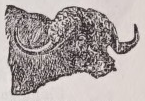
BUFFALO, the English name of Bubalus, a genus of Ruminant Mammals, belonging to the family Bovidoe, and including the well-known Indian and South African species. The Indian Buffalo (Bubalus buffalus) is characterized by its arched forehead, large horns compressed at the base, slightly triangular, and curved in the form of a half moon, and its thick hide covered sparingly with coarse hairs, which become still more scanty in aged individuals. It is a native of India and of the islands forming the Indo-Malay Archipelago, where it now occurs in a state of domestication, and forms a valuable beast of burden; but although it has for ages been under the control of man, the Bainsha or tame buffalo shows little or no variation from the wild form. The Ama or Wild Buffalo is found in great herds throughout India and the adjacent islands, frequenting swampy grounds in the neighbourhood of woods, eating the long, coarse grass which abounds in such localities, and loving above all things to roll itself in mire, or to plunge up to the ears in any pool or stream it may come upon. This fondness for moisture is equally marked in the tame variety, and is decidedly inconvenient when the animal, laden with goods, yields to its instinct and lies down in any stream that may cross its path. The rutting season occurs in autumn, when several females follow a single male, forming for the time a small herd. The period of gestation lasts for ten months, and the female produces one or two calves at a birth. The Ama is a powerful and courageous animal, capable it is said of overthrowing an elephant, and generally more than a match even for the male tiger, which usually declines the combat when not impelled to it by hunger. The Indian driver of a herd of tame buffaloes does not shrink from entering a ...tiger-frequented jungle, his cattle, with their massive horns, making short work of any tiger that may come in their way. Buffalo fights and fights between buffaloes and tigers form principal features in the public entertainments of Indian princes. In Ceylon the buffalo is put to more useful purposes, where, according to Tennent, the natives make an ingenious use of it when shooting waterfowl in the salt marshes, ii Being an object to which the birds are accustomed, the Singhalese train the buffaloes to the sport, and concealed behind the animal, browsing listlessly along, they guide it by ropes attached to its horns, and thus creep undiscovered within shot of the flock.” These are known as “sporting buffaloes.” The domestic buffalo has spread from its original home in India over the greater part of Southern Asia and of North Africa, and was introduced towards the close of the 6th century into Greece and Italy, forming an invaluable beast of burden in the marshy districts of those countries, where the great breadth of its feet, somewhat resembling in this respect those of the reindeer, give it a decided advantage over the horse and ox. It grazes in herds in the Pontine marshes, where, according to Scaliger, it will lie for hours submerged almost to the muzzle. The milk of the buffalo is plentiful and of excellent quality, the Hindoos making it into a kind of butter called ghee; its flesh, however, is not held in much estimation.
The Cape Buffalo (Bubalus caffer) is nearly equal in size and fully equal in strength and courage to its Indian congener, from which it is readily distinguished by the form of its horns, these being immensely broad at the base, where they approximate so closely as almost to meet, thus forming, especially in old bulls, a solid rugose mass impenetrable to bullet, and extending from the eye to the back of the head, then spreading horizontally and curving upwards and inwards to the tips, which are usually 4 feet apart. The hide, which is thick and tough, is thinly clad with hair, old animals being entirely naked with the exception of a slight fringe along the back and withers. This buffalo roams in herds over the plains of Central and Southern Africa, always in the near vicinity of water. Formerly herds sometimes numbered five or six hundred, but such has been the havoc wrought among them in recent years by hunters that rarely are they to be seen in companies of more than ten, while in the colonized portion of South Africa they are rapidly dying out. Nor is man their only enemy, for by night when he ceases to disturb they are liable to the attack of the lion, and by this means the wounded, of which there are great numbers, and the diseased are cut off. The Hon. W. H. Drummond, in his work on The Large Game of South Africa (1875), gives it as his opinion that in “a few years a buffalo will be as scarce as an elephant now is.” This species has never been domesticated, probably owing more to the uncivilized condition of the native inhabitants than to any special intractability in the buffalo itself. Like its Indian ally it is fond of the water, which it visits at regular intervals during the twenty-four hours; it also plasters itself with mud which, when hardened by the sun, protects it from the bite of the great gadflies which in spite of its thick hide seem to cause it considerable annoyance. It is also relieved of a portion of the parasitic ticks, so common on the hides of thick-skinned animals, by means of the red-Deaked rhinoceros birds, a dozen or more of which may be seen partly perched on its horns and partly moving about on its back, and picking up the ticks on which they feed. The hunter is often guided by these birds in his search for the buffalo, but offener still they give timely warning to their host of the dangerous proximity of the hunter, and have thus earned the title of “the buffalo’s guardian birds.” The Cape Buffalo is the most formidable of the large game of South Africa. Generally, however, it attacks only when wounded, although“rogues” or “solitaires ”—terms applied to old bulls which for some reason or other have been expelled from the herd and which wander about morose and savage— often attack without provocation. When wounded they immediately charge in the direction from which the fire proceeded, and on his skill in avoiding this charge the life of the hunter depends. In buffalo hunting, as in bison hunting, it is specially important “to kill with a single bullet.” The hide of the Cape Buffalo is made by the Kaffres into shields impervious to musket shot.
BUFFALO, an American city, the capital of Erie County, in the State of New York, U.S., about 293 miles N.W. from New York, in 42° 53' N. lat. and 78° 55 ’ W. long. It is a port at the east end of Lake Erie, at the mouth of Buffalo River, and at the head of Niagara River, which is here crossed by a fine iron railroad bridge. The city runs for about five miles along the shore of the lake and Niagara River. In population Buffalo is the third city in New York, and the eleventh in the United States. It was founded in 1801, became a military post in 1813, and was burned by the British on the last day of the year 1813. After the war, the place was rebuilt, and in 1832 it attained the rank of a city. In 1820 it contained 2095 inhabitants. After the opening of the Erie Canal in 1825, its growth was rapid, the population being 8653 in 1830, 18,213 in 1840, 42,261 in 1850, 81,129 in 1860, 117,714 in 1870, and 134,238 in 1875. The city commands a fine view of the lake; the climate is pleasant and healthful; the streets, broad and generally lined with trees, are well paved, lighted, and supplied with sewers. There are many fine residences with attractive grounds, and numerous squares and public places. A combination of parks or pleasure grounds has been laid out, extending to over 500 acres. It comprises three sections, situated respectively in the northern, western, and eastern parts of the city, connected by boulevards which together afford a drive of nearly 10 miles. The most prominent public buildings are the City and County Hall, a granite structure, in the form of a double Roman cross, with a tower 245 feet high, just erected at a cost of over $2,000,000; the United States Custom House and Post Office, the State Arsenal, and the Erie County Penitentiary, which is one of the six penal establishments of New York, intermediate between the reformatories and the state prisons. A state asylum for the insane is in process of construction at North Buffalo, with a front of about 2700 feet and a capacity for 600 patients. It will be one of the largest institutions of the kind in the United States, and will cost not less than $3,000,000. The city contains 76 churches, the most imposing edifices being St Joseph’s Cathedral (Roman Catholic) and St Paul’s (Episcopal). The public schools comprise a central grammar school and thirty-six district schools. Four orphanasylum schools are also maintained. One of the eight state normal schools is situated here. Among other educational institutions are Canisius College, founded by the Jesuit fathers; St Joseph’s College, conducted by the Christian brothers; Martin Luther College (theological); St Mary’s Academy and Industrial School for girls, and the Medical College of the University of Buffalo. The charitable institutions of the city are numerous. There are several libraries, the most important being that of the Young Men’s Association, with about 30,000 volumes, and the Grosvenor Free Library, which contains about 15,000 volumes of valuable reference works. The former society has a commodious hall and library building adjoining. The Society of Natural Sciences has made an extensive collection of minerals and foseil casts, and the Buffalo Historical Society has a large library and cabinet. There are published in the city eight daily newspapers, including four in German, one tri-weekly, fourteen weeklies, four monthlies, and three quarterlies. The city is divided into thirteen wards, and is governed by a mayor and twenty-six aidermen. It has a paid fire department, with steam fire-engines and a fire-alarm telegraph, has an efficient police, and is well supplied with water from the Niagara River. The assessed value of property in 1873 was about $38,000,000.
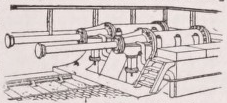
The position of Buffalo on the great water and railway channels of communication between the West and the East gives it a commercial importance surpassed by that of few other American cities. Its harbour is capacious, and is protected by extensive breakwaters. The city is the centre of an important system of railroads. Besides other lines which converge here, it is the eastern terminus of the Lake Shore and Michigan Southern Railway, of the Canada Southern, and of a branch of the Grand Trunk Railway of Canada; it is the wèstern terminus of the Erie Canal, the New York Central Railway, and a division of the Erie Railway. There has been a large decrease in the extent of the lake commerce since 1862, owing to the increase of railroad facilities. The registered marine of the port, June 30, 1874, comprised 801 vessels of 162,789 tons, of which 533 were canal boats. The annual value of the imports from Canada is between $2,000,000 and $3,000,000; the exports are less than $500,000. Since 1870 Buffalo has been a port of foreign entry for imports, which are conveyed thither, in bond, by rail from New York, &c. The number of lake vessels that arrived in 1874 was 3720; the clearance numbered 3727; 7643 canal boats arrived, and about the same number cleared; the latter carried 1,448,172 tons of freight, valued at $46,244,875. The immense quantities of grain moving from the Western States to the seaboard constitute the most important feature of the commerce of the city. The aggregate receipts (including flour) by lake and Grand Trunk and Canada Southern Railways in 1874 were 70,030,555 bushels. The receipts during the ten years ending with 1874 amounted to 522,874,944 bushels. For receiving, storing, and transferring this vast amount of produce to canal boats and railway cars, there are thirty elevators, capable together of storing 6,875,000 bushels, and of transferring no less than 2,672,000 bushels a day. Many of these elevating warehouses are costly structures of stone, or of iron and brick. Several of them have grain “driers” attached. Live-stock and lumber from the Western States and Canada, and coal from Pennsylvania, are also leading items in commerce. In 1874, 504,594 cattle, 783,800 sheep, 1,431,800 hogs, and 21,937 horses, amounting in in value to nearly $60,000,000 passed through Buffalo. For the accommodation of this traffic, extensive and well-arranged yards have been erected at the east end of the city. The receipts of lumber by lake in 1874 amounted to 145,624,639 feet, besides about 40,000,000 shingles, and 25,000,000 staves. The imports of coal comprised 800,000 tons. The coal trade is rapidly increasing. The manufacturing interests of Buffalo are extensive, and have grown with marked rapidity in recent years. The leading establishments are blast furnaces, rolling-mills, foundries, breweries, tanneries, manufactories of agricultural implements, and flour-mills. Of the last-named there are eleven, with a yearly capacity of 839,000 barrels, the average annual production of flour being about 250,000 barrels. Wooden ship-building was formerly carried on here, but it has been superseded by iron ship-building. Two extensive establishments are devoted to this industry; these have constructed the finest lake steamers, besides supplying the Government with a number of iron revenue vessels. The number of ships built at Buffalo in 1874 was thirty-seven, but they were mostly small ones. Many canal boats are also built there.