1. A tree or shrub armed with spines or sharp ligneous shoots; as the black thorn; white thorn etc. The word is sometimes applied to a bush with prickles; as a rose on a thorn
2. A sharp ligneous or woody shoot from the stem of a tree or shrub; a sharp process from the woody part of a plant; a spine. thorn differs from prickle; the latter being applied to the sharp points issuing from the bark of a plant and not attached to the wood, as in the rose and bramble. But in common usage, thorn is applied to the prickle of the rose, and in fact the two words are used promiscuously.
3. Fig.: That which pricks or annoys as a thorn; anything troublesome; trouble; care.
4. The name of the Anglo-Saxon letter /, capital form /. It was used to represent both of the sounds of English th, as in thin, then. So called because it was the initial letter of thorn, a spine.
THORN (Polish Torùn ), an interesting old town in the province of West Prussia, is situated on the right bank of the Vistula, near the point where the river enters Prussian territory, 26 miles south-east of Bromberg and 92 miles south of Dantzic. Its position near the frontier of Russian Poland makes it a strategic point of importance; and, strongly fortified since 1818, in 1878 it was converted into a fortress of the first class. The “old town,” founded in 1231, and the “new town,” founded thirty-three years later, were united in 1454, and both retain a number of quaint buildings dating from the 15th and 16th centuries, when Thorn was a flourishing member of the Hanseatic League. The town-house, of the 14th and 16th centuries, the churches of St John and the Virgin, with aisles as lofty as the nave, the ruined castle of the Teutonic order, and the gates, leaning tower, and fragments of the walls, all of the 13th century, are among the most interesting edifices. The ancient wooden bridge, now burned down, at one time the only permanent bridge across the lower Vistula, has been succeeded by a massive iron railway viaduct, half a mile long. Thorn carries on an active trade in grain, timber, wine, colonial wares, and iron, and has manufactures of leather, hats, starch, candles, and numerous other articles. It is famous for its “Pfefferkuchen,” a kind of gingerbread. Part of the trade is carried on by vessels on the Vistula. In 1885 the population was 23,914 (in 1816 7909), about three-fifths being Protestants and two-fifths (chiefly Poles) Roman Catholics....
Thorn, founded in 1231 by the Teutonic order as an outpost against the Poles, was colonized mainly from Westphalia. The first peace of Thorn, between the order and the Poles, was concluded in 1411. In 1454 the townspeople revolted from the knights of the order, destroyed their castle, and attached themselves to the king of Poland. This resulted in a war, which was terminated in 1466 by the second peace of Thorn. In the 15th and 16th centuries Thorn was a Hanse town of importance, and received the titles of “queen of the Vistula” and “the beautiful.” It embraced the Reformation in 1557, and in 1645 it was the scene of a “colloquium charitativum,” or discussion betwixt the doctors of the rival creeds, which, however, resulted in no agreement. In 1724 a riot between the Protestant and Roman Catholic inhabitants was seized upon by the Polish king as a pretext for beheading the burgomaster and nine other leading Protestant citizens, an act of oppression which is known as the “bloodbath of Thorn.” The second partition of Poland conferred.Thorn upon Prussia; by the treaty of Tilsit it was assigned to the duchy of Warsaw; but since the congress of Vienna it has again been Prussian. Copernicus was born at Thorn in 1473.
9th ed. Encyclopædia Britannica, vol. 23, p. 314 [485 words — estimated reading time: 3 minutes]
A general name for several kinds of prickly plants. 1. In the cursedenounced against the earth, Gen. iii, 18, its produce is threatened to be “thorns and thistles,” קוץ ודרדר, in the Septuagint ἀκάνθας καὶ τριϐόλους. St. Paul uses the same words, Heb. vi, 8, where the last is rendered “briers;” they are also found Hos. x, 8. The word _kutz_ is put for “thorns,” in other places, as Exod. xxii, 6; Judges viii, 7; Ezek. ii, 6; xxviii, 24; but we are uncertain whether it means a specific kind of thorn, or may be a generic name for all plants of a thorny kind. In the present instance it seems to be general for all those obnoxious plants, shrubs, &c, by which the labours of the husbandman are impeded, and which are only fit for burning. If the word denotes a particular plant, it maybe the “rest-harrow,” a perniciouspricklyweed, which grows promiscuously with the large thistles in the uncultivated grounds, and covers entire fields and plains, in Egypt and Palestine. From the resemblance of the Hebrew _dardar_, to the Arabic word _dardargi_, Scheuchzer supposes the _cnicus_ to be intended. 2. תות, from its etymology, must be a kind of thorn, with incurvated spines, like fish hooks, similar to those of the North American “witchhazel.” Celsius says that the same word, and of the same original in Arabic, is the “black thorn,” or “sloe tree,” the _prunus spinosa_ of Linnæus. 3. סירים. It is impossible to determine what plants are intended by this word. Meninski says that _serbin_, in the Persic language, is the name of a tree bearing thorns. In Eccles. vii, 6, and Nahum i, 10, they are mentioned as fuel which quickly burns up; and in Hosea ii, 6, as obstructions or hedges; it may be the _lycium Afrum_. 4. ...סלון, mentioned Josh. xxiii, 13; Ezek. ii, 6, xxviii, 24. From the vexatious character ascribed to this thorn in the places just referred to, compared with Num. xxxiii, 55; Judges ii, 3; it is probably the _kantuffa_, as described by Bruce. 5. By שבים, Num. xxxiii, 55, may be intended goads, or sharp-pointed sticks, like those with which cattle were driven. 6. The שית, Isa. v, 6; x, 17, must mean some noxious plant that overruns waste grounds. 7. The word צנים, Num. xxxiii, 55; Josh. xxiii, 13; Isa. v, 5. It seems, from its application, to describe a bad kind of thorn. Hiller supposes it to be the _vepris_. Perhaps it is the _rhamnus paliurus_, a deciduous plant or tree, a native of Palestine, Spain, and Italy. It will grow nearly to the height of fourteen feet, and is armed with sharp thorns, two of which are at the insertion of each branch, one of them straight and upright, the other bent backward. 8. כרקנים, translated “briers,” Judges viii, 16. “There is no doubt but this word means a sharp, jagged kind of plant: the difficulty is to fix on one, where so many offer themselves. The Septuagint preserves the original word. We should hardly think Gideon went far to seek these plants. The thorns are expressly said to be from the wilderness, or common hard by; probably the _barkanim_ were from the same place. In our country this would lead us to the blackberry bushes on our commons; but it might not be so around Succoth. There is a plant mentioned by Hasselquist, whose name and properties somewhat resemble those which are required in the _barkanim_ of this passage: “_Nabka paliurus Athenæi_, is the _nabka_ of the Arabs. There is every appearance that this is the tree which furnished the crown of thorns which was put on the head of our Lord. It is common in the east. A plant more proper for this purpose could not be selected; for it is armed with thorns, its branches are pliant, and its leaf of a deep green like that of ivy. Perhaps the enemies of Christ chose this plant, in order to add insult to injury by employing a wreath approaching in appearance that which was used to crown emperors and generals.” In the New Testament, the Greek word translated “thorn,” is ἄκανθα; Matt. vii, 16, xiii, 7, xxvii, 29, John xix, 2. The note of Bishop Pearce on Matt. xxvii, 29, is this: “The word ἀκανθῶν may as well be the plural genitive case of the word ἄκανθος, as of ἄκανθα; if of the latter, it is rightly translated ‘of thorns,’ but the former would signify what we call ‘bear’s foot,’ and the French _branche ursine_. This is not of the thorny kind of plants, but is soft and smooth. Virgil calls it _mollis acanthus_. So does Pliny: and Pliny the elder says that it is _lævis_, “smooth;” and that it is one of those plants that are cultivated in gardens. I have somewhere read, but cannot at present recollect where, that this soft and smooth herb was very common in and about Jerusalem. I find nothing in the New Testament concerning this crown which Pilate’s soldiers put on the head of Jesus, to incline one to think that it was of thorns, and intended, as is usually supposed, to put him to pain. The reed put into his hand, and the scarlet robe on his back, were meant only as marks of mockery and contempt. One may also reasonably judge by the soldiers being said to plat this crown, that it was not composed of such twigs and leaves as were of a thorny nature. I do not find that it is mentioned by any of the primitive Christian writers as an instance of the cruelty used toward our Saviour before he was led to crucifixion, till the time of Tertullian, who lived after Jesus’ death at the distance of above one hundred and sixty years. He indeed seems to have understood ἀκανθῶν in the sense of thorns, and says, ‘_Quale oro te, Jesus Christus sertum pro utrogue sexu subiit? Ex spinis, opinor, et tribulis._’ [What kind of a crown, I beseech you, did Jesus Christ sustain? One made of thorns and thistles, I think.] The total silence of Polycarp, Barnabas, Clemens Romanus, and all the other Christian writers whose works are now extant, and who wrote before Tertullian, in particular, will give some weight to incline one to think that this crown was not platted with thorns. But as this is a point on which we have not sufficient evidence, I leave it almost in the same state of uncertainty in which I found it.” See GARDEN.
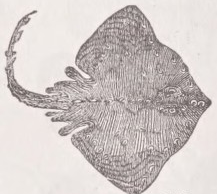
THORNBACK is the name given to a species of ray {Raja clavata) which is found all round the coasts of Europe, and locally abundant; it derives its name from the peculiar armature of the skin of its body, the upper and lower surfaces of the body of the female being armed with scattered, more or less numerous, large round osseous bucklers, each with a spine in the centre; the tail also is armed with rows of similar bucklers. In the male fish these bucklers are absent, or nearly so. The thornback does not grow to the same large size as the skates, a specimen three feet across being considered large. It is more valued as food than the other rays, and consumed in large quantities, fresh as well as salted.
9th ed. Encyclopædia Britannica, vol. 23, p. 314 [130 words — estimated reading time: 1 minute]
Any one of several species of small, brilliantly colored American birds of the genus Rhamphomicron. They have a long, slender, sharp bill, and feed upon honey, insects, and the juice of the sugar cane.
A small South American bird (Anumbius anumbii) allied to the ovenbirds of the genus Furnarius). It builds a very large and complex nest of twigs and thorns in a bush or tree.
THORNHILL, Sir James (1676-1734), historical painter, was born at Melcombe Regis, Dorset, in 1676, coming of an ancient but impoverished county family. His father died while he was young, but he was befriended by his maternal uncle, the celebrated Dr Sydenham, and apprenticed to Thomas Highmore, sergeant-painter to King William III., a connexion of the Thornhill family. Little is known regarding his early career. About 1715 he visited Holland, Flanders, and France; and, having obtained the patronage of Queen Anne, he was in 1719-20 appointed her serjeant-painter in succession to Highmore, and was ordered to decorate the interior of the dome of St Paul’s with a series of eight designs, in chiaroscuroheightened with gold, illustrative of the life of that apostle,—a commission for which Louis Laguerre had previously been selected by the commissioners for the repair of the cathedral. He also designed and decorated the saloon and hall of Moor Park, Herts, and painted the great hall at Blenheim, the princesses? apartments at Hampton Court, the hall and staircase of the Southsea Company, the chapel at Wimpole, the staircase at Easton-Neston, Northamptonshire, and the hall at Greenwich Hospital, usually considered his most important and successful work, upon which he was engaged from 1708 to 1727. Among his easel pictures are the altar-pieces of All Souls and Queen’s College chapels, Oxford, and that in Melcombe Regis church; and he executed such portrait subjects as that of Sir Isaac Newton, in Trinity College, Cambridge, and the picture of the House of Commons in 1730, now in the possession of the earl of Hardwicke, in which he was assisted by Hogarth, who married Jane, his only daughter. He also produced a few etchings in a slight and sketchy but effective manner, and ...executed careful full-size copies of Raphael’s cartoons, which now belong to the Royal Academy. About 1724 he drew up a proposal for the establishment of a royal academy of the arts, and his scheme had the support of the lord treasurerHalifax, but Government declined to furnish the needful funds. Thornhill then opened a drawingschool in his own house in James Street, Covent Garden, where instruction continued to be given till the time of his death. He acquired a considerable fortune by his art, and was enabled to repurchase his family estate of Thornhill, Dorsetshire. In 1715 he was knighted by George L, and in 1719 he represented Melcombe Regis in parliament, a borough for which Sir ChristopherWren had previously been member. Having been removed from his office by some court intrigue, and suffering from broken health and repeated attacks of gout, he retired to his country seat, where he died on the 4th of May 1734. His son James was also an artist. He succeeded his father as serjeant-painter to George IL, and was appointed “painter to the navy.”
The high contemporary estimate of Sir James Thornhill’s works has not since been confirmed; in spite of Dr Young, “late times” do not
“Understand
How Raphael’s pencil lives in Thornhill's hands.”
He is weak in drawing,—indeed, when dealing with complicated figures he was assisted by Thomas Gibson; and, ignorant of the great monumental art of Italy, he formed himself upon the lower model of Le Brun. It must, however, be admitted that, in the departments of art which he chose for his own, he was the best native painter of his time.
9th ed. Encyclopædia Britannica, vol. 23, p. 314 [579 words — estimated reading time: 4 minutes]
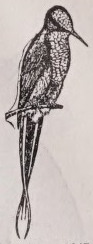
A beautiful South American humming bird (Gouldia Popelairii), having the six outer tail feathers long, slender, and pointed. The head is ornamented with a long, pointed crest.
N. painfulness, trouble, care, trial, affliction, infliction, blow, stroke, burden, load, curse, bitter pill, bitter draught, waters of bitterness, annoyance, grievance, nuisance, vexation, mortification, sickener, bore, bother, pother, hot water, "sea of troubles", hornet's nest, plague, pest, cancer, ulcer, sting, thorn, canker, scorpion, dagger, scourge, carking care, canker worm of care, mishap, misfortune, desagrement, esclandre, rub, source of irritation, source of annoyance, wound, open sore, sore subject, skeleton in the closet, thorn in the flesh, thorn in one's side, where the shoe pinches, gall and wormwood, sorry sight, heavy news, provocation, affront, "head and front of one's offending", infestation, molestation, malignity
V. cause pain, occasion pain, give pain, bring pain, induce pain, produce pain, create pain, inflict pain, pain, hurt, wound, pinch, prick, gripe, pierce, lancinate, cut, hurt the feelings, wound the feelings, grate upon the feelings, grate upon the nerves, jar upon the feelings, wring the heart, pierce the heart, lacerate the heart, break the heart, rend the heart, make the heart bleed, tear the heart strings, rend the heart strings, draw tears from the eyes, sadden, make unhappy, plunge into sorrow, grieve, fash, afflict, distress, cut up, cut to the heart, displease, annoy, incommode, discompose, trouble, disquiet, faze, feaze, feeze (u .s.), disturb, cross, perplex, molest, tease, tire, irk, vex, mortify, wherret|, worry, plague, bother, pester, bore, pother, harass, harry, badger, heckle, bait, beset, infest, persecute, importune, wring, harrow, torment, torture, bullyrag, put to the rack, put to the question, break on the wheel, rack, scarify, cruciate, crucify, convulse, agonize, barb the dart, plant a dagger in the breast, plant a thorn in one's side, irritate, provoke, sting, nettle, try the patience, pique, fret, rile, tweak the nose, chafe, gall, sting to the quick, wound to the quick, cut to the quick, aggrieve, affront, enchafe, enrage, ruffle, sour the temper, give offense, maltreat, bite, snap at, assail, smite, sicken, disgust, revolt, nauseate, disenchant, repel, offend, shock, stink in the nostrils, go against the stomach, turn the stomach, make one sick, set the teeth on edge, go against the grain, grate on the ear, stick in one's throat, stick in one's gizzard, rankle, gnaw, corrode, horrify, appal, appall, freeze the blood, make the flesh creep, make the hair stand on end, make the blood curdle, make the blood run cold, make one shudder, haunt the memory, weigh on the heart, prey on the heart, weigh on the mind, prey on the mind, weigh on the spirits, prey on the spirits, bring one's gray hairs with sorrow to the grave, add a nail to one's coffin
Int. hinc illae lachrymae, phr, surgit amari aliquid, the place being too hot to hold one, the iron entering into the soul, "he jests at scars that never felt a wound", "i must be cruel only to be kind", "what deep wounds ever closed without a scar?"
If fire break out, and catch in thorns, so that the stacks of corn, or the standing corn, or the field, be consumed therewith; he that kindled the fire shall surely make restitution.
If a fire breaks out and spreads to thornbushes so that it consumes stacked or standing grain, or the whole field, the one who started the fire must make full restitution.
But if ye will not drive out the inhabitants of the land from before you; then it shall come to pass, that those which ye let remain of them shall be pricks in your eyes, and thorns in your sides, and shall vex you in the land wherein ye dwell.
But if you do not drive out the inhabitants of the land before you, those you allow to remain will become barbs in your eyes and thorns in your sides; they will harass you in the land where you settle.
Know for a certainty that the LORD your God will no more drive out any of these nations from before you; but they shall be snares and traps unto you, and scourges in your sides, and thorns in your eyes, until ye perish from off this good land which the LORD your God hath given you.
know for sure that the LORD your God will no longer drive out these nations before you. Instead, they will become for you a snare and a trap, a scourge in your sides and thorns in your eyes, until you perish from this good land that the LORD your God has given you.
And Gideon said, Therefore when the LORD hath delivered Zebah and Zalmunna into mine hand, then I will tear your flesh with the thorns of the wilderness and with briers.
“Very well,” Gideon replied, “when the LORD has delivered Zebah and Zalmunna into my hand, I will tear your flesh with the thorns and briers of the wilderness!”
And the bramble said unto the trees, If in truth ye anoint me king over you, then come and put your trust in my shadow: and if not, let fire come out of the bramble, and devour the cedars of Lebanon.
But the thornbush replied, ‘If you really are anointing me as king over you, come and find refuge in my shade. But if not, may fire come out of the thornbush and consume the cedars of Lebanon.’
Wherefore the LORD brought upon them the captains of the host of the king of Assyria, which took Manasseh among the thorns, and bound him with fetters, and carried him to Babylon.
So the LORD brought against them the military commanders of the king of Assyria, who captured Manasseh, put a hook in his nose, bound him with bronze shackles, and took him to Babylon.
This site uses cookies to remember your display preferences (search sources and editions, Bible version, auto-link, images, light/dark theme). No personal data whatsoever is collected. Privacy Policy