
The middle part, cavity, or belly of a sail.
Word of the Day: Catachrestical
1. To swell out; as, the sail bunts.
1. A fungus (Ustilago foetida) which affects the ear of cereals, filling the grains with a fetid dust; -- also called pepperbrand.
To swell out; as, the sail bunts.
A cant word for a woman who picks up rags in the streets; hence, a low vulgar woman.
A woman who picks up rags in the streets; hence, a low, vulgar woman.
A thin woolen stuff, used chiefly for flags, colors, and ships' signals.
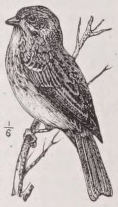
1. A bird of the genus Emberiza. The name is applied to different species, as the English bunting and the rice bunting
2. A thin woolen stuff, of which the colors or flags and signals of ships are made.
1. A bird of the genus Emberiza, or of an allied genus, related to the finches and sparrows (family Fringillidae).
2. Alt. of Buntine
Bunting
Encyclopedia Britannica
BUNTING, a word of uncertain origin, properly the common English name of the bird called by Linnaeus Emberiza miliaria, but now used in a general sense for all members of the family Emberizidoe, which are closely allied to the Finches {Fringillidoe), though, in Professor Parker’s opinion, to be easily distinguished therefrom—the Emberizidoe possessing what none of the Fringillidoe do, an additional pair of palatal bones, “palato-maxillaries.” It will probably follow from this diagnosis that some forms of birds, particularly those of the New World, which have hitherto been commonly assigned to the latter, really belong to the former, and among them the genera Cardinalis and Phrygilus. The additional palatal bones just named are also found in several other peculiarly American families, namely, Tanagridoe, Icteridoe, and Mniotiltidoe — whence it may be perhaps inferred that the Emberizidoe are of Transatlantic origin. The Buntings generally may be also outwardly distinguished from the Finches by their angular gape, the posterior portion of which is greatly deflected; and most of the Old-World forms, together with some of those of the New World, have a bony knob on the palate— a swollen out growth of the dentary edges of the bill. Correlated with this peculiarity the maxilla usually has the tomia sinuated, and is generally concave, and smaller and narrower than the mandible, which is also concave to receive the palatal knob. In most other respects the Buntings greatly resemble the Finches, but their eggs are generally distinguishable by the irregular hair-like markings on the shell. In the British Islands by far the commonest species of Bunting is the Yellow Hammer (E. citrinella), but the true Bunting (or Corn-Bunting, or Bunting-Lark, as it is called in some ...districts) is a very well-known bird, while the Reed-Bunting (E. schoeniclus) frequents marshy soils almost to the exclusion of the two former. In certain localities in the south of England the Cirl-Bunting (E. cirlus) is also a resident; and in winter vast flocks of the Snow-Bunting (Plectrophanes nivalis'), at once recognizable by its pointed wings and elongated hind-claws, resort to our shores and open grounds. This last is believed to breed sparingly on the highest mountains of Scotland, but the majority of the examples which visit us come from northern regions, for it is a species which in summer inhabita the whole circumpolar area. The Ortolan (E. hortulana), so highly prized for its delicate flavour, occasionally appears in England, but this island seems to Jie outside its proper range. On the continent of Europe, in Africa, and throughout Asia, many other species are found, while in America the number belonging to the family cannot at present be computed. As already stated, the beautiful and melodious Cardinal (Cardinalis υirgιnianus), commonly called the Virginian Nightingale, must be included in this family, as also the Bobolink (Dolichonyx oryzivorus), a bird for sapidity perhaps surpassing the far-famed Ortolan, and intimately connecting the Emberizidoe with the Icteridoe. Whether any species of the family inhabit the Australian Region is as yet doubtful, but it would seem possible that several genera of Australian birds hitherto classed with the Fringillidae may have to be assigned to the Emberizidoe. (a. n.)
BUNTING, Jabez, D.D., a distinguished Wesleyan minister, who exerted an influence in his denomination second only to that of John Wesley himself, was born at Manchester 13th May 1779, and died on the 16th June 1858. He was educated at the grammar school of his native town. At the age of nineteen he began to preach, and a year later (1799) he became a member of the Conference. He continued in the active discharge of his ministerial duties for upwards of fifty-seven years—his successive spheres of labour being Manchester, Liverpool, and London. In 1834 he was appointed president of the newly-founded Wesleyan theological college, and in this position, which he held till his death, he succeeded in materially raising the standard of education among Wesleyan ministers. He was four times chosen to be president of the Conference, was repeatedly secretary of the “Legal Hundred,” and for eighteen years was secretary to the Wesleyan Missionary Society. In these and other offices he found ample scope for that great natural sagacity and power of administration which did so much for the consolidation and extension of the Wesleyan denomination. Dr Bunting was a popular preacher, and an effective platform speaker. Two volumes of his sermons were published posthumously in 1862. The first volume of a memoir, by his son, appeared in 1860.
9th ed. Encyclopædia Britannica, vol. 4, p. 525
[537 words — estimated reading time: 4 minutes]
[537 words — estimated reading time: 4 minutes]
Ropes fastened to cringles on the bottoms of square sails, to draw them up to their yards.
Impulse Roget’s Thesaurus §276
N. impulse, impulsion, impetus, momentum, push, pulsion, thrust, shove, jog, jolt, brunt, booming, boost, throw, explosion, propulsion, percussion, concussion, collision, occursion|, clash, encounter, cannon, carambole, appulse, shock, crash, bump, impact, elan, charge, beating, blow, dint, stroke, knock, tap, rap, slap, smack, pat, dab, fillip, slam, bang, hit, whack, thwack, cuff, squash, dowse, swap, whap, punch, thump, pelt, kick, punce|, calcitration, ruade, arietation|, cut, thrust, lunge, yerk|, carom, carrom, clip *, jab, plug*, sidewinder*, sidewipe, sideswipe, hammer, sledge hammer, mall, maul, mallet, flail, ram, rammer, battering ram, monkey, pile-driving engine, punch, bat, cant hook, cudgel, ax, dynamics, seismometer, accelerometer, earthquake detector
V. give an impetus, impel, push, start, give a start to, set going, drive, urge, boom, thrust, prod, foin, cant, elbow, shoulder, jostle, justle, hustle, hurtle, shove, jog, jolt, encounter, run against, bump against, butt against, knock one's head against, run one's head against, impinge, boost, bunt, carom, clip y, fan, fan out, jab, plug *, strike, knock, hit, tap, rap, slap, flap, dab, pat, thump, beat, blow, bang, slam, dash, punch, thwack, whack, hit hard, strike hard, swap, batter, dowse|, baste, pelt, patter, buffet, belabor, fetch one a blow, poke at, pink, lunge, yerk, kick, calcitrate, butt, strike at, whip *c, (punish) 972, come into a collision, enter into collision, collide, sideswipe, foul, fall foul of, run foul of, telescope, throw
Phr. "a hit, a very palpable hit"
No Bible verses found for "Bunt".