1. A plant or weed that grows among corn, the cornrose, a species of Agrostemma. It is also applied to the Lolium or darnel.
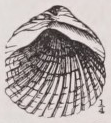
2. A small testaceous shell; or rather a genus of shells, the Cardium. The general characteristics are; shells nearly equilateral and equivalvular; hinge with two small teeth, one on each side near the beak, and two larger remote lateral teeth, one on each side; prominent ribs running from the hinge to the edge of the valve.
1. A bivalvemollusk, with radiating ribs, of the genus Cardium, especially C. edule, used in Europe for food; -- sometimes applied to similar shells of other genera.
COCKLE(Cardium), a genus of Acephalous Mollusks belonging to the family Cardiadae, and comprising about 200 species, nearly a third of which are said to occur in the Indian Ocean, while only a few, but these exceedingly abundant in individuals, and widely distributed, are found in northern and temperate latitudes. The shells of cockles are highly convex, and almost invariably show a ridge-and-furrow sculpture, the ridges or ribs being often spiny, and the valves locking closely together. The animal inhabiting the shell is provided with a large, fleshy, and highly elastic foot, by means of which it can rapidly bury itself in the soft muddy sand which it frequents, reappearing above the surface with equal facility. Iu performing those leaps, for which it is remarkable, “the long taper foot,” says Gosse, “is thrust to its utmost, and feels about for some resisting surface, a stone for instance, which it no sooner feels than the hooked point is pressed stiffly against it, the whole foot, by muscular contraction, is made suddenly rigid, and the entire creature—mantle, siphons, foot, shell, and all—is jerked away in an uncouth manner.” Many of the species are of considerable value as articles of food, especially the Common Cockle (Cardium edule), gregarious everywhere in the sandy bays and estuaries around the British coast, from low-water mark to a few fathoms deep, and extending from Iceland to the Canaries, and as far east as the Caspian and Aral Seas, where it occurs in one of its varieties. The shell of the cockle is liable to considerable variation, getting thinner and more elongated posteriorly in sheltered situations and in muddy ground, more convex and thicker when exposed to rougher conditions. They vary also in size from 1 inch to 2⅜ inches ‘ in ...breadth. They occur in great abundance on several parts of the British coast, and in many places cockle-gathering gives employment to large numbers of people; thus at Penclaw dd in Glamorganshire, the women and children are regularly employed in gathering and preparing cockles, which they afterwards dispose of in the Swansea market. At Starcross they have “cockle-gardens,” where those mollusks are reared, and these are said to possess a better flavour than the ordinary cockle. Some species or other of Cardium is used for food by the maritime populations of almost every country in the world, and the dietetic value of these mollusks appears to have been equally appreciated in prehistoric times, as the shell-mounds or kjökkenmöddings of many countries abundantly testify. As cockle shells contain about 90 per cent, of carbonate of lime, they are calcined and used instead of common lime where the latter cannot readily be obtained.
9th ed. Encyclopædia Britannica, vol. 6, p. 100 [453 words — estimated reading time: 3 minutes]
באשה. This word occurs only in Job xxxi, 40. By the Chaldee it is rendered _noxious herbs_; by Symmachus, ἀτελεσφόρητα, _plants of imperfect fruit_; by the Septuagint, βάτος, _the blackberrybush_; by Castelio, _ebulus_, “dwarf elder;” by Celsius, _aconite_; and by Bishop Stock and Dr. Good, _the night-shade_. M. Michaëlis maintains, after Celsius, that both this word and ֻּבאשִים, Isaiah v, 2, 4, denote the _aconite_, a poisonous plant, growing spontaneously and luxuriantly on sunny hills, such as are used for vineyards. He says that this interpretation is certain, because, as Celsius had observed, ביש, in Arabic, denotes the _aconite_; and he intimates that it best suits Job xxxi, 40, where it is mentioned as growing instead of barley. The word appears to import a weed not only noxious, but of a fetid smell.
CŒLO-SYRIA, _hollow_ or _depressed_ Syria, Syria in the vale, 1 Macc. xiii, 10. This name imports the hollow land, or region, situated between two long ridges of mountains; and those mountains have been always understood to be Libanus and Anti-libanus. As these ridges run parallel for many leagues, they contain between them a long, extensive, and extremely fruitful valley.
V. phr, caress, "faint heart neer won fair lady", fondle, "kisses honeyed by oblivion", pet, dandle, pat, pat on the head, pat on the cheek, chuck under the chin, smile upon, coax, wheedle, cosset, coddle, cocker, cockle, make of, make much of, cherish, foster, kill with kindness, clasp, hug, cuddle, fold in one's arms, strain in one's arms, nestle, nuzzle, embrace, kiss, buss, smack, blow a kiss, salute, fold to the heart, press to the bosom, bill and coo, spoon, toy, dally, flirt, coquet, gallivant, galavant, philander, make love, pay one's court to, pay one's addresses to, pay one's attentions to, serenade, court, woo, set one's cap at, be sweet upon, look sweet upon, ogle, cast sheep's eyes upon, faire les yeux doux, fall in love with, win the affections, die for, propose, make an offer, have an offer, pop the question, plight one's troth, plight one's faith
Adj.caressing, "sighing like furnace", love- sick, spoony, caressed &c
Let thistles grow instead of wheat, and cockle instead of barley. The words of Job are ended.
then let briers grow instead of wheat and stinkweed instead of barley.” Thus conclude the words of Job.
This site uses cookies to remember your display preferences (search sources and editions, Bible version, auto-link, images, light/dark theme). No personal data whatsoever is collected. Privacy Policy