
See Con, to direct a ship.
Word of the Day: Catachrestical
1. The common birth of two or more at the same time; production of two or more together.
2. A being born or produced with another.
3. The act of growing together, or at the same time.
Alt. of Connascency
1. The common birth of two or more at the same tome; production of two or more together.
2. That which is born or produced with another.
3. The act of growing together.
Born together; produced at the same time.
1. Born with another; being of the same birth; as connate notions.
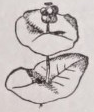
2. In botany, united in origin; growing from one base, or united at their bases; united into one body; as connate leaves or anthers.
1. Born with another; being of the same birth.
2. Congenital; existing from birth.
3. Congenitally united; growing from one base, or united at their bases; united into one body; as, connate leaves or athers. See Illust. of Connate-perfoliate.
Connate or coalescent at the base so as to produce a broad foliaceous body through the center of which the stem passes; -- applied to leaves, as the leaves of the boneset.
Connection by birth; natural union.
1. Connected by nature; united in nature; born with another.
2. These affections are connatural to us, and as we grow up, so do they.
3. Participating of the same nature.
4. And mix with our connatural dust.
1. Connected by nature; united in nature; inborn; inherent; natural.
2. Partaking of the same nature.
Participation of the same nature; natural union.
Participation of the same nature; natural union or connection.
To bring to the same nature as something else; to adapt.
By the act of nature; originally.
By the act of nature; originally; from birth.
Participation of the same nature; natural union.
Participation of the same nature; natural union.
Participation in a common nature or character.
Connaught
Encyclopedia Britannica
CONNAUGHT, one of the four provinces of Ireland, occupying the western quarter of the island. It comprises the counties of Galway, Mayo, Sligo, Leitrim, and Roscommon, and contains an area of 6862 square miles, or 4,392,085 acres, of which 2,889,000 are under cultivation. The annual value of property, which, however, is based on a lower scale of prices than now obtains, is estimated at £4,188,631; and the land is divided among 5264 proprietors. An average property in this province amounts in extent to 795 acres, while in all Ireland it amounts to only 293 acres; and the average value is 6s. 9∣d. peracre, while that of all Ireland amounts to 13s. 2d. The western portion is hilly and occasionally mountainous, while the eastern part is generally level. It is well watered, and has on the greater portion of its eastern boundary the River Shannon. The River Moy is navigable from Killala to Ballina; the extensive lakes Conn, Corrib, and Mask, are navigable; and the sea coast affords many fine bays and harbours. The climate is moist and temperate. Agriculture is the main support of the population, but little progress has been made in its pursuit. The population may be considered as almost purely Celtic, and more than a third of the people speak the Irish language—a larger proportion than in the other provinces. The number of inhabitants in the province at and since the census of 1841 has been as follows :— [table]...
In early times Connaught comprised, beyond its present limits, the territory of Thomond, forming the present county of Clare, and North Breifne, the present county of Cavan. When Sir Henry Sydney, in the 16th century, divided the province into counties, he adopted the ancient boundaries, excluding North Breifne; but in 1602 the county of Clare was restored to Munster, and Connaught now comprises the counties mentioned above.
9th ed. Encyclopædia Britannica, vol. 6, p. 285
[317 words — estimated reading time: 2 minutes]
[317 words — estimated reading time: 2 minutes]
To join, unite or cohere; to have a close relation. This argument connects with another. [This use is rare and not well authorized.]
1. To knit or link together; to tie or fasten together, as by something intervening, or by weaving, winding or twining. Hence,
2. To join or unite; to conjoin, in almost any manner, either by junction, by any intervening means, or by order and relation. We connect letters and words in a sentence; we connect ideas in the mind; we connect arguments in a discourse. The strait of Gibraltar connects the Mediterranean with the Atlantic. A treaty connects two nations. The interests of agriculture are connected with those of commerce. Families are connected by marriage or by friendship.
1. To join, or fasten together, as by something intervening; to associate; to combine; to unite or link together; to establish a bond or relation between.
2. To associate (a person or thing, or one's self) with another person, thing, business, or affair.
In a connected manner.
Connecticut
Encyclopedia Britannica
CONNECTICUT (Indian, Quonektacat, i.e., Long River), one of the six New England, and one of the thirteen original, States of the American Union, lies between 41’ and 42° 3' N. lat., and 71° 55' and 73° 50' W. long....
Physical Description.— It is bounded N. by Massachusetts about 88 miles; E. by Rhode Island, 45 miles; S. by Long Island Sound, 100 miles; W. by New York about 68 miles (in a direct line). The S.W. corner projects along the Sound under New York for about 13 miles. The area is 4750 square miles, or one-tenth of that of New York. The State lies on the S. slope of the hilly regions of New England, with a general surface much diversified; there is, however, no land above 1000 feet in elevation. Besides the Connecticut, two other large rivers flow from the N. into the Sound—the Housatonic and the Thames. The Connecticut is the largest river in New England, rising cn the N. border of New Hampshire, 1600 feet above the sea, flowing S.S.W., separating Vermont and New Hampshire, crossing the W. part of Massachusetts, and central part of Connecticut, flowing S.S.E. below Middletown, and falling into the Sound at Saybrook. Its length is more than 400 miles, with a width in Connecticut varying from 500 to 1000 feet. It is navigable to Middletown (30 miles) for vessels drawing 10 feet, and to Hartford (50 miles) for those drawing 8 feet. Its principal tributary in Connecticut is the Tunxis, or Farmington, which flows S.E. from the slopes of the Green Mountains in Massachusetts, then abruptly N., and, breaking through the trap range, S.E. again to the Connecticut River at Windsor, instead of taking its seemingly natural course to New Haven, whither a part of its waters were formerly carried by the Farmington Canal. The E, part of the State is drained by the Thames, which is formed by the Yantic and Shetucket,—the Quinnebang joining the latter about two miles above. It is navigable to Norwich for the Sound steamers and West India trading vessels. In the W. part of the State is the Housatonic, with its main branch—the Naugatuck—which joins it at Derby. To this place it is navigable for small vessels. Besides these large streams there are very many smaller ones, affording, in their rapid descent from the hills, an immense, amount of water power. Geologically the State is chiefly Eozoic, excepting the Triassic Sandstone and postTertiary terraces of the Connecticut River valley. There are several well-defined ranges of hi] Is. Of these the Housatonic Hills are the most westerly, and extend along that river to the coast. The Green Mountain range, running S. from Vermont, terminates near New Haven. The Blue Hills of Southington—the highest in the State—are a part of the Mount Tom range of Massachusetts, and lie between the Green Mountain range and the Connecticut River. On the E. side of the river is a fourth range which the river crosses at Chatham. While the hills run N. and S., it is noticeable that the three main rivers bend (and on about the same parallel) to the S.E. The ridges and dikes of trap are exceedingly numerous through the centre of fhe State, having been forced up through the red sandstone which is found underlying and on the borders of the trap. These ridges have abrupt columnar W. fronts and gentle E. slopes. The mineral wealth of the State is considerable. Copper is found in the Simsbury mines at Granby, and at Bristol; but these mines have lost their former importance since the working of the abundant and purer ores of Lake Superior. Iron ore is found in great quantities in Salisbury, Kent, Sharon, Cornwall, and Canaan, and has been worked for 125 years. Limestone and marble of the very best quality are found at Canaan, Washington, and Milford. At Portland and Cromwell, on both sides of the Connecticut River, are the well-known immense quarries of freestone largely in demand for building. The excellent slate flagging from Bolton and Haddam is abundant in supply, and in great demand. Granite, gneiss, hydraulic lime, tiling slate, clay (fire, potters’, and porcelain), and sulphate of barytes are found in great quantities. There were twenty extensive quarries and mines in the State in 1870. There are over 100 miles of deeply indented coast on the Sound (which measures 140 miles by 24 miles), affording excellent harbours. The chief of these are Stonington, New London, Saybrook, New Haven, Bridgeport, and Fairfield. The harbour at New London is one of the best in the country, capacious, and never frozen over. The climate of the State, while very changeable, is very healthful,—the mortality being below the average of the other States. There is scarcely any spring season, but summer opens abruptly about May 3, and the cold weather begins in November. The winters, with their keen N.W. winds, are severe, but the serenity of the sky and dryness of the air make some compensation. The mean temperature for the year is 48° Fahr. Consumption is the most fatal disease, causing 16 per cent, of all the deaths. The vegetation is rich and varied. The most abundant trees are chestnut, walnut, birch, oak, elm, maple, beech, and ash. The forests have been recklessly cut away, and only patches of woodland remain; but the people are waking up to the importance of tree-planting. As for zoology, songbirds of all sorts are plentiful, and the grouse and woodcock are increasing under the game laws, after having been nearly killed out. The Sound abounds in the best qualities of fish and shell-fish, while the freshwater varieties of the former are found in great quantities in the rivers and ponds. Aside from these there are few animals of importance save the domestio ones.
Population. Divisions.— The State is divided into 8 counties :—Hartford, New Haven, New London, Fairfield (all incorporated in 1666), Windham (1726), Litchfield, (1751), Middlesex, and Tolland (1785). New London, Middlesex, New Haven, and Fairfield occupy the lower half of the State, bordering on the Sound; the others occupy the other half, adjoining Massachusetts. The number of towns in 1876 was 167; and there were ten cities :—Hartford, the capital (population in 1870, 37,180), New Haven (50,840), Bridgeport (18,969), Norwich (16,653), Waterbury (10,826), Middletown (6923), Meriden (10,521), New London (9576), New Britain (9480), and South Norwalk. There were also 17 boroughs largely engaged in industry, of which the chief are Birmingham, Danbury, Danielsonville, Fairfield, Stamford, Stonington, Willimantic, and Winsted. The population of the State in 1679 was 12,535; in 1774 it had risen to 197,856; and from 1790 it was as follows (the last column showing its ulace among the other States as regards population): [table]
In 1870 there were about 7000 more females than males. About one-fifth of the population were foreign born, chiefly Irish, German, English, French, Canadian, and Scotch. It is the third State in the density of its population (11345 to the square mile), Massachusetts (186) and Rhode Island (208) exceeding it, while New York follows next (87). In 1875 the births were 14,328 (141 illegitimate); marriages, 4385 (below the average for the last 11 years); deaths, 9833 (25 per cent, from diseases of the respiratory organs); divorces, 476 (one for every 9 ’ 21 marriages solemnized; the average for 12 years is 455). The laws regarding divorce are very lax.
Industry and Finances.— Of the total population over ten years of age in 1870 (425,896), there were engaged in all occupations, 193,421; chiefly classed as—in agriculture, 43,653; in professional and personal service, 38,704; in trade, 24,720; and in manufactures, 86,344. There is very little soil that can be called good, except in the river valleys, and agriculture is as backward as in other parts of New England. The hills through the State furnish excellent pasturage and cheap fuel. The chief cultivated fruits are apples, pears, grapes, and the numerous kinds of berries. The principal crops are hay, oats, rye, corn, potatoes, and tobacco; and in the Connecticut River valley (extending, in this State, 30 miles N. of Middletown, and 20 miles wide) farming is very productive. The tobacco raised in the valley is said to be superior to any other. In the uplands dairy products and cattle raising are the chief resources of the farmer. There were in 1870, 25,508 farms, having 1,646,752 acres of improved land, and 717,664 acres unimproved, of which 577,333 were woodland. The value of these farms was $124,241,382. Though the number of farms has increased since 1850 and 1860, yet the acreage devoted to them has decreased, as has also the cultivated farm land in proportion to the uncultivated. The farms are passing into the hands of the Irish and Germans, who do their own work and live with few comforts. Pisciculture is receiving much attention, commissioners having been appointed in 1866, who have well stocked the ponds and rivers. Black-bass, trout, and shad have been very successfully cultivated, and it is hoped as much can be done with salmon. Notwithstanding the extensive sea coast and fine harbours, the foreign commerce is not heavy,—the coast trade and fisheries being more important. There are in the State five custom districts, of which the ports of entry are Fairfield, Middletown, New Haven, New London, and Stonington. The imports from foreign countries and domestic exports for the year ending June 30, 1875, were as follows :—
[table]
The chief articles of export were grain, fire-arms, provisions, and manufactures of wood. Of the total number of enrolled, registered, and licensed vessels (820), 718 were sailing vessels, with a tonnage of 53,329, and 78 were steam vessels, with a tonnage of 26,550. The fisheries are carried on from New London and Stonington. In 1875, there were 173 vessels engaged in the cod and mackerel fisheries, with a tonnage of 3756; and in the whale fishery 14, with a tonnage of 2050—a great reduction on the decade from 1850 to 1860. Engaged in coastwise trade and fisheries, there entered 2257 vessels and cleared 1678. In foreign trade there entered 161 and cleared 102. In 1870, 1001 persons were engaged in fisheries, and the annual product was $769,799. Ship-building is a considerable industry. In 1875, 34 vessels were built of 5915 tons. The great industry of the State is in manufactures. These are exceedingly numerous and very productive, and most of them such as require ingenuity and intelligence on the part of the workmen. The chief industries and some of their statistics in 1870 were :— . [table]
It ranks first among the States in the production of clocks, Indian - rubber goods, and hardware, and (small as it is) eighth in the total value of all manufactured products. It must be remembered, however, in connection with the above statistics, that the ninth United States census of 1870 is very inaccurate in relation to manufactures, the superintendent estimating that only about one-quarter of the capital invested is reported, and that there are other great errors in the way of under-estimate. In 1875 Connecticut had 1 mile of railway to 5 ’ 16 square miles of territory, and to 585 inhabitants. (Massachusetts had 1 mile to 4'29 square miles and 909 inhabitants; England 1 mile to 5 ’ 02 square miles and 1954 inhabitants. ) There were 23 railroad companies, with 1184 miles of single track. The cost of these was $75,831,210; receipts for the year, $12,020,194 (50 per cent, from passengers); net earnings, $2,816,004, being 3’71 per cent, on the cost of the roads. Nineroads, costing nearly 8 millions, have no net income. The capital stock of all the companies was $59,282,784 (paid in), and debt, $17,077,739. The amount paid in dividends (only eight companies make any) was 4 ∙3 per cent, on the entire capital of all the roads, but 9'24 on the capital of the dividend-paying ones. There is an elaborate system of State inspection of the roads and their accounts. There is a State tax of 1 per cent, on the market value of stock and bonds after deducting cash on hand. The principal lines are those running N. and S., connecting the shore with the valleys of the interior, and forming highways between the important cities of JNew England and New York city. Connected with these are important steamboat lines (passenger and freight) from Stonington, New London, and New Haven to New York. The waggon roadways all over the State are kept in very fair condition, except in the poorer hill towns. There are about 13,000 miles of them, costing annually about $650,000. The banking interest of the State is commensurate with its large business, and shows a steadily increasing prosperity. At January 1, 1876, there were 79 national banks in the State, with a capital of $25,687,820; 4 State banks, with a capital of $1,450,000, and assets $3,917,953; 12 trust companies, with a capital of $2,450,000, and assets $6,183,643. These all do a heavy discounting and lending business with their capital and deposits, and pay dividends of 8 to 12 per cent, on their stock. The savings banks numbered 87, with a deposit of $76,489,310, and 208,030 depositors. The average income (during 1875) was 6’62 per cent., nearly all of which is paid to depositors, there being no capital stock. The management is very strictly controlled by law, and about three-quarters of the assets are lent on real estate in the State. The whole number of fire and marine insurance companies doing business in the State in 1875 was 130, of which 32 were Connecticut companies. The assets of these last were $17,345,790? of which over 16 millions were held by 10 companies (mostly in Hartford). The premiums received by all the companies were $1,949,867, and the corresponding losses $1,248,989; total risks written in the State, $165,660,801. The premiums received by the Connecticut companies from their entire business were $9,195,617, and corresponding losses $5,203,416. The life and accident companies doing, business numbered 27, of which 11 were Connecticut companies; the assets of the last were $98,964,945. There were 2740 life policies issued in Connecticut in 1875, insuring $5,066,438. The life premiums paid amounted tn $1,927,663. The policies in force in the State numbered 25,359, insuring $51,063,720. The Connecticut companies (all of Hartford) issued 26,104 policies, insuring $48,822,881 in 1875 (a large reduction on previous years), and paid losses of $6,463,473. The State debt in 1860 was only $50,000, which was borrowed from the school fund. From July 1, 1861, to October 1, 1865, five issues of bonds were made, amounting to $10,000,000, drawing 6 per cent, interest. This debt has been steadily reduced, and on April 1, 1876, was $5,014,500, or deducting cash in the treasury, only $4,302,775. The revenue of the State for the year ending March 31, 1876, was $2,H7,719. This amount was chiefly derived from the tax of 1 mill on the grand list of the towns ($437,473), from savings banks ($462,664), mutual insurance companies ($398,266), and railroads ($302,758). In 1860 the assessed value of all property in the State was $341,256,976, and the true value $444,274,114. In 1870 the assessed value of real estate was $204,H0,500, and of personal estate $221,322,728; total, $425,433,228. The true value was $774,631,524. In 1860 the total taxation, not national, was $1,015,039; in 1870, $6,064,843. The total indebtedness of towns and cities in the State on June 1, 1874, was $13,995,090, more than one-third of which was incurred in aid of railroads.
Social Statistics.— A large number of public and charitable institutions are maintained wholly or in part by the State, and for them it spent $135,463 during the year ending March 31, 1876. Among them are the following. The American Asylum for the Deaf and Dumb, at Hartford, was incorporated in 1816, being the oldest institution of the kind in the United States. In all, 2056 persons have received instruction, with an average attendance in 1875 of 218. The funds of the institution amount to $338,925. The annual State grant is $11,000. The charge per pupil is $175 a year. There is no asylum for the blind, but an annual grant of $6000 is made for the care of the indigent blind at the Perkins Institute at Boston. There is a general hospital at New Haven chartered in 1827, with a training school for nurses attached; funds, $20,000; annual grant, $2000; patients in 1875, 436. The Hartford Hospital was opened August 1,1860; funds, $153,500, but considerably in debt; annual grant, $2000; patients in 1875, 707. The Connecticut Hospital for the Insane, at Middletown, was opened in 1868; cost, $640,043; it accommodates 450 with attendants and physicians, and is always crowded. To April 1, 1876,1272 had been admitted. One-half the board of paupers is paid by the State. Revenue in 1875, $124,305, of which the State paid $62,004. The Retreat for the Insane at Hartford was opened in 1824, and has treated 5786 patients. Though receiving large State and private aid, it is intended for patients who can pay for comfortable accommodation. It had in 1875 about 159 inmates. The Reform School at West Meriden was opened in 1854; cost $115,000, with a farm of 195 acres. The expense to the State in 1875 was $30,368. Boys from ten to sixteen years old may be sent to it for crime, by the several courts, for not less than 9 months, and during minority. The inmates are required to labour 6⅜ hours a day, and attend school 4⅜ hours. The Industrial School for Girls at Middletown was opened in 1870. Its property has cost $122,363, mostly given by individuals. The expense to the State in 1875 was $16,223, and the inmates numbered 53. Girls from eight to sixteen may be committed to it for vagrancy, and are taught housekeeping, sewing, box-making, and farm and garden work. The School for Imbeciles at Lakeville cost $10,000, appropriated by the legislature. In 1875 its income was $14,165, with an average of 95 inmates. The State prison at Wethersfield, erected in 1827, is inadequate to the needs of the State, having, in March 1876, 40 more prisoners than cells, viz., 252 prisoners. Its income in 1875 was $25,539, and payments $28,414,—the deficit being due to the recent decrease in the demand for convict labour. The punishments are solitary confinement, fetters, and shackles. The warder may deduct five days from the term of imprisonment for good behaviour. Schools were begun in New Haven in 1640. The provision and regulation of schools rested with the towns till 1712; with towns and parishes together till 1798; with parishes alone till 1856, when the towns were restored to their original place in the system. Though school districts existed in 1725, and were legalized in 1766, they were not fully endowed corporate bodies till 1839. Schools have been maintained in three ways,—by taxes, by tuition fees or rate bills, and by the income of invested funds. Taxes were a source of income from the beginning to 1821, and were restored in 1854. Rate bills were not discontinued till 1868. Local school funds were begun towards the close of the 17th century, and increased by sales of land in 1733, and by excise on liquors, tea, &c., authorized by Acts of May 1766 and October 1774. The State school fund was begun in 1795, it being the money procured by the sale of lands granted by Charles II. in 1662, and described as “from Narrogancett Bay on the east to the South Sea on the west.” This was, in fact, a strip of land 70 miles wide, and running one-eighth of the circumference of the globe. Subsequently, this being found to interfere with other colonial grants, all this territory was given up, save portions in New York and Ohio. The land was sold for $1,200,000; the fund, however, has increased, and at September 1, 1874, was $2,044,266; the dividend per child has varied from $1, 50 to $1 per year, decreasing with the increase of population; the fund is almost wholly invested in real estate mortgages at 7 per cent. Another fund, the entire income of which since 1855 has been devoted to schools, is the Town Deposit Fund. The 24th Congress of 1835-6 voted to deposit the surplus revenue of the Union, then on hand, with the different States in proportion to their national representation. Connecticut received $764,670, which was divided among the towns according to their population in 1830; the present income from this is about $46,000 a year. (While Connecticut has preserved this fund almost intact, in other States it has been squandered or lost. ) At present, aside from the income z>f these funds, the maintenance of the schools is provided for by these taxes :—the town tax, which must be sufficient to maintain 30 weeks of school in the larger, and 24 in the smaller districts; the district tax to provide for buildings and repairs, or any deficit; and the State appropriation of $1, 50 per child per year. In 1865 a State Board of Education...
9th ed. Encyclopædia Britannica, vol. 6, p. 285
[5,358 words — estimated reading time: 35 minutes]
[5,358 words — estimated reading time: 35 minutes]
of Connect
The act of joining or state of being joined; a state of being knit or fastened together; union by junction, by an intervening substance or medium, by dependence or relation, or by order in a series; a word of very general import. There is a connection of links in a chain; a connection between all parts of the human body; a connection between virtue and happiness, and between this life and the future; a connection between parent and child, master and servant, husband and wife; between motives and actions, and between actions and their consequences. In short, the word is applicable to almost every thing that has a dependence on or relation to another thing.
1. The act of connecting, or the state of being connected; junction; union; alliance; relationship.
2. That which connects or joins together; bond; tie.
3. A relation; esp. a person connected with another by marriage rather than by blood; -- used in a loose and indefinite, and sometimes a comprehensive, sense.
4. The persons or things that are connected; as, a business connection; the Methodist connection.
No thesaurus entries found for "Conn".
King James Bible KJV Bible
Berean Standard Bible BSB Bible
0 KJV and 3 BSB verses contain “Conn”
Two tenons shall there be in one board, set in order one against another: thus shalt thou make for all the boards of the tabernacle.
Two tenons must be connected to each other for each frame. Make all the frames of the tabernacle in this way.
One board had two tenons, equally distant one from another: thus did he make for all the boards of the tabernacle.
Two tenons were connected to each other for each frame. He made all the frames of the tabernacle in this way.
And not holding the Head, from which all the body by joints and bands having nourishment ministered, and knit together, increaseth with the increase of God.
He has lost connection to the head, from whom the whole body, supported and knit together by its joints and ligaments, grows as God causes it to grow.