
Consisting of copper
Word of the Day: Catachrestical
1. A metal, of a pale red color, tinged with yellow. Next to gold, silver and platina, it is the most ductile and malleable of the metals, and it is more elastic than any metal, except steel, and the most sonorous of all the metals. It is found native in lamins or fibers, in a gangue almost always quartzous; it is also found crystalized, and in grains or superficial lamins on stones or iron. It is not altered by water, but is tarnished by exposure to the air, and is at last covered with a green carbonated oxyd. copper in sheets is much used for covering the bottoms of ships, for boilers and other utensils; mixed with tin and zink, it is used in enamel-painting, dyeing, etc. : mixed with tin, it forms bell-metal; with a smaller proportion, bronze; and with zink, it forms brass, pinchbeck, etc. When taken into the body ti operates as a violent emetic, and all its preparations are violent poisons.
2. A vessel made of copper particularly a large boiler.
3. 2 Formerly, a small copper coin.
4. My friend filled my pocket with coppers.
To cover or sheathe with sheets of copper; as, to copper a ship.
1. A common metal of a reddish color, both ductile and malleable, and very tenacious. It is one of the best conductors of heat and electricity. Symbol Cu. Atomic weight 63.3. It is one of the most useful metals in itself, and also in its alloys, brass and bronze.
2. A coin made of copper; a penny, cent, or other minor coin of copper.
3. A vessel, especially a large boiler, made of copper.
To cover or coat with copper; to sheathe with sheets of copper; as, to copper a ship.
Copper
Encyclopedia Britannica
COPPER is a metal which has been known to and used by the human race from the most remote periods. Its alloy with tin (bronze) was the first metallic compound in common use by mankind, and so extensive and characteristic was its employment at an early stage in pre-historic times that the epoch is known in archaeological chronology as the Bronze Age. Metallic relics of that age in the form of arms, ornaments, and domestic implements are still very abundant. By the Greeks and Romans both the metal and its alloys were indifferently known as χaλκoς and aes. As, according to Pliny, the Roman supply was chiefly drawn from Cyprus, it came to be termed aes cyprium, which was gradually shortened to cyprium, and corrupted into cuprum, whence comes our copper, the French cuivre, and the German kupfer.
Copper (chemically, Cuprum, Cu) is a brilliant metal of a peculiar red colour, in which respect it differs from all others excepting, perhaps, titanium. The atomic weight of copper is 63 - 3, and its specific gravity varies between 8 - 91 and 8 ’ 95, according to the treatment to which it may have been subjected. It takes a brilliant polish, is in a high degree malleable and ductile, and in tenacity it only falls short of iron, exceeding in that quality both silver and gold. By different authorities its melting point is stated at from 1000° C. to 1398° C. In electric conductivity it stands next to silver; the conducting power of silver being equal to 100, that of perfectly pure copper is given by Matthiessen as 96 ’ 4 at 13° C. On solidifying from its molten condition it expands. Copper is not affected by exposure in dry air, but in a moist atmosphere it becomes coated with green carbonate. When heated or rubbed it emits a peculiar disagreeable odour....
Copper, according to Walchner, is as widely distributed in nature as iron, and occurs in all soils, and ferruginous mineral waters and ores. It has been discovered in seaweed; in the blood of certain Cephalopoda and Ascidia, and of a species of Limulus ; in straw, hay, eggs, cheese, meat, and other food-stuffs; in the liver and kidneys, and, in traces, in the blood of man and other animals; it has also been shown by Church to exist to the extent of 5 - 9 per cent, in turacin, the colouring-matter of the wing-feathers of the Tτιraco. The ores containing copper in sufficient proportion to render its extraction economically practicable are numerous. It occurs not unfrequently native, sometimes in very great masses, as on the south shores of Lake Superior, where pieces of 150 tons weight have sometimes been obtained. Native copper most frequently occurs in masses of irregular form in rocky fissures, and often crystallized. The principal ores of copper are Cuprite, Melaconite, Malachite, Chessylite, Atacamite, Chrysocolla, Chalcodte, Chalcopyrite, Erubescite, and Tetrahedrite. Cuprite, or red oxide of copper,. Cu 2 O, is a mineral which crystallizes in the cubic system, and contains 88 - 78 of metal. It occurs in most cupriferous mines, but never by, itself in large quantities. Melaconite, or black oxide of copper, CuO, contains, when pure, 79 , 85 of the metal. It was formerly largely worked in the Lake Superior region, and is abundant in some of the mines of Tennessee and the Mississippi valley. Malachite, or green carbonate of copper, CuCO 3 , Cu(HO) 2 , is a beautiful and valuable ore containing about 56 per cent, of the metal; it is obtained in very large quantities from South Australia, Siberia, and other localities. Frequently intermixed with the green carbonate is the blue carbonate of copper, chessylite or azurite, 2CuCO 3 , Cu(H0) 2 , an ore containing when pure 55*16 per cent, of the metal. It was formerly characteristic of Chessy, near Lyons. Atacamite is a hydrated oxychloride of copper, occurring chiefly in Chili and Peru; it crystallizes in the rhombic system. Chrysocolla is a hydrated silicate of copper, CuSiO 3 , 2H 2 O, containing in the pure state 30 per cent, of the metal; it is an abundant ore in Chili, Wisconsin, and Missouri. The sulphur compounds of copper are, however, the most valuable in an economical point of view. Chalcocite, redruthite, copper-glance, or vitreous copper, is a sulphide, Cu 2 S, containing very nearly 80 per cent, of copper. Copper pyrites, or chalcopyrite, a sulphide of copper and iron, CuFeS 2 , crystallizes in the pyramidal system and contains 34 ’ 6 per cent, of copper when pure; but many of the ores, such as those worked specially by wet processes on account of the presence of a large proportion of sulphide of iron, contain less than 5 per cent, of copper. Cornish ores are almost entirely pyritous; and indeed it is from such ores that by far the largest proportion of copper is extracted throughout the world. In Cornwall copper lodes usually run east and west. They occur both in the killas or clay-slate, and in the growan or granite. Erubescite, bornite, or horseflesh ore is a sulphide of copper andiron much richer in copper than the ordinary pyrites, and containing 56 or 57 or, according to the formula FeCu 2 S 3 , 62 5 per cent, of copper. Tetrahedrite, fahlerz, or grey copper, a sulphide crystallizing in the cubical system, contains from 30 to 48 per cent, of copper, with arsenic, antimony, iron, and sometimes zinc, silver, or mercury. The numerous other compounds of copper have more interest from a mineralogical than from a metallurgical point of view.
Copper is obtained from its ores by two principal methods, which may be denominated—(1) the pyro-metallurgical or dry method, and (2) the hydro-metallurgical or wet method; and a small proportion of metallic copper is procured by (3) the electro-metallurgical method.
The methods of working vary according to the nature of the ores treated and local circumstances. The dry method, or ordinary smelting, cannot be profitably practised with ores containing less than 4 per cent, of copper, for which and for still poorer ores the wet process is preferred.
Smelting. —In Great Britain ordinary copper smelting is almost entirely centred at Swansea in Wales, although it is also practised in Lancashire. The processes there employed for extracting copper are technically known as the “English method,” in contradistinction to numerous other modified processes adopted at Continental and other foreign smelting centres. The following is an outline of the English method as conducted at Swansea.
The ores are divided by the smelter into two general classes—those containing sulphur, and those having little or no sulphur. The former are subdivided according as they contain much silica, iron pyrites, tin, arsenic, &c., or a larger or smaller quantity of copper. The object of this classification of ores in the yard is to enable the operative smelter to make up a constant working mixture, having the following characters :—
1. The copper present is not under 9 nor above 14 per cent.; if under the former it would be unprofitably poor; if over the latter, the slags would have a tendency to retain copper, creating a loss.
2. After being calcined for an ordinary length of time, it will fuse easily without the necessity of adding flux, giving a clean and easily fused slag.
3. The mat or coarse metal obtained from fusion contains as nearly as possible 30 per cent of copper.
4. The mixture does not contain ores having impurities calculated to make the copper of too low a quality.
There is no definite or fixed rule to guide the smelter in these classifications, except a practised eye in distinguishing the character of ores, and the report of the assayer.
I. Calcination of the Ores.— The mixture of ores being selected according to these rules, it is carried to hoppers on the top of a large reverberatory furnace, termed the calcining furnace, and is then let down into the hearth, where, after drying a little, it is spread equally over the bottom, and covered to a depth of from 6 to 8 inches. The quantity of ore put in varies, according to the size of the furnace, from 3 tons to 4 tons. The fire of the furnace is kept low at first; after two or three hours the ore on the sur face becomes visibly red, and the heat is gradually increased to a yellow red; but this heat penetrates to the depth of only about 2 inches, consequently the ore has to be stirred and turned over by means of long iron paddles every hour, so as to expose a new surface to the action of the air and fire. The calcination lasts generally from twelve to twenty-four hours, the length of time being dependent on the proportions of silica and sulphide of iron in the charge. Calcining furnaces are now very commonly provided .with Siemens regenerators and heated with gas. The following changes take place :—the sulphur is partly burned off, forming sulphurous and sulphuric acids, and partly volatilized in the free state; arsenic is volatilized and oxidized; and part of the copper and iron lose sulphur and combine with oxygen, forming oxides.
When the ore is sufficiently calcined, it is let down into the cubs or vaults beneath, by openings in the floor. Water is added to the hot ore in the cubs to prevent dust and assist further oxidation; the ore is then removed to a yard, and there stored up, ready for the fusing furnace. The following analysis of ore, before and after calcining, will give an idea of the changes that have taken place :— [table]
IT. Fusion of Calcined Ore.— The next operation is the fusing of the calcined ore, which is done in a reverberatory furnace, termed an ore fusing furnace, fitted also with a hopner on the top for charging it. The charge consists of [table]
When the charge islet down into the furnace it is spread equally over the bottom, the doors are all closed, every airhole is stopped with clay, and the heat of the furnace increased as rapidly as possible.
After about five hours’ firing, when the furnace has reached a white heat, the door-plate is removed, and a long iron rake passed through the contents to make sure that the whole is perfectly fused. This being the case, the workman begins the operation of skimming, that is, drawing off the slag, which floats on the surface of the mat, and removing it at the front door. When the surface is skimmed, the common practice is to let down a second charge of ore, and to fuse and skim in the same manner, before tapping the furnace to let out the metal or mat, which is generally tapped into large pits of water, and so granulated. These pits are from 6 to 8 feet deep, and from 4 to 5 feet square, and into them a perforated box is lowered, which receives the charge of metal, and is raised by a crane or pulley. The metal is then removed to a yard for the next operation. This mat is termed granulated coarse metal. In many cases the coarse metal is first run into moulds and subsequently crushed for the next operation.
The average composition of good coarse metal is given by Le Play as [table]
III. Calcination of Coarse Metal.— This operation is performed in the same manner as the calcination of the ore. The charge of metal, which is about 4 tons, covers the bottom of the hearth to the depth of 4 inches or so. It is put in through the hoppers fitted upon the top of the furnace, as described for the ore. The coarse metal being easily fused, great care is required not to raise the heat of the furnace too high, otherwise the metal will cake, and by adhering to the bricks will prove prejudicial bcth to the calcination and to the furnace. When the charge is let into the furnace, it is slowly brought to a visible red, which during the next fourteen hours is gradually increased to a bright red heat. This temperature is continued until the charge has been altogether twenty-four hours in the furnace, when it is let down through the bottom into the cubs, and water is thrown upon it.
The following analyses give an average result of the changes effected in this operation :— [table]
IV. Fusion of Calcined Coarse Metal.— Tn this operation the charge for an ordinary-sized furnace of 8 feet by 13 feet is—
25 cwt of calcined metal,
5 to 7 cwt. slags from the roaster and refinery furnaces;
2 to 3 cwt. of cobbing
In this mixture the oxide of iron is in excess in relation to the silica, and it is therefore much more easily fused than the ore; but the reactions which take place are similar: the silica and oxide of iron combine to form slag, which floats upon the surface of the mat and has to be skimmed off, after which the mat is tapped out into sand-moulds. Two charges are generally fused before the metal is tapped out. This mat is termed blue metal from its being of a slate-blue colour; the scoria is termed sharp slag, from its containing an excess of oxide of iron, and being consequently used as a flux for fusing the ore in operation II.
The following is the composition of good blue metal and sharp slag :— [table]
Should there be no ores such as carbonates or oxides on hand to smelt, the blue metal, instead of being tapped into sand-beds as described, is run into pits of water in the same manner as coarse metal, and subjected to another calcination and fusion.
When oxides and carbonates, such as the Australian ores, are on hand, they are generally fused with the calcined coarse metal, by which means a double advantage is obtained; the excess of oxide of iron in the calcined metal fluxes the silica of the ore which has little iron, and the copper in the ore is converted into cupric sulphide, a condition necessary for reduction by the present method of smelting. The produce of this fusion is a mat termed pimpled or white metal, from its having small rough granules on the surface of the ingots. The average composition of this metal is— [table]
The composition of the slag from this operation is very variable; it always contains copper, and has to be remelted.
V. Roasting.— This operation has been often identified with calcining, from which, however, it is distinct. The roasting differs from the fusing furnace by having a large opening in the side for putting in the charge, and it is furnished with more air-holes in the bridge. The charge for an ordinary-sized furnace is 3 tons. When the metal is brought to fusion, the air-holes of the furnace are all opened, and a free current is allowed to pass over the surface of the fused mass: the heat of the fire is then regulated so as to keep the charge in a sort of semi-fluid state. This is continued for about twenty-four hours, during which a great portion of the sulphur is driven off, and the iron, by uniting with silica and other matters, forms scoria, which is from time to time skimmed off. When all the impurities are removed, and the mat or regulus acquires the composition of sulphide of copper, Cu 2 S, then (except when the regulus has been very rich) begins another operation termed the second roasting, or roasting proper, requiring other twenty-four hours. In this last roasting, when the air-holes are opened, a brisk effervescence ensues over the surface of the fluid mass.
The chemical reactions which give rise to this effervescence may be explained thus, The oxygen of the air combines in the first place with a portion of the sulphur. forming sulphurous acid. A portion of the copper is also oxidized, to form the sub-oxide, and instantly reacts upon another portion of the sulphide, reducing the metal. The reactions are chemically represented thus :—
2Cu 2 O + Cu 2 S = 6Cu + SO,.
The process is a very beautiful one, and exhibits a nice adaptation of principles to practice. The sponge regulus has a specific gravity of 5, the reduced copper of about 8; so that the copper sinks to the bottom, where it is protected, and a new surface of regulus becomes exposed to the action of the air.
If the ore be pure, or if no select copper be required, the operation of roasting is continued until the whole of the copper is reduced; when it is tapped out into sand-moulds, forming coarse copper, bed copper, pimpled copper, or blistered copper, according to quality. The term, coarse copper is applied occasionally to all these kinds except the blistered. If the ingot sets with contraction and exhibits a smooth hollow surface, it is termed bed, and generally indicates the presence of other metals, as tin. When the surface of the ingot is covered with pimples, it is termed pimpled copper, and indicates the presence of sulphur. When covered with large scales of oxide of copper, it is termed blistered; but this is only when the copper is good and ready for refining. The following analysis of blister copper is given by Le Play :— [table]
To make select copper, the roasting is carried on until about one-fourth of the copper in the regulus is reduced; the furnace is then tapped, and the reduced metal is obtained at the bottom of the first and second ingots, or pigs, as copper bottoms, which contain most of the metallic impurities. The regulus is collected and again roasted, which produces the purest metal the ordinary process of smelting can give; it is termed best selected.
VI. Refining.— In this operation, the remainder of the sulphur and foreign metals present in the copper is removed, and the metal is brought into a condition fit for the market. The refining furnace is similar in general form to a roasting furnace, except that the bottom inclines gradually down from all sides towards a deep part, or well, which is near the end door. It has also a large door on one side, but neither opening in the roof nor side tap-hole. Siemens’s regenerative furnace has been very generally introduced for refinery purposes. When the copper is to be finally ladled out of the furnace the deep part, or well, allows of the ladle being dipped into the metal till the last portions are quite baled out. From 6 to 8 tons of copper from the roasting furnace are put into the refining furnace, the doors and air-holes of which are closed, and the heat is raised until the metal is in fusion, when the air-holes are opened. A short roasting is generally required, which is done in the manner above described, and the scoria which collects is carefully skimmed off. The separation of impurities is facilitated by occasionally stirring the metal with a rake. Some refiners throw pieces of green wood upon the surface, under the impression that it assists the escape of sulphur. The roasting is continued until a ladleful of the metal taken out sets with contraction. If the metal be very coarse, it will set with a surface having a frothy appearance; if finer, it sets with expansion, first round the edge, then swelling towards the centre, forming a little mound or cone, and occasionally boiling over and throwing up jets of metal, forming a miniature volcano. When the setting of the metal in the ladle is favourable, the charge is ready for the operation of poling. A quantity of charcoal or anthracite coal is first thrown upon the metal to prevent oxidation by the air, and then the end of a large pole of green wood, generally of birch or oak, is inserted into the melted copper, and kept pressed down to the bottom of the metal, which spurts and boils violently. This operation, it will be at once apparent, consists in the reduction of an oxide or suboxide. Since oxide of copper dissolves in metallic copper, as a salt dissolves in water, and makes it brittle, to put pieces of wood or charcoal upon the surface would not remove the oxygen; hence the necessity of poling, in order to bring the carbonaceous matters into contact with the dissolved oxide. As the poling proceeds the refiner takes from time to time small samples called assays, which he hammers and breaks for examination. When the copper reaches the proper “pitch” the assay bends without breaking, and if cut and broken the fracture is fibrous, and presents a silky lustre. When this pitch is attained the pole is withdrawn, and a quantity of charcoal thrown upon the surface; and, if the copper is for rolling or hammering, a little lead is...
9th ed. Encyclopædia Britannica, vol. 6, p. 347
[6,424 words — estimated reading time: 40 minutes]
[6,424 words — estimated reading time: 40 minutes]
Copper
Watson's Biblical & Theological Dictionary
נחשת. Anciently, copper was employed for all the purposes for which we now use iron. Arms, and tools for husbandry and the mechanic arts, were all of this metal for many ages. Job speaks of bows of copper, Job xx, 24; and when the Philistines had Samson in their power, they bound him with fetters of copper. Our translators indeed say “brass;” but under that article their mistake is pointed out. In Ezra viii, 27, are mentioned “two vessels of copper, precious as gold.” The Septuagint renders it σκεύη χαλκοῦ ϛίλϐοντος; the Vulgate and Castellio, following the Arabic, “_vasa æris fulgentis_;” and the Syriac, “vases of Corinthian brass.” It is more probable, however, that this brass was not from Corinth, but a metal from Persia or India, which Aristotle describes in these terms: “It is said that there is in India a brass so shining, so pure, so free from tarnish, that its colour differs nothing from that of gold. It is even said that among the vessels of Darius there were some respecting which the sense of smelling might determine whether they were gold or brass.” Bochart is of opinion that this is the _chasmal_ of Ezekiel i, 27, the χαλκολίϐανον of Rev. i, 15, and the _electrum_ of the ancients. Mr. Harmer quotes from the manuscript notes of Sir John Chardin a reference to a mixed metal in the east, and highly esteemed there; and suggests that this composition might have been as old as the time of Ezra, and be brought from those more remote countries into Persia, where these two basins were given to be conveyed to Jerusalem. Ezekiel, xxvii, 13, speaks of the merchants of Javan, Jubal, and Meshech, as bringing vessels of _nehesh_ (copper) to the markets of Tyre. According to Bochart and Michaëlis, these were people ...situated toward Mount Caucasus, where copper mines are worked at this day. See BRASS.
Watson's Biblical & Theological Dictionary
[317 words — estimated reading time: 2 minutes]
[317 words — estimated reading time: 2 minutes]
Copper works
Webster's Dictionary 1913
A place where copper is wrought or manufactured.
Having a bottom sheathed with copper.
Having a bottom made of copper, as a tin boiler or other vessel, or sheathed with copper, as a ship.
Faced or covered with copper; as, copper-faced type.
Fastened with copper bolts.
Fastened with copper bolts, as the planks of ships, etc.; as, a copper-fastened ship.
A red nose.
A red nose.
A plate of copper on which concave lines are engraved or corroded, according to some delineated figure or design. This plate, when charged with any colored fluid, imparts an impression of the figure or design to paper or parchment.
One whose occupation is to manufacture copper utensils.
A place where copper is wrought or manufactured.
A little worm in ships; a worm that frets garments; a worm that breeds in ones hand.
Sulphate of iron, or green vitriol; a salt of a peculiar astringent taste, and of various colors, green, gray, yellowish, or whitish, but more usually green. It is much used in dyeing black and in making ink, and in medicine, as a tonic. The copperas of commerce is usually made by the decomposition of iron pyrites. The term copperas was formerly synonymous with vitriol, and included the green, blue and white vitriols, or the sulphates of iron, copper and zink.
Copperas
Encyclopedia Britannica
COPPERAS (French, couperose ; Latin, cupri rosa, the flower of copper), melanterite, green-vitriol, or ferrous sulphate, is a salt of iron of the composition FeSO 4 , 7H 2 O. Ithas a bluish-green colour and an astringent, inky, and somewhat sweetish taste. It crystallizes in oblique rhombic prisms of the monoclinic system, but generally occurs renifυrm, botryoidal, incrusting, stalactitic, pulverulent, or massive in nature. It is readily dissolved by water, but is insoluble in alcohol. On exposure to the air it effloresces slightly, and if moist becomes coated with a basic ferric sulphate having, according to Berzelius, the formula 2Fe 2 O 3 , SO 3 , or Fe 2 (SO 4 ) 3 .5Fe 2 O 3 . If precipitated from its aqueous solution by alcohol, copperas does not readily absorb oxygen. When heated to 114° C. it loses six molecules of water, but the last molecule is not given up at a temperature of 280° C. Copperas is frequently found in metalliferous mines, being produced by the oxidation of marcasite and iron-pyrites, FeS 2 , in a damp atmosphere. The oxidation of the pyrites of coal to ferrous sulphate tends to promote the disintegration of the coal; occasionally, in the presence of shale, it gives rise to the formation of finely crystallized “feather-alum,” FeAl 2 (SO 4 ) 4 , 24H 2 O. Copperas is manufactured, with alum, by the oxidation of the iron-pyrites contained in aluminous schists, such as those of the Coal measures of Renfrew and Lanark (see Alum, vol. i. p. 646). It may also be prepared by Spence’s method of heating ground puddling-furnace slag, tap-cinder, or Cleveland or black-band ironstone with sulphuric acid. A factory for making copperas from the pyritous nodules of the clay of the Island of Sheppey, is said to have been established at Queenborough by ...Matthias Falconer, a Brabanter, in 1597.
Copperas is used in dyeing and tanning, in the manufacture of ink, Prussian blue, and Nordhausen sulphuric acid or fuming oil of vitriol, in medicine as an astringent and tonic, and in analytical chemistry. In the 13th century it was in request for sheepdressing. When calcined it yields first a white salt, FeSO 4 ,H 2 O, the ferri sulphas exsiccata of pharmacy, and finally brownish-red ferric oxide or colcothar of vitriol (colcothar vitrioli, caput mortuum, or crocus Martis), employed as a paint and polishing-powder. Colcothar may also be prepared by calcining a mixture of 100 parts by weight of copperas with 42 of common salt, and washing out the resulting sodium sulphate. Jeweller's rouge or plate-powder is the washed and calcined precipitate of ferric oxide obtained by adding solution of sodium carbonate to solution of copperas.
9th ed. Encyclopædia Britannica, vol. 6, p. 352
[453 words — estimated reading time: 3 minutes]
[453 words — estimated reading time: 3 minutes]
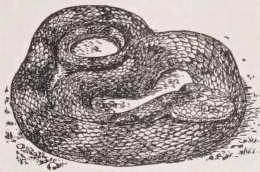
1. A poisonous American serpent (Ancistrodon conotortrix), closely allied to the rattlesnake, but without rattles; -- called also copper-belly, and red viper.
2. A nickname applied to a person in the Northern States who sympathized with the South during the Civil War.
1. The act of covering with copper.
2. An envelope or covering of copper.
Containing, or partaking of the nature of, copper; like copper; as, a copperish taste.
1. A plate of polished copper on which a design or writing is engraved.
2. An impression on paper taken from such a plate.
One whose occupation is to manufacture copper utensils; a worker in copper.
1. The teredo; -- so called because it injures the bottoms of vessels, where not protected by copper.
2. The ringworm.
Mixed with copper; containing copper, or made of copper; like copper in taste or smell.
Mixed with copper; containing copper, or made of copper; like copper.
Money Roget’s Thesaurus §800
N. money, legal tender, money matters, money market, finance, accounts, funds, treasure, capital, stock, assets, wealth, supplies, ways and means, wherewithal, sinews of war, almighty dollar, needful, cash, mammon, dough, cabbage, money-like instruments, m1, m2, sum, amount, balance, balance sheet, sum total, proceeds, currency, circulating medium, specie, coin, piece, hard cash, cold cash, dollar, sterling coin, pounds shillings and pence, ls, d, pocket, breeches pocket, purse, money in hand, cash at hand, ready money, ready cash, slug, wad* wad of bills, wad of money, thick wad of bills, roll of dough, rhino|, blunt|, dust|, mopus|, tin|, salt|, chink|, argent comptant, bottom dollar, buzzard dollar|, checks, dibs*, double eagle, eagle, federal currency, fractional currency, postal currency, federal reserve note, united states note, silver certificate, gold certificate, long bit, short bit, moss, nickel, pile*, pin money, quarter, red cent, roanoke, rock*, seawan, seawant, thousand dollars, grand, single, one-dollar bill, two-dollar bill, five-dollar bill, fiver, fin, lincoln, ten-dollar bill, sawbuck, twenty-dollar bill, jackson, double sawbuck, fifty-dollar bill, hundred-dollar bill, c-note, penny, cent, lincoln cent, indian head penny, copper, two-cent piece three-cent piece, half-dime, nickel, buffalo nickel, v nickel, dime, disme|, mercury dime, quarter, two bits, half dollar, dollar, silver dollar, eisenhower dollar, susan b, anthony dollar, precious metals, gold, silver, copper, bullion, ingot, nugget, petty cash, pocket money, change, small change, small coin, doit, stiver, rap, mite, farthing, sou, penny, shilling, tester, groat, guinea, rouleau, wampum, good sum, round sum, lump sum, power of money, plum, lac of rupees, major coin, crown, minor coin, monetarist, monetary theory, numismatics, chrysology, numismatist, paper money, greenback, major denomination, minor denomination, money order, postal money order, post office order, bank note, bond, bill, bill of exchange, order, warrant, coupon, debenture, exchequer bill, assignat, blueback, hundi, shinplaster*, note, note of hand, promissory note, i o u, draft, check, cheque, back-dated check, negotiable order of withdrawal, now, remittance, credit, liability, drawer, drawee, obligor, obligee, moneyer, coiner, false money, bad money, base coin, flash note, slip|, kite*, fancy stocks, bank of elegance, argumentum ad crumenam, letter of credit, circulation, multiplier effect, inflation, double-digit inflation, hyperinflation, erosion of the currency, debasement of the currency, deflation, stagflation, exchange rate, rate of exchange, floating exchange rates, fixed rates, currency counter, currency exchange, bureau de change, gold-backed currency, gold standard, silver standard, bank account, savings account, checking account, money market account, now account, time deposit, deposit, demand deposit, super now account, certificate of deposit, cd, $, u, s, $, a$, federal reserve bank, central bank, federal reserve board, board of governors of the federal reserve, treasury department, secret service, mint, bureau of engraving, seigniorage, counterfeit, funny money, bogus money, (see falsehood) 545, interest, interest rate, discount rate
V. amount to, come to, mount up to, touch the pocket, draw, draw upon, indorse, issue, utter, discount, back, demonetize, remonetize, fiscalize, monetize, circulate, be in circulation, be out of circulation, mint, coin, print, inflate, deflate, debase, devalue, revalue, circulate, put in circulation, withdraw from circulation, exchange currencies, change money, charge interest, pay interest, lose interest
Adj. monetary, pecuniary, crumenal|, fiscal, financial, sumptuary, numismatic, numismatical, sterling, nummary
Phr. barbarus ipse placet dummodo sit dives, "but the jingling of the guinea helps the hurt that honor feels", gelt regiert die welt, money makes the world go round, nervos belli pecuniam infinitam, redet geld so schweigt die welt, "money is the mother's milk of politics", money is the root of all evil, money isn't everything, "as phony as a three-dollar bill", "don't take any wooden nickels"
King James Bible KJV Bible
Berean Standard Bible BSB Bible
2 KJV and 9 BSB verses contain “Copper”
A land wherein thou shalt eat bread without scarceness, thou shalt not lack any thing in it; a land whose stones are iron, and out of whose hills thou mayest dig brass.
a land where you will eat food without scarcity, where you will lack nothing; a land whose rocks are iron and whose hills are ready to be mined for copper.
Then set it empty upon the coals thereof, that the brass of it may be hot, and may burn, and that the filthiness of it may be molten in it, that the scum of it may be consumed.
And he saw also a certain poor widow casting in thither two mites.
and He saw a poor widow put in two small copper coins.
Alexander the coppersmith did me much evil: the Lord reward him according to his works:
Alexander the coppersmith did great harm to me. The Lord will repay him according to his deeds.