
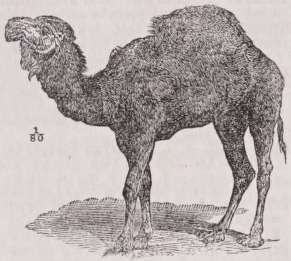
DROMEDARY. See Camel, vol. v, p. 737..
[7 words — estimated reading time: 1 minute]
This name answers to two words in the original, בכר, and feminine בכרה, Isa. lx, 6; Jer. ii, 24; and אחשתרנים, Esther viii, 10, “young dromedaries;” probably the name in Persian. The dromedary is a race of camels chiefly remarkable for its prodigious swiftness. The most observable difference between it and the camel is, that it has but one protuberance on the back; and instead of the slow solemn walk to which that animal is accustomed, it will go as far in one day as the camel in three. For this reason it is used to carry messengers where haste is required. The animal is governed by a bridle, which, being usually fastened to a ring fixed in the nose, may very well illustrate the expression, 2 Kings xix, 28, of turning back Sennacherib by putting a hook into his nose; and may farther indicate his swift retreat.
[148 words — estimated reading time: 1 minute]
DRÔME, a department in the south-east of France, formed of parts of Dauphiné and Provence, is bounded W. by the Rhone, which separates it from Ardèche, N. and N.E. by Isère, E. by Hautes-Alpes, S.E. by Basses-Alpes, and S. by Vaucluse, and Ees between 44° 8 ’ and 45° 20' 25" N. lat. and 4° 41' and 5° 55' E. long. To the east it is covered by spurs of the maritime Alps, one of the largest of which forms part of its eastern boundary, and throws off ridges, mostly wooded, that run east and west with tolerable regularity. These ridges divide the department in its whole extent into three great valleys, having a general slope westwards to the Rhone, namely, that of the Isère in the north, that of the Drôme, which occupies the central portion of the province, and that of the Aygues, in the south. The Rhone and Isère are both navigable. The former receives the whole of the drainage of the department. The soil consists of clays and argillaceous sand with rolled pebbles. Irrigation canals are numerous, and are skilfully managed. The climate, except in the valleys bordering the Rhone, is rather cold, but on the whole bracing and healthy. Snow is visible on the mountain-tops during the greater part of the year. The principal forest-trees are the pine, beech, and oak. In the valleys flourish the olive, chestnut, vine, almond, mulberry, nut, and other fruit trees, and wheat and madder are grown. Black truffles are abundant. Besides agriculture the principal industries are the rearing of silkworms and sheep, and the manufacture of wines, the best of which are the red and white Ermitage, of woollen, cotton, and dyed linen goods, spun and woven silk, paper, oil, ropes, earthenware, and leather. The wool and wood trades are considerable. The mineral products include ...iron,.copper, lead, lignite, marble, granite, black and red potter’s clay, millstones, chalk, and cement-stone. Drôme is divided into the arrondissements of Valence, Die, Montélimart, and Nyons, comprising 29 cantons and 366 communes. The capital is Valence. Of the total area of 652,155 hectares (1,610,823 acres) about 514,227 acres are arable, 415,866 under wood, 329,961 heath, 58,430 vineyards, and 49,203 meadow. The population in 1872 was 320,417.
[398 words — estimated reading time: 3 minutes]