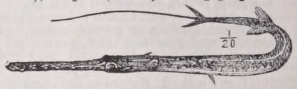
3. A permanent abnormal opening into the soft parts with a constant discharge; a deep, narrow, chronicabscess; an abnormal opening between an internal cavity and another cavity or the surface; as, a salivary fistula; an anal fistula; a recto-vaginal fistula.
FISTULA, a term in surgery used to designate an abnormal communication leading either (1) from the surface of the body to a normal cavity or canal, or (2) from one normal cavity or canal to another. These communications are the result of disease or injury. They receive different names according to their situation :— lachrymal fistula, in connexion with the lachrymal apparatus; salivary fistula, in connexion with the salivaryduct on the cheek ; anal fistula, in connexion with the anus; urethral fistula, in connexion with the urethra,—are all examples of the variety of the first kind of fistula; while recto-vesical fistula, a communication between the rectum and bladder, and vesicovaginal fistula, a communication between the bladder and vagina, are examples of the second. The abnormal canal may be straight or tortuous, of considerable diameter or of narrow calibre. Fistulae are formed in various ways :— (1) by an obstruction of the normal channel, the result of disease or injury, which prevents, for example, the tears, saliva, or urine, as the case may be, from escaping; their retention gives rise to inflammation and ulceration, and the result is that they make a way of exit behind the obstruction; (2) by the formation of an abscess near, for example, the anus, which bursts into the gut and through the skin; the cavity does not close, and a fistula in ano is the result; (3) by destruction, by injury or ulceration, of the septum between one cavity and another, as in recto-vesical fistula, or between a cavity and a canal, as in vesico-vaginal fistula. The fistulous channel will remain patent as long as the contents of the cavity or canal with which it is connected pass along it in whole or in part. There is always a natural tendency to contraction. The treatment is ...founded on these principles :—remove the obstruction, encourage the flow along the natural channel; for example, open up the nasal duct, allow the tears to reach the nasal cavity, and the lachrymal fistula will close; so also in the salivary and urethral varieties. Sometimes it may be necessary to lay the channel freely open, and allow it to close from its deeper parts to the surface, as in anal fistula; in other cases it may be necessary to pare the edges of the abnormal opening and stitch them together, hoping for union of the edges.
9th ed. Encyclopædia Britannica, vol. 9, p. 270 [398 words — estimated reading time: 3 minutes]
This site uses cookies to remember your display preferences (search sources and editions, Bible version, auto-link, images, light/dark theme). No personal data whatsoever is collected. Privacy Policy