
A field or immense mass of ice, formed in deep but elevated valleys, or on the sides of the Alps or other mountains. These masses of ice extend many miles in length and breadth, and remain undissolved by the heat of summer.
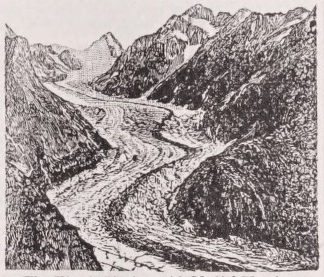
GLACIER, a name given to a mass of ice, having its origin in the hollows of mountains where perpetual snow accumulates, but which makes its way down towards the lower valleys, where it gradually melts, until it terminates exactly where the melting, due to the contact of the warmer air, earth, and rain of the valley, compensates for the bodily descent of the ice from the snow reservoirs of the higher mountains.
The diminution of temperature as we ascend the slopes of mountains, is indicated by successive zones of vegetation, and finally by the occurrence of perpetual snow (see Geology, p. 280). It was first shown by Baron Humboldt and Von Buch that the limit of perpetual snow depends principally on the temperature of the summer, and not upon that of the whole year....
A glacier usually protrudes into a valley far below the limit of perpetual snow, and terminates amidst a wilderness of stones borne down upon its surface and deposited by its fusion. This earthy and rocky rubbish is termed moraine matter, and has already been described (Geology, p. 281). Lying in front of the lower end of a glacier, it marks in a characteristic and certain manner the greatest limit of extension which the glacier has at any one time attained. Sometimes a glacier is seen to have withdrawn very far within its old limits, leaving a prodigious barren waste of stones in advance of it, which, being devoid of soil, nourishes not one blade of grass. At other times the glacier pushes forward its margin beyond the limit which it has ever reached (at least within the memory of man), tears up the ground with its icy ploughshare, and shoves forward the yielding turf in wrinkled folds, uprooting trees, moving vast rocks, and scattering the walls of dwellinghouses in fragments before its irresistible onward march.
The lower end of a glacier is usually steep,—sometimes with a dome-shaped unbroken outline, more frequently broken up by intersecting cracks into prismatic masses which the continued action of the sun and rain sharpen into pyramids, often assuming (as in the glacier of Bossons at Chamouni) grotesque or beautiful forms. From a vault in the green-blue ice, more or less perfectly formed each summer, the torrent issues which represents the natural drainage of the valley, derived partly from land springs, partly from the fusion of the ice. The united or crevassed condition of the glacier generally depends almost entirely on the slope of its bed. If it incline rapidly, numerous transverse fissures are formed from the imperfect yielding of the ice during its forced descent along its uneven channel. These cracks often extend for hundreds of yards, and may be hundreds of feet in depth; but their greatest depth is not accurately known, since they are rarely quite vertical. In many cases, however, the crevasses are comparatively few in number, and the glacier may be readily traversed in all directions. This is especially the case if a glacier of considerable dimensions meets with any contraction in its course. The ice is embayed and compressed, and its slope lessens, just as in the case of a river when it nears a similar contraction preceding a fall. Such level and generally traversable spaces may be found about the middle regions of the Mer de Glace, the lower glacier of Grindelwald, the lower glacier of the Aar, and in many other cases. The last-named glacier is perhaps the most remarkably even and accessible of any in Switzerland. The slope of its surface is in many places only 3°. The Pasterzen glacier in Carinthia is even less inclined. It is in such portions of a glacier that we commonly find internal cascades, or “moulins.” These arise from the surface water being collected into a considerable mass by a long course over its unbroken surface, and then precipitated with violence into the first fissure it meets with. The descending cascade keeps open its channel, which finally loses the form of a fissure, presenting that of an open shaft, often of immense depth.
Nearly connected in their origin with the internal cascades are the “gravel cones,” occasionally seen on the surface of glaciers, which appear to be formed in this way. A considerable amount of earthy matter derived by the superficial water-runs from the moraine accumulates in heaps in the inequalities of the ice, or at the bottom of the “moulins.” As the glacier surface wastes by the action of the sun and rain, these heaps are brought to the surface, or rather the general surface is depressed to their level. If the earthy mass be considerable, the ice beneath is protected from the radiation of the sun and from the violent washing of the rain; it at length protrudes above the general level of the glacier, and finally forms a cone which appears to be entirely composed of gravel, but is in fact ice at the heart, with merely a protecting cover of earthy matter. These singular cones are very well seen on the glacier of the Aar, but on most others they are comparatively rare. The similar protective action of large stones detached from the moraines and lying on the surface of the ice often produces the striking phenomenon of “glacier tables.” Stones of any considerable size almost invariably stand upon a slightly elevated pillar of ice; but when they are broad and flat they occasionally attain a height of 6 and even of 12 feet above the general level.
The superficial waste of a glacier is thus a very important phenomenon. Owing to it the body of the ice has its vertical thickness rapidly diminished during the heats of summer, and, as we have already intimated, the lower end of a glacier has its position determined by the amount of this waste. Suppose a glacier to move along its bed at the rate of 300 feet per annum, and imagine (merely for the sake of illustration) its yearly superficial waste to be 20 feet; then the thickness of the glacier will diminish by 20 feet for every 300 feet of its length, or at the rate of 360 feet per mile, so that the longitudinal section of a glacier has the form of a wedge; and however enormous its original thickness, after a certain course we must at length come to the thin end of the wedge, and that the more rapidly as the causes of melting increase towards the lower extremity. These causes are indeed so various that it is difficult to estimate them with accuracy. We have (1) the direct solar heat, (2) the contact of warm air, and (3) the washing of rain. All these causes act on the surface and produce the “ablation” of the surface. Besides these, the ice of the glacier wastes somewhat beneath by the contact of the soil and the washing of the inferior streams. This may be called its “subsidence.” Further, the natural slope of the rocky bed of the glacier causes any point of the surface to stand absolutely lower each day in consequence of the progressive motion. These three causes united produce the “geometrical depression” of the surface. Principal J. D. Forbes showed how the several effects may usually be distinguished by observation. During the height of summer, near the Montanvert, he found the daily average ablation to be 3 ’ 62 inches, the daily subsidence to be 1 ’ 63 inches. Seven-tenths of the geometrical depression are due therefore to the former cause, and three-tenths to the latter. This is a very large amount, and it is certain that during the colder period of the year, and whilst the glacier is covered with snow, the subsidence is not only suspended, but the glacier recruits in thickness a portion of its waste during the seasons of summer and autumn. To this subject we shall again return.
The middle region of the great glaciers of the Alps extends from the level of about 6000 to 8000 feet above the sea. The inclination is usually there most moderate—say from 2⅛ 0 to 6 q . But this is not invariably the case. Beyond 8000 feet we reach the snow-line. The snow-line is a fact as definite on the surface of a glacier as on that of a mountain, only in the former case it occurs at a somewhat lower level. It cannot be too distinctly understood that the fresh snow annually disappears from the glacier proper. Where it ceases entirely to melt, it of course becomes incorporated with the glacier. We have therefore arrived at the region where the glacier forms·, everywhere below it only wastes. This snowy region of the glacier is called in French névé, in German Jim. As we ascend the glacier it passes gradually from the state of ice to the state of snow. The superficial layers are more snowy and white, in fact nearly pure snow; the deeper ones have more colour and consistence, and break on the large scale into vast fragments, which at Chamouni are called seracs. The névé moves, as the glacier proper does, and it is fissured by the inequalities of the ground over which it passes. These fissures are less regular than those of the lower glacier. They are often much wider, in fact of stupendous dimensions, and, being often covered with treacherous snowy roofs, constitute one of the chief dangers of glacier travelling. The constitution of the névé may be well studied on the Glacier du Géant, a tributary of the Mer de Glace. The mountain-clefts in which large glaciers lie usually expand in their higher portions (in conformity with the ordinary structure of valleys) into extensive basins in which snow is perpetual, and which therefore contain the névé, the true origin and material of the glacier, which is literally the overflow of these snowy reservoirs. The amount of overflow, or the discharge of the glacier—upon which depends the extent of its prolongation into the lower valleys—depends in its turn on the extent of the névé or collecting reservoir. Glaciers with small reservoirs of necessity perish soon. Their thickness being small, the wedge of the glacier soon thins out. They are common in confined cirques of the higher mountains. Such are the glaciers of the second order described by De Saussure. Their slope is often very great—from 20° to 40°.
The ice of the glacier proper has a very peculiar structure, quite distinct from the stratification of the snow on the névé (the relics of its mode of deposit), and one which requires special notice. When we examine the appearance of the ice in the wall of an ordinary crevasse (especially if it be tolerably near the side of the glacier) we are struck with the beautiful vertically laminated structure (first observed by Principal Forbes) which it commonly presents, resembling delicately veined marble (especially the variety called in Italy cipollino), in shades varying from bluish-green, through green, to white. When we trace the direction of the planes constituting the laminated structure, by observing them on the surface of the glacier (where they are usually well seen after rain, or in the channels of superficial water-runs), we find that where best developed (or not very far from the sides of the glacier) these laminae are nearly parallel to the sides, but rather incline from the shore to the centre of the ice stream as we follow the declivity of the glacier.
Forbes found that certain superficial discolorations in the form of excessively elongated hyperbolas are due to the recurrence (at intervals of some hundred feet along the course of the glacier) of portions of ice in which the veined structure is more energetically developed than elsewhere, and where, by the decomposition of the softer laminae, portions of sand and dirt become entangled in the superficial ice, and give rise to the phenomena of “dirt bands,” which thus at a distance display (though in a manner requiring some attention to discover) the exact course of this singular structure on the surface of the glacier. Fig. 1 displays the superficial form of the dirt bands, and the course of the structural laminae projected horizontally. Fig. 2 shows an ideal transverse section of the glacier, and fig. 3 another vertical section parallel to its length. These three sections in rectangular planes will serve to give a correct idea of the course of this remarkable structure within the ice, but a more popular conception will be formed of it from 'he imaginary sections of a canal-shaped glacier in fig. 4. The structure of the compound glacier, originally double, becomes gradually single; and the “frontal dip” of the laminae at the loop of the horizontal curves, which in the upper region is nearly vertical, gradually slopes forwards until at the lower termination it has a very slight dip inwards, or indeed may be reversed and fall outwards and forwards. The general form of a structural lamina of a glacier rudely resembles that of a spoon.
This structure and the accompanying dirt bands have been recognized by different observers in almost all glaciers, including those of Norway and of India. The interval between the dirt bands has been shown in the case of the Mer de Glace (and therefore probably in other cases) to coincide with annual rate of progression, and in the higher parts of the glacier (towards the névé) to be accompanied by wrinkles or inequalities of the surface which are well marked by the snow lying in them during the period of its partial disappearance.
The Motion of Glaciers and its Causes.— There is something about a glacier which almost inevitably conveys to the mind the idea of a stream. This may be traced in the descriptions of unscientific tourists, of poets, and of some of those who have addressed themselves more seriously to the question of the real nature of these bodies. To the latter class of observers belong Captain Basil Hall and Monseigneur Rendu, bishop of Annecy, who had much more than hinted at the possibility of a true mechanical connexion between the descent of a glacier and that of a mountain torrent, or of a stream of lava. But until the actual conditions of motion were reduced to rule, it was impossible to know how far the analogy was real.
The most characteristic and remarkable feature of glaciers is their motion downwards from the névé towards the lower valley. The explanation of it is by far the most important application of mechanical physics connected with the subject. The principal theories to account for the progressive motion of glaciers which were prevalent previous to 1842 may be briefly characterized as De Saussure’s and De Charpentier’s, though each had been maintained long before by the earlier Swiss writers. The first may be called the gravitation theory, the latter the dilatation theory. Both suppose that the motion of the ice takes place by its sliding bodily over its rocky bed, but they differ as to the force which urges it over the obstacles opposed by friction and the irregularities of the surface on which it moves.
The following quotation from De Saussure explains his views with his usual precision :—“These frozen masses, carried along by the slope of the bed on which they rest, disengaged by the water (arising from their fusion owing to the natural heat of the earth) from the adhesion which they might otherwise contract to the bottom—sometimes even elevated by the water—must gradually slide and descend along the declivity of the valleys or mountain slopes {croupes) which they cover. It is this slow but continual sliding of the icy masses {des glaces) on their inclined bases which carries them down into the lower valleys, and which replenishes continually the stock of ice in valleys warm enough to produce large trees and rich harvests.” Very sufficient objections have been urged against this theory. It is evident that De Saussure considered a glacier as an accumulation of icy fragments, instead of a great and continuous mass, throughout which the fissures and “crevasses” bear a small proportion to the solid portion; and that he has attributed to the subglacial water a kind and amount of action for which there exists no sufficient or even probable evidence. The main objection, however, is this, that a sliding motion of the kind supposed, if it commence, must be accelerated by gravity, and the glacier must slide from its bed in an avalanche. The small slope of most glaciervalleys, and the extreme irregularity of their bounding walls, are also great objections to this hypothesis.
The dilatation theory ingeniously meets the difficulty of the want of a sufficient moving power to drag or shove a glacier over its bed, by calling in the well-known force with which water expands on its conversion into ice. The glacier being traversed by innumerable capillary fissures, and being in summer saturated with water in all its parts, it was natural to invoke the freezing action of the night to convert this water into ice, and by the amount of its expansion to urge the glacier onwards in the direction of its greatest slope. In answer to this, it is sufficient to observe, in the first place, that during the height of summer the portions of those glaciers which move fastest are never reduced below the freezing point, and that, even in the most favourable cases of nocturnal radiation producing congelation at the surface, it cannot (by well-known laws of conduction) penetrate above a few inches into the interior of the glacier. Again, the ascertained laws of glacier-motion are (as will be immediately seen) entirely adverse to this theory, as it is always accelerated by hot weather and retarded by cold, yet does not cease even in the depths of winter.
It is singular how slow observers were to perceive the importance to the solution of the problem of glaciermotion of ascertaining with geometrical precision the amount of motion of the ice, not only from year to year, but from day to day, in summer and winter, whether constant or variable at the same point, whether continuous or by starts; if variable, on what circumstances it depended, and in what manner it was affected at different points of the length and breadth of a glacier.
This method of studying the question was taken up by Forbes. His observations were commenced on the Mer de Glace of Chamouni, in Juue 1842. Between the 26th and 27th of that month the motion of the ice opposite a point called the “Angle” was found, by means of a theodolite, to be 16 ’ 5 inches in 26 hours; between the 27th and 28th, 17 ’ 4 inches in 25∣ hours; and from about 6 a.m. to 6 p.m. on the 28th the motion was 9 ’ 5 inches, or 17’5 inches in 24 hours; whilst the proportional motion during even an hour and a half was observed. No doubt could therefore remain that the motion of the ice is continuous and tolerably uniform—in short, that it does not move by jerks. He also ascertained about the same time that the motion of the ice is greatest towards the centre of a glacier and slower at the sides, contrary to an opinion then maintained on high authority. He next found that the rate of motion varied at different points of the length of the same glacier, being on the whole greatest where the inclination of its surface is greatest. As the season advanced, he observed notable changes in the rate of motion of the same part of the ice, and connected it by a very striking direct relation with the temperature of the air. These facts were established during the summer of 1842, and promptly published. By means of occasional observations during the following winter and spring by his guide, Auguste Balmat of Chamouni, and by a more full comparison of the entire motion of a glacier for twelve months with its motion during the hot season of the year, another generally received error was rectified: the motion of the glacier continues even in winter, and it has a very perceptible ratio to the summer motion. Last of all, it was found that the surface of a glacier moves faster than the ice nearer the bottom or bed.
These and some minor laws of motion, being undoubted expressions of the way in which glaciers move, were formulated by Forbes in an approximate theory: “A glacier is an imperfect fluid or a viscous body, which is urged down slopes of a certain inclination by the mutual pressure of its parts.” The analogy subsisting between the motion of a glacier and that of a river (which is a viscous fluid,—were it not so, its motion would be widely different) will be best perceived by stating more precisely its laws of motion.
1. Each portion of a glacier moves, not indeed with a constant velocity, but in a continuous manner, and not by sudden...