
of get.
Word of the Day: Catachrestical
Goat-toothed; having a lickerish tooth.
Gataker
Encyclopedia Britannica
GATAKER, Thomas (1574-1654), a learned English divine, was born in London in 1574, and educated at St John’s College, Cambridge. From 1601 to. 1611 he held the appointment of preacher to the society of Lincoln’s Inn, which he resigned on obtaining the rectory of Rotherhithe. In 1642 he was chosen a member of the Assembly of Divines at Westminster. The parts of the Assembly’s annotations upon the Bible which were executed by him are those on Isaiah, Jeremiah, and the Lamentations. At Westminster he disapproved of the introduction of the Covenant, and declared himself in favour of Episcopacy. He was also one of the forty-seven London clergymen who disapproved of the trial of Charles I. He died in 1654. His principal works, besides some volumes of sermons, are —On the Nature and Use of Lots, 1616, a curious treatise which gave rise to much controversy; Dissertatio de Stylo Novi Testamenti, 1648; Cinnus, sive Adversaria Miscellanea, in quibus Sacroe Scmpturoe primo, deinde aliorum Scriptorum, locis aliquam multis lux redditur, 1651, to which was afterwards subjoined Adversaria Posthuma ; and his edition of Marcus Antoninus, which, according to Hallam, is the “earliest edition of any classical writer published iu England with original annotations,” and for the period at which it was written possesses remarkable merit. The best edition of his works is that published at Utrecht in 1668.
9th ed. Encyclopædia Britannica, vol. 10, p. 107
[230 words — estimated reading time: 2 minutes]
[230 words — estimated reading time: 2 minutes]
Gatchina
Encyclopedia Britannica
GATCHINA, a town of Russia, in the government of St Petersburg and district of Tsarskoselo, 29 miles W. of St Petersburg, in 59° 34' N. lat. and 30° 6' E. long. It is situated in a flat, well-wooded, and partly marshy district, and on the south side of the town are two lakes, distinguished as the White and the Black. Among its more important builings are the imperial palace, which was founded in 1770 by Prince Orloff, and executed according to the plans of the Italian architect Rinaldi, the four Greek churches, the Protestant church, a foundling asylum, a military orphanage founded in 1803 by Maria Feodorina, a school for horticulture, a public hospital for 1500 patients, founded by Paul I., an asylum for the families of twenty blind men, and another for fifty poor peasants. In one of the Greek churches are preserved several relics originally brought from Rhodes to Malta by the grand-master Lille Adam; and the so-called priory is shown where the knights of Malta assembled under the mastership of the emperor Paul I. Gatchina is a junction on the railway between St Petersburg and Warsaw, but its trade is of no great development. Among the few industrial establishments is a porcelain factory. The inhabitants in 1860 numbered 9184, of whom 2255 were members of the National Church, 1431 Protestants, 182 Catholics, and 50 Jews. By 1867 the total had sunk to 8337; but according to the St Petersburg Calendar for 1878 it has again risen to 8890.
9th ed. Encyclopædia Britannica, vol. 10, p. 108
[254 words — estimated reading time: 2 minutes]
[254 words — estimated reading time: 2 minutes]
1. A large door which gives entrance into a walled city, a castle, a temple, palace or other large edifice. It differs from door chiefly in being larger. gate signifies both the opening or passage, and the frame of boards, planks or timber which closes the passage.
2. A frame of timber which opens or closes a passage into any court, garden or other inclosed ground; also, the passage.
4. An avenue; an opening; a way.
5. In scripture, figuratively, power, dominion. 'Thy seed shall possess the gate of his enemies; ' that is, towns and fortresses. Genesis 22:17 .
6. The gates of hell, are the power and dominion of the devil and his instruments. Matthew 16:18 .
7. The gates of death, are the brink of the grave. Psalms 9:13 .
1. A large door or passageway in the wall of a city, of an inclosed field or place, or of a grand edifice, etc.; also, the movable structure of timber, metal, etc., by which the passage can be closed.
2. An opening for passage in any inclosing wall, fence, or barrier; or the suspended framework which closes or opens a passage. Also, figuratively, a means or way of entrance or of exit.
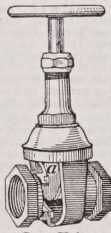
3. A door, valve, or other device, for stopping the passage of water through a dam, lock, pipe, etc.
4. The places which command the entrances or access; hence, place of vantage; power; might.
6. The channel or opening through which metal is poured into the mold; the ingate.
8. A way; a path; a road; a street (as in Highgate).
9. Manner; gait.
1. To supply with a gate.
2. To punish by requiring to be within the gates at an earlier hour than usual.
Gate
Watson's Biblical & Theological Dictionary
is often used in Scripture to denote a place of public assembly, where justice was administered, Deut. xvii, 5, 8; xxi, 19; xxii, 15; xxv, 6, 7, &c. One instance of these judgments appears in that given at the gate of Bethlehem, between Boaz and a relation of Naomi, on the subject of Ruth, chap. iv, 2; another in Abraham’s purchase of a field to bury Sarah, Gen. xxiii, 10, 18. The gate of judgment is a term still common to the Arabians to express a court of justice, and even introduced by the Saracens into Spain. “I had several times,” says Jacob, “visited the Alhambra, the ancient palace and fortress of the Moorish kings: it is situated on the top of a hill, overlooking the city, and is surrounded by a wall of great height and thickness. The entrance is through an archway, over which is carved a key, the symbol of the Mohammedan monarchs. This gate, called the gate of judgment, according to eastern forms, was the place where the kings administered justice.” In Morocco, the gate is still the place where judgment is held. “All complaints,” says Host, “are brought, in the first instance, to the cadi, or governor, who, for that purpose, passes certain hours of the day in the gate of the city, partly for the sake of the fresh air, and partly to see all those who go out; and, lastly, to observe a custom which has long prevailed, of holding judgment there. The gate is contrived accordingly, being built like a square chamber, with two doors, which are not directly opposite to each other, but on two adjoining sides, with seats on the other sides. In this manner David sat between two gates,” 2 Sam. xviii, 24. Gate sometimes signifies power, dominion, almost in the same sense as the Turkish emperor’s palace is called the _Porte_. God promises Abraham that his ...posterity shall possess the gates of their enemies, their towns, their fortresses, Genesis xxii, 17. Jesus Christ says to Peter, “Thou art Peter; and on this rock will I build my church, and the gates of hell shall not prevail against it,” Matt. xvi, 18. This may mean either the powers of hell, or invisible spirits; or simply death,--the church shall be replenished by living members from generation to generation, so that death shall never annihilate it. Solomon says, “He that exalteth his gate seeketh destruction.” The Arabs are accustomed to ride into the houses of those they design to harass. To prevent this, Thevenot tells us that the door of the house in which the French merchants live at Rama was not three feet high, and that all the doors of that town are equally low. Agreeably to this account, the Abbé Mariti, speaking of his admission into a monastery near Jerusalem, says, “The passage is so low, that it will scarcely admit a horse; and it is shut by a gate of iron, strongly secured in the inside. As soon as we entered, it was again made fast with various bolts and bars of iron: a precaution extremely necessary in a desert place, exposed to the incursions, and insolent attacks of the Arabs.” Mr. Drummond says, that in the country about Roudge, in Syria, “the poor miserable Arabs are under the necessity of hewing their houses out of the rock, and cutting very small doors or openings to them, that they may not be made stables for the Turkish horse, as they pass and repass.” And thus, long before him, Sandys, at Gaza, in Palestine: “We lodged under an arch in a little court, together with our asses; the door exceeding low, as are all that belong unto Christians, to withstand the sudden entrance of the insolent Turks.” “To exalt the gate,” would consequently be to court destruction. Morier says, “A poor man’s door is scarcely three feet in height; and this is a precautionary measure to hinder the servants of the great from entering it on horseback; which, when any act of oppression is intended, they would make no scruple to do. But the habitation of a man in power is known by his gate, which is generally elevated in proportion to the vanity of its owner. A lofty gate is one of the insignia of royalty: such is the _Allan Capi_, at Ispahan, and _Bob Homayan_, or the _Sublime Porte_, at Constantinople. It must have been the same in ancient days; the gates of Jerusalem, Zion, &c, are often mentioned in the Scripture, with the same notion of grandeur annexed to them.”
Watson's Biblical & Theological Dictionary
[764 words — estimated reading time: 5 minutes]
[764 words — estimated reading time: 5 minutes]
Having gates.
Having gates.
A house connected or associated with a gate.
Having no gate.
A gate keeper; a gate tender.
2. A post against which a gate closes; -- called also shutting post.
Gates
Encyclopedia Britannica
GATES, Horatio (1728-1806), an American general, was born at Maldon in Essex, England, in 1728. He entered the English army at an early age, and soon obtained considerable promotion. He was severely wounded while accompanying General Braddock in his unfortunate expedition against the French settlements on the Ohio in 1755, and he took part in the expedition against Martinico in January 1762. After the peace of 1763 he purchased an estate in Virginia, where he resided till the commencement of the revolutionary war in 1775, when he was named by congress adjutant-general. In 1776 he was appointed to command the army on Lake Champlain; but, his conduct there not having been approved of, he was superseded in’the following spring; yet in August he was sent to oppose General Burgoyne, whom he totally defeated on the 16th of October, and compelled to surrender his whole army,— an achievement which was, however, largely due to the previous manoeuvres of Schuyler, whom Gates superseded. After obtaining the chief command in the southern districts, Gateβ was totally defeated at Camden, in South Carolina, by Lord Cornwallis, on the 16th of August 1780. On this account he was superseded by General Greene; but an investigation into his conduct terminated in acquitting him fully and honourably of all blame, on the ground that his defeat had been unavoidable in the disorganized state of the army under his command. After this he again retired to his Virginian estate, whence he removed to New York in 1800. On his arrival he was immediately admitted to the freedom of the city, and then elected a member of the State legislature. Before his departure from Virginia he granted emancipation to his slaves, accompanying their manumission with a provision for those who needed assistance. He ...died on the 10th of April 1806.
9th ed. Encyclopædia Britannica, vol. 10, p. 108
[304 words — estimated reading time: 2 minutes]
[304 words — estimated reading time: 2 minutes]
Gateshead
Encyclopedia Britannica
GATESHEAD, a municipal and parliamentary borough and market-town of England, county of Durham, is situated on the right bank of the Tyne, opposite Newcastle, of which it practically forms a part, being united with it by three bridges. The town consists of two principal and nearly parallel streets, from which others diverge in various directions. A great fire which occurred in 1854 was taken advantage of for the carrying out of improvements in the old part of the town, and it is now much less crowded than formerly. In the suburbs there are a considerable number of fine mansions. The parish church, recently restored, is an ancient cruciform edifice surmounted by a lofty tower; and several of the other churches and chapels are handsome buildings. The Wesleyan and Primitive Methodists, the Congregationalists, Baptists, Presbyterians, and Roman Catholics are all represented. The town possesses a fine cemetery, a well laid out public park, a new town-hall, a grammar school, a hospital (St Edmund’s) for fifteen indigent persons, a reformatory, a mechanics’ institute, and a dispensary. There are large iron works (including foundries and factories for engines, boilers, chains, and cables), shipbuilding yards, glass manufactories, chemical, soap, and candle works, brick and tile works, breweries and tanneries. The town also contains the principal depot of the North-Eastern Railway, with large stores and locomotive works. Extensive coal mines exist in the vicinity; and at Gateshead Fell are large quarries for grindstones, which are much esteemed and are exported to all parts of the world....
The large number of Roman relics found at Gateshead would seem to indicate that it was originally an outwork of the Roman station at Newcastle. The name is mentioned as early as 1080, and in 1164 the bishop of Durham granted to its burgesses equal privileges with those of Newcastle. On the dissolution of the see of Durham in 1552, an Act was passed for uniting the town to the borough of Newcastle, but on the restoration of the rights of the bishopric it was again placed under that jurisdiction, being governed, from 1317 to 1695, with the exception of that short intermission, by a bailiff nominated by the bishop. From 1695 to 1826, when it became a municipal borough, it was governed by two stewards, elected by the inhabitants. Gateshead returns one member to parliament. The population of the municipal borough, which in 1861 was 33,587, was 48,627 in 1871.
9th ed. Encyclopædia Britannica, vol. 10, p. 108
[408 words — estimated reading time: 3 minutes]
[408 words — estimated reading time: 3 minutes]
1. A way through the gate of some inclosure.
2. A building to be passed at the entrance of the area before a mansion.
In the manner of a gate.
Gath
Encyclopedia Britannica
GATH, one of the five chief cities of the Philistines. Its site appears to have been known in the 4th century, but the name is now lost. Eusebius (in the Onomasticori) places it near the road from Eleutheropolis (Beit Jibrîn) to Diospolis (Ludd) about 5 Roman miles from the former. The Roman road between these two towns is still traceable, and its milestones remain in places. East of the road at the required distance rises a white cliff, almost isolated, 300 feet high, and full of caves. On the top is the little mud village of Tell-es-Sâfi (“the shining mound ”), and round it are the mounds which mark the site of the crusading castle of Blanchegarde (Alba Custodia), built in 1144. Telles-Sâfi was known by its present name as far back as the 12th century, but it appears probable that the strong site here existing represents the ancient Gath. The cliff stands on the south bank of the valley of Elah, and Gath appears to have been near this valley (1 Sam. xvii. 2, 52). The name Gath, meaning a “winepress,” designates several other places in Palestine.
9th ed. Encyclopædia Britannica, vol. 10, p. 108
[193 words — estimated reading time: 2 minutes]
[193 words — estimated reading time: 2 minutes]
Gath
Watson's Biblical & Theological Dictionary
the fifth of the Philistine cities. It was a place of strength in the time of the prophets Amos and Micah, and is placed by Jerom on the road between Eleutheropolis and Gaza. It appears to have been the extreme boundary of the Philistine territory in one direction, as Ekron was on the other. Hence the expression, “from Ekron even unto Gath,” 1 Sam. vii, 14.
Watson's Biblical & Theological Dictionary
[66 words — estimated reading time: 1 minute]
[66 words — estimated reading time: 1 minute]
1. To collect; to unite; to increase; to be condensed. The clouds gather in the west.
2. To increase; to grow larger by accretion of like matter.
3. Their snow ball did not gather as it went.
4. To assemble. The people gather fast.
1. To bring together; to collect a number of separate things into one place or into one aggregate body.
2. Gather stones; and they took stones, and made a heap. Genesis 31:46 .
3. To get in harvest; to reap or cut and bring into barns or stores. Leviticus 25:20 .
5. Gather out the stones. Isaiah 62:10 .
6. He must gather up money by degrees.
8. Do men gather grapes of thorns, or figs of thistles? Matthew 7:16 .
10. To collect in abundance; to accumulate; to amass.
11. I gathered me also silver and gold, and the peculiar treasure of kings. Ecclesiastes 2:26 .
12. To select and take; to separate from others and bring together.
13. Save us, O Lord our God, and gather us from among the heathen. Psalms 106:47 .
14. To sweep together.
15. The kingdom of heaven is like a net that was cast into the sea, and gathered of every kind. Matthew 13:28 .
16. To bring into one body or interest.
17. Yet will I gather others to him. Isaiah 56:8 .
18. To draw together from a state of expansion or diffusion; to contract.
19. Gathering his flowing robe he seemed to stand,
20. In act to speak, and graceful stretch'd his hand.
21. To gain.
22. He gathers ground upon her in the chase.
24. To deduce by inference; to collect or learn by reasoning. From what I hear I gather that he was present.
25. After he had seen the vision, immediately we endeavored to go into Macedonia, assuredly gathering that the Lord had called us to preach the gospel to them. Acts 16:1 .
26. To coil as a serpent.
27. To gather breath, to have respite.
2. The inclination forward of the axle journals to keep the wheels from working outward.
3. The soffit or under surface of the masonry required in gathering. See Gather, v. t., 7.
1. To come together; to collect; to unite; to become assembled; to congregate.
2. To grow larger by accretion; to increase.
4. To collect or bring things together.
1. To bring together; to collect, as a number of separate things, into one place, or into one aggregate body; to assemble; to muster; to congregate.
2. To pick out and bring together from among what is of less value; to collect, as a harvest; to harvest; to cull; to pick off; to pluck.
4. To bring closely together the parts or particles of; to contract; to compress; to bring together in folds or plaits, as a garment; also, to draw together, as a piece of cloth by a thread; to pucker; to plait; as, to gather a ruffle.
5. To derive, or deduce, as an inference; to collect, as a conclusion, from circumstances that suggest, or arguments that prove; to infer; to conclude.
6. To gain; to win.
That may be collected; that may be deduced. [Unusual.]
Collected; assembled; contracted; plaited; drawn by inference.
One who gathers or collects; one who gets in a crop.
1. One who gathers or collects.
2. An attachment for making gathers in the cloth.
No thesaurus entries found for "gat".
King James Bible KJV Bible
Berean Standard Bible BSB Bible
962 KJV and 722 BSB verses contain “gat” — showing the first 20. Show all 1,070 verses (searchable)
And God said, Let the waters under the heaven be gathered together unto one place, and let the dry land appear: and it was so.
And God said, “Let the waters under the sky be gathered into one place, so that the dry land may appear.” And it was so.
And God called the dry land Earth; and the gathering together of the waters called he Seas: and God saw that it was good.
God called the dry land “earth,” and the gathering of waters He called “seas.” And God saw that it was good.
And take thou unto thee of all food that is eaten, and thou shalt gather it to thee; and it shall be for food for thee, and for them.
You are also to take for yourself every kind of food that is eaten and gather it as food for yourselves and for the animals.”
And Abraham gat up early in the morning to the place where he stood before the LORD:
Early the next morning, Abraham got up and returned to the place where he had stood before the LORD.
That in blessing I will bless thee, and in multiplying I will multiply thy seed as the stars of the heaven, and as the sand which is upon the sea shore; and thy seed shall possess the gate of his enemies;
And they blessed Rebekah, and said unto her, Thou art our sister, be thou the mother of thousands of millions, and let thy seed possess the gate of those which hate them.
And they blessed Rebekah and said to her, “Our sister, may you become the mother of thousands upon thousands. May your offspring possess the gates of their enemies.”
Then Abraham gave up the ghost, and died in a good old age, an old man, and full of years; and was gathered to his people.
And at a ripe old age he breathed his last and died, old and contented, and was gathered to his people.
And thither were all the flocks gathered: and they rolled the stone from the well’s mouth, and watered the sheep, and put the stone again upon the well’s mouth in his place.
When all the flocks had been gathered there, the shepherds would roll away the stone from the mouth of the well and water the sheep. Then they would return the stone to its place over the mouth of the well.
And they said, We cannot, until all the flocks be gathered together, and till they roll the stone from the well’s mouth; then we water the sheep.
But they replied, “We cannot, until all the flocks have been gathered and the stone has been rolled away from the mouth of the well. Then we will water the sheep.”
And unto Hamor and unto Shechem his son hearkened all that went out of the gate of his city; and every male was circumcised, all that went out of the gate of his city.
All the men who went out of the city gate listened to Hamor and his son Shechem, and every male of the city was circumcised.