
Word of the Day: Catachrestical
Any one of several species of large wading birds of the family Ciconidae, having long legs and a long, pointed bill. They are found both in the Old World and in America, and belong to Ciconia and several allied genera. The European white stork (Ciconia alba) is the best known. It commonly makes its nests on the top of a building, a chimney, a church spire, or a pillar. The black stork (C. nigra) is native of Asia, Africa, and Europe.
Stork
Encyclopedia Britannica
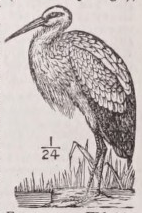
STORK (A.S. Store ; Germ. Storch), the Ciconia alba of ornithology, and, through picture and story, one of the best known of foreign birds; for, though often visiting Britain, it has never been a native or even inhabitant of the country. It is a summer-visitant to most parts of the European continent,—the chief exceptions being France (where the native race has been destroyed), Italy, and Russia,—breeding from southern Sweden to Spain and Greece, and being especially common in Poland. It reappears again in Asia Minor, the Caucasus, Persia, and Turkestan, but further to the eastward it is replaced by an allied species, C. boyciana, which reaches Japan. Though occasionally using trees (as was most likely its original habit) for the purpose, the Stork most generally places its nest on buildings, a fact familiar to travellers in Denmark, Holland, and Germany, and it is nearly everywhere a cherished guest, popular belief ascribing good luck to the house to which it attaches itself. Its food, consisting mainly of frogs and insects, is gathered in the neighbouring pastures, across which it may be seen stalking with an air of quiet dignity; but in the season of love it indulges in gestures which can only be called grotesque,—leaping from the ground with extended wings in a kind of dance, and, absolutely voiceless as it is, making a loud noise by the clattering of its mandibles. At other times it may be seen gravely resting on one leg on an elevated place, thence to sweep aloft and circle with a slow and majestic flight. Apart from its considerable size,—and a Stork stands more than three feet in height,— its contrasted plumage of pure white and deep black, with its bright red bill and legs, makes it a conspicuous and beautiful object, especially when seen against the ...fresh green grass of a luxuriant meadow. In winter the Storks of Europe retire to Africa,—some of them, it would seem, reaching the Cape Colony,—while those of Asia visit India. A second species, with much the same range, but with none of its relative’s domestic disposition, is the Black Stork, C. nigra, of which the upper parts are black, brilliantly glossed with purple, copper, and green, while it is white beneath,—the bill and legs, with a patch of bare skin round the eyes, being red. This bird breeds in lofty trees, generally those growing in a large forest. Two other dark-coloured, but somewhat abnormal, species are the purely African C. abdimii, and the C. episcopus, which has a wider range, being found not only in Africa but in India, Java, and Sumatra. The New World has only one true Stork, C. maguari which inhabits South America, and resembles not a little the C. boyciana above mentioned, differing therefrom in its greenish-white bill and black tail. Both these species are very like C. alba, but are larger, and have a bare patch of red skin round the eyes.
The Storks form the Pelargi of Nitzsch, as separated by him from the Herons and the Ibises, but all three are united by Prof. Huxley in his group Pelargomorphae. The relations of the Storks to the Herons may be doubtful; but there is no doubt that the former include the Jabiru (vol. xiii. p. 529) and its allies, as well as the curious genus Anastomus (with its lower mandible hollowed out so as only to meet the maxilla at the base and the tip), of which there are an African and an Asiatic species. Two other remarkable forms probably belong to the Pelargi. These are Balaeniceps rex and Scopus umbretta, each the sole member of its own genus, and both from Africa. The former, first brought to Europe by Mr M. Parkyns from the White Nile, was regarded by Gould, who described it in the Zoological Proceedings (1851, pp. 1, 2, pl. xxxv.), as an abnormal Pelican. This view was disputed by Reinhardt (op. cit., 1860, p. 377), and wholly dispelled by Prof. Parker in the Zoological Transactions (iv. pp. 269-351), though these two authors disagreed as to its affinities, the first placing it with the Storks, the last assigning it to the Herons. In singularity of aspect few birds surpass Balaeniceps, with its gaunt grey figure, some five feet in height, its large head surmounted by a little curled tuft, the scowling expression of its eyes, and its huge bill in form not unlike a whale’s head—this last suggesting its generic name—but tipped with a formidable hook. The shape of the bill has also prompted the Arabs to call it, according to their idiom, the “Father of a Shoe,” and it has been designated “Shoe-bill” in English. The other form that remains to be noticed is the Scopus umbretta of ornithologists, called the “Umbre” by Pennant. This was discovered by Adanson the French traveller in Senegal about the middle of the last century, and was described by Brisson in 1760. It has since been found to inhabit nearly the whole of Africa and Madagascar, and is the “Hammerkop” (Hammerhead) of the Cape colonists. Though not larger than a Raven, it builds an enormous nest, some six feet in diameter, with a flat-topped roof and a small hole for entrance and exit, and placed either on a tree or a rocky ledge. The bird, of an almost uniform brown colour, slightly glossed with purple, and its tail barred with black, has a long occipital crest, generally borne horizontally, so as to give rise to its common name. It is somewhat sluggish by day, but displays much activity at dusk, when it will go through a series of strange performances. In all the Storks, so far as is known, the eggs are white, and in most forms distinguishable by the grain of their shell, which, without being rough, is closely pitted with pore-like depressions. (a. n.)
9th ed. Encyclopædia Britannica, vol. 22, p. 577
[991 words — estimated reading time: 6 minutes]
[991 words — estimated reading time: 6 minutes]
Stork
Watson's Biblical & Theological Dictionary
חסידה, Lev. xi, 19; Deut. xiv, 18; Job xxxix, 13; Psalm civ, 17; Jer. viii, 7; Zech. v, 9; a bird similar to the crane in size, has the same formation as to the bill, neck, legs, and body, but is rather more corpulent. The colour of the crane is ash and black; that of the stork is white and brown. The nails of its toes are also very peculiar; not being clawed like those of other birds, but flat like the nails of a man. It has a very long beak, and long red legs. It feeds upon serpents, frogs, and insects, and on this account might be reckoned by Moses among unclean birds. As it seeks for these in watery places, nature has provided it with long legs; and as it flies away, as well as the crane and heron, to its nest with its plunder, therefore its bill is strong and jagged, the sharp hooks of which enable it to retain its slippery prey. It has long been remarkable for its love to its parents, whom it never forsakes, but tenderly feeds and cherishes when they have become old, and unable to provide for themselves. The very learned and judicious Bochart has collected a variety of passages from the ancients, in which they testify this curious particular. Its very name in the Hebrew language, _chasida_, signifies mercy or piety: and its English name is taken, if not directly, yet secondarily, through the Saxon, from the Greek word στοργὴ, which is often used for natural affection. The stork’s an emblem of true piety; Because, when age has seized and made his dam Unfit for flight, the grateful young one takes His mother on his back, provides her food, Repaying thus her tender care of him Ere he was fit to fly. BEAUMONT. It is a bird of passage, and is spoken of as such in Scripture: “The stork knoweth her appointed time,” Jer. viii, 7. Who bid the stork, ...Columbus-like, explore Heavens not its own, and worlds unknown before? Who calls the council, states the certain day, Who forms the phalanx, and who points the way? POPE. Bochart has collected several testimonies of the migration of storks. Ælian says, that in summer time they remain stationary, but at the close of autumn they repair to Egypt, Libya, and Ethiopia. “For about the space of a fortnight before they pass from one country to another,” says Dr. Shaw, “they constantly resort together, from all the adjacent parts, in a certain plain; and there forming themselves, once every day, into a ‘douwanne,’ or council, (according to the phrase of these eastern nations,) are said to determine the exact time of their departure, and the place of their future abodes.” See SWALLOW.
Watson's Biblical & Theological Dictionary
[461 words — estimated reading time: 3 minutes]
[461 words — estimated reading time: 3 minutes]
Having a bill like that of the stork.
A plant of the genus Geranium.
No thesaurus entries found for "stork".
King James Bible KJV Bible
Berean Standard Bible BSB Bible
5 KJV and 6 BSB verses contain “stork”
Yea, the stork in the heaven knoweth her appointed times; and the turtle and the crane and the swallow observe the time of their coming; but my people know not the judgment of the LORD.
Even the stork in the sky knows her appointed seasons. The turtledove, the swift, and the thrush keep their time of migration, but My people do not know the requirements of the LORD.
Then lifted I up mine eyes, and looked, and, behold, there came out two women, and the wind was in their wings; for they had wings like the wings of a stork: and they lifted up the ephah between the earth and the heaven.
Then I lifted up my eyes and saw two women approaching, with the wind in their wings. Their wings were like those of a stork, and they lifted up the basket between heaven and earth.