
A quadruped having very short fore legs.
Word of the Day: Catachrestical
Any small jumping rodent of the genus Dipus, esp. D. Aegyptius, which is common in Egypt and the adjacent countries. The jerboas have very long hind legs and a long tail.
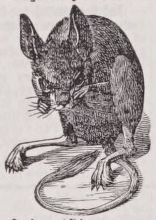
Jerboa
Encyclopedia Britannica
JERBOA, a family of rodent mammals (Dipodidae), chiefly characterized by the great length of the hind limbs as compared with those in front, the disproportion being, in most cases, greater even than in the kangaroos. Like the latter, the jerboas, or jumping mice, as they are also called, raise themselves when disturbed on their hind legs, and execute enormous leaps by the aid of a long muscular tail. When undisturbed, however, they make use of all their limbs in walking, while the front pair are also employed by many species as hands for the conveyance of food to the mouth. The jerboas, of which there are three genera and twenty-two species known, occur chiefly throughout northern and central Africa, south-eastern Europe, and central and southern Asia, while one genus (Pedetes) is confined to South Africa and another (Jaculus) to North America. Of the third genus (Dipus) there are twenty known species, a typical example of which is the Egyptian jerboa (Dipus segyptius). The length of its body is 8 inches, and of its tail, which is long, cylindrical, and covered with short hair, terminated by a tuft, 10 inches. Its front limbs are pentadactylous, and only 1 inch in length, the hind pair three-toed and six times as long. When about to spring, it raises its body by means of the hinder extremities, and supports itself at the same time upon its tail, while the fore feet are so closely pressed to the breast as to be scarcely visible. Hence probably the name Dipus, or two-footed. It then leaps into the air and alights upon its four feet, but instantaneously erecting itself, it makes another spring, and so on in such rapid succession as to appear as if rather flying than running. It is a gregarious animal, living in considerable colonies in burrows, which it excavates with its ...nails and teeth in the sandy soil of Egypt and Arabia. In these it remains during great part of the day, emerging at night in search of the herbs on which it feeds. It is exceedingly shy, and this, together with its extraordinary agility, renders it difficult to capture. The Arabs, however, succeed, it is said, in this by closing up all the exits from the burrows with a single exception, by which therefore they are forced to come, and over which a net is placed for their capture. When confined, they will gnaw through the hardest wood in order to make their escape. The Indian jerboa (Dipus indiens) is also a nocturnal burrowing animal, feeding chiefly on grain, which it stores up in underground repositories, closing these when full, and only drawing upon them when the supply of food above ground is exhausted. The natives in some parts of India are in the habit of searching for and robbing those granaries. The South African form, known as the spring haas or jumping hare of the colonists (Pedetes capensis), is the largest member of the family, measuring about a foot in length, exclusive of the tail, which is somewhat longer, and is bushy throughout. Its molar teeth are rootless, while its toes, which are three in number on each hind foot, are armed with long hoof-like nails. It is a powerful animal, nearly as large as a hare, and progresses when pursued by a series of leaps, each usually from 20 to 30 feet in length. Those jumping hares are found abundantly in the rocky plateaus of South Africa, where colonies of them form extensive burrowings somewhat similar to the rabbit warrens of Britain. Like other jerboas it is chiefly nocturnal, and occasionally it does considerable injury to the grain crops on which it feeds. Of the American genus (Jaculus) there is only a single species—the Labrador jumping mouse (Jaculus hudsonius). It occurs over a wide area of North America, extending from Missouri northward to Labrador, and from the Atlantic westward to the Pacific coast. It resembles the spring haas, and differs from all other jerboas in having the metatarsal bones separated, and also in having its feet fivetoed. It is a small creature, measuring about 5 inches in length, exclusive of the much longer and very rat-like tail, and lives chiefly in the neighbourhood of woods and shrubby places, where it conceals itself by day but roams in companies at night. Its agility is extraordinary; one kept in confinement by General Davies took, he says, “progressive leaps of from 3 to 4 and sometimes of 5 yards”; while Audubon considered it as probably the most agile of all wild animals. On the approach of winter the American jumping mouse retires into its burrow, and there encloses itself within a hollow ball of mud, in which it passes the cold season in a state of complete torpidity. The North American Indians neither eat its flesh nor make any use of its skin.
9th ed. Encyclopædia Britannica, vol. 13, p. 625
[817 words — estimated reading time: 5 minutes]
[817 words — estimated reading time: 5 minutes]
Leap Roget’s Thesaurus §309
N. leap, jump, hop, spring, bound, vault, # saltation, ance, caper, curvet, caracole, gambade|, gambado|, capriole, demivolt, buck, buck jump, hop skip and jump, falcade, kangaroo, jerboa, chamois, goat, frog, grasshopper, flea, buckjumper, wallaby
V. leap, jump up, jump over the moon, hop, spring, bound, vault, ramp, cut capers, trip, skip, dance, caper, buck, buck jump, curvet, caracole, foot it, bob, bounce, flounce, start, frisk, jump about, trip it on the light fantastic toe, trip the light fantastic, dance oneself off one's legs, dance off one's shoes
Adv. on the light fantastic toe
Phr. di salto in salto
No Bible verses found for "Jerboa".