
A plant of the genus Rubia, one species of which is much used in dyeing red. The root is used in medicine as an aperient and detergent, and is in great reputation as an emmenagogue. It is cultivated in France and Holland.
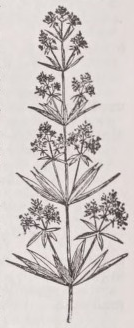
MADDER, or Dyer’s Madder, is the root of Rubia tinctorum, I.., and perhaps of R. peregrina, I., as well, both being European; but R. cordifolia, I.., and perhaps Muηgista, Roxb., a native of the mountains of Nepal, Bengal, Japan, &c., supply the Indian madder or manjit (see Pickering, Chrom Hist, of Pl., 421; Drury, Useful Plants of India, 541). Rubia is a genus of about thirty species of the tribe Galieae of the order Rubiaceae, and much resembles the familiar Galiums, e.g., the lady’s bedstraw and cleaver of English hedges having similarly whorled leaves, but the parts of the flowers are in fives and not fours, while the fruit is somewhat fleshy. The sole British species is Rubia peregrina, I.. The use of madder appears to have been known from the earliest times, as cloth dyed with it has been found on the Egyptian mummies. It was the ∈p∈υ0∈δαvoy used for dyeing the cloaks of the Libyan women in the days of Herodotus (Herod., iv. 189). It is the ∈pυ0poδαι∕ov of Dioscorides, who speaks of its cultivation in Caria (iii. 160), and of Hippocrates (De Morl). Mul., i.), and the Rubia of Pliny (xix. 17), (see Pickering, p. 275). Rubia tinctorum, I.., a native of western Europe, &c., has been extensively cultivated in South Europe, France, where it is called garance, and Holland, and to a small extent in the United States. Large quantities have been imported into England from Smyrna, Trieste, Leghorn, &c. The cultivation, however, is decreasing since alizarin, the red colouring principle of madder, has been made artificially (see Alizarin). Madder was employed medicinally by the ancients and in the Middle Ages. Gerard, in 1597, speaks of it as having been cultivated in many gardens in his day, and describes its supposed many virtues (Herball, p. 960); ...but the influence of madder over the system is now believed to be exceedingly slight. Its most remarkable physiological effect is that of colouring red the bones of animals fed upon it, as also the claws and beaks of birds. This appears to be due to the chemical affinity of phosphate of lime for the colouring matter (Pereira, Mat. Meil., vol. ii. pt. ii. p. 52). Rubiα chilensis, Mol., has been used for dyeing red from time immemorial (Pickering, p. G61). The chay-root, which furnishes a red dye in Coromandel and other parts of India, is obtained from Hedyotis umbellata, Lam., of the same family as madder (Drury, p. 366).