
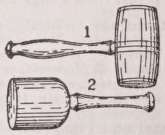
A wooden hammer or instrument for beating, or for driving pins; particularly used in carpentry, for driving the chisel.
MALLET, Paul Henri (1730-1807), born in Geneva in 1730, and educated there, became tutor in the family of the count of Calenberg in Saxony. In 1752 he was appointed professor of belles lettres to the academy at Copenhagen, but as the French language was then little known in Denmark he had but few students. He was naturally attracted to the study of the ancient literature and history of his adopted country, and in 1755 he published the first fruits of his researches, under the title —Introduction à Γhistoire de Danemarck où l'on traite de la religion, des moeurs, des lois, et des usages des anciens Danois. A second part was issued in 1750, more particularly relating to the ancient literature of the country, and bearing the title— Monuments de la mythologie et de la poesie des Celtes, et particulièrement des anciens Scandinaves. In the same year a translation of the work appeared in Danish. This is the work by which the author is best known in Britain. Though intended only as a preliminary dissertation to the formal history of Denmark, by which it was followed, it has all the merits of an independent work, complete in itself, and presenting a general view of the civilization and culture, religion and customs, of the Scandinavian nations. A translation into English, with notes and preface, by Bishop Percy, was issued in 1770 under the title of Northern Antiquities (republished with additions in 1847). It had a wide circulation, and attracted much attention on account of its being the first (though a very defective) translation into French of the Edda. Mallet’s dissertations and notes are vitiated by untenable theories as to the racial affinities of the early inhabitants of Scandinavia; but, judged by the standards of its time, his work was of great merit and ...usefulness. Its publication attracted the notice of the king to its author, and he was chosen as preceptor of the prince of Denmark. In 1760 he returned to Geneva, and became professor of history in his native city. While there t e was requested by the czarina to undertake the education of the heir-apparent of Russia (afterwards the Czar Paul I.), but declined the honour. An invitation more congenial to his tastes led to his accompanying Lord Mountstuart in his travels through Italy and thence to England, where he was presented at court and commissioned to write the history of the house of Brunswick. He had previously received a similar commission from the landgrave of Hesse-Cassel for the preparation of a history of the house of Hesse, and both works were completed in 1785. The quietude of a literary life was rudely broken by the shock of the Revolution, to which he was openly hostile. His leanings to the unpopular side were so obnoxious to his fellow citizens that he was obliged to quit his native country in 1792, and remained in exile till 1801. He died at Geneva, 8th February 1807.
A memoir of his life and writings by Simonde Sismondi was published at Geneva in 1807. Besides the Introduction to the History of Denmark, his principal works are— Histoire de Danemarck,
3 vols., Copenhagen, 1758-77; Histoire de la maison de Hesse, 4 vols., 1767-85; Histoire de la maison de Brunswick, 4 vols., 1767-85; Histoire de la maison et des états de Mecklenbourg, ∖1W; Histoire des Suisses ou Helvétiens, 4 vols., Geneva, 1803; Histoire de la Ligue Hanséatique, 1805.