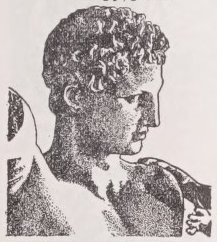
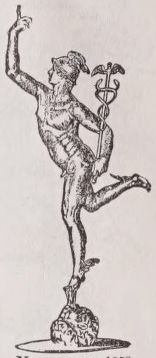
Roman statuettes of bronze, in which Mercury is represented, like the Greek Hermes, standing holding the caduceus in the one hand and a purse in the other, are exceedingly common. The caduceus must have been introduced as a symbol of Mercury at a very early time, for it is found on Italian coins as early as the 4th century before Christ, and we learn that several were kept as sacred objects in the adytum of the sanctuary at Lavinium (Dion. Hal., i. 67). But its foreign origin is shown by the fact that, although it was a sign of peace, it was never borne by the fetiales, the old Italian heralds. The very name is derived from the Greek κ∙ηpυκeιov. Preller’s view (Röm. Myth.) that mercuriales and mercatores are the same guild is a tempting one, but its truth is very doubtful. Mommsen thinks that mercuriales were a purely local guild, viz., the pagani of the Circus valley.
MERCURY, in chemistry, is a metal (symbol Hg) which is easily distinguished from all others by its being liquid at even the lowest temperatures naturally occurring in moderate climates. To this exceptional property it owes the synonyms of quicksilver in English (with the Germans quecksilber is the only recognized name) and of hydrargyrum (from υδωp, water, and άργυρο?, silver) inGraeco-Latin.
This metal does not appear to have been known to the ancient Jews, nor is it mentioned by the earlier Greek writers. Theophrastus (about 300 b.c.) mentions it as a derivative of cinnabar. With the alchemists it was a substance of great consequence. Being ignorant of its susceptibility of freezing into a compact solid, they did not recognize it as a true metal, and yet, on the authority of Geber, they held that mercury (meaning the predominating element in this metal) enters into the composition of all metals, and is the very cause of their metalhcity. When, about the beginning of the 16 th century, chemistry and scientific medicine came to merge into one, this same mysterious element of “mercury” played a great part in the theories of pathology; and the metal, in the free as in certain combined states, came to be looked upon as a powerful medicinal agent, which position, on purely empirical grounds, it continues to hold to the present day.
Mercury occurs in nature chiefly in the form of a red sulphide, HgS, called cinnabar, which, as a rule, is accompanied by more or less of the reguline metal,—the latter being probably derived from the former by some secondary reaction. The most important mercury mines in Europe are those of Almaden in Spain and of Idria in Illyria; these until lately furnished the bulk of the mercury of commerce, but they are now almost eclipsed by the rich deposits of New Almaden in California. Considerable quantities of mercury are said to be produced in China and in Japan; minor deposits are being worked in the Bavarian Palatinate, in Hungary, Transylvania, Bohemia, and Peru. At Almaden the ore forms mighty veins traversing micaceous schists of the older transition period; in Illyria it is disseminated in beds of bituminous schists or compact limestone of more recent date.
Chemically speaking, the extraction of mercury from its ores is a simple matter. Metallic mercury is easily volatilized, and separated from the gangue, at temperatures far below redness, and cinnabar at a red heat is readily reduced to the metallic state by the action of iron or lime or atmospheric oxygen, the sulphur being eliminated, in the first case as sulphide of iron, in the second as sulphide and sulphate of calcium, in the third as sulphurous acid gas. To the chemical mind a close iron retort would suggest itself as the proper kind of apparatus for carrying out these operations, but this idea is acted upon only in a few small establishments,—for instance, in that of Zweibrücken in the Palatinate, where lime is used as a decomposing agent. In all the large works the decomposition of the cinnabar is effected by the direct exposure of the ore to the oxidizing flame of a furnace, and the mercury vapour, which of course gets diffused through an immense mass of combustion gases, is sought to be recovered in more or less imperfect condensers.
At Almaden this roasting distillation is effected in prismatic furnaces, which, by a second upper (brick) grating are divided into two flats, the lower one serving for the generation of a wood fire, while the upper accommodates the ore, which is introduced through an opening in the dome-shaped roof. To avoid an excessive dilution of the mercury vapour with combustion gases, part of these are led out laterally into a chimney and the rest allowed to strike up through the heap of ore. The large mass of metalliferous vapour produced passes out through a system of pipes inserted laterally into the dome and so arranged that they follow first a descending and then an ascending plane, to lead ultimately into a condensation chamber which communicates in its turn with a chimney. The pipes are formed each of a large number of elongated pear-shaped earthenware adapters (called aludels), which are telescoped into one another as in the case of the iodine-distillation apparatus, the joints being luted with clay. The lowest row of aludels, which lie in the line of intersection of the two inclined planes, are pierced with holes below, so that what arrives as liquid mercury there runs out into a gutter leading to a reservoir. What of mercury vapour remains uncondensed in the aludels passes into the chamber, the intention being to have it condensed there; in reality a large proportion of the mercury passes out through the chimney (and through the numerous leaks in the aludels) into the atmosphere to poison the surrounding vegetation and the workmen. Similar furnaces to the Almaden ones are used in Idria and at New Almaden; only the condensation apparatus are a little less imperfect. But in all three places the loss of metal is very considerable; at New Almaden it is said to amount to close upon 40 per cent.
The mercury obtained is purified mechanically by straining it through dense linen bags, and then sent out into commerce in leather bags, or in wrought-iron bottles provided with screw plugs, each holding about 75 lb avoirdupois.
According to Balling’s Metallurgische Chemie (Bonn, 1882), the production of mercury in the years named was as follows :—
[table]
Assuming the amount to be the same from year to year, this gives a total of 3587 tons.
The price of the metal is subject to immense fluctuations; it generally ranges from 2s. to 7s. 6d. a pound avoirdupois.
Commercial mercury, as a rule, is very pure chemically, so that it needs only to be forced through chamois leather to become fit for all ordinary applications; but the metal, having the power of dissolving most ordinary other metals, is very liable to get contaminated with these in the laboratory or workshop, and requires then to be purified. For this purpose a great many chemical methods have been proposed, which, however, all come to this, that the base admixtures are sought to be removed by treatment with nitric acid, oil of vitriol, or other agents which act preferably on the impurities. The best of these methods is that of Brühl, who shakes the metal with a solution of 5 grammes of bichromate of potash and a few cubic centimetres of sulphuric acid in one litre of water, until the red chromate of mercury, first produced, has disappeared, and its place been taken by green chromic sulphates. The supernatant liquor and chromic scum are washed away by a powerful jet of water, and the clean metal is dried and filtered through a perforated paper filter. The only really exhaustive method is redistillation out of a glass apparatus. Unfortunately the operation is difficult of execution, as mercury “bumps” badly on boiling; but this can be avoided by distilling the metal in a perfect vacuum. An ingenious apparatus for this purpose, in which the distilled metal itself is made to keep up the vacuum, was constructed lately by Leonhard Weber. A U-tube, the limbs of which are longer than the height of the barometer, is filled with pure mercury, and inverted, the one limb being made to dip into a vessel with pure, the other into another containing the impure, mercury. This second limb is inflated above so that the meniscus is about the middle of the bulb. This bulb is heated, and the consequence is that the metal there distils over into the first limb to add to the supply of pure metal, the impure rising up in the second by itself to maintain a constant level. Dewar has modified the apparatus so that there is no need of a supply of pure metal to start with. Absolutely pure mercury does not at all adhere to any surface which does not consist of a metal soluble in mercury. Hence the least quantity of it, when placed on a sheet of paper, forms a neatly rounded-off globule, which retains its form on being rolled about, and, when subdivided, breaks up into a number of equally perfect globules. The presence in it of the minutest trace of lead or tin causes it to “draw tails.” A very impure metal may adhere even to glass, and in a glass vessel, instead of the normal convex, form an irregular flat meniscus.
Properties.— The pure metal is silver-white, and retains its strong lustre even on long exposure to ordinary air. At - 38 0, 8 C., i.e., - 37 0, 9 F. (Balfour Stewart), it freezes, with considerable contraction, into a compact mass of regular octahedra, which can be cut with a knife and be flattened under the hammer. The specific gravity of the frozen metal is 14'39; that of the liquid metal at 0° C. is 13'595 (water of 4°C. = 1). Under 760 mm. pressure it boils at 357° '3 C. (675° 'l Fahr.) (Régnault). At very low temperatures it seems to be absolutely devoid of volatility (Faraday); but from - 13° C. upwards (Régnault) it exhibits an appreciable vapour tension.
The following table gives the tensions “p” in millimetres of mercury of 0° C., for a series of centigrade temperatures “i,” according to Régnault :—
[table]
According to the same authority, its average coefficient of expansion k per degree C. is as follows: —
[table]
Its specific heat in the liquid state is Ό3332; that of the frozen metal (between -78° and -40° C.) is Ό319 (Régnault). Its electric conductivity is κ 1 τ of that of pure silver (Matthiesen). Its conductive power for heat is greater than that of water, and is proved (by Herwig) to be perfectly constant from 40° to 160° C. Its vapour density (air of the same temperature and pressure = 1) is 6'976 (Dumas), or 100'93 for hydrogen = 1. Hence its molecular weight (H 2 = 2) is 201'86. The atomic weight, by chemical methods, was found = 200 ’ 0 (Erdmann and Marchand); hence mercury-vapour molecules consist of single atoms. Mercury does not appreciably absorb any chemically inert gas.
Mercury is in constant requisition in the laboratory. It is used for the collecting and measuring of gases, in the construction of thermometers, barometers, and manometers, for the determination of the capacity of vessels, and many other purposes. In medicine it serves for the preparation of mercurial ointment and of “hydrargyrum cum creta” (the chief component of “blue pills ”); both are obtained by diligently triturating the metal with certain proportions of grease and chalk respectively until it is “deadened,” i.e., subdivided into invisibly small globules (see below).
Alloys.— Mercury readily unites directly with all metals (except iron and platinum) into what are called amalgams. In some cases the union takes place with considerable evolution of heat and large modification of the mean properties of the components. Thus, for instance, sodium when rubbed up with mercury unites with it with deflagration and formation of an alloy which, if it contains more than 2 per cent, of sodium, is hard and brittle, although sodium is as soft as wax and mercury a liquid. Liquid amalgams of gold and silver are employed for gilding and silvering objects of copper, bronze, or other base metal. The amalgam is spread out on the surface of the object by means of a brush, and the mercury then driven off by the application of heat, when a polishable, firmly adhering film of the noble metal remains. Copper amalgam containing from 25 to 33 per cent, of the solid metal, when worked in a mortar at 100° C., becomes highly plastic, but on standing in the cold for ten or twelve hours becomes hard and crystalline. Hence it is used for the stuffing of teeth. A certain amalgam of cadmium is similarly employed.
Oxides.— There are two oxides of mercury, namely, an oxide, Hg 2 O, called mercurous, and another, HgO, called mercuric oxide. The latter can be produced directly by keeping the metal for a long time in air at a temperature somewhat below its boiling point, when the oxide is gradually formed as a red powdery solid. This solid has long been known as “red precipitate,” or as mercurius praecipitatus per se. Priestley made the important discovery that the “precipitate” when heated to dull redness is reduced to metal, with evolution of what has since been known as oxygen gas; but it was reserved for Lavoisier to correctly interpret this experiment, and thus to establish our present views on the constitution of atmospheric air. The oxide is easily prepared by heating any nitrate of the metal as long as nitrous fumes are seen to go off (when it remains as a scaly mass, black when hot, red after cooling), or else by precipitating the solution of a mercuric salt with excess of caustic potash or soda, when it comes down as an amorphous yellow precipitate, which is free of combined water. Mercurous oxide, a black solid, can be obtained only indirectly, by the decomposition of mercurous salts with fixed caustic alkalies. Both oxides are insoluble in water, but dissolve in certain, and combine with all, aqueous acids with formation of mercury salts and elimination of water. Thus, for instance,
Hg 2 O + 2HN0 s = H 2 O + Hg a (N0,) 2 ,
Mercurous nitrate
HgO + 2HNO 3 = H 2 O + Hg(N O 3 ) 2 .
Mercuric nitrate.
The Nitrates.— When metallic mercury is set aside with its own weight of nitric acid of 1'2 specific gravity, at ordinary temperatures, the normal mercurous salt Hg 2 (NO 3 ) 2 is gradually produced, and after a day or two is found to have separated out in colourless crystals. These are soluble (somewhat sparingly) in water acidulated with nitric acid, but are decomposed by the action of pure water, with formation of difficultly soluble basic salts. When this salt (or the metal itself) is treated with excess of nitric acid it is oxidized into mercuric nitrate Hg(NO 3 ) 2 , a white crystalline salt, readily soluble in water without decomposition.
The Sulphates. — Cold aqueous sulphuric acid does not act upon mercury, but the hot concentrated acid converts it first into mercurous and then into mercuric sulphate, with evolution of sulphurous acid.
Hg 2 + 2H 2 SO 4 = 2H 2 O + SO 2 + Hg 2 SO 4 , Hg 2 SO 4 + 2H 2 SO 4 = 2H 2 O + SO 2 + 2 HgSO 4 .
Both salts form white crystalline magmas. The mercurous salt is difficultly soluble in water, and consequently producible by precipitation of the nitrate with sulphuric acid. The mercuric salt, when treated with water, is decomposed with formation of a yellow insoluble basic salt, which has long been known as turpethum minerale. Its composition is SO 3 . 3HgO when produced by excess of hot water. Mercuric sulphate is of importance chiefly as forming the basis for the manufacture of the two chlorides.
The Chlorides. — These are both extensively used medicinal agents. The mercuric salt, HgCl 2 , known in medicine as corrosive sublimate, is prepared by mixing the sulphate intimately with common salt, and subjecting the mixture to sublimation, a little binoxide of manganese being added to oxidize the mercurous salt, which is generally present as an impurity. The process is conducted in a glass flask buried in a hot sand-bath. When the decomposition is accomplished, the sand is removed from the upper half of the flask and the temperature raised so that the chloride HgCl 2 produced sublimes up and condenses in the upper part as a “sublimate.” The salt, as thus produced, forms compact crystalline crusts, which, when heated, melt into a limpid liquid before volatilizing. It is soluble in water, 100 parts of which at 10°, 20°, 100° dissolve 6'57, 7'39, 54 parts of salt. Corrosive sublimate dissolves in 3 parts of alcohol and in 4 parts of ether. This salt, on account of its solubility in water, is a deadly poison. Mercurous chloride, Hg 2 Cl 2 , better known as “calomel” (from κaλos, fair, and μeλ,as, black, because it becomes dead-black when treated with ammonia, mercuric chloride yielding a white product), is prepared by mixing corrosive sublimate with the proper proportion of metallic mercury (HgCl 2 : Hg) or mercuric sulphate with salt and mercury in the proportions of HgS0 4 : Hg: 2NaCl, and subjecting the mixture to sublimation in glass flasks. The salt Hg 2 Cl 2 is thus obtained in the form of white, opaque, crystalline crusts, which, when heated, volatilize, without previously melting, into a mixture of HgCl 2 and Hg vapour, which, on cooling, recombine into calomel. For medicinal purposes the sublimate is reduced to an impalpable powder, washed with water to remove any corrosive sublimate that may be present, and dried. Being insoluble in water, it acts far less violently on the organism than mercuric chloride does. Its action, no doubt, is due to its very gradual conversion in the stomach into mercury and corrosive sublimate. Finely divided calomel can be produced, without trouble, by the precipitation of a solution of mercurous nitrate with hydrochloric acid or common salt; but this preparation is liable to be contaminated with mercurous nitrate, and, even when pure, has been found to act far more violently than ordinary calomel does. Hence its use is not tolerated by the pharmacopoeias. According to Wöhler a mercurous chloride, more nearly equivalent to the sublimed article, is producible by heating corrosive sublimate solution with sulphurous acid—
2HgCl 2 + H 2 SO 3 + H 2 O = H 2 SO 4 + 2HC1 + Hg 2 Cl 2 .
The writer is unable to say whether Wöhler’s calomel has ever found its way anywhere into medicinal practice.
The Iodides. — The mercuric salt Hgl 2 is produced in two ways, viz., first by mixing the two elementary components intimately and subjecting the mixture to sublimation, and secondly by precipitating corrosive sublimate solution with its exact equivalent of iodide of potassium. In the first case the salt is obtained in yellow crystals, which, on the slightest touch with a solid body, assume and then permanently retain a rich scarlet colour. The precipitation process at once yields the scarlet salt. The salt is insoluble in water, but soluble in alcohol and in iodide of potassium solution. The mercurous salt Hg 2 I 2 is obtained by precipitating mercurous nitrate with iodide of potassium as a dirty-green powder insoluble in water. Both iodides are used medicinally’.
The Sulphides.— Mercurous sulphide, Hg 2 S, does not seem to exist. The mercuric salt, HgS, exists in two modifications, of which one is amorphous and has a black colour, while the other is crystalline and red. The black one is obtained by precipitation of solutions of mercuric salts with excess of sulphuretted hydrogen, or by direct synthesis. The right proportions of mercury and flowers of sulphur are rubbed together in a mortar until the whole is converted into a jet-black uniform powder. This preparation (the sethiops mineralis of the pharmaceutist), however, is apt to be contaminated with uncombined sulphur and mercury. Application of a gentle heat causes exhaustive combination. The red sulphide, HgS, occurs in nature as cinnabar, and can be produced artificially from the black. The artificial preparation, known as vermilion, is highly valued as the most brilliant, stable, and innocuous of all mineral red pigments. Vermilion can be produced from the black sulphide in two ways, viz., first by sublimation, and secondly by treatment of it with fixed alkaline sulphide solution. According to Brunner, 100 parts of mercury are mixed intimately with 38 parts of flowers of sulphur, and the aethiops is digested, with constant agitation, in a solution of 25 parts of potash in 150 parts of water at 45° C. (the water lost by evaporation being constantly 7 replaced), until the preparation has come up to its maximum of fire and brilliancy, which takes a good many hours. Purely sublimed vermilion has a comparatively dull colour, and must be manipulated with alkaline sulphide solution to give it the necessary fire. The action of the alkaline sulphide consists probably in this, that it dissolves successive instalments of the amorphous preparation and redeposits them in the crystalline form.
Mercuric Derivatives of Ammonia.— (1) Recently precipitated oxide HgO is digested, cold, in carbonic-acid-free ammonia, and the mixture allowed to stand for a few days. The liquor is then decanted off, and the precipitate washed with alcohol and then with ether, and dried over sulphuric acid. The product is a yellow solid base (“Millon’s base”) of the composition
N 2 H 6 + 4HgO + H 2 O = N 2 Hg 4 O.2H 2 O + 2H 2 O.
It is insoluble in alcohol and in ether, and requires 13,000 parts of cold water for its solution. It readily unites with all acids, forming salts, which, as a rule, are insoluble in water. Hence all ordinary salt solutions, when shaken with the base, are decomposed with elimination of the base of the salt. Thus, for instance, even such salts as alkaline nitrates, chlorides, or sulphates are decomposed with formation of solutions of caustic alkali.
(2) A body N 2 Hg 4 I 2 + 2H 2 O, i.e., of the composition of the iodide corresponding to the oxide in (1), is produced as a brown precipitate when ammonia or an ammonia salt is added to a solution of mercuric iodide in iodide of potassium mixed with large excess of caustic potash or soda (“Nessler’s reagent”). In very dilute solutions of ammonia Nessler’s reagent produces only a brown or yellow coloration, which, however, is so intense that 7 5τ∏⅛γrσ-σth of ammonia in about 50 cubic centimetres of liquid becomes clearly visible.
(3) The chloride NH 2 Hg.Cl of the “ammonium” NH 2 Hg is produced as an insoluble white precipitate when ammonia is added to a solution of corrosive sublimate. This substance is known in medicine as infusible white precipitate, in contradistinction to (4).
(4) The fusible white precipitate was at one time supposed to be identical with (3), and is obtained by boiling it with sal-ammoniac solution. Its composition is NH 2 HgCl + NH 4 Cl=N 2 H 6 . Hg. Cl 2 .
Analysis.— Any ordinary solid mercury compound, when heated in a sublimation tube with carbonate of soda, yields a sublimate of metallic mercury, which, if necessary, needs only to be scraped together with a wooden spill to unite into visible globules. From any mercury-salt solution the metal is precipitated by digestion with a piece of bright copper-foil. The precipitated mercury forms a coating on the copper, which becomes silvery on being rubbed with blotting paper. When the quicksilvered copper is heated in a sublimation tube, it reassumes its red colour with formation of a sublimate of mercury.
Solutions of mercurous salts with hydrochloric acid give a white precipitate of calomel, which, after filtration, is easily identified by its becoming jet-black on treatment with ammonia. From mercuric solutions hydrochloric acid precipitates nothing; but stannous chloride, in its twofold capacity as a chloride and a reducing agent, yields a precipitate of calomel. On addition of an excess of reagent the precipitate becomes grey through conversion into finely divided quicksilver. Sulphuretted hydrogen, when added very gradually to an acid mercuric solution, gives at first an almost white precipitate, which, on addition of more and more reagent, assumes successively a yellow, orange, and at last jet-black colour. The black precipitate is HgS, which is identified by its great heaviness, and by its being insoluble in boiling nitric and in boiling hydrochloric acid. A mixture of the two (aqua regia) dissolves it as chloride. (W. D.)
Therapeutics of Mercury.
The use of mercury as a therapeutic agent is of comparatively recent date. To the Greeks and Romans its value was unknown, and the Arabian physicians only used it for skin affections. It was not till the middle of the 16th century that the special properties of mercury were fully appreciated, but since that time the metal has continued to hold a high though fluctuating value as a medicine. At first the metal in a finely divided state or in vapour was used; but very soon its various compounds were found to be endowed with powers even greater than those of the metal itself, and with the discovery of new compounds the number of mercurial medicines has largely increased.
The preparations now in use may be thus classified. (1) Of the preparations containing metallic mercury the chief members are blue pill (pilula hydrargyri), grey powder (hydrargyrum cum creta), and blue ointment (unguentum hydrargyri). The first consists of mercury, liquorice root, and confection of roses, the second of mercury and chalk, the third of mercury, suet, and lard. The power of the three preparations seems to depend on the fine state of subdivision of the mercury they contain; mercury in its ordinary liquid state seems devoid of medicinal properties. It is thought by some that the fine subdivision of the metal leads to the formation of a little oxide, and that the efficacy of the preparations in part depends on this. (2) Three oxides of mercury are employed in medicine,—the red, from which is made red precipitate ointment (unguentum hydrargyri oxydi rubri), the yellow, an allotropic form of the red, and the black oxide. The yellow and black oxides suspended in lime water form respectively yellow and black wash (lotio flava and lotio nigra). (3) The chlorides of mercury form a very important group: calomel (hydrargyri subchloridum) is a white heavy powder; corrosive sublimate (hydrargyri perchloridum) is a heavy crystalline substance. (4) Two iodides are used medicinally; they are known from their colour as the green and red iodides. (5) Nitrate of mercury enters into the composition of a powerful caustic known as the acid nitrate of mercury. It is also the active principle of citrine ointment (unguentum hydrargyri nitratis). (6) In this class only ammoniated mercury and its ointment commonly known as white precipitate ointment, are contained. Of the many compounds not included in the above classification the oleate and albuminate are the most important.
Mercurial preparations are largely employed as external applications. Several of them are potent agents for the destruction of the lower forms of animal life, and hence are employed to destroy parasites having their habitat in skin, hair, and clothing. The white and red precipitate ointments are specially effective in the destruction of pediculi, and blue ointment is occasionally used for the same purpose. Corrosive sublimate is, however, the most energetic of the mercurial parasiticides, and recent observations seem to show that it is superior to almost all other substances as a germ destroyer. It is sometimes used to get rid of ringworm. It should be remembered that corrosive sublimate is a powerful irritant to the skin, and also an active poison.
Acid nitrate of mercury is a caustic, and by it warts and small growths are sometimes removed; it is also one of the caustics occasionally applied to prevent the spread of lupus.
In skin diseases mercurial preparations are largely used, especially in some forms of eczema. A few grains of the red oxide or of ammoniated mercury in an ounce of zinc ointment are often found of great service in this ailment; citrine ointment is also useful.
Calomel ointment is not irritating, but rather tends to soothe. It is therefore sometimes applied to irritable rashes; in pruritus ani it is of special value. Mercurial preparations are not usually found of benefit in scaly eruptions. In acne a weak solution of corrosive sublimate is often most effective.
Preparations of mercury are often used to heal ulcers, especially those of syphilitic origin. Black wash is one of the commonest applications for this purpose. The red oxide ointment is at times employed to stimulate indolent ulcers, and it is capable of removing exuberant granulations (proud flesh), which sometimes retard the healing of wounds.
Mercury is largely used externally to promote the absorption of inflammatory products, especially in the neighbourhood of joints. The blue ointment is frequently employed for this purpose, more rarely a plaster containing mercury or a mercurial liniment. For effecting the absorption of goitre (Derbyshire neck) the ointment of the red iodide is often relied on, especially in India, where it is customary to expose the patient’s neck to the sun after rubbing it with the ointment. In enlargements of the liver and spleen the application of mercurial ointment sometimes seems to promote reduction in size.
Taken internally in continued doses, mercury produces a peculiar effect known as salivation. First a metallic taste is experienced; this is followed by soreness of the gums, an undue flow of saliva, and foetor of the breath. Further administration of the drug may increase greatly the salivary flow, and also lead to swelling of the tongue, ulceration of the mouth, and even disease of the jaw-bone. At the same time the blood becomes impoverished, and feverishness with loss of flesh occurs. A single large dose—rarely too a single small dose—may produce some of the above symptoms. They may also follow the inhalation of the metal or its compounds, or their absorption through the skin. The long-continued inhalation of the vapour of mercury acts likewise on the nervous system, causing a peculiar kind of trembling. Mercurial tremor is sometimes seen in looking-glass makers, often in those who work in quicksilver mines.
Internally mercury is chiefly given for two purposes—(1) to check inflammation and cause the absorption of the products it gives rise to, and (2) to antagonize the syphilitic virus and remove the evils it causes. Some years ago the belief in the power of mercury to control inflammation was almost universal, and it was largely administered in almost all inflammatory affections, but of late it has been much less used, both because it seems doubtful whether it has really the power it was once supposed to have and because of the possibility of evil results from its continued use. In peritonitis and iritis it is still often employed, small doses of calomel being given. No