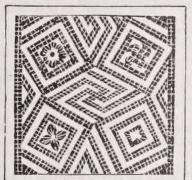
MOSAIC (late Greek φηφωσι<s, from φηφos, a small stone; also μoυ<reιov, i.e., refined, delicate work; hence the Latin opus musivum) is the fitting together of many, generally small, pieces of marble, opaque glass, coloured clays, or other substances, so as to form a pattern; the design may be of various degrees of elaboration, from the simplest, almost monochromatic, geometrical pattern to the most elaborate picture, with figure-subjects represented in colours of countless gradations.
The earliest existing specimens of mosaic belong to one of the less important branches of the art — namely, the ornamentation on a small scale of jewellery, ivory thrones, and other furniture, or more rarely of some elaborate architectural ornament. Most of this earliest sort of mosaic resembles in execution what are called cloisonnée enamels. In the Louvre and in the British Museum are preserved some very beautiful ivory carvings in low relief, some from Nineveh and others from Egypt, in which figures of deities, ornaments formed of the lotus and papyrus plants, and royal cartouches are enriched by small pieces of glass or lapis-lazuli and other gem-like stones, which are let into holes made in the ivory. Each minute piece is separated from the next by a thin wall or cloison of ivory, about as thick as cardboard, which thus forms a white outline, and sets off the brilliance of the coloured stones. The favourite pattern in this sort of work for decorating the larger surfaces appears to have been suggested by the feathers on a bird’s wing. See Ivory, vol. xiii. pl. vii. fig. 3....
Recent excavations at Tel al-Yâhudfya in Lower Egypt have brought to light some mosaics on a larger scale, but treated in the same way. These are caps of columns, wall tiles, and other objects, either of white limestone or earthenware, in which designs, chiefly some forms of the papyrus, are formed by brilliantly-coloured bits of glass or enamelled earthenware, let into a sinking in the tile or column. This form of mosaic was employed by the Greeks: the Erechtheum at Athens, built in the middle of the 5th century b.c., had the bases of some of its white marble columns ornamented with a plait-like design, in which pieces of coloured glass were inserted to emphasize the main lines of the pattern.
Another, quite different sort of mosaic was known to the Egyptians of the Ptolemaic and Roman periods. This is made entirely of glass, and is extremely minute. The finest known specimen is in the British Museum: it is a small tablet about three-eighths of an inch square, apparently the bezel of a ring, on which is represented the sacred hawk,—every feather on the bird’s wing being produced with a great number of colours and tints, each quite distinct, and so minute that a strong magnifying glass is required to distinguish its details.
The way in which this wonderful little mosaic was produced is extremely ingenious. Numbers of long sticks of various-coloured glass were arranged in such a way that their ends produced the figure of the hawk; other sticks of blue glass were placed all round so as to form the ground. The whole bundle of sticks of glass when looked at endwise now presented the figure of the hawk with a blue background, immensely larger than it afterwards became. The bundle was then heated till the sticks melted together, and the whole thick rod, softened by fire, was then drawn out to a greatly-diminished thickness. In this process the relative positions of the sticks of coloured glass forming the design were not altered. A slice of the rod was then cut off, and its faces polished,—the design, much reduced in size, of course being equally visible at both sides of the slice; and thus the microscopic minuteness of the mosaic was produced, with astonishing delicacy and refinement; many slices, each showing the same mosaic, could be cut from the same rod.
The more important use of mosaic has been on a large scale either for pavements or for walls and vaulted ceilings. Mosaic for these purposes has by many writers, both ancient and modern, been divided on various systems into classes; perhaps the simplest classification is thefollowing:— I. For Pavements : — (a) Tesselated, in which the design is formed of small cubes, generally of marble, more rarely of glass or clay; (δ) Sectile, formed of larger pieces of marble, shaped and cut so as to fit accurately one with another. II. For Walls and Vaults·.—Fictile or vermiculated; pieces of opaque glass, in small cubes, arranged so as to form complicated pictures.
This classification is not altogether satisfactory, more than one method often being employed in the same mosaic^ as, e.g., in the “opus Alexandrinum” of mediaeval writers,, which is often partly tesselated and partly sectile.
Until Roman times we know but little of these kinds of mosaic. There is some evidence (in Pliny and other writers) to show that elaborate mosaic pavements, λι0o- στpωτov or λι0oλoγψια, were made by the Greeks in the 4th century b.c., or even earlier; but most of the numerous fine specimens of tesselated work still existing in Greece, such as those at Sparta and Athens, must be referred to the time of the Roman occupation. The best examples of Hellenic mosaic are some pavements discovered during the recent excavations at Olympia (sea fig. 1 and Ausgrabungen zu Olympia, 1877-82).
Among the Romans the use of mosaic, both of marble· and opaque glass, was very extensive. According to· Pliny (1I.N., xxxvi. 25), they derived this art from the. Greeks, but not until the time of the Third Punic War, 146- b.c., while glass mosaics for walls, “vitreae parietes,’” were a recent invention in his time. Many of these have, been found at Pompeii; most commonly they are used to. decorate niches for fountains or statuettes. Judging from the description given by Vitruvius (vii. 1), and an examination of numerous specimens of Roman tesselated mosaics,.
the process of manufacture was the following. The earth was first carefully rammed down to a firm and even surface;: on this was laid a thick bed of stones, dry rubbish, and lime,, called “rudus,” from 6 to 9 inches deep, and above this, another layer, 4 to 6 inches thick, called “nucleus,” of one part of lime to three of pounded brick, mixed with water “on this, while still soft, the pattern could be sketched out with a wooden or metal point, and the tesserae or small bits of marble stuck into it, with their smoothest side uppermost. Lime, pounded white marble, and water were then mixed to the consistency of cream, forming a very hard-setting cement, called “marmoratum.” This cement, while fluid, was poured over the marble surface, and well brushed into all the interstices between the tesserae. When the concrete and cement were both set, the surface of the pavement was rubbed down and polished. This kind of mosaic was largely used for floors of hypocausts; the concrete bed was then supported on large tiles resting on numbers of short pillars.
If used for upper floors very strong joists were required, and both Pliny (xxxvi. 25) and Vitruvius (vii. 1) recommend a double layer of boards, one crossing the other, on which the concrete and cement bedding was to be laid.
The usual Roman pavement was made of pieces of marble, averaging from a half to a quarter of an inch square, but rather irregular in shape. A few other, but quite exceptional, kinds of mosaic pavements have been found, such as that at the Isola Farnese, 9 miles from Rome, made of tile-like slabs of green glass, and a fine “sectile” pavement on the Palatine Hill, made of various-shaped pieces of glass, in black, white, and deep yellow. In some cases— e.g., in the “House of the Faun” at Pompeii—glass tesserae in small quantities have been mixed with the marble ones, for the sake of greater brilliance of colour. Pompeii is especially rich in its mosaics both on floor and walls, almost every house having at least its vestibule paved in this way.
In addition to graceful flowing patterns and geometrical designs, picture-like subjects of great elaboration frequently occur: of these the most important is the large and minutely-executed scene of the battle of Issus, found in the “House of the Faun.” It is of special value as being the chief classical historical picture still existing. It is a well-designed though somewhat crowded composition, representing the moment of Alexander’s victorious charge against the cavalry of Darius. The expression of the faces and the characteristic dresses of the Greeks and Persians are represented with great skill (see fig. 2). The tesserae, as was always the case in this sort of work, are not all the same size, the smallest (only about one-tenth of an inch square) being reserved for the faces, where greatest refinement of detail was required. This was a floormosaic, though generally these minutely-executed works were affixed to walls.
The most skilfully-executed of all existing mosaics of this pictorial kind is that known as “Pliny’s Doves,” found in Hadrian’s villa at Tivoli, and now in the Capitoline Museum. It may possibly be the one so highly praised by Pliny (xxxvi. 25) as the work of Sosus, for, although he describes it as being at Pergamum, yet it was a common practice with the Romans to transport these mosaics from one place to another, and this very celebrated one may well have been brought to Tivoli to adorn the emperor’s villa. It is treated in a very realistic way: the light on the gold bowl, the plumage of the doves, and especially the reflexion in the water of the drinking dove, are represented with wonderful skill. It is, in fact, far too pictorial, and, like the late mosaics in St Peter’s, Rome, is more remarkable for its technical skill than for any real artistic merit. This excessive realism, produced with great difficulty and cost, is a not uncommon fault of the more elaborate Roman mosaics, and was the inevitable result of the luxury and ostentation of imperial Rome, which made art the bond-slave of the wealthy, rather than the free and natural expression of a whole people, as it was among the earlier Greeks.
Another interesting mosaic from the wall of a house at Pompeii, of extremely delicate work, is a rehearsal scene in a Greek theatre, where the choregus is instructing the actors: it is specially remarkable from its being signed as the work of Dioscorides of Samos. Other figure-subjects are not uncommon, such as various representations of the victory of Theseus over the Minotaur, others of Achilles in Scyros, many hunting scenes, and the like.
Throughout England, Germany, France, Spain, Asia Minor, and Northern Africa in no way have signs of Roman occupation been left so clearly and in so conspicuous a form as by the numerous large and generally well-preserved mosaic pavements which have at various times been discovered in all these countries. In many cases, long after all traces of the walls of the buildings have disappeared, owing to their being dug up and removed for building purposes, the mosaics still remain to testify of the artistic power and mechanical skill of the Roman colonists.
Few countries are richer than England in these remains; the great pavements of York, Woodchester, Cirencester, and many other places are as elaborate in design and as skilfully executed as any that now exist even in Rome itself. In whatever country these mosaics are found, their style and method of treatment are always much the same; the materials only of which the tesserae are made vary according to the stone or marble supplied by each country. In England, for instance, limestone or chalk often takes the place of the white marble so common in Italian and North African mosaics; while, instead of red marble, a fine sort of burnt clay or red sandstone is generally used; other makeshifts had to be resorted to, and many of the Anglo-Roman mosaics are made entirely without marble. It is perhaps partly owing to the great wealth of Northern Africa in marbles of many colours and of varying shades that the finest of all Roman mosaics have been found in Algeria and Tunis, especially those from Carthage, some of which have been brought to the British Museum. See Archaeologia, vol. xxxviii. p. 202.
The range of colour in the marble tesserae is very great, and is made use of with wonderful taste and skill: there are three or four different shades of red, and an equal number of yellows and greens, the last colour in all its tints being almost peculiar to this part of Africa, and one of the most pleasant and harmonious in almost any combination. Deep black, browns, and bluish-greys are also abundant. The white marble which forms the ground of nearly all the designs is often not pure white, but slightly striated with grey, giving great softness and beauty of texture to the surface, and doing away with too great monotony of tone. The Roman practice, common to all their mosaics, of not fitting the tesserae quite closely together, but allowing the cement joints to show freely, was also of great value in giving effect to the general texture of the surface—a point quite forgotten by some later mosaic-workers, who thought that the closer their tesserae were fitted together the better the mosaic would be. This remark does not apply to sectile mosaic, in which sufficient variety can be given by the markings and veins in each piece of marble. To return to the mosaics from Carthage, they are no less excellent in design than in the richness and beauty of their materials. Large spaces are filled by grand sweeping curves of acanthus and other leaves, drawn with wonderful boldness and freedom of hand, and varied with great wealth of invention. Without the use of very small tesserae, much richness of effect is given by gradations of tints, suggesting light and shade, without a painful attempt to represent actual relief. The colours of the marbles used here and elsewhere by the Romans are so quiet and harmonious that it would have been almost impossible to produce with them a harsh or glaring design, and when used with the skill and strong artistic feeling of the mosaic-workers at Carthage the result is a real masterpiece of decorative design. In Rome, and in the Roman colonies of Europe, this kind of marble tesselated mosaic was largely produced, with but little alteration in style or method of treatment, till the 4th century. In Syria and Asia Minor the art survived some centuries later.
Perhaps the latest existing example in Rome is that which decorates the vault of the ambulatory of the circular church of S. Costanza, built by Constantine the Great (320), outside the walls of Rome. This very interesting mosaic might from its style and materials have been executed in the 1st century, and is equal in beauty to any work of the kind in Italy. It shows no trace whatever of the Byzantine influence which, in the next century, introduced into Italy a novel style of mosaic, in materials of the most glittering splendour. These S. Costanza mosaics are almost unique in Italy as an application of the old classical marble mosaic to the decoration of a Christian church. On the main compartment of the vault the surface is covered by vine branches, laden with grapes, twining in graceful curves over the space. In the centre is a large medallion with life-sized male bust, and at the lower part are vintage scenes—oxen carts bringing the grapes, and boys treading them in a vat. Other more geometrical designs, of circles framing busts and full-length figures, with graceful borders, cover other parts of the vault. Farther east this classical style of mosaic appears to have lasted till the 6th century. At Kabr-Hiram, near Tyre, Μ. Renan discovered among the ruins of a small three-apsed Christian church a fine mosaic pavement, covering the nave and aisles, thoroughly classical in style. The design, consisting of circles enclosing figures emblematic of the seasons, the months, aud the winds, is almost the same as that of some mosaics discovered on the site of the Roman Italica near Seville, and others at Ephesus and Halicarnassus in Asia Minor. No trace of other than classical influence is visible, and yet it is pretty clear, from the evidence of an inscription, inlaid among the marble tesserae, that the date of this pavement is not earlier than the latter part of the 6th century. A very similar mosaic, of about the same date, was discovered at Neby Yûnas, near Sidon.
Mediaeval Mosaics.— These may be divided into four principal classes :—(1) those used to decorate walls and vaults, made of glass cubes; (2) those for pavements, made of marble, partly in large shaped pieces, and partly in small tesserae; (3) glass in small pieces, either rectangular or triangular, used to enrich marble pulpits, columns, and other architectural features; (4) wood mosaics.
1. The wall mosaics were, in their origin, purely Byzantine, and appear to date from the beginning of the 5th century. They are made of coloured glass, rendered opaque by the addition of oxide of tin. The melted glass was cast into flat slabs, generally about half an inch thick, and then broken into small cubes. Every possible colour and gradation of tint was produced by the mediaeval glassmakers. Tesserae of gold (which were very largely used) and of silver were made thus :—the metal leaf was spread over one of the glass slabs, the colour of which did not matter, as it was hidden by the gold or silver; over this metal-coated slab a skin of colourless glass was fused, so as to protect the metal leaf from injury or tarnish; and then the slab was broken up into cubes, the ψi ∣ φoι χpvσcoι of Byzantine writers.
The method of putting together the mosaic was much the same as that employed by the Romans in their tesselated pavements. A thick coat of cement was applied to the wall or vault, the outline indicated with a metal point, and the cubes stuck one by one into the cement while it was yet soft,—the main difference being that no rubbing down and polishing were required, the faces of the glass tesserae showing the natural surface of the fracture, which was not quite level, and by this slight inequality of surface great additional lustre and brilliance of effect were given to the whole picture.
Owing to the intense conservatism of Byzantine art, no regular stages of progression can be traced in this class of mosaic. Some of the 5th century mosaics at Ravenna are, in every way, as fine as those of the 12th, and it was not till the end of the 13th century that any important change in style took place, when Cimabue, and more especially his pupils Jacopo da Turrita and Taddeo Gaddi, applied their increased knowledge of the human form and of the harmonies of colour to the production of the most beautiful of all mosaics, such as those in the apse of S. Maria Maggiore in Rome. It must not, however, be supposed that during all this time (from the 5th to the 14th century) one steady level of excellence was kept up. The mosaics of the 9th century are inferior in drawing and general treatment to those both of the earlier and later time, while in Italy at least this art was almost entirely extinct during the 10th and 11th centuries. Extreme splendour of colour and jewel-like brilliance combined with the most stately grandeur of form are the main characteristic of this sort of decoration. Its most frequent application is to the sanctuary arch and apse of the early basilicas.
A “majesty,” or colossal central figure of Christ with saints standing on each side, is the most frequent motive. In many cases, especially in the 5th and 6th centuries, Christ was represented as a lamb, to whom the twelve apostles, in the form of sheep, are paying adoration. Christ, the Good Shepherd, is sometimes depicted as a beardless youth, seated among a circle of sheep—the treatment of the motive being obviously taken from pagan representations of Orpheus playing to the beasts. The tomb of Galla Placidia has a good example of this subject, with much of the old Roman grace in the drawing and composition. Frequently the Virgin Mary, or the patron saint of the church, occupies the central space in the apse, with ranges of other saints on each side.
The “Doom,” or Last Judgment, is a favourite subject for domes and sanctuary arches; the Florence baptistery has one of the grandest mosaic pictures of this subject, executed in the 13th century. The earlier baptisteries usually have the scene of Christ’s baptism,—the river Jordan being sometimes personified in a very classical manner, as an old man with flowing beard, holding...