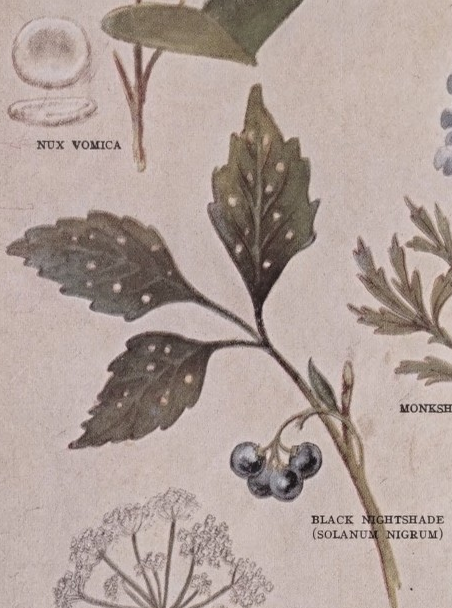
A plant of the genus Solanum. The deadly nightshade is of the genus Atropa; the American nightshade of the genus Phytolacea; the bastard nightshade of the genus Rivina; the enchanter's nightshade of the genus Circaea; the Malabar nightshade of the genus Basella; and the three-leaved nightshade of the genus Trillium.
A common name of many species of the genus Solanum, given esp. to the Solanum nigrum, or black nightshade, a low, branching weed with small white flowers and black berries reputed to be poisonous.
NIGHTSHADE, a general term for the genus of plants known to botanists as Solanum. The species to which the name of Nightshade is commonly given in England is the SolanumDulcamara, L., which is also called the Bittersweet or Woody Nightshade. It is a common plant in damp hedgebanks and thickets, scrambling over underwood and hedges. It has slender slightly woody stems, with alternate lanceolate leaves more or less cordate and auriculate at the base. The flowers are arranged in drooping cymes, and resemble those of the potato in shape, although much smaller. The corolla is rotate, of a lilacblue colour with a green spot at the base of each segment, and is furnished with yellow sessile anthers united at their margins so as to form a cone in the centre of the corolla....
The flowers are succeeded by ovate scarlet berries, which in large doses appear to be poisonous or, to say the least, dangerous to children, cases of poisoning by them having occurred. The plant derives its names of bittersweet aud Dulcamara from the fact that its taste is at first pleasantly sweet and then bitter. The young stems collected in autumn have been used in medicine as an alterative in rheumatism and certain skin diseases, but are little used at the present time except by homoeopaths, by whom Dulcamara is given as an anticatarrhal remedy in all symptoms produced by cold arising from exposure to damp. It owes its medicinal activity to a bitter principle yielding by decomposition sugar and the alkaloid “solania,” C 43 H 69 NO 16 . This principle has been found in small quantity in the leaves, stalks, and berries. Dulcamara also contains another glucoside “dulcamarin,” C 22 H 34 O 10 , which when boiled with dilute acid splits up into sugar and “dul-camaretin,” C 10 H 26 O 6 . Solania appears to exert a depressant action on the vagus nerve and an excitant action on the medullaoblongata. The term Deadly Nightshade is often erroneously applied to this plant, and the popular usage has even been confirmed by so eminent a botanist as Bentham (Handbook of the British Flora, p. 384, 1858). It is generally accepted, however, that the deadly nightshade is Atropa Belladonna, L. (see vol. iii. p. 543).
SolanumDulcamara is subject to the same parasitic fungus (Peronospora infestans) as the potato, and may serve as a medium for communicating the spores to the potato if not removed from the hedges of the fields where potatoes are grown.
The Garden Nightshade, Solanum nigrum, L., differs from & Dulcamara in having white flowers in small umbels and globose black berries. It is a common weed in gardens and waste places, growing about 12 or 18 inches high, and has ovate, entire or sinuate-dentate leaves. Two varieties of the plant, one with red and the other with yellow berries, are sometimes met with, but are comparatively rare. The berries have been known to produce poisonous effects when eaten by children, and owe their properties to the presence of solania. They are, however, said to be eaten without inconvenience in British Kaffraria, and in Réunion and Mauritius the leaves are eaten like spinach; their innocuousness in these cases may, however, be due to the poisonous principle being removed or decomposed by the process of cooking.
The name of nightshade is applied to plants of different genera in other countries. American Nightshade is a species of Phytolacca ; the Three-leaved Nightshade is a Trillium·, the Malabar Nightshade is a Basella·, the Bastard Nightshade is a Rivina; and the Enchanter’s Nightshade is Circaea lutetiana. The last-named is not known to possess any poisonous property, and the name seems to have been given to it in the first place in mistake for a species of Mandragora (see Mandrake).
9th ed. Encyclopædia Britannica, vol. 17, p. 499 [635 words — estimated reading time: 4 minutes]
Adj.baneful, poisonous, phr, bibere venenum in auro, 3. contingent subservience
No Bible verses found for "NIGHTSHADE".
This site uses cookies to remember your display preferences (search sources and editions, Bible version, auto-link, images, light/dark theme). No personal data whatsoever is collected. Privacy Policy