
A plant, a species of Atropa, or deadly nightshade.
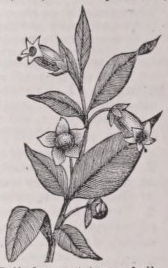
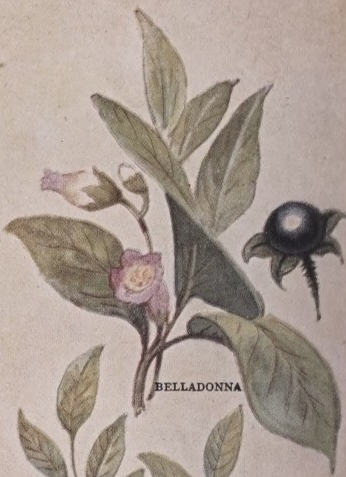
BELLADONNA, Dwale, or Deadly Nightshade(Atropa BdlaΛonnay, a tall bushy herb of the natural order Solanace<n, growing to a height of 4 or 5 feet, having leaves of a dull green colour, with a black shining berry fruit about the size of a cherry, and a large tapering root. The plant is a native of Central and South Europe, extending into Asia, and it is also found in waste places and hedgerows of Britain, though it is a doubtful native. The entire plant is highly poisonous, and accidents not unfrequently occur through children and unwary persons eating the attractive-looking fruit. Its leaves and roots are largely used in medicine, on which account the plant is cultivated, chiefly in South Germany, Switzerland, and France. Both roots and leaves contain the poisonous alkaloid atropia, but in practice the roots only are employed for its extraction. The proportions in which atropia is present in the roots range between 0 ’ 6 and 0 ’ 25, the roots of young plants being always richest in the alkaloid. The percentage found in leaves is much more uniform, being about 0’47, and extracts and tinctures of the leaves are therefore of much more constant strength than if prepared from roots. Preparations of belladonna and atropia are used in medicine as anodynes in local nervous pains,—atropia being frequently hypodermically injected but rarely taken internally. They are also of great value in ophthalmic practice on account of their peculiar property of producing dilatation of the pupil, either when painted around or dropped into the eye. Belladonna is also used as an antispasmodic in hooping-cough and spasmodic coughs generally, and for various other medicinal purposes. A remarkable antagonism between the physiological action of atropia and the alkaloid of the calabar bean ...has been experimentally worked out by Dr Thomas R. Fraser (Trans. Roy. Soc. Ed., 1870-1). To a more limited extent also an anta gonism between atropia and morphia and other alkaloids has been established; and the researches on these substances, and on the mutual action of alkaloids generally, have been continued in experiments conducted by Dr J. G. M'Kendrick, reported to the British Medical Association in 1874.