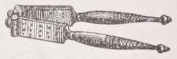
NUT. The term nut is applied to that class of fruit which consists generally of a single kernel enclosed in a hard shell. Botanically speaking, nuts are one-celled fruits with hardened pericarps, more or less enveloped in a cupule or cup, formed by the aggregation of the bracts. In commerce, however, the term has a wider application and embraces many fruits having hard woody indehiscent shells or coverings without reference to their enclosed seeds or kernels, besides leguminous pods, and even tuberous roots. A great number of nuts enter into commerce for various purposes, principally as articles of food or sources of oil, and for several ornamental and useful purposes. For the most part the edible nuts are very rich in oil, with only a small percentage of the other carbohydrates, starch, sugar, l fcc., and they also contain a large proportion of nitrogenous constituents. Thus possessing rich nutrient principles in a highly-concentrated form, nuts are by themselves rather difficult of digestion, and the liability of many of them to become rancid is also a source of danger and a hindrance to their free use. Oleaginous nuts used for food are likewise employed more or less as sources of oil, but on the other hand there are many oil-nuts of commercial importance not embraced in the list of edible nuts. The following is an alphabetical enumeration of the more important nuts, and of products passing under that name, used either as articles of food or as sources of oil :— [table] [table]
There remain to be enumerated a number of nuts of commercial value for turnery and ornamental purposes, foτ medicinal use, and for several miscellaneous applications in the arts. These include :— [table]...
The application of the term nut to many of these products is purely arbitrary, and it is obvious that numerous other bodies not known commercially as nuts might with equal propriety be included in the list. Most of the nuts of real commercial importance are or will be separately noticed, and here further allusion is only made to a few which form current articles of commerce, not otherwise treated of.
The Bread nut of Jamaica is the fruit of a lofty tree, Brosimum Alicastrum. It is about an inch in diameter, and encloses a single seed, which, roasted or boiled, is a pleasant and nutritious article of food.
The Souari or Surahwa nut, called also the “Butter nut of Demerara,” and by fruiterers the “Suwarrow nut,” is the fruit of Caryocar nuciferum (Jlhizobolaceae), a native of the forests of Guiana, growing 80 feet in height. This is perhaps the finest of all the fruits called nuts. The kernel is large, soft, and even sweeter than the almond, which it somewhat resembles in taste. The few that are imported come from Demerara, and are about the size of an egg, somewhat kidney-shaped, of a rich reddish-brown colour, and covered with large rounded tubercles.
The Pekea nut, similar in appearance and properties, is the produce of Caryocar butyrosum, growing in the same regions of tropical America.
The Jamaica Cob nut is the produce of a euphorbiaceous tree, 0mphalea diandra, the seeds of which resemble in taste the ordinary cob or hazel nut. The seed, however, contains a deleterious embryo, which must not be eaten.
Cola, Kola, or Goora nuts are the produce of Cola acuminata (βterculiacese), a tree native of tropical Africa, now introduced into the West Indies and South America. The nuts form an important article of commerce throughout Central Africa, being used over a wide area as a kind of stimulant condiment. The nuts, of which there are numerous varieties, are found to contain a notable proportion of theine, as much as 2T3 per cent., besides theobromine and other important food-constituents, to which circumstances, doubtless, their valuable properties are due.
Coquilla nuts, the large seeds of the palm, Attalea funifera, the piassaba of Brazil, are highly valued for turnery purposes. They have an elongated oval form, 3 to 4 inches in length, and being intensely hard they take a fine polish, displaying a richly-streaked brown colour.
The Marking nut, Semecarpus Anacardium, is a fruit closely allied in its source and properties to the Cashew Nut (q.v.~). The marking nut is a native of the East Indies, where the extremely acrid juice of the shell of the fruit in its unripe state is mixed with quicklime, and used as a marking-ink. The juice also possesses medicinal virtues as an external application, and when dry it is the basis of a valuable caulking material and black varnish. The seeds are edible, and the source of a useful oil.
Physic nuts are the produce of the euphorbiaceous tree, Curcas purgans, whence a valuable oil, having similar purgative properties to castor oil, is obtained. The plant is a native of South America; but is now found throughout all tropical countries.
Pine nuts are the seeds of several species of Pinus, eaten in the countries of their growth, and also serving to some extent as sources of oil. Of these the most important are the Stone Pine, Pinus Pinea, of Italy and the Mediterranean coasts, and the Russian Stone Pine, Pinus Cembra. The Pimιs Sabiniana of California and P. Gerardiana of the Himalayas similarly yield edible seeds. These seeds possess a pleasant, slightly resinous flavour.
The Pistachio nut is the fruit of Pistacia vera, L. (Anacardiaceae). It is a native of Syria. Although a remarkably delicious nut and much prized by the Greeks and other Eastern nations, it is not well known in Britain. It is not so large as a hazel nut, but is rather longer and much thinner, and the shell is covered with a somewhat wrinkled skin. The small nut of Pistacia Lentiscus, L., not larger than a cherry stone, is also occasionally imported from Smyrna, Constantinople, and Greece.
Ravensara nuts, the fruit of Agathophyllum aromaticum (Lauraceae), a native of Madagascar, is used as a spice under the name of the Madagascar clove nutmeg.
The Sapucaya nut, a Brazilian fruit, is seen occasionally in fruit-shops. It is produced by a large tree, Lecythis Ollaria, or “Cannon-ball tree.” Its specific name is taken from the large urn-shaped capsules, called “monkey-pots” by the inhabitants, which contain the nuts. The sapucaya nut has a sweet flavour, resembling the almond, and if better known would be highly appreciated. It is, however, scarce, as the monkeys and other wild animals are said to be particularly fond of it. This nut, which is of a rich amber-brown, is not unlike the Brazil nut, but it has a smooth shell furrowed with deep longitudinal wrinkles.
Soap nuts are the fruits of various species of Sapindus, especially >S ’. Saponaria, natives of tropical regions. They are so called because their rind or outer covering contains a principle, saponine, which lathers in water, and so is useful in washing. The pods of Acacia concinna, a native of India, possess the same properties, and are also known as soap nuts. (j. pa.)

[1,176 words — estimated reading time: 7 minutes]
NUTATION. See Astronomy, vol. ii. pp. 794-5.
[8 words — estimated reading time: 1 minute]
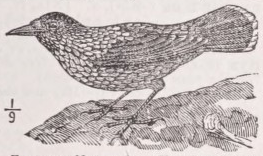
NUTCRACKER, the name given by Edwards in 1758 {Gleanings, No. 240) to a bird which had hitherto borne no English appellation, though described in 1544 by Turner, who, meeting with it in the Rhaetic Alps, where it was called “Nousbrecher” (hodie “Nussbrecher ”), translated that term into Latin as Nucifraga. In 1555 Gesner figured it and conferred upon it another designation, 0aryocatactes. It is the Corvus caryocatactes of Linnaeus and the Nucifraga caryocatactes of modern ornithology. Willughby and Ray obtained it on the road from Vienna to Venice as they crossed what must have been the Sömmerring Pass, 26th September 1663. The first known to have occurred in Britain was, according to Pennant, shot at Mostyn in Flintshire, 5th October 1753, and about fifteen more examples have since been procured, and others seen, in the island. In further continuation of the particulars already given (Crow, vol. vi. p. 618), it may here be stated that a careful monograph of the species by the Ritter Victor von Tschusi-Schmidhoffen was printed at Dresden in 1874 with the title of Der Tannenheher, which is one of its many German names. Contrary to what was for many years believed, the nest of the Nutcracker seems to be invariably built on the bough of a tree, some 20 feet from the ground, and is a comparatively large structure of sticks, lined with grass. The eggs are of a very pale bluish-green, sometimes nearly spotless, but usually more or less freckled with pale olive or ash-colour. The chief food of the Nutcracker, though it at times searches for insects on the ground, appears to be the seeds of various conifers, which it extracts as it holds the cones in its foot, and it has been questioned whether the bird has the faculty of cracking nuts—properly so called—with its ...bill, though that can be used with much force and, at least in confinement, with no little ingenuity. The old supposition that the Nutcrackers had any affinity to the Woodpeckers (Picidae) or were intermediate in position between them and the Crows (Corvidae) is now known to be wholly erroneous, for they undoubtedly belong to the latter Family. (a. n.)
[366 words — estimated reading time: 3 minutes]
NUTHATCH, in older English Nuthack, from its habit of hacking or chipping nuts, which it cleverly fixes, as though in a vice, in a chink or crevice of the bark of a tree, and then hammers them with the point of its bill till the shell is broken. This bird was long thought to be the Sittα europaea of Linnaeus; but that is now admitted to be the northern form, with the lower parts white, and its buff-breasted representative in central, southern, and western Europe, including England, is known as Sitta caesia. It is not found in Ireland, and in Scotland its appearance is merely accidental. Without being very plentiful anywhere, it is generally distributed in suitable localities throughout its range—those localities being such as afford it a sufficient supply of food, consisting during the greater part of the year of insects, which it diligently seeks on the boles and larger limbs of old trees; but in autumn and winter it feeds on nuts, beech-mast, the stones of yew-berries, and hard seeds. Being of a bold disposition, and the trees favouring its mode of life often growing near houses, it will become on slight encouragement familiar with men; and its neat attire of ash-grey and warm buff, together with its sprightly gestures, render it an attractive visitor. It generally makes its nest in a hollow branch, plastering up the opening with clay, leaving only a circular hole just large enough to afford entrance and exit; and the interior contains a bed of dry leaves or the filmy flakes of the inner bark of a fir or cedar, on which the eggs are laid. In the Levant occurs another species, S. syriaca, with somewhat different habits, as it haunts rocks rather than trees; and four or five representatives of the European arboreal species have their respective ranges from Asia Minor ...to the Himalayas and Northern China. North America possesses nearly as many; but, curiously enough, the geographical difference of coloration is just the reverse of what it is in Europe—the species with a deep rufous breast, S. canadensis, being that which has the most northern range, while the white-bellied S. carolinensis, with its western form, S. aculeata, inhabits more southern latitudes. The Ethiopian Region seems to have no representative of the group, unless it be the Hypositta corallirostris of Madagascar. Callisitta and Dendrophila are nearly allied genera, inhabiting the Indian Region, and remarkable for their beautiful blue plumage; but some doubt may for the present be entertained as to the affinity of the Australian Sittella, with four or five species, found in one or another part of that continent, which doubt is increased by the late Mr Forbes’s discovery (Proc. Zool. Society , 1882, pp. 569-571) that the genera Λcanthisitta and Xenicus, peculiar to New Zealand, and hitherto generally placed in the Family Sittidae, belong really to the Mesomyodian group and are therefore far removed from it. The unquestioned members of the Sittidae seem to be intermediate between the Paridae and the Certhiidae, and some authors comprehend them in either one or the other of those groups. (a. n.)
[526 words — estimated reading time: 4 minutes]
NUTMEG. The spice known in commerce under this name is the kernel of the seed of Myristica fragrans, Houtt., a dioecious evergreen tree, about 50 to 60 feet high, found wild in the Banda Islands and a few of the neighbouring islands, extending to New Guinea but not to the Philippines. Nutmeg and mace are almost exclusively obtained from the Banda Islands, although the cultivation has been attempted with varying success in Singapore, Penang, Bengal, Réunion, Brazil, French Guiana, and the West Indies. The trees yield fruit in eight years after sowing the seed, reach their prime in twenty-five years, and bear for sixty years or longer. Almost the whole surface of the Banda Islands is planted with nutmeg trees, which thrive under the shade of the lofty Canarium commune. The light volcanic soil, shade, and excessive moisture of these islands, where it rains more or less during the whole year, seem exactly to suit the requirements of the nutmeg tree. In Bencoolen the tree bears all the year round, but the chief harvest takes place in the later months of the year, and a smaller one in April, May, and June. In the Banda Islands the fruits are collected in small neatly-made oval baskets at the end of a bamboo, which prevents bruising, the baskets being open for half their length on one side and furnished with a couple of small prongs projecting from the top, by which the fruit-stalk is broken, the fruit falling into the basket. The ripe fruit is about 2 inches in diameter, of a rounded pear-shape, and when mature splits into two halves, exposing a crimson arillus surrounding a single seed. When the fruit is collected the pericarp is first removed; then the arillus is carefully stripped off and dried, in which state it forms the mace of commerce. The seed consists of a thin ...hard testa or shell enclosing a kernel, which, when dried, is the nutmeg. To prepare the nutmegs for use, the seed enclosing the kernel is dried at a gentle heat in a drying-house over a smouldering fire for about two months, the seeds being turned every second or third day. When thoroughly dried the shells are broken with a wooden mallet or flat board and the nutmegs picked out and sorted, the smaller and inferior ones being reserved for the expression of the fixed oil which they contain, and which forms the so-called oil of mace.
The dried nutmegs are then rubbed over with dry sifted lime. The process of liming, which originated at the time when the Dutch held a monopoly of the trade, was commenced with the view of preventing the germination of the seeds, which were formerly immersed for three months in milk of lime for this purpose, and a preference is still manifested in some countries for nutmegs so prepared. It has, however, been shown that this treatment is by no means necessary, since exposure to the sun for a week destroys the vitality of the kernel. Nor is the dry liming process needful, for nutmegs keep well in their natural shell, in which form they are usually exported to China. The weight of the shells, however, adds one-third to the cost of freight, hence this plan is not generally adopted. Penang nutmegs are never limed. The entire fruit preserved in syrup is used as a sweetmeat in the Dutch East Indies.
“Oil of mace,” or nutmeg butter, is a solid fatty substance of a reddish-broλvn colour, obtained by grinding the refuse nutmegs to a fine powder, enclosing it in bags and steaming it over large cauldrons for five or six hours, and then compressing it while still warm between powerful wedges, the brownish fluid which flows out being afterwards allowed to solidify. Nutmegs yield about one-fourth of their weight of this substance. It is partly dissolved by cold alcohol, the remainder being soluble in ether. The latter portion, about 10 per cent, of the -weight of the nutmegs, consists chiefly of myristin, which is a compound of myristic acid, C 14 H., 8 O 2 , with glycerin. The fat which is soluble in alcohol appears to consist, according to Schmidt and Roemer (Arch. Pharm. [3], xxi. pp. 34-48), of free myristic and stearic acids; the brown colouring matter has not been satisfactorily investigated. Nutmeg butter yields on distillation with water a volatile oil to the extent of about 6 per cent., consisting almost entirely of a hydrocarbon called myristicene, C 10 H 10 , boiling at 165° C. It is accompanied by a small quantity of an oxygenated oil, myristicol, isomeric with carvol, but differing from it in not forming a crystalline compound with hydrosulphuric acid. Mace contains a similar volatile oil, macene, boiling at 160° C., which is said by Cloëz to differ from that of nutmegs in yielding a solid compound when treated with hydrochloric acid gas.
The annual imports of nutmegs to the United Kingdom amount to from 400,000 to 800,000 lb, each lb consisting of about 110 fair-sized nutmegs, and of mace from 60,000 to 80,000 lb per annum. The former are valued at from three to five shillings per ft), and mace at from one to three shillings per ft). Long, wild, or male nutmegs, the produce of Μ. tomentosa and Μ. fatua, are sometimes imported in small quantities. Several species of Myristica yield fatty oils, which form commercial products, but none of these are remarkable for fragrance.
The name nutmeg is also applied to other fruits or seeds in different countries. The Jamaica or calabash nutmeg is derived from Monodora Myristica, the Brazilian irom Cryptocarya moschata, the Peruvian from Laurelia semperυirens, the New Holland or plume nutmeg from Λtherosperma moschata, the Madagascar orclove nutmeg from Agathophyllum aromaticum, and the Californian or stinking nutmeg from Torreya myristica. The cotyledons of Nectandra Puchury were at one time offered in England as nutmegs.
Seemann, in Hooker's Journ. Bot., 1852, p. 83; Collingwood, Jburn. Lin. Soc. Bot., 1869, p. 45; Lumsdaine, Pharm. Journ. [1], xi. p. 516; Wallace, Malay Archipelago, i. p. 452, 1869; Bickmore, Travels in E. Indian Archipelago, 1868, p. 225; Pharmacographia (2d. ed.), p. 502; Journ. Pharm. Soc. [3J, xiii. p. 304.
[1,050 words — estimated reading time: 6 minutes]