
1. A procession distinguished by ostentation of grandeur and splendor; as the pomp of a Roman triumph.
Word of the Day: Catachrestical
2. Show of magnificence; parade; display; power.
To make a pompons display; to conduct.
A crimson or pink color; also, a style of dress cut low and square in the neck; also, a mode of dressing the hair by drawing it straight back from the forehead over a roll; -- so called after the Marchioness de Pompadour of France. Also much used adjectively.
Pompadour
Encyclopedia Britannica
POMPADOUR, Jeanne Antoinette Poissonle Normant d’Étioles, Marquise de (1721-1764), the most famous of all the mistresses of Louis XV., was born in Paris on 29th December 1721, and was baptized as the legitimate daughter of François Poisson, an officer in the household of the duke of Orleans, and his wife Madeleine de la Motte, in the church of St Eustache, but she was suspected, as well as her brother, afterwards marquis of Marigny, to be the child of a very wealthy financier, and farmer-general of the revenues, Le Normant de Tourne-hem. He at any rate took upon himself the charge of her education; and, as from the beauty and wit she showe I from childhood she seemed to be born for some uncommon· destiny, he declared her “un morceau de roi,” and specially educated her to be a king’s mistress. This idea was confirmed in her childish mind by the prophecy of an old woman, whom in after days she pensioned for the correctness, of her prediction. In 1741 she was married to a nephew of her protector and guardian, Le Normant d’Étioles, who was passionately in love with her, and soon became a queen of fashion. Y’et the world of the financiers at Paris was far apart from the court world, where she wished to reign; she could get no introduction at court, and could only try to catch the king’s eye when he went out hunting. But Louis XV. was then under the influence of Madame de· Mailly, who carefully prevented any further intimacy with “la petite L·tioles,” and it was not until after her death that the king met the fair qιieen of the financial world of Paris at a ball given by the city to the dauphin in 1744, and he was immediately subjugated. She at once gave up· her husband, and in 1745 was established at Versailles as. “maîtresse en titre.” Louis ...XV. bought her the estate of Pompadour, from which she took her title of marquise. She was hardly established firmly in power before she showed that ambition rather than love had guided her, and began to mix in politics. Knowing that the French people of that time were ruled by the literary kings of the time, she paid court to them, and tried to play the part of a Maecenas. Voltaire was her poet in chief, and the founder of the physiocrats, Quesnay, was her physician. In the arts she was even more successful; she was herself no mean etcher and engraver, and she encouraged and protected Vanloo, Boucher, Vien, Greuze, and the engraver Jacques Guay. Yet this policy did not prevent her from being lampooned, and the famous Poissardes against her contributed to the ruin of many wits suspected of being among the authors, and notably of the Comte de Maurepas. The command of the political situation passed entirely into her hands; she it was who brought Belle-Isle into office with his vigorous policy; she corresponded regularly with the generals of the armies in the field, as her recently published letters to the Comte de Clermont prove; and she introduced the Abbé de Bernis into the ministry in order to-effect a very great alteration of French politics in 1756. The continuous policy of France since the days of Richelieu had been to weaken the house of Austria by alliances in Germany; but Madame de Pompadour changed this hereditary policy because Frederick the Great wrote scandalous verses on her; and because Maria Theresa wrote her a friendly letter she entered into an alliance with Austria. This alliance brought on the Seven Years’ War with all its disasters, the battle of Rosbach and the loss of Canada; but Madame de Pompadour persisted in her policy, and when Bernis failed her, brought Choiseul into office, and supported him in all his great plans, the Pacte de Famille, the suppression of the Jesuits, and the peace of Versailles. But it was to internal politics that this remarkable woman paid most attention; no one obtained office except through her; in imitation of Madame de Maintenon she prepared all business for the king’s eye with the ministers, and contrived that they should meet in her room; and she daily examined the letters sent through the post office with Janelie, the director of the post office. By this continuous labour she made herself indispensable to Louis. Y τ et, when she had lost the heart of her lover after a year or two, she had a difficult task before her; to maintain her influence she had not only to save the king as much trouble as possible, but to find him fresh pleasures. When he first began to weary of her, she remembered her talent for acting and her private theatricals at Etioles, and established the “théâtre des petits cabinets,” in which she acted with the greatest lords about the court for the king’s pleasure in tragedies and comedies, operas and ballets. By this means and the “concerts spirituels” she kept in favour for a time; but at last she found a surer way, by encouraging the king in his debaucheries, and Louis wept over her kindness to his various mistresses. Only once, when the king was wounded by Damiens in 1757, did she receive a serious shock, and momentarily left the court; but on his recovery she returned more powerful than ever. She even ingratiated herself with the queen, after the example of Madame de Maintenon, and was made a lady-in-waiting; but the end was soon to come. “Ma vie est un combat,” she said, and so it was, with business and pleasure; she gradually grew weaker and weaker, and when told that death was at hand she dressed herself in full court costume, and met it bravely on 15th April 1764 at the age of forty-two.
See Capefitrue, Madame la Marquise de Pompadour, 1858; E. and J. de Gon- <ourt, ∕-<s Maîtresses de Louis Λ'l r ., vol. ii., 1860; and Campardon, Madame de Pompadour et la Cour de Louis XV. an milieu du dix-huitième siècle, 1867. Far more valuable are Malassis , s two recently published volumes of correspondence, Correspondance de Madame de Pompadour avec son père Μ. Poisson, et son frère Μ. de Vandières, Ac., 1878, and Bonhomme, Madame de Pompadour, général d'armée. 1880, containing lier letters to the Comte de Clermont. For her artistic and theatrical tastes see particularly J. F. Leturcq, Notice sur Jacques Guay, Graveur sur pierres fines du Rd Louis X V.: Documents inédits emanant de Guay et notes sur les oeuvres de gravure en taille douce et en pierres durs de la Marquise de Pompadour, 1873; and Adolphe Jullien, Histoire du Théâtre de Madame de Pompadour, dit Théâtre des Petits Cabinets, 1874.
9th ed. Encyclopædia Britannica, vol. 19, p. 443
[1,151 words — estimated reading time: 7 minutes]
[1,151 words — estimated reading time: 7 minutes]
1. Any one of several species of marine fishes of the genus Trachynotus, of which four species are found on the Atlantic coast of the United States; -- called also palometa.
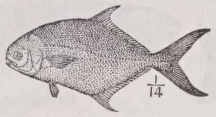
2. A California harvest fish (Stromateus simillimus), highly valued as a food fish.
Pompous; splendid; ostentatious. [Not in use.]
Pompeii
Encyclopedia Britannica
POMPEII, an ancient town of Campania, situated on the shore of the Bay of Naples, almost immediately at the foot of Mount Vesuvius. To its proximity to that volcano it owes its celebrity,—the peculiar circumstances of its destruction by the great volcanic outburst of Vesuvius in 79 A.D., and of its rediscovery in modern times, having converted that which would otherwise have been known only as an obscure country town into a place of world-wide fame, as one of the most interesting relics preserved to us from antiquity. Of its previous history comparatively little is recorded, but it appears that, like most other towns in the beautiful region in which it was situated, it had a population of a very mixed character, and it passed successively into the hands of several different nations, each of which probably contributed an additional element to its composition. Though its foundation was ascribed by Greek tradition to Heracles, in common with the neighbouring city of Herculaneum, no value can be attached to these mythological or etymological fables; it is certain that it was not a Greek colony, in the proper sense of the term, as we know to have been the case with the more important cities of Cumae and Neapolis. Strabo, in whose time it was a populous and flourishing place, tells us that it was first occupied by the Oscans, afterwards by the Tyrrhenians (t.e., Etruscans) and Pelasgians, and lastly, by the Samnites. The conquest of Campania by the last-mentioned people is an undoubted historical fact, and there can be no doubt that Pompeii shared the fate of the neighbouring cities on this occasion, and afterwards passed in common with them under the yoke of Rome. But its name is only once mentioned during the wars of the Romans with the Samnites and Campanians in this ...region of Italy, and then only incidentally (Liv., ix. 38). At a later period, however, it took a prominent part in the outbreak of the nations of central Italy known as the Social War (91—89 b.c.), when it withstood a long siege by Sulla, and was one of the last cities of Campania that was reduced by the Roman arms. After that event the inhabitants were admitted to the Roman franchise, but a military colony was settled in their territory by the dictator Sulla, and there can be no doubt that the whole population became rapidly Romanized. Before the close of the republic it became a favourite resort of the leading nobles of Rome, many of whom acquired villas in the neighbourhood. Among the most prominent of these was Cicero, whose letters abound with allusions to his Pompeian villa, which was one of his favourite places of occasional residence. The same fashion continued under the Roman empire, and there can be no doubt that during the first century after the Christian era, Pompeii, without rising above the rank of an ordinary provincial town, had become a flourishing place with a considerable population, for which it was indebted in part to its position at the mouth of the river Sarnus, which rendered it the port of the neighbouring towns in the interior. But two events only are recorded of its history during this period. In 59 a.d. a tumult took place in the amphitheatre of Pompeii between the citizens of the place and the visitors from the neighbouring colony of Nuceria, which led to a violent affray, in which many persons were killed and wounded on both sides. The Pompeians were punished for this violent outbreak by the prohibition of all gladiatorial and theatrical exhibitions for ten years (Tacitus, Ann. xiv. 17). A characteristic, though rude, painting, found on the walls of one of the houses, gives a representation of this untoward event.
Only four years afterwards (63 a.d.) a much more serious disaster befell the city. An earthquake, which affected all the neighbouring towns, vented its force especially upon Pompeii, a large part of which, including most of the public buildings, was either destroyed or so seriously damaged as to require to be rebuilt rather than repaired (Tacit., Ann., xv. 21; Seneca, Q. A r ., vi. 1). The actual amount of the injuries sustained, which is intimated in general terms by Tacitus and Seneca, is more accurately known to us from the existing remains. For the inhabitants were still actively engaged in repairing and restoring the ruined edifices when the whole city was overwhelmed by a much more appalling catastrophe. In 79 a.d. the neighbouring mountain of Vesuvius, the volcanic forces of which had been slumbering for unknown ages, suddenly burst into a violent eruption, which, while it carried devastation all around the beautiful gulf, buried the two cities of Herculaneum and Pompeii under dense beds of cinders and ashes. It is singular that, while we possess a detailed description of this famous eruption in two well-known letters of the younger Pliny (Eρist. vi. 16, 20), he does not even notice the destruction of Pompeii or Herculaneum, though his uncle perished in the immediate neighbourhood of the former city. But their unhappy fate is noticed by Dion Cassius, and its circumstances may be gathered with certainty from the condition in which it has been found. These were such as eminently to conduce to its preservation and interest as a relic of antiquity. Pompeii, was not, like Herculaneum, buried in a solid mass of volcanic tuff, but merely covered with a bed of lighter substances, cinders, small stones, and ashes, thrown out by the volcano, and falling from above on the devoted city. It is clearly established that the whole of this superincumbent mass, though attaining to an average thickness of from 18 to 20 feet, was the product of one eruption,—though the materials may be divided generally into two distinct strata, the one consisting principally of cinders and small volcanic stones (called in Italian “lapilli”), and the other and uppermost layer of fine white ash, often consolidated by the action of water from above, so as to take thie moulds of objects contained in it like clay or plaster of I ’ aris.
So completely was the unfortunate city buried under this overwhelming mass that its very site was forgotten, and even the celebrated topographer Cluverius in the 17th century was unable to fix it with certainty. This difficulty arose in part from the physical changes consequent on the eruption, and it was not till 1748 that an accidental discovery drew attention to its remains, and revealed the fact that beneath the vineyards and mulberry grounds which covered the site there lay entombed the ruins of a city, far more accessible, if not more interesting, than those (previously discovered) of the neighbouring Herculaneum. It was not till 1755 that systematic excavations on the site were begun, and, though they were thenceforth carried on more or less continuously during the whole of that century, it was not till the beginning of the present century that they assumed a regular character; and the work, which had received a vigorous stimulus during the period of the French government (1806-1814), was prosecuted, though in a less methodical and systematic manner, under the succeeding rule of the Bourbon kings (1815-61). Of late years the process has been carried on, under the enlightened direction of Signior Fiorelli, in a much more careful and scientific manner than before, and the results have been in many respects of the highest interest. At the same time the invention of photography has enabled the directors to preserve a far more satisfactory record of every step in the explorations than could previously be attempted.
It would be impossible for us to present our readers in this place with anything like an idea of the results of these excavations. Interesting as are the numerous works of art that have been brought to light, and important as is their bearing upon the history of some branches of ancient art, they cannot compare in interest with the flood of light which this marvellous discovery has thrown upon ancient life in all its details, enabling us to picture to ourselves the ways and manners and habits of life of a cultivated and flourishing population eighteen centuries ago, in a manner which no amount of study of ancient literature could possibly accomplish. We must confine ourselves in the present article chiefly to those points which bear more immediately on the topography and character of the town of Pompeii, referring our readers for other details to the numerous works in which they have been described and delineated.
The town was situated on a rising ground of small elevation, separated by a distance of less than a mile from the foot of the actual rise of the outer cone of Vesuvius. This eminence is itself undoubtedly due to an outflow of lava from that mountain, during some previous eruption in prehistoric times, for we know from Strabo that Vesuvius, though presenting in his time all the appearances of an extinct volcano, had been quiescent ever since the first records of the Greek settlements in this part of Italy. But the position of Pompeii in ancient times differed materially from that which it occupies at the present day. It was situated close to the sea-shore, from which it is now mure than a mile distant, and adjoining the mouth of the river Sarnus or Sarno, which now enters the sea nearly two miles from its site, but the present course of this stream is due in part to modern alteration of its channel, as well as to the effects of the great eruption. It is certain, however, that in Strabo’s time Pompeii owed much of its prosperity to its serving as the port of the adjoining plain, and the neighbouring towns of Nuceria, Nola, and Acerrae (Strabo, v. c. 4, § 8).
The area occupied by the ancient city was of an irregular oval form, and about two miles in circumference. It was surrounded by a wall, which is still preserved around more than two-thirds of its extent, but no traces of this are found on the side towards the sea, and there is no doubt that on this side it had been already demolished in ancient times, so as to give room for the free extension of houses and other buildings in that direction. These walls are strengthened at intervals by numerous towers, which occur in some parts at a distance of only about 100 yards, but in general much less frequently. They are, however, of a different style of construction from the walls, and appear to have been added at a later period, probably that of the settlement of the Roman colony by Sulla. Similar evidences of the addition of subsequent defences are to be traced also in the case of the gates, of which no less than eight are found in the existing circuit of the walls. Some of these present a very elaborate system of defence, but it is evident from the decayed condition of others, as well as of parts of the walls and towers, that they had ceased to be maintained for the purposes of fortification long before the destruction of the city. The gates are now known by names given them in modern times from the direction in which they led, as, the gate of Herculaneum, of Stabiae, of Nola, ic. No trace has been found of their ancient appellations.
The general plan of the town is very regular, the streets, being generally straight, and crossing one another at right angles or nearly so. But an exception is found in the street leading from the gate of Herculaneum to the forum, which, though it must have been one of the principal thoroughfares in the city, was crooked and irregular, as well as very narrow, in some parts not exceeding 12 to 14 feet in width, including the raised trottoirs or footpaths on each side, which occupy a considerable part of the space, so that the carriage-way could only have admitted of the passage of one vehicle at a time. The other streets are in some cases broader, but rarely exceed 20 feet in width, and the broadest yet found is less than 30, while the back streets running parallel to the main lines are only about 15 feet. They are uniformly paved with large polygonal blocks of hard basaltic lava, fitted very closely together, though now in many cases marked with deep ruts from the passage of vehicles in ancient times. They are also in all cases bordered by raised trottoirs on both sides, paved in a similar manner; and for the convenience of foot passengers, these are connected from place to place by stepping-stones raised above the level of the carriageway. Such an arrangement must have presented a considerable obstacle to the passage of vehicles; and altogether it is evident that the streets of Pompeii, like those of most Roman towns, were calculated much more for foot passengers than for any extensive traffic of wheeled carriages. In other respects they must have been far from presenting the lively aspect of the streets of modern and even mediaeval towns, and must rather have resembled those of Oriental cities,—the living apartments all opening towards the interior, and showing only blank walls towards the street; while the windows were generally to be found only in the upper story, and were in all cases small and insignificant, without any attempt at architectural effect. In some instances indeed the monotony of their external appearance was broken by small shops, occupying the front of the principal houses, as it were let in to the main building; these were in some cases numerous enough to form a continuous façade to the street. This is seen especially in the case of the Street of Herculaneum, and that of Stabiae, both of which were among the principal and most frequented thoroughfares.
The former of these main lines of street, which, as already described, led from the gate of Herculaneum to the forum, was crossed, a little before it reached that important centre, by a long straight line of street, which led directly to the gate of Nola. Two other parallel lines of street struck off from the forum itself towards the east, and these have been followed as far as the points where they cross nearly at right angles another main line of street, which leads direct from the gate of Vesuvius to that of Stabiae, near the theatres, thus traversing the city in its whole width from north to south. Almost the whole portion of the city which lies to the west of this last line, towards the forum and the sea, has been more or less completely excavated; but the greater part of that on the other side of it remains still unexplored, with the exception of the amphitheatre, and a small space in its immediate neighbourhood. Altogether it may be calculated that about two-fifths of the whole extent has been already excavated. But there can be little doubt that the portion already known is the most important, as it includes the forum, with the temples and public buildings adjacent to it, the thermae, theatres, amphitheatre, &c.
The forum was unquestionably at Pompeii, as at Borne itself, and in all other Italian cities, the focus and centre of all the life and movement of the city, and was at once the resort of the lounger and the gathering place of men of business. Hence it was surrounded on all sides by public buildings or edifices of a commanding character. It was not, however, of large size, as compared to the open spaces in modern towns, being only 160 yards in length by 35 in breadth. Nor was it a centre of traffic in the modern sense of the word, being only accessible to any description of wheeled carriages at one angle, and the nature of its pavement, composed of broad flags of travertine, excluding the idea of its being intended for their passage. It was surrounded on three sides by a portico, or rather by a series of porticos, some supported on arcades, others in the Grecian manner on columns; and these porticos were originally surmounted by a gallery or upper story, traces of the staircases leading to which still remain, though the gallery itself has altogether disappeared. It is, however, certain from the existing remains that both this portico and the adjacent buildings had suffered severely from the earthquake of 63, and that they were undergoing a process of restoration, involving material changes in the original arrangements, which was still incomplete at the time of their final destruction.
The north end of the forum, where alone the portico is wanting, is occupied in great part by a building, the most imposing in the whole city, which is now generally known, on grounds that may be considered satisfactory, as the temple of Jupiter. It was raised on a podium or base of considerable elevation, and had a portico with six Corinthian columns in front, which, according to Sir W. Gell, are nearly as large as those in the portico of St Paul’s. This magnificent edifice had, however, been evidently overthrown by the earthquake of 63, and is in its present condition a mere ruin. On each side of it were two arches, affording an entrance into the forum, but capable of being closed by iron gates. The principal of these, at the north-east angle of the forum, was the approach by which that open space was entered in coming from the gate of Herculaneum; the passage, however, was barred to wheeled carriages by a descent of three small steps. On the east side of the forum were four edifices, all of them unquestionably of a public character, but of which the names and attribution have been the subject of much controversy. The first (proceeding from the north) is generally known, though without doubt erroneously, as the Pantheon, or temple of the Twelve Gods; but it is very doubtful whether it is a temple at all, and the latest authorities are disposed to regard it as a macellum or meat-market, though the situation would seem to be unhappily chosen for such a purpose. Next to this comes a building generally regarded as the curia or senaculum—the meeting-place of the local senate, or town council. Beyond this comes another temple of small «dimensions commonly called the temple of Mercury, but supposed also, on very slight grounds, to have been dedicated to Augustus; and beyond this again, bounded On the south by a street known as the Street of the Silversmiths, is a large and spacious edifice, which, as we learn from an extant inscription, was erected by a priestess named Eumachia. Notwithstanding this, its purpose and character are open to considerable doubt; but it resembles .a basilica in its form and disposition, and was probably designed for similar purposes. The name of Chalcidicum, by which it is commonly known, is an erroneous inference from the inscription just referred to. The south eud of the forum is occupied by three small buildings of very similar form and arrangement, which are supposed to have served as courts of law, though their destination is a matter of much uncertainty; while the greater part of the west side is occupied by two large buildings,—a basilica, which is the largest edifice in Pompeii, and a temple, which presents its side to the forum, and hence fills up a large portion of the surrounding space. The former, as we learn from an inscription on its walls, was anterior in •date to the consulship of Μ. Lepidus and Q. Catulus (78 b.c. ), and therefore belongs to the Oscan period of the •city, before the introduction of the Roman colony. The temple was an extensive edifice, having a comparatively •small cella, raised upon a podium, and standing in the midst of a wide space surrounded by a portico of columns, outside which again is a wall, bounding the sacred •enclosure. It is commonly called the temple of Venus, but without any evidence; the most recent authorities regard it, on somewhat better grounds, as dedicated to Apollo. Between this temple and the basilica a street of unusual width leads off direct to the gate which opens towards the sea, and is still preserved, though the walls on this side of the city have ceased to exist.
Besides the temples which surrounded the forum, the remains of four others have been discovered, three of which are situated in the immediate neighbourhood of the theatres. Of these by far the most interesting, though the least perfect, is one which is commonly known as the temple of Hercules (an appellation wholly without foundation), and which is not only by far the most ancient "edifice in Pompeii, but presents us with all the characters of a true Greek temple, resembling in its proportions that •of Neptune at Paestum, and probably of as remote antiquity. Unfortunately only the...
9th ed. Encyclopædia Britannica, vol. 19, p. 444
[8,342 words — estimated reading time: 50 minutes]
[8,342 words — estimated reading time: 50 minutes]
A shaddock, esp. one of large size.
of Pompelmous
The ball which printers use to black the types.
The ball formerly used to ink the type.
Pompey
Encyclopedia Britannica
POMPEY is the common English form of the Roman name Pompeius.'...
I. Cneius Pompeius Magnus (106-48 b.c.), the great triumvir, whose name we always associate with Caesar and Crassus, may be said to have led a soldier’s life fqom his boyhood to his death. Born in 106 b.c., he fought by his father’s side when a stripling of seventeen in the Social or Italian War on the side of Sulla against the party of Marius and Cinna. Thus early in life he connected himself with the cause of the aristocracy, and a decisive victory which he won in 83 over the Marian armies gained for him from Sulla the title of “imperator.” He followed up his successes in Italy by defeating the Marians in Sicily and Africa, and on his return to Rome in 81, though he was still merely an “eques” and not legally qualified to celebrate a triumph, he was allowed by general consent to enjoy this great distinction, while Sulla greeted him with the surname of Magnus, a title he always retained and handed down to his sons. Yet in 79 he used his influence in getting elected to the consulship a man politically opposed to Sulla, Aemilius Lepidus, who threatened Rome with another revolution and civil war in the interest of the democratic party. Pompey, however, at this crisis was loyal to his friends, and with the defeat of Lepidus the danger passed away. With some fears and misgivings the senate permitted him to retain the command of his victorious army, and decided on sending him to Spain, where, under a leader of singular ability, Sertorius, the Marian party was still formidable. Pompey was fighting in Spain from 76 to 71, and though at first he met with serious reverses he was ultimately successful, his great opponent, Sertorius, having, it would seem, lost the confidence of some of the native Spanish tribes. In 71 he was again in Italy at the head of his army, and won fresh glory by giving a finishing blow to the slave insurrection of Spartacus. That same year, amid great popular enthusiasm, but without the hearty concurrence of the senate, whom he had alarmed by talking of restoring the dreaded power of the tribunes, and though still merely an “eques,” he was elected with Crassus to the consulship, and entered Rome in triumph for his Spanish victories. The following year saw the work of Sulla undone: the tribuneship was restored, and the administration of justice was no longer left exclusively to the senate, but was to be shared by them with the wealthier portion of the middle class, the “knights,” as from old time they had been called, and the farmers and collectors of the revenue. The change was really necessary, as the provincials could never get justice from a court composed of senators, and it was carried into effect by Pompey with Caesar’s aid. Pompey as a matter of course rose still higher in popularity, and on the motion of the tribune Gabinius in 67 he was entrusted with an extraordinary command over the greater part of the empire, specially for the extermination of piracy in the Mediterranean, by which the corn supplies of Rome were seriously endangered, while high prices of provisions caused great distress. It soon appeared that the right man had been chosen for the work: the price of corn fell immediately on Pompey’s appointment, and in forty days the Mediterranean was swept from end to end and the pirates cleared out of its waters. Next year, on the proposal of the tribune Manilius, he had a yet further extension of his powers, the whole of Rome’s empire in the East being put under his control for three years with the view of finally terminating the war with Mithradates, king of Pontus, who had recovered from the defeats he had sustained from Lucullus and regained his dominions. Both Caesar and Cicero supported the tribune’s proposal, which was easily carried in spite of the interested opposition of the senate and the aristocracy, several of whom held provinces which would now be practically under Pompey’s command. Pompey was now by far the first man in the Roman world. His operations in the East were thoroughly successful, and, though no doubt he owed something to the victories of Lucullus, he showed himself an able soldier. The wild tribes of the Caucasus were cowed by the
Roman arms, and the king of Pontus himself fled from Asia across the Black Sea to Panticapaeum, the modern Kertch. In the years 64 and 63 Syria and Palestine were annexed to Rome’s empire. After the capture of Jerusalem Pompey is said to have entered the temple, and even the Holy of Holies. Asia and the East generally were left under the subjection of petty kings who were mere vassals of Rome. Several cities had been founded which became centres of Greek life and civilization. A really great work had been accomplished, and Pompey, now in his forty-fifth year, returned to Italy in 61 to celebrate the most magnificent triumph which Rome had ever witnessed, and to be hailed as the conqueror of Spain, Africa, and Asia.
The remainder of Pompey’s life is inextricably interwoven with that of Caesar. He was married to Caesar’s daughter Julia, and as yet the relations between the two had been friendly. On more than one occasion Caesar had supported Pompey’s policy, which of late had been in a decidedly democratic direction. Pompey was now in fact ruler of the greater part of the empire, while Caesar had only the two provinces of Gaul. The control of the capital, the supreme command of the army in Italy and of the Mediterranean fleet, the governorship of the two Spains, the superintendence of the corn supplies, which were mainly drawn from Sicily and Africa, and on which the vast population of Rome was wholly dependent, were entirely in the hands of Pompey. The senate and the aristocracy disliked and distrusted him, but they felt that, should things come to the worst, they might still find in him a champion of their cause. At the same time the senate itself was far from unanimous: among many of its members there was a feeling that a military imperialism had become a necessity, while to the rich and idle world generally peace and quiet at any price seemed the best of all blessings. Hence the joint rule of Pompey and Caesar was not unwillingly accepted, and anything like a rupture between the two was greatly dreaded as the sure beginning of anarchy throughout the Roman world. With the death of Pompey’s wife Julia, in 54, came strained relations between him and Caesar, and soon afterwards he drew closer to what we may call the old conservative party in the senate and aristocracy. The end was now near, and Pompey blundered into a false political position and an open quarrel with Caesar. In 50 the senate by a very large majority revoked the extraordinary powers conceded to Pompey and Caesar in Spain and Gaul respectively. Pompey’s refusal to submit gave Caesar a good pretext for declaring war and marching at the head of his army into Italy. At the beginning of the contest, the advantages were decidedly on the side of Pompey, but very speedily the superior political tact of his rival, combined with extraordinary promptitude and decision in following up his blows, turned the scale against him. Pompey’s cause, with that of the senate and aristocracy, was finally ruined by his defeat in 48 in the neighbourhood of the Thessalian city Pharsalus. That same year he fled with the hope of finding a safe refuge in Egypt, but was treacherously murdered as he was stepping on the shore by one of his old centurions. He had just completed his fifty-eighth year.
Pompey, though he had some great and good qualities, hardly deserved his surname of “the Great.” He was certainly a very good soldier, and is said to have excelled in all athletic exercises, but he fell short of being a first-rate general. He won great successes in Spain and more especially in the East, but for these he was no doubt partly indebted to what others had already done. Of the gifts which make a good statesman he had really none. As plainly appeared in the last years of his life, he was too weak and irresolute to choose a side and stand by it. Pitted against such a man as Caesar, he could not but fail. But to his credit be it said that in a corrupt time he never used his opportunities for plunder and extortion, and his domestic life was pure and simple.
A very complete life of Pompey will be found in Smith’s Diet, of Greek and Roman Biography. The allusions to him in Cicero’s works are very frequent.
II. Sextus Pompeius Magnus (75-35 b.c.), the younger son of Pompey the Great, born 75 b.c., continued after his father’s death to prolong the struggle against the new rulers of the Roman empire. Caesar’s victory at Munda in 45 drove him out of Corduba (Cordova), though for a time he held his ground in the south of Spain, and defeated Asinius Pollio, the governor of the province. In 43, the year of the triumvirate of Octavius, Antony, and Lepidus, he was proscribed along with the murderers of Caesar, and not daring to show himself in Italy he put himself at the head of a fleet manned chiefly by slaves or proscribed persons, by means of which he made himself master of Sicily, and from thence ravaged the coasts of Italy. Rome was threatened with a famine, as the corn supplies from Egypt and Africa were cut off by his ships, and it was thought prudent to negotiate a peace with him, which was to leave him in possession of Sicily, Sardinia, and Achaia, provided he would allow Italy to be freely supplied with corn. But the arrangement could not be carried into effect, as Sextus renewed the war and gained some considerable successes at sea. However, in 36 his fleet was defeated and destroyed by Agrippa off the north coast of Sicily, and in the following year he was murdered at Mitylene by an officer of Antony. He had his father’s bravery as a soldier, but seems to have been a rough uncultivated man. . (w. J. B.)
9th ed. Encyclopædia Britannica, vol. 19, p. 450
[1,764 words — estimated reading time: 11 minutes]
[1,764 words — estimated reading time: 11 minutes]
1. Impure zinc oxide.
See Pompelmous.
1. Any trifling ornament for a woman's dress or bonnet.
of Pomposity
The quality or state of being pompous; pompousness.
1. Displaying pomp; showy with grandeur; splendid; magnificent; as a pompous procession; a pompous triumph.
2. Ostentatious; boastful; as a pompous account of private adventures.
With great parade or display; magnificently; splendidly; ostentatiously.
Ostentation Roget’s Thesaurus §882
N. ostentation, display, show, flourish, parade, etalage, pomp, array, state, solemnity, dash, splash, splurge, glitter, strut, pomposity, pretense, pretensions, showing off, fuss, magnificence, splendor, coup d'oeil, grand doings, coup de theatre, stage effect, stage trick, claptrap, mise en scene, tour de force, chic, demonstration, flying colors, tomfoolery, flourish of trumpets, pageant, pageantry, spectacle, exhibition, exposition, procession, turn out, set out, grand function, fte, gala, field day, review, march past, promenade, insubstantial pageant, dress, court dress, full dress, evening dress, ball dress, fancy dress, tailoring, millinery, man millinery, frippery, foppery, equipage, ceremony, ceremonial, ritual, form, formality, etiquette, puncto, punctilio, punctiliousness, starched stateliness, stateliness, mummery, solemn mockery, mouth honor, attitudinarian, fop
V. be ostentatious, come forward, put oneself forward, attract attention, star it, cut a figure, make a dash, make a splash, make a splurge, cut a dash, cut a splash, cut a splurge, figure, figure away, make a show, make a display, glitter, show off, show off one's paces, parade, march past, display, exhibit, put forward, hold up, trot out, hand out, sport, brandish, blazon forth, dangle, dangle before the eyes, cry up, proner, flaunt, emblazon, prink, set off, mount, have framed and glazed, put a good face upon, put a smiling face upon, clean the outside of the platter
Adj. ostentatious, showy, dashing, pretentious, janty, jaunty, grand, pompous, palatial, high-sounding, turgid, gairish, garish, gaudy, gaudy as a peacock, gaudy as a butterfly, gaudy as a tulip, flaunting, flashing, flaming, glittering, gay, splendid, magnificent, sumptuous, theatrical, dramatic, spectacular, ceremonial, ritual, solemn, stately, majestic, formal, stiff, ceremonious, punctilious, starched, dressed to kill, dressed to the nines, decjed out, all decked out, en granite tenue, in best bib and tucker, in sunday best, endimanch, chic
Adv. with flourish of trumpet, with beat of drum, with flying colors, ad captandum vulgus
Phr. honores mutant mores
King James Bible KJV Bible
Berean Standard Bible BSB Bible
9 KJV and 6 BSB verses contain “Pomp”
Therefore hell hath enlarged herself, and opened her mouth without measure: and their glory, and their multitude, and their pomp, and he that rejoiceth, shall descend into it.
Now therefore, behold, the Lord bringeth up upon them the waters of the river, strong and many, even the king of Assyria, and all his glory: and he shall come up over all his channels, and go over all his banks:
the Lord will surely bring against them the mighty floodwaters of the Euphrates— the king of Assyria and all his pomp. It will overflow its channels and overrun its banks.
We have heard of the pride of Moab; he is very proud: even of his haughtiness, and his pride, and his wrath: but his lies shall not be so.
We have heard the pride of Moab, (he is exceeding proud) his loftiness, and his arrogancy, and his pride, and the haughtiness of his heart.
We have heard of Moab’s pomposity, his exceeding pride and conceit, his proud arrogance and haughtiness of heart.
Wherefore I will bring the worst of the heathen, and they shall possess their houses: I will also make the pomp of the strong to cease; and their holy places shall be defiled.
So I will bring the most wicked of nations to take possession of their houses. I will end the pride of the mighty, and their holy places will be profaned.
At Tehaphnehes also the day shall be darkened, when I shall break there the yokes of Egypt: and the pomp of her strength shall cease in her: as for her, a cloud shall cover her, and her daughters shall go into captivity.
The day will be darkened in Tahpanhes when I break the yoke of Egypt and her proud strength comes to an end. A cloud will cover her, and her daughters will go into captivity.
By the swords of the mighty will I cause thy multitude to fall, the terrible of the nations, all of them: and they shall spoil the pomp of Egypt, and all the multitude thereof shall be destroyed.
And on the morrow, when Agrippa was come, and Bernice, with great pomp, and was entered into the place of hearing, with the chief captains, and principal men of the city, at Festus’ commandment Paul was brought forth.
The next day Agrippa and Bernice came with great pomp and entered the auditorium, along with the commanders and leading men of the city. And Festus ordered that Paul be brought in.