
A small quadruped of the genus Lepus, which feeds on grass or other herbage, and burrows in the earth. The rabbit is said to be less sagacious than the hare. It is a very prolific animal, and is kept in warrens for the sake of its flesh.
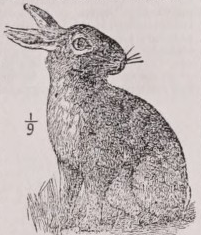
RABBIT. This animal, one of the best known and most frequently seen of all wild British mammals, is, with the hare, a member of the Rodent genus Lepus, which contains about twenty-five other species spread over the greater part of the world, and whose more important characters have already been referred to (see Hare, vol. xi. p. 476, and Mammalia, vol. xv. p. 421).
The rabbit (Lepus cuniculus), speaking for the present of the wild race only, is distinguished from the hare externally by its smaller size, shorter ears and feet, by the absence or reduction of the black patch at the tip of the ears so characteristic of the hare, and by its greyer colour. The skull is very similar to that of the hare (see Mammalia, fig. 99), but is smaller and lighter, and has a slenderer muzzle and a longer and narrower palate. Besides these characters, however, the rabbit is sharply separated from the hare by the fact that it brings forth its young naked, blind, and helpless; to compensate for this, it digs a deep burrow in the earth in which they are born and reared, while the young of the hare are born fully clothed with fur, and able to take care of themselves in the mere shallow depression or “form” in which they are born. The weight of the rabbit is from 2| to 3 lb, although individuals perfectly wild have been recorded up to more than 5. Its general habits are too well known to need a detailed description here. It breeds from four to eight times a year, bringing forth each time from three to eight young. Its period of gestation is about thirty days, and it is able to bear when six months old. It attains to an age of about seven or eight years....
The geographical distribution of the rabbit presents many most interesting peculiarities. It is believed to be originally a native of the western half of the Mediterranean basin only, and still abounds in Spain, Sardinia, southern Italy and Sicily, Greece, Tunis, and Algeria; and many of the islands adjoining these countries are quite overrun with it. Thence it has spread, partly by man’s agency, northwards throughout temperate western Europe, increasing rapidly wherever it gains a footing; and this extension is still going on, as is shown by the case of Scotland, in which sixty years ago rabbits were little known, while they are now found in all suitable localities up to the extreme north. It has also gained admittance into Ireland, and now abounds there as much as in England. Out of Europe the same extension of range has been going on. In New Zealand and Australia rabbits, introduced either for profit or sport, have increased to such an extent as to form one of the most serious pests that the farmers have to contend against, as the climate and soil seem to suit them perfectly and their natural enemies are too few and too lowly organized to keep their numbers within reasonable bounds. In other cases rabbits introduced into islands have become or remained more or less distinct from their parent stock; thus the rabbits both of the Falkland Islands and of Jamaica still show traces of their descent from domesticated varieties, and have never reverted to the ordinary brownish-grey type. And again, as was pointed out by Mr Darwin, the rabbits in the island of Porto Santo, near Madeira, whose ancestors were introduced from Spain in 1418 or 1419, have formed quite a distinct diminutive race, barely half the bulk or weight of English rabbits, and differing in certain slight details of colour and habits.
The rabbit has been domesticated by man from a very early period. No doubt exists amongst naturalists that all the varieties of the domestic animal are descended from the Lepus cuniculus. The variations which have been perpetuated and intensified by artificial selection are, with the exception of those of the dog, greater than have been induced in any other species of mammal. For not only has the weight been more than quadrupled in some of the larger breeds, and the structure of the skull and other parts of the skeleton greatly altered, but the proportionate size of the brain has been considerably reduced and the colour and texture of the fur altered in the most remarkable manner. The establishment of these extreme variations is dependent on the highly artificial conditions under which the animals are kept, their great prolificacy, and the rapidity with which the generations succeed each other, which enable the process of artificial selection by the preservation of those most suited to the purposes of the breeder to be carried into effect with facility.
The Lop-eared breed is the oldest English fancy variety; it has been cultivated carefully for about a century, the aim of the breeder being chiefly directed to the development of the size of the ears, and with such success that they sometimes measure more than 23 inches from tip to tip and exceed 6 inches in width. This development, which is accompanied by great changes in the structure of the skull, that have been carefully described by Darwin in his Variation of Animals, &c., depends on breeding the animals in warm damp hutches, without which the best developed parents fail to produce the desired offspring. In colour the lop-eared rabbits vary greatly.
The Belgian hare is a large variety of a hardy and prolific character, which closely resembles the common hare in colour, and is not unlike it in form. Some few years since many of these animals were sold as leporides or hybrids, produced by the union of the hare and the rabbit; but the most careful experimenters have failed to obtain any such hybrid, and the naked immature condition in which young rabbits are born as compared with the clothed and highly developed young hares renders it exceedingly unlikely that hybrids could be produced. Nor does the flesh of the Belgian rabbit resemble that of the hare in colour or flavour. A closely allied variety, though of even larger size, is known by the absurd name of Patagonian rabbit; it has no relation to the country after which it is called.
The Angora rabbit is characterized by the extreme elongation and fineness of the fur, which in good specimens reaches 6 or 7 inches in length, requiring great care and frequent combing to prevent it from becoming matted. The Angoras most valued are albinos, with pure white fur and pink eyes; in some parts of the Continent they are kept by the peasants and clipped regularly.
Amongst the breeds which are valued for the distribution of colour on the fur are the Himalayan and the Dutch. The former is white, but the whole of the extremities—viz., the nose, the ears, tail, and feet—are black or very dark in colour. This very pretty breed has no connexion with the mountain chain from whence it has taken its name, but is a variety produced by careful breeding and selection as fully described by Darwin ( op. cit.). Though but recently produced by crossing, it now generally breeds true to colour, at times throwing back, however, to the silver greys from which it was derived. The rabbits known in Great Britain as Dutch are of small size, and are valued for the disposition of the colour and markings. The entire body behind the shoulder-blades is uniformly coloured, with the exception of the feet; the anterior part of the body, including the fore legs, neck, and jaws, is white, the cheeks and ears being coloured. In some strains the coloured portion extends in front of the fore legs, leaving only a ring of white round the neck. The more accurately the coloured portion is defined the higher is the animal esteemed.
The Silver grey is a uniform coloured variety, the fur of which is a rich chinchilla grey, varying in depth of colour in the different strains. From the greater value of the fur silver greys have been frequently employed to stock warrens, as they breed true to colour in the open if the ordinary wild rabbits are rigorously excluded. Other colours known, as Silver cream and Silver brown, are closely allied varieties.
As an article of food the domesticated rabbit is of considerable importance. From 100 to 200 tons are imported into London from Ostend every week during the colder months of the year, having been reared in hutches by the Belgian peasants. They are forwarded without their skins, which are half the value of the flesh. A plan has been recently devised by Major Morant, which is known as “hutch-farming in the open.” The animals are kept in large hutches with projecting roofs, floored with coarse galvanized iron netting, through which the grass projects to be eaten by the rabbits. The hutches are shifted twice or thrice a day, so that the animals are constantly on clean ground and have fresh food. The young, when old enough to leave the mother, are reared in somewhat larger hutches of a similar description and killed for market under three months of age.