
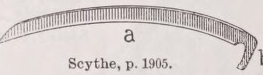
SCYTHE and SICKLE. Till the invention of the reaping machine, which came into practical use only about the middle of the 19th century, scythes and sickles were the sole reaping implements. The scythe is worked with two hands with a swinging motion, while the sickle or reaping hook is held in one hand and the reaper bends and cuts the crop with a shearing or hitting motion. Of the two the sickle is the more ancient, and indeed there is some reason to conclude that its use is coeval with the cultivation of grain crops. Among the remains of the later Stone period in Great Britain and on the European continent curved flint knives have occasionally been found the form of which has led to the suggestion that they were used as sickles. Sickles of bronze occur quite commonly among remains of the early inhabitants of Europe. Some of these are deeply curved hooks, flat on the under-side, and with a strengthening ridge or back on the upper surface, while others are small curved knives, in form like the ordinary hedge-bill. Among the ancient Egyptians toothed or serrated sickles of both bronze and iron were used. Ancient Roman drawings show that both the scythe and the sickle were known to that people, and Pliny makes the distinction plain. extensive domains; for there they cut their grass only in the middle, and pass over the shorter blades. The Italian mowers cut with the right hand only” (II. N., xviii. 67). ] Although both implements have lost much of their importance since the general introduction of mowing and reaping machinery, they are still used very extensively, especially in those countries where small agricultural holdings prevail. The principal modern forms are the toothed hook, the scythe hook, the Hainault scythe, and the common scythe. The toothed hook, which was ...in general use till towards the middle of the 19th century, consists of a narrow-bladed curved hook, having on its cutting edge a series of fine close-set serratures cut like file-teeth, with their edges inclined towards the heft or handle. Such sickles were formerly made of iron edged with steel; but in recent times they came to be made of cast steel entirely. Towards the middle of the century the toothed hook was gradually supplanted by the scythe hook or smooth-edged sickle, a somewhat heavier and broader-bladed implement, having an ordinary knife edge. Both these implements were intended for “shearing” handful by handful, the crop being held in the left hand and cut with the tool held in the right. A heavy smooth-edged sickle is used for “bagging” or “clouting,”—an operation in which the hook is struck against the straw, the left hand being used to gather and carry along the cut swath. The Hainault scythe is an implement intermediate between the scythe and the sickle, being worked with one hand, and the motion is entirely a swinging or bagging one. The implement consists of a short scythe blade mounted on a vertical handle, and in using it the reaper collects the grain with a crook, which holds the straw together till it receives the cutting stroke of the instrument. The Hainault scythe is extensively used in Belgium. The common hay scythe consists of a slightly curved broad blade varying in length from 28 to 46 inches, mounted on a bent, or sometimes straight, wooden sned or snathe, to which two handles are attached at such distances as enable the workman, with an easy stoop, to swing the scythe blade along the ground, the cutting edge being slightly elevated to keep it clear of the inequalities of the surface. The grain-reaping scythe is similar, but provided with a cradle or short gathering rake attached to the heel and following the direction of the blade for about 12 inches. The object of this attachment is to gather the stalks as they are cut and lay them in regular swaths against the line of still-standing corn. The reaping scythe, instead of a long sned, has frequently two helves, the right hand branching from the left or main helve and the two handles placed about 2 feet apart. The best scythe blades are made from rolled sheets of steel, riveted to a back frame of iron, which gives strength and rigidity to the blade. On the Continent it is still common to mould and hammer the whole blade out of a single piece of steel, but such scythes are difficult to keep keen of edge. There is a great demand for scythes in Russia, chiefly supplied from the German empire and Austria. The principal manufacturing centre of scythes and sickles in the United Kingdom is Sheffield.
[789 words — estimated reading time: 5 minutes]