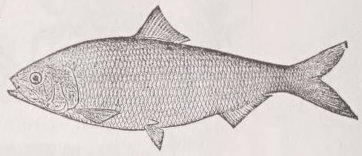
It has no plural termination. Shad is singular or plural. A fish, a species of Clupea. Shad enter the rivers in England and America in the spring in immense numbers.
Shad[Noun singular and plural]Webster's Dictionary 1913
Any one of several species of food fishes of the Herring family. The American species (Clupea sapidissima), which is abundant on the Atlantic coast and ascends the larger rivers in spring to spawn, is an important market fish. The European allice shad, or alose (C. alosa), and the twaite shad. (C. finta), are less important species.
SHAD is the name given to certain migratory species of Herrings (Clupea), which are distinguished from the herrings proper by the total absence of teeth in the jaws. Two species occur in Europe, much resembling each other,...
—one commonly called Allis Shad (Clupea alοsa), and the other known as Twaite Shad (Clupea finta). Both are, like the majority of herrings, greenish on the back and bright silvery on the sides, but they are distinguished from the other European species of Clupea by the presence of a large blackishblotch behind the gill-opening, which is succeeded by a series of several other similar spots along the middle of the side of the body. So closely allied are these two fishes that their distinctness can be proved only by an examination of the gill-apparatus, the allis shad having from sixty to eighty very fine and long gill-rakers along the concave edge of the first branchial arch, whilst the twaite shad possesses from twenty-one to twenty-seven stout and stiff gill rakers only. In their habits and geo graphical distribution also the two shads are very similar. They inhabit the coasts of temperate Europe, the twaite shad being more numerous in the Mediterranean. While they are in salt water they live singly or in very small companies, but during May (the twaite shad some weeks later) they congregate, and in great numbers ascend large rivers, such as the Severn (and formerly the Thames), the Seine, the Rhine, the Nile, &c., in order to deposit their spawn,—sometimes traversing hundreds of miles, until their progress is arrested by some natural obstruction. A few weeks after they may be observed dropping down the river, lean and thoroughly exhausted, numbers floating dead on the surface, so that only a small proportion seem to regain the sea. Although millions of ova must be deposited by them in the upper reaches of a river, the fry does not seem to have been actually observed in fresh water, so that it seems probable that the young fish travel to the sea long before they have attained to any size.
On rivers in which these fishes make their periodical appearance they have become the object of a regular fishery, and their value increases in proportion to the distance from the sea at which they are caught. Thus they are much esteemed on the middle Rhine, where they are generally known as “Maifisch”; those caught on their return journey are worthless and uneatable. The allis shad is caught at a size from 15 to 24 inches, and is considered to be better flavoured than the twaite shad, which generally remains within smaller dimensions.
Other, but closely allied species, occur on the Atlantic coasts of North America, all surpassing the European species in importance as food-fishes and economic value, viz., the American Shad (Clupea sapidissima), the Gaspereau or Ale-wife (C. mattowocca), and the Menhaden (C. menhaden). See Menhaden.
9th ed. Encyclopædia Britannica, vol. 21, p. 726 [493 words — estimated reading time: 3 minutes]
SHADDOCK(Citrus decumana) is a tree allied to the orange and the lemon, presumably native to the Malay and Polynesian islands, but generally cultivated throughout the tropics. The leaves are like those of the orange, but downy on the under surface, as are also the young shoots. The flowers are large and white, and are succeeded by very large globose or pear-shaped fruits like oranges, but paler in colour, and with less flavour. The name Shaddock is asserted to be that of a captain who introduced the tree to the West Indies. The fruit is also known under the name of pommeloes and “forbidden fruit.” There are two varieties commonly met with, one with pale and the other with red pulp.
9th ed. Encyclopædia Britannica, vol. 21, p. 727 [122 words — estimated reading time: 1 minute]
1. Literally, the interception, cutting of or interruption of the rays of light; hence, the obscurity which is caused by such interception. Shad differs from shadow , as it implies no particular form or definite limit. whereas a shadow represents in form the object which intercepts the light. Hence when we say, let us resort to the shade of a tree, we have no reference to its form; but when we speak of measuring a pyramid or other object by its shadow , we have reference to its extent.
2. Darkness; obscurity; as the shades of night.
3. An obscure place, properly in a grove or close wood, which precludes the sun's rays; an hence, a secluded retreat.
4. Let us seek out some desolate shade , and there
10. White, red, yellow, blue, with their several degrees, or shades and mixtures, as green, come only in by the eyes. Locke .
11. A shadow. [See Shadow .]
12. Envy will merit, as its shade , pursue. Pope . [This is allowable in poetry.]
13. The soul, after its separation from the body; so called because the ancients supposed it to be perceptible to the sight, not to the touch; a spirit; aghost; as the shades of departed heroes.
1. To shelter or screen from light by intercepting its rays; and when applied to the rays of the sun, it segnifies to shelter from light and heat; as, a large tree shades the plants under its branches; shaded vegetables rarely come to perfection.
1. Comparative obscurity owing to interception or interruption of the rays of light; partial darkness caused by the intervention of something between the space contemplated and the source of light.
2. Darkness; obscurity; -- often in the plural.
3. An obscure place; a spot not exposed to light; hence, a secluded retreat.
4. That which intercepts, or shelters from, light or the direct rays of the sun; hence, also, that which protects from heat or currents of air; a screen; protection; shelter; cover; as, a lamp shade.
5. Shadow.
6. The soul after its separation from the body; -- so called because the ancients it to be perceptible to the sight, though not to the touch; a spirit; a ghost; as, the shades of departed heroes.
7. The darker portion of a picture; a less illuminated part. See Def. 1, above.
8. Degree or variation of color, as darker or lighter, stronger or paler; as, a delicate shade of pink.
9. A minute difference or variation, as of thought, belief, expression, etc.; also, the quality or degree of anything which is distinguished from others similar by slight differences; as, the shades of meaning in synonyms.
1. Shade within defined limits; obscurity or deprivation of light, apparent on a plane and represtnting the form of the body which intercepts the rays of light; as the shadow of a man, of a tree or a tower. The shadow of the earth in in an eclipse of the moon is proof of its sphericity.
2. Darkness; shade; obscurity.
3. Night's sable shadows from the ocean rise. Denham .
4. Shelter made by any thing that intercepts the light, heat or influence of the air.
17. Augustus is shadowed in the person of adjective Eneas. Dryden .
18. To represent typically. The healing power of the serpent shadoweth the efficacy of Christ's righteousness. [The two last senses are in use. In place of the others, shade is now more generally used.]
1. Shade within defined limits; obscurity or deprivation of light, apparent on a surface, and representing the form of the body which intercepts the rays of light; as, the shadow of a man, of a tree, or of a tower. See the Note under Shade, n., 1.
2. Darkness; shade; obscurity.
3. A shaded place; shelter; protection; security.
4. A reflected image, as in a mirror or in water.
5. That which follows or attends a person or thing like a shadow; an inseparable companion; hence, an obsequious follower.
Behold now, I have two daughters which have not known man; let me, I pray you, bring them out unto you, and do ye to them as is good in your eyes: only unto these men do nothing; for therefore came they under the shadow of my roof.
Look, I have two daughters who have never slept with a man. Let me bring them to you, and you can do to them as you please. But do not do anything to these men, for they have come under the protection of my roof.”
And the bramble said unto the trees, If in truth ye anoint me king over you, then come and put your trust in my shadow: and if not, let fire come out of the bramble, and devour the cedars of Lebanon.
But the thornbush replied, ‘If you really are anointing me as king over you, come and find refuge in my shade. But if not, may fire come out of the thornbush and consume the cedars of Lebanon.’
And when Gaal saw the people, he said to Zebul, Behold, there come people down from the top of the mountains. And Zebul said unto him, Thou seest the shadow of the mountains as if they were men.
When Gaal saw the people, he said to Zebul, “Look, people are coming down from the mountains!” But Zebul replied, “The shadows of the mountains look like men to you.”
And Isaiah said, This sign shalt thou have of the LORD, that the LORD will do the thing that he hath spoken: shall the shadow go forward ten degrees, or go back ten degrees?
And Isaiah had replied, “This will be a sign to you from the LORD that He will do what He has promised: Would you like the shadow to go forward ten steps, or back ten steps?”
And it came to pass, that when the gates of Jerusalem began to be dark before the sabbath, I commanded that the gates should be shut, and charged that they should not be opened till after the sabbath: and some of my servants set I at the gates, that there should no burden be brought in on the sabbath day.
When the evening shadows began to fall on the gates of Jerusalem, just before the Sabbath, I ordered that the gates be shut and not opened until after the Sabbath. I posted some of my servants at the gates so that no load could enter on the Sabbath day.
There is no darkness, nor shadow of death, where the workers of iniquity may hide themselves.
There is no darkness or deep shadow where the workers of iniquity can hide.
This site uses cookies to remember your display preferences (search sources and editions, Bible version, auto-link, images, light/dark theme). No personal data whatsoever is collected. Privacy Policy